Sylow theorems
Anchor (Master): Sylow 1872 *Theoremes sur les groupes de substitutions*; Dummit-Foote §4.5; Rotman *An Introduction to the Theory of Groups*
Intuition [Beginner]
A finite group has a fixed number of elements. If that number factors into primes, say , then the group is guaranteed to contain a subgroup of size and a subgroup of size . The Sylow theorems guarantee the existence of these large, well-structured subgroups for every prime dividing the group order.
Think of it as packing a box. The total number of items is . The Sylow theorems say you can always find a neatly packed sub-box of size , one of size , and one of size inside the larger box, no matter how jumbled the overall arrangement looks.
Why does this concept exist? It gives a powerful structural handle on any finite group by locating subgroups of prime-power order inside it.
Visual [Beginner]
The diagram shows a group of order , decomposed into its Sylow subgroups. The Sylow -subgroup (order ) and the Sylow -subgroup (order ) sit inside the larger group.
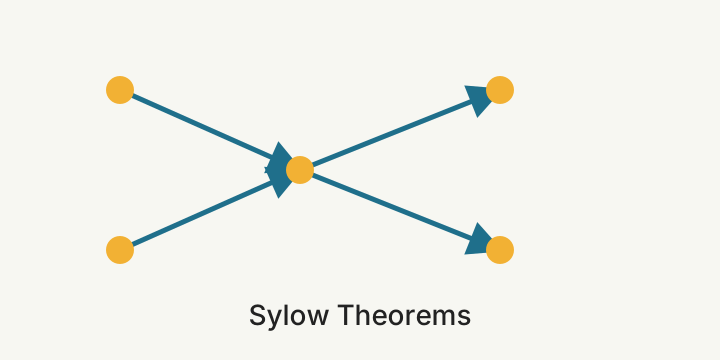
The Sylow -subgroup has elements and the Sylow -subgroup has elements. Together they account for the prime-power structure of .
Worked example [Beginner]
A group has elements. The prime factorization is .
Step 1. For the prime , the highest power of dividing is . The Sylow theorems say contains a subgroup of order .
Step 2. For the prime , the highest power of dividing is . So contains a subgroup of order .
Step 3. For the prime , the highest power of dividing is . So contains a subgroup of order .
What this tells us: every prime dividing the group order produces a subgroup whose size is the largest power of that prime dividing the total.
Check your understanding [Beginner]
Formal definition [Intermediate+]
Let be a finite group of order where is prime, , and does not divide . A Sylow -subgroup of is a subgroup of order .
The three Sylow theorems govern the existence, conjugacy, and counting of these subgroups.
First Sylow Theorem (Existence). For every prime dividing , the group contains a Sylow -subgroup.
Second Sylow Theorem (Conjugacy). Any two Sylow -subgroups of are conjugate: if and are Sylow -subgroups, there exists with .
Third Sylow Theorem (Counting). The number of Sylow -subgroups satisfies: (1) divides (where ), and (2) .
[Sylow 1872]
Counterexamples to common slips [Intermediate+]
Conjugacy does not mean equality. Two distinct Sylow -subgroups can exist. In (order ), there are three Sylow -subgroups: , , and . They are conjugate but not equal.
The divisibility condition constrains but does not pin down . For , the Sylow -subgroup count must divide and satisfy . The divisors of are ; among these, only and are congruent to modulo . So .
A subgroup of order is not necessarily a Sylow -subgroup. The Sylow -subgroup has order equal to the highest power of dividing . A subgroup of order is only Sylow when divides exactly once.
Key theorem with proof [Intermediate+]
Theorem (First Sylow Theorem). Let be a finite group with where does not divide . Then contains a subgroup of order .
Proof. The proof proceeds by constructing a group action and examining its orbits.
Let be the set of all subsets of having exactly elements. The group acts on by left multiplication: for and , define .
The size of is the binomial coefficient
We claim that does not divide . The power of in is at least where denotes the -adic valuation. The power of in is at most (and equals for ). The power of in is . Hence the -adic valuation of is at least . More precisely, since does not divide , the binomial coefficient , which is not divisible by .
Since is not divisible by , at least one orbit of the action has size not divisible by . Pick . By the orbit-stabilizer theorem,
Since does not divide , every power of dividing must divide , so divides .
Now we show . Pick any . For every , the element lies in . So left multiplication by elements of permutes the elements of . The map given by is injective (since left multiplication in a group is injective). Therefore .
Combining: divides and . Hence , and is the desired Sylow -subgroup.
Bridge. This existence proof builds toward the classification of groups of small order, where the Sylow theorems provide the central structural constraint on possible subgroup configurations. The technique of acting on subsets appears again in 01.02.01 where group actions on cosets produce the index formula, and this is exactly the engine powering the simplicity criteria: if , the unique Sylow -subgroup is normal. The foundational reason the proof works is that a group acting on subsets of the right size forces the stabilizer to have order equal to the subset size, putting these together with the orbit-stabilizer theorem to identify the Sylow subgroup as a stabilizer. The bridge is between the combinatorial data of set subsets and the algebraic structure of -subgroups.
Exercises [Intermediate+]
Advanced results [Master]
Theorem 1 (Frattini argument). If is a normal subgroup of and is a Sylow -subgroup of , then .
If , then is a Sylow -subgroup of (since is normal, conjugation preserves ). By Sylow's second theorem applied inside , there exists with . Then , so . [Rotman Ch. 4]
Theorem 2 (Simplicity criterion). If with prime and does not divide , and , then is not simple. The unique Sylow -subgroup is normal.
Theorem 3 (Cauchy's theorem as a corollary). If a prime divides , then contains an element of order . This follows from the first Sylow theorem: the Sylow -subgroup has order with , and any group of prime-power order has a subgroup of order (hence an element of order ).
Theorem 4 (Burnside's theorem). If for primes , then is solvable. The proof uses character theory and is beyond the scope of this unit, but the Sylow theorems provide the starting point by constraining the Sylow subgroup configurations. [Rotman Ch. 4]
Theorem 5 (Classification of groups of order ). Every group of order for an odd prime is either cyclic or dihedral. By the Sylow theorems, , so the Sylow -subgroup is normal. The semidirect product classification reduces to analyzing .
Theorem 6 (Sylow system in solvable groups). In a finite solvable group, the Sylow subgroups for different primes can be chosen to form a Sylow system: a family where each is a Sylow -subgroup and any product of distinct 's is a subgroup of .
Theorem 7 ( is simple). The alternating group has order . The Sylow theorems give , , and . Careful counting of elements from each Sylow subgroup, combined with the class equation, shows that no proper normal subgroup exists. This is the smallest non-abelian simple group.
Synthesis. The Sylow theorems are the foundational reason that finite group theory reduces to the analysis of -subgroups and their interactions. The central insight is that the three theorems — existence, conjugacy, and counting — together identify each prime factor of the group order with a distinguished conjugacy class of subgroups, and this is exactly the structural data needed to rule out simplicity or to pin down group structure. Putting these together with the Frattini argument and the semidirect product construction, every group of order or or can be classified up to isomorphism. The bridge is between arithmetic data (prime factorization of the group order) and algebraic structure (normal subgroups, simplicity, solvability), and the pattern generalises through Burnside's theorem to all groups of order divisible by at most two primes, and through the Sylow system to all solvable groups.
Full proof set [Master]
Proposition 1 (Second Sylow Theorem — Conjugacy). Any two Sylow -subgroups of are conjugate.
Proof. Let and be Sylow -subgroups of . Consider the action of on the left coset space by left multiplication. The number of cosets is , which is not divisible by . Since , the orbit decomposition of this action has orbits whose sizes divide . An orbit of size corresponds to a coset with for all , which means for all , so . Since , we get , hence .
If no orbit of size existed, then every orbit size would be divisible by , and the total number of cosets would be divisible by , a contradiction. So an orbit of size must exist, and and are conjugate.
Proposition 2 (Third Sylow Theorem — Counting). The number of Sylow -subgroups divides and satisfies .
Proof. Let be a Sylow -subgroup. The group acts on the set of Sylow -subgroups by conjugation. By the second Sylow theorem, this action is transitive, so , where is the normalizer of in . Since , the index divides , so divides .
For the congruence, consider the action of on by conjugation. The orbit of itself has size (since normalizes itself). For any other Sylow -subgroup , the orbit size is . This orbit size divides , so it is a power of . If the orbit size of were , then would normalize , and both and would be Sylow -subgroups of . By the second Sylow theorem applied inside , we get . So every orbit other than has size divisible by . Therefore , which gives .
Connections [Master]
Group
01.02.01. The Sylow theorems apply the group action machinery developed in the group unit. The orbit-stabilizer theorem and the conjugation action are the same tools introduced there, now deployed to extract prime-power subgroups from the order of the group. The foundational reason Sylow theory works is that conjugation partitions subgroups into orbits whose sizes are controlled by the group order.Group action
03.03.02. The proof of the first Sylow theorem acts on subsets, and the proof of the second and third theorems act on the set of Sylow subgroups by conjugation. The full power of the orbit-stabilizer theorem and fixed-point counting appears again in that unit in a general setting.Linear algebra: eigenvalue-eigenvector
01.01.08. The Sylow theory of general linear groups over finite fields connects prime-power subgroup structure to the eigenvalue structure of matrices. The classification of Sylow -subgroups of uses upper-triangular unipotent matrices, analogous to the Jordan form analysis in the eigenvalue unit.
Historical & philosophical context [Master]
Ludwig Sylow 1872 established the three theorems bearing his name in Theoremes sur les groupes de substitutions (Math. Ann. 5) [Sylow 1872], generalizing earlier observations by Cauchy on the existence of elements of prime order. Sylow's original proof worked in the context of permutation groups, the dominant language for group theory at the time. The modern proof via group actions on subsets is due to several authors and became standard after the development of the abstract group concept in the late nineteenth century.
The simplicity criterion — that for any prime forces a normal subgroup — became the central tool in the classification of finite simple groups throughout the twentieth century. Burnside's theorem (1904) extended Sylow's arithmetic constraints using character theory, and the Sylow system in solvable groups appears in Philip Hall's 1928 work on solvable groups [Rotman Ch. 4].
Bibliography [Master]
@article{Sylow1872,
  author = {Sylow, Ludwig},
  title = {Theoremes sur les groupes de substitutions},
  journal = {Mathematische Annalen},
  volume = {5},
  year = {1872},
  pages = {584--594},
}

@book{DummitFoote,
  author = {Dummit, David S. and Foote, Richard M.},
  title = {Abstract Algebra},
  publisher = {John Wiley \& Sons},
  year = {2004},
  edition = {3rd},
}

@book{Rotman,
  author = {Rotman, Joseph J.},
  title = {An Introduction to the Theory of Groups},
  publisher = {Springer},
  year = {1995},
  edition = {4th},
}

@book{Artin,
  author = {Artin, Michael},
  title = {Algebra},
  publisher = {Pearson},
  year = {2011},
  edition = {2nd},
}