Fundamental theorems of calculus (FTC1 and FTC2)
Anchor (Master): Newton 1665 method of fluxions (originator); Leibniz 1675 integral notation (originator); Cauchy 1823 Resume des lecons (rigorous FTC); Lebesgue 1904 Lecons sur l'integration (Lebesgue FTC); Rudin Real and Complex Analysis Ch. 7
Intuition [Beginner]
A derivative tells you how fast something is changing right now. An integral tells you how much has accumulated over a stretch of time. The fundamental theorems of calculus say these two operations are inverses: each one undoes the other.
Imagine driving at a steadily increasing speed. Your speedometer reads the rate of change (derivative). The odometer tracks the total distance covered (integral). If you know the speed at every instant, you can compute the total distance. If you know the total distance at every moment, you can read off the speed. That two-way relationship is the entire content of the two fundamental theorems.
The first theorem says: build a running-total function by accumulating area under a curve, then take the derivative of that running total, and you get back the original curve. The second says: the total area under a curve between two points equals the change in any antiderivative (a function whose derivative is the original curve).
This concept exists because without it, every area computation requires a separate geometric argument. The FTC reduces all of them to a single algebraic step: find an antiderivative, plug in the endpoints, subtract.
Visual [Beginner]
The picture shows a coordinate plane with a rising curve drawn above the horizontal axis from to . A shaded region fills the area between the curve and the axis, growing wider from left to right. Below the shaded region, a second graph shows the accumulated-area function , which rises steeply where is tall and rises gently where is small. A tangent line on the lower graph at has slope equal to on the upper graph.
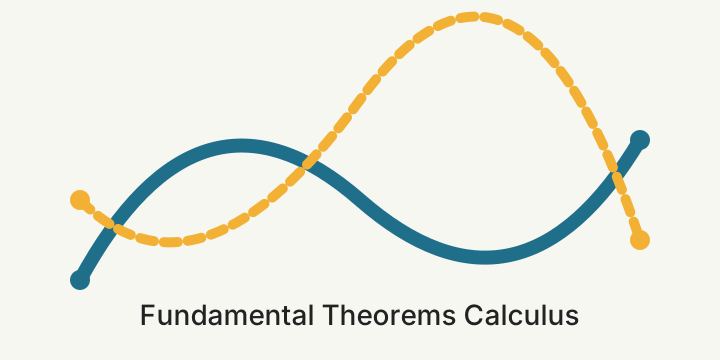
The slope of the lower graph at any point equals the height of the upper graph directly above it. This is the first fundamental theorem in visual form.
Worked example [Beginner]
A car moves along a straight road. Its speed at time minutes is kilometres per minute. How far does the car travel from to ?
Step 1. The total distance equals the accumulated area under the speed curve. The speed curve is a straight line through the origin with slope . The area from to is a triangle with base and height .
Step 2. Triangle area is one-half times base times height: .
Step 3. Verify via the second theorem: an antiderivative of is the distance function . The total change is .
What this tells us: the area method (Step 2) and the antiderivative method (Step 3) always agree. That agreement is the second fundamental theorem.
Check your understanding [Beginner]
Formal definition [Intermediate+]
Let be a function. Define the accumulated-area function (also called the integral function) by
Theorem (FTC1). If is continuous on , then is differentiable on and
In words: the derivative of the integral function is the original integrand.
Theorem (FTC2). If is Riemann-integrable on and is any antiderivative of on (meaning for all and is continuous on ), then
In words: the integral of over equals the net change in any antiderivative.
Counterexamples to common slips
FTC1 requires continuity. The function on is Riemann-integrable (its integral is ), but the integral function is not differentiable at . Discontinuity of at a single point can break differentiability of .
FTC2 requires an antiderivative that exists everywhere on the closed interval. The function on has no antiderivative valid on all of because blows up at . Blindly applying and writing gives a negative result for a non-negative function.
Two antiderivatives can differ by more than a constant on a disconnected domain. On , the function and both satisfy , yet is not constant on the full domain. FTC2 applies on each connected component separately.
Key theorem with proof [Intermediate+]
Theorem (FTC1 — derivative of the integral). Let be continuous. Define . Then is differentiable on and for every .
Proof. Fix . For with , the difference quotient is
By the mean value theorem for integrals (a consequence of the intermediate value theorem applied to continuous functions), there exists a point between and such that
Therefore the difference quotient equals . As , the point is squeezed between and , so . By continuity of ,
Theorem (FTC2 — integral via antiderivative). Let be Riemann-integrable on and let be continuous on with for all . Then
Proof. Let be any partition of with . On each subinterval , the mean value theorem for derivatives gives a point with
Summing from to :
The right side is a Riemann sum for over . As , every Riemann sum for a Riemann-integrable function converges to the integral. Therefore
Bridge. The FTC is the foundational reason that integration and differentiation are inverse operations, and this is exactly the bridge between the geometric theory of area and the algebraic theory of antiderivatives. FTC1 builds toward the Lebesgue differentiation theorem 02.11.04 where the derivative-of-the-integral result holds almost everywhere for locally integrable functions, and appears again in 02.05.04 as the multivariable chain rule that underpins change of variables in higher dimensions. The central insight is that continuity of forces the integral function to be differentiable, and putting these together with the mean value theorem closes the loop: every continuous function has an antiderivative (by FTC1), and the bridge is that evaluating that antiderivative at the endpoints yields the integral (by FTC2).
Exercises [Intermediate+]
Advanced results [Master]
Theorem 1 (Lebesgue differentiation theorem). If , then for almost every ,
This is the measure-theoretic strengthening of FTC1: the derivative of the indefinite Lebesgue integral recovers at almost every point, even when is only integrable, not continuous. The proof goes through the Hardy-Littlewood maximal inequality.
Theorem 2 (Absolute continuity and the Lebesgue FTC). A function is absolutely continuous if and only if there exists such that for all . In that case almost everywhere.
Absolute continuity replaces the continuity hypothesis of the classical FTC1 with a stronger condition (uniform control of increments) and in return gains existence almost everywhere without requiring to be continuous.
Theorem 3 (Integration by parts for the Lebesgue integral). If and are absolutely continuous on , then
This follows from the product rule and the Lebesgue FTC applied to the absolutely continuous function .
Theorem 4 (FTC for the Riemann-Stieltjes integral). If is continuous on and is of bounded variation on , then
whenever either side exists. If is continuously differentiable, the Riemann-Stieltjes integral reduces: .
Theorem 5 (Fundamental theorem for line integrals). Let be open and connected, and let be a continuous vector field. Then for some function if and only if depends only on the endpoints of for every piecewise- curve in . In that case,
where and are the start and end of . This is the multivariable FTC2: the line integral of a gradient field equals the change in the potential function.
Theorem 6 (FTC1 fails without absolute continuity). The Cantor function is continuous, non-decreasing, and has almost everywhere. Yet . The Cantor function is not absolutely continuous; it is singular. This demonstrates that continuity of the integrand is not sufficient to replace absolute continuity in the Lebesgue FTC.
Theorem 7 (Change of variables via the FTC). If is a diffeomorphism and is continuous, then
The proof applies FTC2 to both sides: has , so the left side is , and by the chain rule , so the right side is also .
Synthesis. The foundational reason the FTC holds across all its versions is that differentiation and integration are inverse operations at the level of measures and densities. The central insight is that absolute continuity of is both necessary and sufficient for to be an indefinite Lebesgue integral, and this is exactly the condition that identifies the absolutely continuous functions with the Sobolev space . Putting these together with the Lebesgue differentiation theorem, every locally integrable function has an integral function differentiable almost everywhere with , and the bridge is that the Stieltjes integral generalises both the Riemann and Lebesgue settings by encoding the integrator's variation into a measure, while the fundamental theorem for line integrals 02.05.04 extends the same pattern to gradient fields on . The pattern generalises to differential forms via Stokes' theorem, where the integral of over a region equals the integral of over the boundary — the FTC2 statement is the -dimensional case.
Full proof set [Master]
Proposition 1 (FTC1 via the mean value theorem). Restated from the Key theorem. Let be continuous and . Then for all .
Proof. For (the case is analogous), consider
Since is continuous on the compact interval , the extreme value theorem gives and . Then
Dividing by :
As , both and converge to by continuity. By the squeeze theorem, . The same argument with gives . Hence .
Proposition 2 (Absolute continuity characterises indefinite Lebesgue integrals). A function is absolutely continuous if and only if there exists with for all , and in that case almost everywhere.
Proof (sketch). () If , then for any finite collection of disjoint intervals ,
where . If , then , and by the absolute continuity of the Lebesgue integral, for chosen appropriately. Hence is absolutely continuous.
() If is absolutely continuous, then is of bounded variation, hence differentiable almost everywhere, and . Define . Then is absolutely continuous by the forward direction, and a.e. Thus a.e., and an absolutely continuous function with zero derivative a.e. is constant (this uses the Vitali covering lemma). Since , we get .
Proposition 3 (The Cantor function violates FTC2). The Cantor function is continuous and non-decreasing on with , , and almost everywhere.
Proof (construction). Let be the standard Cantor set. At stage of the construction, remove open middle thirds. Define on the complement of by assigning values: on the removed interval at stage (the middle third ), set . At stage , set on and on . Continue: at each stage, takes the average of the values at the adjacent intervals already assigned. This defines on , and extends continuously to because the jumps shrink to zero.
The function is constant on each removed interval, so there. The Cantor set has Lebesgue measure zero, so a.e. Yet . The function is not absolutely continuous: for the intervals of 's complement at stage , the total length is but increases by across them.
Connections [Master]
Multivariable chain rule and change of variables
02.05.03. The change-of-variables formula for multivariable integrals generalises the one-dimensional substitution rule (Theorem 7 above). The chain rule02.05.03provides the derivative computation that makes the substitution work, and the FTC supplies the proof mechanism — evaluate antiderivatives at the transformed endpoints.Implicit and inverse function theorems
02.05.04. The inverse function theorem's proof integrates the derivative to construct a local inverse, relying on FTC1 to guarantee that the constructed integral function has the correct derivative. The implicit function theorem is a corollary, and both appear in the proof of Stokes' theorem where the FTC for line integrals handles the one-dimensional base case.Banach spaces and bounded linear operators
02.11.01. The Lebesgue FTC (Theorem 2 above) identifies the absolutely continuous functions with the Sobolev space , a subspace of . The bounded linear operators framework02.11.01provides the functional-analytic setting in which the Lebesgue differentiation theorem and the Hardy-Littlewood maximal inequality are formulated, and the operator is bounded from to .Lyapunov stability and conserved quantities
02.12.08. The direct method of Lyapunov02.12.08constructs Lyapunov functions whose time derivative is negative definite. Proving that a Lyapunov function decreases along trajectories requires FTC2 to relate the integral of the derivative to the function's net change. First integrals02.12.12— conserved quantities whose derivative along the flow vanishes — are characterised through FTC1 applied to the flow map.
Historical & philosophical context [Master]
Newton 1665–1666, in his method of fluxions [Newton1665], discovered the inverse relationship between what he called fluxions (rates of change) and fluents (accumulated quantities). His geometric reasoning treated the area under a curve as a quantity generated by the motion of an ordinate sweeping along the axis, and recognised that the rate of generation at each instant equals the height of the ordinate. Leibniz 1675, independently, introduced the elongated-S notation for the integral and articulated the inverse relationship in the notation itself: the differential and the integral are inverse operations [Leibniz1675]. Cauchy 1823, in his Resume des lecons at the Ecole Polytechnique [Cauchy1823], gave the first rigorous proof of the FTC for continuous functions using the mean value theorem, replacing the geometric intuitions of Newton and Leibniz with an - argument.
The Lebesgue strengthening came with Lebesgue 1904 in his Lecons sur l'integration [Lebesgue1904], which identified absolute continuity as the precise condition under which a function is an indefinite integral. This result closed a gap exposed by the Cantor function (a continuous, monotone function with zero derivative almost everywhere yet non-constant), demonstrating that continuity alone is insufficient. The Stieltjes integral, introduced by Stieltjes 1894 in connection with moment problems, generalises the FTC to integrators of bounded variation. The fundamental theorem for line integrals extends the FTC to gradient fields on and is the one-dimensional precursor to Stokes' theorem on manifolds.
Bibliography [Master]
@article{Cauchy1823,
  author = {Cauchy, Augustin-Louis},
  title = {R\'esum\'e des le\c{c}ons donn\'ees \`a l'{\'E}cole Royale Polytechnique sur le calcul infinit\'esimal},
  journal = {Imprim\'erie Royale},
  year = {1823},
  volume = {},
  pages = {},
}

@book{Lebesgue1904,
  author = {Lebesgue, Henri},
  title = {Le\c{c}ons sur l'int\'egration et la recherche des fonctions primitives},
  publisher = {Gauthier-Villars},
  year = {1904},
}

@book{Newton1665,
  author = {Newton, Isaac},
  title = {Method of Fluxions},
  publisher = {Manuscript, published posthumously 1736 by John Colson},
  year = {1665},
}

@article{Leibniz1675,
  author = {Leibniz, Gottfried Wilhelm},
  title = {Manuscript on integral notation and the fundamental theorem},
  journal = {Manuscript, Hanover},
  year = {1675},
  note = {Published in Gerhardt's edition of Leibniz's mathematical writings, 1849},
}

@article{Stieltjes1894,
  author = {Stieltjes, Thomas Jan},
  title = {Recherches sur les fractions continues},
  journal = {Annales de la Facult\'e des Sciences de Toulouse},
  volume = {8},
  year = {1894},
  pages = {1--122},
}

@book{Rudin1976,
  author = {Rudin, Walter},
  title = {Principles of Mathematical Analysis},
  publisher = {McGraw-Hill},
  year = {1976},
  edition = {3rd},
}

@book{Rudin1987,
  author = {Rudin, Walter},
  title = {Real and Complex Analysis},
  publisher = {McGraw-Hill},
  year = {1987},
  edition = {3rd},
}

@book{Apostol1967,
  author = {Apostol, Tom M.},
  title = {Calculus, Volume 1},
  publisher = {John Wiley \& Sons},
  year = {1967},
}