Mean value theorem (Rolle, Lagrange, Cauchy)
Anchor (Master): Apostol Calculus Vol. 1 Ch. 4; Rolle 1691 Demonstration d'une methode; Lagrange 1797 Theorie des fonctions analytiques; Cauchy 1823 Resume des lecons; Darboux 1875 Memoire sur les fonctions discontinues Ann. Sci. Ecole Norm. Sup. 4
Intuition [Beginner]
Imagine a road trip. You drive 60 miles in exactly one hour. Your average speed is 60 miles per hour. At some moment during that trip, your speedometer must have read exactly 60 mph. You could not have been slower the whole time, or you would not have covered the distance. You could not have been faster the whole time, or you would have overshot it. The transition requires passing through the average.
This is the mean value theorem. Given a smooth curve between two points, at least one place on the curve has slope equal to the slope of the straight line joining the endpoints. The straight line captures the average rate of change. The curve's own slope captures the instantaneous rate. The theorem guarantees they match somewhere in between.
The mean value theorem exists because it converts local derivative information into global control over the function. Knowing the derivative at individual points constrains how the function behaves across an entire interval.
Visual [Beginner]
A graph of a smooth curve passing through two marked points and . A dashed secant line connects the endpoints, labelled "average slope". At a point between and , a tangent line to the curve runs parallel to the secant line, labelled "instantaneous slope = average slope".
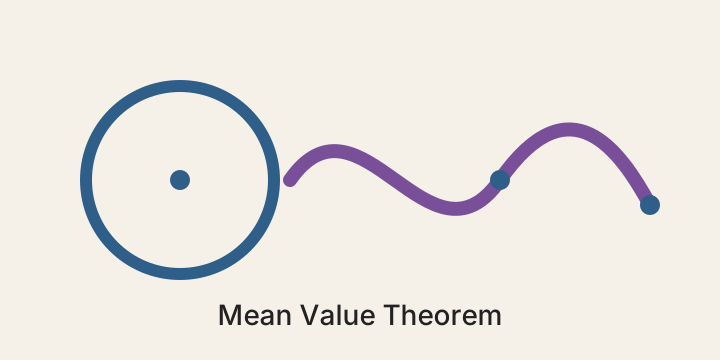
The tangent and secant share the same slope. The mean value theorem guarantees at least one such interior point where this parallelism holds.
Worked example [Beginner]
Take on the interval from to . At the left endpoint, . At the right endpoint, . The average slope is .
Step 1. The derivative is .
Step 2. Set the derivative equal to the average slope: .
Step 3. Solve: , so , which lies between and .
What this tells us: at the point on the curve , the tangent line has slope , matching the secant line from to . The mean value theorem guaranteed such a point, and the computation finds it.
Check your understanding [Beginner]
Formal definition [Intermediate+]
All functions in this section are real-valued, defined on a closed interval with . The notation denotes the ordinary derivative [Apostol Ch. 4].
Definition (secant slope). For a function , the secant slope from to is the quotient , representing the average rate of change of over .
Rolle's theorem. Let be continuous on , differentiable on , and satisfy . Then there exists with . The proof uses the extreme-value theorem: a continuous function on a closed bounded interval attains its maximum and minimum. If both occur at the endpoints, is constant and everywhere. If at least one extreme occurs at an interior point , then by Fermat's criterion.
Mean value theorem (Lagrange). Let be continuous on and differentiable on . Then there exists with
The geometric content: at some interior point, the tangent line is parallel to the secant line through the endpoints. The proof subtracts the secant line from to reduce to Rolle's theorem [Apostol Ch. 4].
Cauchy mean value theorem. Let be continuous on and differentiable on , with for all . Then and there exists with
The condition prevents by Rolle's theorem, so the left side is well-defined. The Cauchy MVT reduces to the Lagrange MVT when [Rudin Ch. 5].
Counterexamples to common slips
- Differentiability is needed on the open interval. The function on satisfies and is continuous, but it is not differentiable at . No point in has , because for and for . The corner at the origin breaks the theorem.
- Continuity at the endpoints is needed. The function on with undefined cannot satisfy the hypotheses, because the interval is not closed and blows up near .
- The denominator condition is essential for Cauchy MVT. If somewhere, Rolle's theorem no longer guarantees , and the ratio may be undefined.
- The point need not be unique. The function on has secant slope . Setting gives , yielding two points .
Key theorem with proof [Intermediate+]
Theorem (Mean value theorem — Lagrange). Let be continuous on and differentiable on . Then there exists with
Proof. Step 1 (Rolle's theorem). We first establish that if is continuous on , differentiable on , and satisfies , then some has .
By the extreme-value theorem (a continuous function on a compact set attains its maximum and minimum, itself a consequence of the completeness of proved in 02.02.01), the function attains its maximum and its minimum on .
If , then is constant on and for every . If , then since , at least one of the two extreme values is attained at an interior point . At this interior extremum, the derivative vanishes: for a local maximum at , the quotient for and for , and the existence of forces both one-sided limits to equal .
Step 2 (Auxiliary function). Define
Geometrically, subtracts the secant line through and from . The function is continuous on and differentiable on , being a linear combination of continuous and differentiable functions.
Step 3 (Verify Rolle's conditions). At the endpoints:
So .
Step 4 (Apply Rolle). By Step 1, there exists with .
Step 5 (Compute the derivative). Differentiating:
Setting yields .
Bridge. The proof of the Lagrange MVT is the foundational reason that the derivative controls the function globally: by subtracting the secant line, the problem reduces to Rolle's theorem, which rests on the extreme-value theorem for continuous functions on closed bounded intervals — a consequence of the completeness of from 02.02.01. The MVT generalises from scalar-valued to vector-valued functions as an inequality version, where the componentwise MVT paired with the Cauchy-Schwarz inequality replaces the equality; this content feeds the multivariable Taylor expansion in 02.05.05, where the Lagrange remainder is controlled by bounding the derivative. The central insight is that the auxiliary-function technique — subtract the secant line, apply Rolle's theorem — identifies the mean value theorem with Rolle's theorem, and putting these together with an appropriate auxiliary function yields the Cauchy MVT, the tool behind L'Hopital's rule and Taylor's theorem with Lagrange remainder. This is exactly the bridge from the single-variable differential calculus to the multivariable setting of 02.05.03 and 02.05.04.
Exercises [Intermediate+]
Advanced results [Master]
Taylor's theorem with Lagrange remainder. Let be times differentiable on an open interval containing , and fix . For every there exists between and with
The remainder term is the Lagrange form. The proof applies the Cauchy MVT to and on , exploiting the telescoping cancellation in [Apostol Ch. 4].
L'Hopital's rule (0/0 case). Let and be differentiable on an open interval containing , with and near . If , then . The proof extends and by continuity to (setting ), then applies the Cauchy MVT on to obtain for some between and . As , the point and the right side converges to .
MVT for vector-valued functions. Let be continuous on and differentiable on . Then
The equality version of the scalar MVT fails for vector-valued functions because the intermediate point may differ for each component. The inequality version suffices for the contraction estimates in the inverse function theorem 02.05.04.
Darboux's theorem (intermediate values of derivatives). Let be differentiable on and suppose . Then there exists with . Derivatives satisfy the intermediate value property even when they are not continuous. The proof considers , which has and , forcing an interior minimum where [Darboux 1875].
Sign of the derivative and monotonicity. If is continuous on , differentiable on , and for all , then is strictly increasing on . If , then is strictly decreasing. The converse is false: is strictly increasing on but .
Synthesis. Four observations organise the unit. First, Rolle's theorem, the Lagrange MVT, and the Cauchy MVT form a hierarchy, each a specialisation of the next, and each proved by reducing to Rolle via an auxiliary function. The foundational reason the reduction works is that continuity on a compact interval guarantees an interior extremum, forcing the derivative to vanish. Second, the Cauchy MVT is the bridge to L'Hopital's rule, resolving indeterminate forms by comparing rates of vanishing or growth of two functions. Third, the pattern recurs for vector-valued functions, where equality degrades to an inequality bounding the displacement norm by the supremum of the speed, and this is exactly the estimate powering the contraction argument in the inverse function theorem of 02.05.04.
Fourth, Darboux's theorem reveals that derivatives satisfy the intermediate value property even when discontinuous, identifying derivatives as more regular than arbitrary functions. Fifth, Taylor's theorem with Lagrange remainder appears again in the multivariable Taylor expansion of 02.05.05, where the single-variable remainder estimate extends component by component to give the second-derivative test for functions on . Putting these together, the MVT is the central insight that converts local derivative information into global function control, and generalises from scalars to vectors, from equalities to inequalities, and from single variables to many.
Full proof set [Master]
Proposition 1 (Taylor's theorem — Lagrange remainder). Statement as in Advanced results.
Proof. Fix and with . Define two functions on the interval between and :
Both are continuous on the closed interval and differentiable on the open interval. Note and . Differentiating :
Re-index the second sum by setting :
The second sum cancels all terms of the first sum except the term:
Also , which is nonzero for . Apply the Cauchy MVT on the interval (or if ): there exists between and with .
Computing: , and . So:
Therefore .
Proposition 2 (L'Hopital's rule, 0/0 case). Statement as in Advanced results.
Proof. Define (extending by continuity; the original values at may not be defined, but the limits are ). For near with , the Cauchy MVT on (or ) gives a point between and with Since , this reads . As , the point (which lies between and ) also satisfies . By hypothesis, , so as . Therefore as .
Proposition 3 (MVT for vector-valued functions). Statement as in Advanced results.
Proof. If the inequality holds at once. Assume . Define (the dot product with the displacement vector). The scalar function is continuous on and differentiable on . By the scalar MVT, some satisfies .
Compute: . Also . So:
By Cauchy-Schwarz: . Dividing both sides of the MVT equality by :
This completes the inequality.
Proposition 4 (Darboux's theorem). Statement as in Advanced results.
Proof. Define . Then is differentiable on , hence continuous, with and .
Since , the quotient for all sufficiently small , so . Hence there exist points in where is less than , and is not the minimum of on .
Since , the quotient for small . For small negative , the numerator , so . Hence is not the minimum either.
The continuous function attains its minimum on by the extreme-value theorem. Since neither endpoint can be the minimiser, the minimum occurs at some . At this interior minimum, , giving .
Connections [Master]
Multi-variable limit and continuity
02.05.01. The MVT requires continuity on and differentiability on , both of which are the foundational notions developed in02.05.01. The proof of Rolle's theorem invokes the extreme-value theorem for continuous functions on compact intervals, which is a consequence of the completeness of and the Heine-Cantor theorem proved there.Multivariable chain rule
02.05.03. The proof of the Cauchy MVT constructs an auxiliary function involving compositions of and ; the differentiability of this composition relies on the chain rule. Conversely, the vector-valued MVT inequality proved in this unit is used in02.05.03to control the remainder terms in the chain-rule expansion for maps between Euclidean spaces.Implicit and inverse function theorems
02.05.04. The contraction-mapping proof of the inverse function theorem uses the vector-valued MVT inequality to bound in terms of the supremum of the second derivative, producing the contraction estimate that drives the Banach fixed-point iteration.Multivariable Taylor theorem and extrema
02.05.05. Taylor's theorem with Lagrange remainder, proved in this unit via the Cauchy MVT, extends to the multivariable setting by applying the scalar Taylor theorem along line segments in . The second-derivative test for local extrema of functions rests on this multivariable Taylor expansion with its remainder estimate.Real-number axioms
02.02.01. The completeness of — the least-upper-bound axiom proved in02.02.01— is the foundation on which the extreme-value theorem, and therefore Rolle's theorem and the MVT, rest. Without completeness, continuous functions on closed intervals need not attain their extrema, and the MVT fails.
Historical & philosophical context [Master]
Michel Rolle stated his theorem in 1691 [Rolle 1691] in the context of polynomial equations, not differential calculus — Rolle was initially hostile to the infinitesimal methods of Newton and Leibniz, and his result concerned the location of roots of polynomials and their derivatives. The modern differential form of the mean value theorem appeared in Lagrange's 1797 Theorie des fonctions analytiques [Lagrange 1797], where the derivative was defined via the coefficients of a power-series expansion and the theorem served as the link between local series data and the global function. Augustin-Louis Cauchy gave the first rigorous proof in his 1823 Resume des lecons sur le calcul infinitesimal [Cauchy 1823], using the - framework he had introduced two years earlier in the Cours d'analyse. The Cauchy MVT and its application to L'Hopital's rule crystallised in this same period, although L'Hopital's rule itself first appeared in the 1696 textbook Analyse des Infiniment Petits by Guillaume de l'Hopital, based on earlier results of Johann Bernoulli.
Gaston Darboux proved in 1875 [Darboux 1875] that derivatives satisfy the intermediate value property even when they are not continuous — the function extended by has a derivative that oscillates near the origin yet takes every intermediate value. Darboux's result closed a gap in the understanding of derivatives that had persisted since Cauchy: the continuity of the derivative is not needed for many applications of the MVT, because the intermediate value property of derivatives is sufficient.
Bibliography [Master]
@book{ApostolCalculusVol1,
  author    = {Apostol, Tom M.},
  title     = {Calculus, Volume I: One-Variable Calculus, with an Introduction to Linear Algebra},
  edition   = {2nd},
  publisher = {John Wiley \& Sons},
  year      = {1967}
}

@book{RudinPrinciples,
  author    = {Rudin, Walter},
  title     = {Principles of Mathematical Analysis},
  edition   = {3rd},
  publisher = {McGraw-Hill},
  year      = {1976}
}

@book{Rolle1691,
  author    = {Rolle, Michel},
  title     = {D\'emonstration d'une m\'ethode pour r\'esoudre les \'egalit\'es de tous les degr\'es},
  publisher = {Paris},
  year      = {1691}
}

@book{Lagrange1797,
  author    = {Lagrange, Joseph-Louis},
  title     = {Th\'eorie des fonctions analytiques},
  publisher = {Imprimerie de la R\'epublique},
  address   = {Paris},
  year      = {1797}
}

@book{Cauchy1823,
  author    = {Cauchy, Augustin-Louis},
  title     = {R\'esum\'e des le\c{c}ons sur le calcul infinit\'esimal},
  publisher = {de Bure},
  address   = {Paris},
  year      = {1823}
}

@article{Darboux1875,
  author  = {Darboux, Gaston},
  title   = {M\'emoire sur les fonctions discontinues},
  journal = {Annales scientifiques de l'\'Ecole Normale Sup\'erieure},
  volume  = {4},
  pages   = {57--112},
  year    = {1875}
}