Associative algebra
Anchor (Master): Lang Algebra §III §1; Bourbaki Algebra I Ch. III
Intuition [Beginner]
An associative algebra is a vector space where vectors can also be multiplied.
Numbers are the first example: you can add them, scale them, and multiply them. Matrices are a richer example. You can add matrices, multiply them by numbers, and multiply two matrices together.
The word associative means grouping does not change a product. If you multiply three objects, doing the first two first or the last two first gives the same final answer.
Visual [Beginner]
The two bracketings of a three-term product land at the same result.
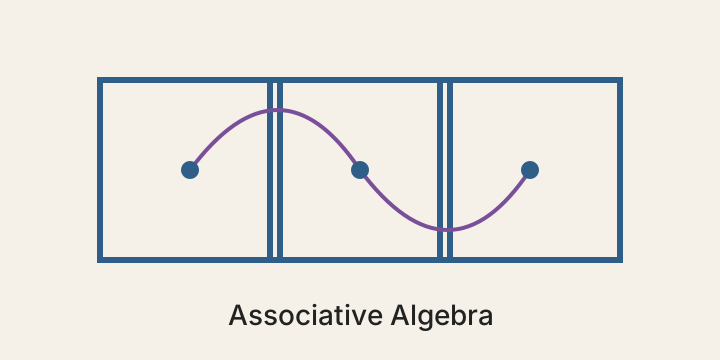
Associativity is about grouping, not about swapping order.
Worked example [Beginner]
Use ordinary two-by-two matrices. Let
You can add them:
You can scale by 3. You can also multiply and , and the result is again a two-by-two matrix.
What this tells us: an associative algebra combines vector-space operations with an internal product.
Check your understanding [Beginner]
Formal definition [Intermediate+]
Let be a field 01.01.01. An associative unital -algebra is a -vector space 01.01.03 equipped with a bilinear multiplication map
and an element such that
for all .
Equivalently, an associative unital -algebra is a ring together with a homomorphism into the center of . The vector-space scalar action is recovered from [Lang §III §1].
An algebra homomorphism is a -linear map preserving multiplication and unit.
Key theorem with proof [Intermediate+]
Theorem (commutator Lie algebra). Let be an associative -algebra. Define
Then this bracket is bilinear, alternating, and satisfies the Jacobi identity
Proof. Bilinearity follows from bilinearity of multiplication and subtraction. Alternating follows from .
For Jacobi, expand:
Similarly,
and
Adding the three displayed expressions, every word cancels with its negative. Hence the Jacobi sum is zero.
Bridge. The construction here builds toward 03.01.03 (ideal in an algebra), where the same data is upgraded, and the symmetry side is taken up in 03.01.05 (quotient algebra). The defining pattern appears again in those units in a sharpened form, where the local data is glued or quotiented. Putting these together, the foundational insight is that the data of this unit gives the structural signature that the rest of the strand reads off.
Exercises [Intermediate+]
Lean formalization [Intermediate+]
import Mathlib.Algebra.Algebra.Basic

namespace Codex.ModernGeometry.TensorAlgebra

variable {K A : Type*} [CommSemiring K] [Semiring A] [Algebra K A]

theorem algebra_mul_assoc (a b c : A) :
    (a * b) * c = a * (b * c) :=
  mul_assoc a b c

end Codex.ModernGeometry.TensorAlgebra
Advanced results [Master]
Associative algebras over form a category with unital algebra homomorphisms. Tensor algebra 03.01.04 is the free object generated by a vector space: linear maps into an associative algebra extend uniquely to algebra homomorphisms .
Every associative algebra has a Lie algebra obtained by the commutator bracket. This construction is functorial and explains the appearance of matrix Lie algebras inside associative matrix algebras 03.04.01. Conversely, the universal enveloping algebra of a Lie algebra is an associative algebra built to encode Lie brackets as commutators.
Two-sided ideals are precisely the subspaces that can be collapsed while preserving multiplication. Quotient algebras 03.01.05 and Clifford algebras 03.09.02 use this mechanism to impose relations.
Synthesis. Associative algebras sit at the crossroads where vector-space linearity meets ring-theoretic multiplication: the commutator bracket extracts a Lie algebra from every associative algebra, tensor algebra 03.01.04 provides the free object in this category via its universal property, two-sided ideals are exactly the subspaces whose quotients preserve the multiplicative structure, and the resulting quotient algebras impose relations ranging from commutativity (symmetric algebra) to the Clifford relation . Wedderburn's structure theory decomposes finite-dimensional algebras over algebraically closed fields into matrix blocks over division algebras, while the representation theory of an algebra is controlled by its ideal lattice — kernels of representations are two-sided ideals, and faithful representations are those with zero kernel. Every downstream construction in this strand (enveloping algebras, Clifford algebras, group algebras) is an associative algebra built to encode a specific pattern of linear composition.
Full proof set [Master]
Proposition. The kernel of an algebra homomorphism is a two-sided ideal of .
The kernel is a vector subspace because is linear. If and , then
Thus and lie in . This is exactly the two-sided absorption condition.
Proposition. A unital algebra homomorphism preserves invertible elements.
If has inverse , then
and similarly . Hence is invertible with inverse .
Connections [Master]
Tensor algebra
03.01.04is the free associative algebra on a vector space.Ideals in an algebra
03.01.03are the subspaces compatible with multiplication.Quotient algebra
03.01.05imposes algebraic relations by collapsing a two-sided ideal.Lie algebra
03.04.01can be obtained from an associative algebra by the commutator bracket.
Historical & philosophical context [Master]
Associative algebras emerged from matrices, polynomial algebras, group algebras, and linear operators. Wedderburn's structure theory made finite-dimensional associative algebras central objects in early twentieth-century algebra [Wedderburn 1908].
Bourbaki's algebra volumes present algebras through rings, modules, tensor products, and universal constructions, matching the modern categorical treatment used by tensor and quotient algebras [Bourbaki Algebra I Ch. III].
Bibliography [Master]
@article{Wedderburn1908Hypercomplex,
  author = {Wedderburn, J. H. M.},
  title = {On Hypercomplex Numbers},
  journal = {Proceedings of the London Mathematical Society},
  volume = {6},
  year = {1908},
  pages = {77--118}
}

@book{BourbakiAlgebraAssociative,
  author = {Bourbaki, Nicolas},
  title = {Algebra I},
  publisher = {Springer},
  year = {1989}
}