General fibre bundle
Anchor (Master): Whitney 1935; Steenrod Topology of Fibre Bundles 1951; Husemoller Ch. 1-4
Intuition [Beginner]
A fibre bundle is a space that locally looks like a product but globally may twist. Think of a hair band: locally it is a product (a small strip of hair times a small arc of the band), but globally the strip twists around.
The Möbius strip is the simplest twisted bundle. Locally it looks like a rectangle . But when you go once around the circle, the strip flips. The result is non-orientable — you cannot paint one side consistently.
A product bundle is globally a product . A twisted bundle has the same local product structure but different global topology. The fibre is the "hair," the base is the "band," and the twisting is encoded in transition functions.
Other examples: the cylinder (product circle bundle over a circle), the torus (product ), the Hopf fibration (a highly twisted -bundle over the 2-sphere).
Visual [Beginner]
A Möbius strip as a twisted ribbon over a circle. At each point on the base circle, the fibre is a short interval. Two overlapping charts shown as product patches, with a twist in the transition between them.
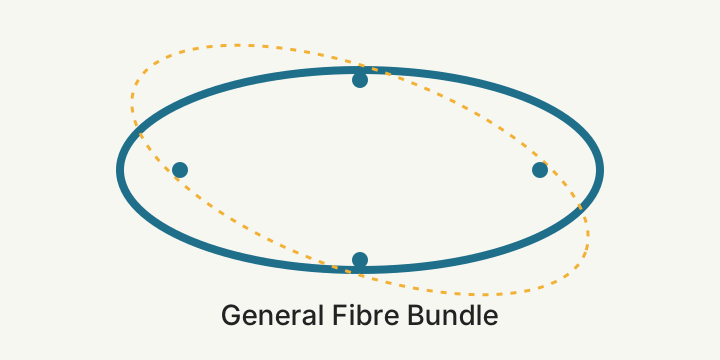
A fibre bundle: locally a product, globally possibly twisted.
Worked example [Beginner]
The tangent bundle of a manifold is a vector bundle. At each point , the fibre is the tangent space . Locally, in coordinates, looks like . The transition functions are the Jacobian matrices of the coordinate changes.
For (the 2-sphere), the tangent bundle is twisted — you cannot comb a hairy ball flat everywhere. This is the hairy ball theorem: has no nonvanishing section.
For (the circle), is a product: (you can comb a hairy circle flat).
Check your understanding [Beginner]
Formal definition [Intermediate+]
Definition (Fibre bundle). A fibre bundle with fibre , structure group , and base is a surjective map such that:
- For each , (the fibre over ).
- There is an open cover of and diffeomorphisms (local product charts).
- On overlaps , the transition satisfies .
Definition (Principal -bundle). A principal -bundle is a fibre bundle with fibre and a free right -action on that preserves fibres and is locally equivariantly a product.
Cocycle condition. The transition functions satisfy:
- (identity on overlaps with itself)
- (inverse on swap)
- on triple overlaps (cocycle)
Key theorem with proof [Intermediate+]
Theorem (Reconstruction from cocycles). Given an open cover of and maps satisfying the cocycle condition, there exists a unique (up to isomorphism) fibre bundle with transition functions .
Proof. Define as the quotient of the disjoint union by the equivalence relation: for .
The cocycle condition ensures is transitive: if , then guarantees consistency.
The projection is well-defined. Each sending is a diffeomorphism.
Bridge. The cocycle reconstruction is the fibre-bundle analogue of gluing a manifold from coordinate patches; the foundational reason it works is that the cocycle condition ensures the gluing is consistent on all triple overlaps. This pattern appears again in sheaf cohomology where Cech cocycles classify twisted objects. The bridge is that fibre bundles are classified by cohomology — the transition functions are Cech 1-cocycles with values in , and isomorphic bundles correspond to cohomologous cocycles.
Exercises [Intermediate+]
Advanced results [Master]
Classification theorem. For a topological group , there exists a classifying space and a universal bundle such that isomorphism classes of principal -bundles over are in bijection with homotopy classes . For : . For : is the Grassmannian of -planes in .
Characteristic classes. The cohomology gives characteristic classes: the Chern classes for , Stiefel-Whitney classes for , Pontryagin classes for . Each characteristic class is a cohomology class on the base pulled back from via the classifying map.
Associated bundles. Given a principal -bundle and a -representation , the associated bundle is the quotient of by . Every vector bundle with structure group arises as an associated bundle of its frame bundle.
Synthesis. Fibre bundles are the topological framework for describing twisted geometric structures; the central insight is that the local product structure is rigid enough to classify global twists via cohomology. This pattern appears again in sheaf theory where locally free sheaves correspond to vector bundles, and in gauge theory where connections on principal bundles describe force fields. The bridge is that fibre bundles identify global geometry with local data plus gluing information — this builds toward characteristic classes and index theory.
Full proof set [Master]
Proposition (Frame bundle of a vector bundle). For any rank- vector bundle , the frame bundle is a principal -bundle whose associated bundle recovers .
Proof. The fibre of over is the set of ordered bases (frames) of . This set is a -torsor: acts freely and transitively by changing the basis. The local product charts of induce local product charts of . The associated bundle identifies a point with , recovering .
Connections [Master]
Topological manifolds 03.02.01 provide the base spaces for fibre bundles; the bundle construction builds layers of structure (tangent vectors, frames, spinors) on top of the bare manifold.
Vector bundles are the special case where the fibre is a vector space; the tangent bundle is the most important example, and its frame bundle is the principal bundle associated to any Riemannian metric.
Characteristic classes (Chern, Stiefel-Whitney, Pontryagin) are cohomological invariants that detect bundle twisting; they live in the cohomology of the base space pulled back from the classifying space.
Bibliography [Master]
@book{steenrod1951,
  author = {Steenrod, Norman},
  title = {The Topology of Fibre Bundles},
  publisher = {Princeton Univ. Press},
  year = {1951}
}

@book{husemoller,
  author = {Husemoller, Dale},
  title = {Fibre Bundles},
  edition = {3},
  publisher = {Springer},
  year = {1994}
}

@book{kobayashi-nomizu,
  author = {Kobayashi, Shoshichi and Nomizu, Katsumi},
  title = {Foundations of Differential Geometry},
  volume = {1},
  publisher = {Wiley},
  year = {1963}
}
Historical & philosophical context [Master]
Whitney introduced fibre bundles in 1935 as part of his work on manifold topology. Steenrod's 1951 monograph [Steenrod 1951] systematised the theory, establishing the classification theorem and the relationship to obstruction theory.
The conceptual breakthrough was realising that many geometric objects (tangent vectors, differential forms, spinor fields) are sections of appropriate fibre bundles. This unification — due principally to Ehresmann (1944) and Koszul (1960) — made fibre bundles the standard language of differential geometry and gauge theory.
In physics, Yang and Mills (1954) independently reinvented principal bundles as the mathematical framework for non-abelian gauge theories. The Yang-Mills equations are equations for connections on principal bundles, making fibre bundle theory the mathematical backbone of the Standard Model of particle physics.