Stiefel-Whitney classes
Anchor (Master): Milnor-Stasheff §4–§9; Bott-Tu §23; Husemoller §16
Intuition [Beginner]
Stiefel-Whitney classes are the mod-2 characteristic classes of real vector bundles. They live in the integer-coefficient cohomology, but with a twist: they take values in , the integers mod 2. So each class is a finite-degree obstruction whose value is either zero or one.
The first Stiefel-Whitney class measures orientability: it is zero if and only if the bundle is orientable. The second class measures the obstruction to a spin structure. Higher classes measure deeper obstructions to additional structure (string structures, fivebrane structures, etc.).
Stiefel-Whitney classes are the prototype of characteristic-class theory: a small list of cohomology classes capturing global invariants of bundles by purely topological means. They are computable, axiomatically characterised, and underlie much of the topology of manifolds.
Visual [Beginner]
A real vector bundle over a base manifold; Stiefel-Whitney classes are mod-2 cohomology elements detecting structural obstructions — orientability, spin lift, and beyond.
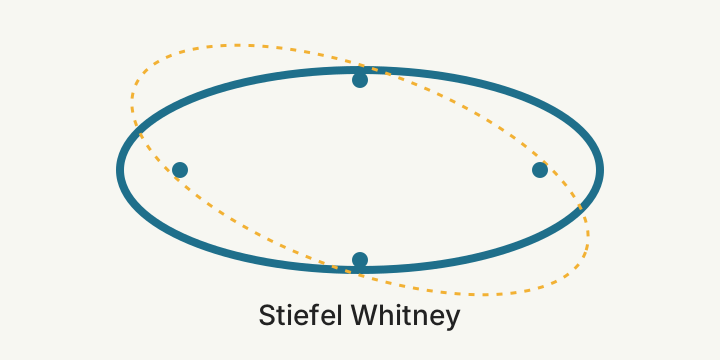
The classes are natural: pulling back the bundle pulls back the classes; the product bundle has all classes zero.
Worked example [Beginner]
The tangent bundle of the sphere has Stiefel-Whitney classes that vanish in low degrees:
- (the sphere is orientable for all ).
- (the sphere is spin for all , since it is simply connected for and orientable).
- All higher except possibly the top class (which is the mod-2 reduction of the Euler class, vanishing for odd and nonzero for even ).
The tangent bundle of the real projective plane has — projective space is not orientable in even dimension. So correctly detects the non-orientability.
The tangent bundle of has — projective 4-space is orientable but not spin. So correctly detects the spin obstruction.
Check your understanding [Beginner]
Formal definition [Intermediate+]
Let be a real vector bundle of rank over a topological space 03.05.02, 02.01.01. The Stiefel-Whitney classes of are cohomology classes
with and for . They are characterised axiomatically by the Stiefel-Whitney axioms:
- Naturality: for a continuous map and the pullback bundle ,
- Whitney product formula: for two real vector bundles ,
equivalently for the total Stiefel-Whitney class .
- Normalisation: for the tautological line bundle ,
is the nonzero generator.
- Dimension/vanishing: for .
These four axioms determine the Stiefel-Whitney classes uniquely.
Equivalent formulations.
- Via Steenrod squares on the Thom class: is the unique cohomology class such that where is the Thom class and is the bundle projection.
- Via the cohomology of the classifying space: , a polynomial ring in the universal Stiefel-Whitney classes; pullback along the classifying map of gives .
Standard interpretations:
- iff is orientable.
- For an orientable bundle, iff admits a spin structure.
- For a spin bundle, iff admits a string structure (a higher cohomological lift); see
03.09.04.
Key theorem with proof [Intermediate+]
Theorem (existence and uniqueness of Stiefel-Whitney classes). There is a unique assignment of cohomology classes to real vector bundles satisfying the four axioms (naturality, Whitney product, normalisation, dimension).
Proof sketch. Uniqueness. Any Stiefel-Whitney theory is determined by its values on the universal bundle , by naturality. The cohomology ring is a polynomial ring in generators in degrees . The normalisation axiom fixes for the universal line bundle on . The Whitney product formula extends to all via the identification of with the -fold product of universal line bundle factors (after splitting principle), forcing the to be the elementary symmetric polynomials in line-bundle Chern roots (mod 2).
So the universal classes are uniquely determined, and naturality forces all classes for all bundles.
Existence. Construct as follows: for the universal bundle on , take to be the elementary symmetric polynomials in the Stiefel-Whitney classes of the universal line bundle factors (after the natural map — the splitting). Verify the axioms hold (the constraints are compatible with the cohomology ring structure of ). Naturality propagates this to general bundles via the classifying-map construction.
The Steenrod square approach gives an alternative direct construction: on the Thom class gives a class , which under the Thom isomorphism corresponds to a class in — defined to be . The Steenrod-square approach is the most computational.
Bridge. The construction here builds toward 03.06.04 (pontryagin and chern classes), where the same data is upgraded, and the symmetry side is taken up in 03.09.04 (spin structure on an oriented riemannian manifold). The defining pattern appears again in those units in a sharpened form, where the local data is glued or quotiented. Putting these together, the foundational insight is that the data of this unit gives the structural signature that the rest of the strand reads off.
Exercises [Intermediate+]
Lean formalization [Intermediate+]
lean_status: none — Mathlib lacks bundled characteristic classes.
-- Pseudocode only.

constant StiefelWhitney : RealVectorBundle M → Nat → CohomologyClass M
constant w : RealVectorBundle M → TotalCohomologyClass M

axiom whitney_product (E F : RealVectorBundle M) :
    w (E ⊕ F) = w E * w F

axiom orientability (E : RealVectorBundle M) :
    Orientable E ↔ StiefelWhitney E 1 = 0
Advanced results [Master]
Wu's formula. Stiefel-Whitney classes are computable from Steenrod squares on the manifold's cohomology. Wu's formula expresses the Wu classes (defined by on top-degree classes) in terms of Stiefel-Whitney classes of the tangent bundle: in suitable graded sense. Wu's formula reduces computation of Stiefel-Whitney classes to computation of Steenrod squares plus knowledge of the cohomology ring.
Cobordism invariants. The total Stiefel-Whitney number (evaluated on the fundamental class) is a cobordism invariant: two closed manifolds are unoriented-cobordant iff all their Stiefel-Whitney numbers agree. This is the bridge between Stiefel-Whitney classes and Thom's cobordism theory: , the homotopy of the universal Thom spectrum.
Higher obstructions and Whitehead tower. The vanishing of successive Stiefel-Whitney / Pontryagin classes corresponds to lifts up the Whitehead tower:
- : orientation, lifting .
- : spin, lifting .
- : string, lifting .
- Higher: fivebrane, etc.
Each lift is gated by a cohomological obstruction in or .
Classifying space cohomology. , the polynomial ring in countably many generators. This is the "universal Stiefel-Whitney ring" — every real vector bundle's classes pull back from here. Compare with for complex bundles (Chern classes).
Connection to Stiefel manifolds. The original construction by Stiefel and Whitney was via Stiefel manifolds of orthonormal -frames. The Stiefel-Whitney class is the obstruction to extending an -frame on a -skeleton to a -frame on -skeleton. This was the historical origin of the theory and remains the most geometric viewpoint.
Synthesis. Stiefel-Whitney classes w_i∈H^i(M;Z/2) are the Z/2-valued obstructions to finding linearly independent sections of a vector bundle, with w₁ detecting orientability and w₂ detecting spinability. They satisfy the Whitney sum formula, making them multiplicative under direct sums and computable via Steenrod squares acting on the Thom class of the bundle. Wu's formula expresses Stiefel-Whitney classes purely in terms of the Steenrod algebra and the Poincaré duality structure of the base, revealing them as homotopy invariants rather than merely differential-geometric ones. The vanishing conditions w₁=0 and w₂=0 define the orientability and spinability gates through which all of spin geometry and the index theorem must pass.
Full proof set [Master]
Existence and uniqueness via universal bundle. Sketched in §"Key theorem". Full uniqueness uses the polynomial-ring structure of . Full existence uses the Steenrod-square / Thom-class construction.
Whitney product formula. Proved on the universal bundle (where classifies the direct sum), then propagated by naturality.
orientability. A bundle is orientable iff its -reduction exists iff the classifying map lifts through , with fibre . Obstruction theory: lift exists iff a single class in vanishes — namely .
spin obstruction. Proved in Exercise 6 — obstruction theory applied to with fibre .
Pullback formula. Naturality is direct from the classifying-map formulation: pulled back along .
Connections [Master]
Vector bundle
03.05.02— the input.De Rham cohomology
03.04.06— Stiefel-Whitney classes live in mod-2 cohomology, related to integral / rational cohomology by reduction.Spin structure
03.09.04— is the obstruction.Pontryagin and Chern classes
03.06.04— the integral / complex companions.Smooth manifold
03.02.01— the underlying setting.Stiefel-Whitney and Pontryagin numbers
03.06.10— the numerical-invariant downstream specialisation: top-degree monomials in the classes constructed here are evaluated against the mod-2 fundamental class to produce Stiefel-Whitney numbers, the bordism-invariant integers of . Anchor phrase: the numerical-invariant downstream of the present unit.Unoriented bordism and Thom's theorem
03.06.12— the completeness statement on the present unit's classes: Stiefel-Whitney numbers separate unoriented-bordism classes, and together with Thom's polynomial-ring computation they identify SW classes as a complete set of bordism invariants. Anchor phrase: Stiefel-Whitney numbers classify unoriented bordism.Steenrod squares and the Wu formula
03.06.14— defines the SW classes of via the cohomology-operation formula , where the Wu class is the unique class with on top cohomology. The Wu formula is the bridge that turns the present unit's classes into a computation purely inside via the Steenrod algebra. Anchor phrase: Steenrod squares define SW classes via the Wu formula.Oriented bordism and Pontryagin-Thom
03.06.13. Oriented bordism is the natural setting where Stiefel-Whitney classes of the present unit appear alongside Pontryagin classes: the 2-primary torsion in is detected by SW numbers, while the rational structure is detected by Pontryagin numbers. The Wall 1960 integral classification uses both families jointly. Anchor phrase: oriented bordism uses both SW and Pontryagin classes.Whitney duality and immersion obstructions
03.06.16. Whitney duality applies the Whitney product formula of the present unit directly to the splitting of the tangent bundle and the normal bundle in a Euclidean immersion. The immersion-obstruction theory of03.06.16uses no input other than the present unit's classes plus the Whitney sum identity. Anchor phrase: Whitney duality applies the Whitney product formula directly to SW classes.
Historical & philosophical context [Master]
Eduard Stiefel (1936) introduced the classes that bear his name in his Zürich thesis, in the context of the obstruction to extending sections of frame bundles. Hassler Whitney (1937) independently introduced the same classes from the cohomological side and proved the product formula. Steenrod (1947) gave the modern Steenrod-square interpretation that makes the classes mod-2 cohomology operations.
Milnor and Stasheff's monograph (1974) systematised the theory: axioms, classifying spaces, cobordism applications, computational examples. The relation to the Whitehead tower and higher gauge theory (string structures, fivebrane structures) is a more recent development (Stolz-Teichner, Sati-Schreiber-Stasheff), tying Stiefel-Whitney classes to elliptic cohomology and the chromatic structure of stable homotopy theory.
In modern physics, vanishing of Stiefel-Whitney classes signals the existence of fermionic / spinorial physical structures: for matter to have a definite chirality (orientation), for a spin structure to define Dirac fermions, for heterotic string anomaly cancellation.
Bibliography [Master]
- Milnor, J. & Stasheff, J., Characteristic Classes, Princeton University Press, 1974. §4–§9.
- Bott, R. & Tu, L. W., Differential Forms in Algebraic Topology, Springer GTM 82, 1982. §23.
- Husemoller, D., Fibre Bundles, Springer, 3rd ed., 1994. §16.
- Stiefel, E., "Richtungsfelder und Fernparallelismus in n-dimensionalen Mannigfaltigkeiten", Comm. Math. Helv. 8 (1936), 305–353.
- Whitney, H., "On the topology of differentiable manifolds", Lectures in Topology (1941), 101–141.
Wave 4 Strand B unit #5. Stiefel-Whitney classes — the mod-2 characteristic classes of real vector bundles; foundation for orientability, spin structures, and the Whitehead-tower obstruction theory.