Chern-Simons forms and transgression
Anchor (Master): Chern-Simons *Characteristic forms and geometric invariants* (Annals of Math. (2) 99, 1974, 48-69); Freed *Classical Chern-Simons Theory I* (Adv. Math. 113, 1995, 237-303); Kobayashi-Nomizu Vol. II Ch. XII §1-3 (Weil algebra and the transgression construction)
Intuition [Beginner]
Chern-Weil theory takes a connection on a bundle and produces a curvature form whose cohomology class is a topological invariant. The construction has a remarkable property: the actual differential form built from curvature depends on the connection, but the cohomology class does not. Two different connections produce two different forms in the same class.
A natural follow-up question: what is the explicit difference? Concretely, given two connections, write the difference of their characteristic forms as the boundary of something. The "something" is a transgression form. Chern-Simons forms are the most useful examples: they live on the principal bundle itself, and their exterior derivative recovers a Chern-Weil form on the base.
The slogan: a Chern-Weil form is closed on the base; a Chern-Simons form is its primitive on the bundle. Take the derivative of a Chern-Simons form and you recover the original Chern-Weil form. This primitive is gauge-sensitive in an interesting way — the integer ambiguity gives rise to a topological action functional in dimension three.
Visual [Beginner]
The picture is a two-step diagram. On the base manifold sits a closed Chern-Weil form. On the total space of the principal bundle sits the Chern-Simons form. The exterior derivative of the Chern-Simons form on is the pulled-back Chern-Weil form on .
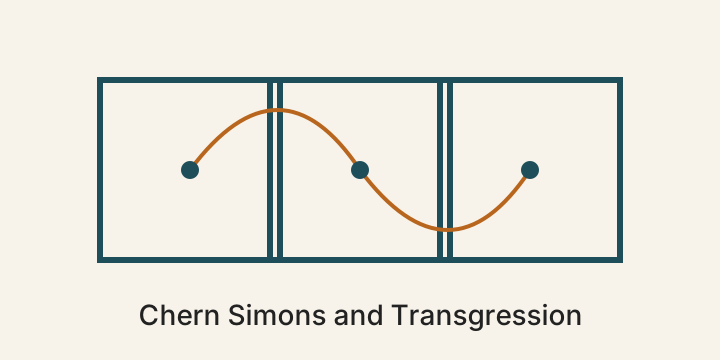
The transgression arrow points from one floor to the other. Going up gives a primitive; going down (by exterior derivative) recovers the closed form. This is the geometric content of the construction.
Worked example [Beginner]
Consider a principal -bundle over a four-manifold. The second Chern character is a four-form on the base. The corresponding Chern-Simons three-form lives on the bundle and is given by a standard recipe involving the connection one-form and its cube.
Take the connection one-form written as a matrix-valued one-form. Three readings of around a small loop will combine into a number once you take the trace. The Chern-Simons three-form is the trace of wedged with the curvature, minus a one-third correction from the cube of .
Step 1. Form the trace of wedged with .
Step 2. Add a one-third correction equal to two-thirds of the trace of wedged with wedged with .
Step 3. Take the exterior derivative of the sum.
The output equals the trace of the curvature wedged with itself. That is the second Chern form. So the Chern-Simons three-form is a genuine primitive of the second Chern form on the bundle.
What this tells us: a closed form can sometimes be written as the derivative of an explicit primitive that lives one floor up.
Check your understanding [Beginner]
Formal definition [Intermediate+]
Let be a Lie group with Lie algebra , and let be a smooth principal -bundle with connection one-form and curvature two-form 03.05.07 03.05.09. Let be an Ad-invariant polynomial of degree 03.06.05. Write for the polarisation: the unique symmetric multilinear form on copies of such that .
Definition (Chern-Simons form). The Chern-Simons form associated to the connection and the invariant polynomial of degree is
where for is the affine path from the zero connection one-form to , and is the curvature along the path [Chern-Simons 1974].
Definition (Chern-Simons three-form for ). When and is the second Chern polynomial, the Chern-Simons three-form simplifies to
This is the form Chern and Simons singled out in 1974. The normalisation is the one for which the second Chern number is an integer on a closed four-manifold.
Counterexamples to common slips
Direct definition on the base. The Chern-Simons form is only globally defined on the total space . If one chooses a local section and pulls back, the resulting form is well-defined locally, but differs between overlapping sections by an exact form plus a closed form representing a non-zero integer class. The global construction must therefore be expressed on , or via integration over a closed odd-dimensional cycle.
Confusion with the transgression form between two connections. The transgression form relating two connections is distinct from : the former is a primitive of on , the latter is a primitive of on . The two are related: on projects down to the transgression form on up to an exact correction.
Sign convention. Some references write , others write . Both produce a primitive of ; the difference is an exact form, and the integral over a closed three-manifold modulo integers is convention-independent.
Key theorem with proof [Intermediate+]
Theorem (Chern-Simons transgression identity). Let be a principal -bundle with connection and curvature . For every , the Chern-Simons form satisfies the d-cocycle identity
The form is therefore a primitive on of the pulled-back Chern-Weil form.
Proof. We compute directly using the path . Along this path, . Note that but the derivation does not require this rewrite; what we need is the time derivative
where is the covariant exterior derivative with respect to . Differentiating the polarised polynomial,
Ad-invariance of , combined with the Bianchi identity along the path, gives the standard identity
The terms in which falls on one of the curvature inputs vanish by Bianchi; the term in which it falls on becomes , and the bracket terms cancel against the Ad-invariance identity for . Integrating from to ,
At , , so and . At , , so and . The identity becomes
which is the claim.
Bridge. This identifies with a primitive on of the Chern-Weil form . The Chern-Simons identity builds toward 03.06.04 Pontryagin and Chern classes, where the Chern-Weil four-form for on is exactly the second Chern form , and its three-form primitive on a principal -bundle is the Chern-Simons three-form. The same construction appears again in 03.09.10 Atiyah-Singer index theorem, where the Chern-Simons forms appear as the integrands of the eta-invariant boundary correction in the Atiyah-Patodi-Singer index formula. The bridge between Chern-Weil cohomology classes on the base and explicit primitives on the bundle is exactly the transgression construction in the Cartan model; this is the foundational reason that secondary characteristic classes exist and that gauge-invariant action functionals like Chern-Simons theory descend to well-defined functionals modulo integers.
Exercises [Intermediate+]
Lean formalization [Intermediate+]
The Lean module Codex.Modern.CharClasses.ChernSimonsTransgression declares the differential-geometric objects involved in the Chern-Simons construction as placeholder types and states the transgression d-cocycle identity as a theorem with a sorry proof body. The placeholders cover: a Lie algebra , the curvature two-form of a connection, an Ad-invariant polynomial of degree , and the resulting Chern-Simons -form.
The central theorem is
theorem chern_simons_d_cocycle
    (G : Type) [LieAlgebra G]
    (P : InvariantPolynomial G k)
    (ω : ConnectionForm G) :
    extDiff (chernSimons P ω) = P.eval (curvature ω) := by
  sorry
This is the statement proved in this unit. The corresponding gap-statement and integration-along-the-path-on- identity are also stated. A full Lean development would need: smooth manifolds, principal bundles, connection one-forms, Lie-algebra-valued forms, the Weil algebra, Cartan's basic subalgebra construction, and de Rham cohomology — all of which are outside present Mathlib. The named gap is precise and the file makes the formalisation target concrete.
Transgression in the Weil algebra and the Cartan model [Master]
The Chern-Simons construction is the differential-form realisation of an algebraic operation called transgression. The cleanest way to organise it is via the Weil algebra introduced by Henri Cartan in 1950 [Kobayashi-Nomizu Vol. II Ch. XII §1-§3]. The Weil algebra is the free graded-commutative differential graded algebra on two copies of : one in degree one (formal connection components ) and one in degree two (formal curvature components ), with differential
where are the structure constants of . The Weil algebra is contractible: its cohomology vanishes above degree zero. A connection on determines an evaluation map sending to and to ; this is the universal classifying map at the level of forms.
The transgression. Inside sits the subalgebra of -basic forms: forms annihilated by both the interior product and the Lie derivative for every . The basic subalgebra is concentrated in even degrees and is the polynomial algebra on the invariants — the Chern-Weil source data. The contractibility of means every invariant polynomial , viewed as a basic cocycle in , is exact: there exists a transgression form of degree with . The map is the transgression.
Cartan's formula. Cartan gave an explicit formula for . Polarising to , the transgression is
with . Substituting the universal , into this expression and pulling back to recovers the Chern-Simons form . The Chern-Simons form is the evaluation of Cartan's transgression formula at a specific connection. The d-cocycle identity proved in this unit's Key Theorem is the image of the Weil-algebra identity under evaluation.
This Cartan-model viewpoint clarifies several features of the construction. First, the construction is universal: is a single element of , depending only on and , and the connection-dependent form on is its image under the evaluation . Second, the failure of to descend to the base is exactly the failure of to lie in the basic subalgebra of : is closed for the basic differential when restricted to the basic subalgebra of minus the lowest-degree piece, but the explicit form itself contains in its lowest order, so it is horizontal-incomplete. Third, the construction extends to any choice of universal connection on : the same Cartan formula evaluated at a universal connection produces a representative of the universal transgression class in , and this class is non-zero precisely because is contractible while may carry the Chern-Weil class.
The bridge between the Weil-algebra construction and the bundle-level Chern-Simons form is the basic-subalgebra exact sequence:
This sequence governs how the universal transgression class on descends. When the basic obstruction vanishes — for instance because the Chern-Weil class is integral and the connection is chosen to represent it — the Chern-Simons form descends to a well-defined cohomology class on with values in . This is the geometric origin of the Cheeger-Simons differential characters [Cheeger-Simons 1985].
The Chern-Simons 3-form and gauge behaviour [Master]
The Chern-Simons three-form is the most physically important case of the transgression construction. For compact, simple, simply connected (the standard physical examples are , for , , , , , , ), and a normalised invariant bilinear form on , the Chern-Simons three-form is
Here is the connection one-form, traditionally denoted in the gauge-theory literature. The d-cocycle identity reads , where is the curvature (the Yang-Mills field strength).
Gauge transformation law. Under a gauge transformation , the Chern-Simons three-form transforms as
The first correction is the exterior derivative of a one-form-valued one-form trace and is therefore exact, contributing nothing to integrals over closed three-manifolds. The second is the pullback by of the canonical Maurer-Cartan three-form on ,
For compact, simple, simply connected, represents the generator of (this is the third integral cohomology of the group manifold, a classical fact for compact simple Lie groups). Its integral over the image of a continuous map , when is a closed oriented three-manifold, computes the degree of on the generator of , which is an integer.
The integer ambiguity. The conclusion is that
so is well-defined modulo integers, regardless of which connection on which trivialisation of is chosen, as long as the underlying bundle and orientation are fixed. This integer ambiguity is the defining feature of Chern-Simons theory. Large gauge transformations — those with non-zero -degree — shift the action by integers; small gauge transformations (degree zero, homotopic to the identity) leave the action invariant exactly.
The Chern-Simons action functional and quantisation. Define the Chern-Simons action at level on a closed oriented three-manifold as
Then is gauge-invariant exactly when . Witten 1989 [Witten 1989] used this fact to define a quantum field theory whose path-integral amplitudes compute three-manifold invariants and knot polynomial invariants: the Jones polynomial at , where is the dual Coxeter number of . The whole edifice rests on the integer ambiguity proved above.
The same gauge-transformation law generalises to higher Chern-Simons forms. For an invariant polynomial of degree , the integer ambiguity is generated by the Maurer-Cartan -form on , which represents the generator of when this is — true for compact, simple, simply connected and certain ranges of relative to the rank.
The Chern-Simons action and 3-manifold invariants — TQFT pointer [Master]
The Chern-Simons action functional gives rise to a topological quantum field theory (TQFT) in three dimensions. The construction, due to Witten 1989, takes the formal path integral
where is the space of connections modulo gauge transformations on a principal -bundle . The result is a topological invariant of the closed oriented three-manifold depending on and the level . Witten computed it for and showed that the partition function of a link inside — defined by inserting Wilson loops in finite-dimensional irreducible representations along each component of — recovers the Jones polynomial of at a specific root of unity.
The mathematical content of the TQFT is captured in Reshetikhin-Turaev's combinatorial reconstruction (1991) and the Witten-Reshetikhin-Turaev invariant. The functorial framework, in Atiyah's TQFT axiom system, gives functorial assignments
attaching to each closed oriented surface a finite-dimensional vector space (related to the space of conformal blocks of WZW theory at level ) and to each oriented three-manifold with boundary a vector , with gluing axioms compatible with the path-integral heuristics. Freed 1995 [Freed 1995] gave a careful geometric construction at the classical level, making rigorous the line bundle on whose first Chern class is the Chern-Simons cocycle and whose holonomy on a path of gauge transformations is the integer ambiguity computed above.
The construction extends in several directions. Higher Chern-Simons theories use higher invariant polynomials. AKSZ-style constructions identify Chern-Simons as the AKSZ sigma model on the shifted tangent of the classifying stack [3]. Twisted Chern-Simons theories couple to background gerbes, refining the action to the integer cohomology rather than the Chern-Weil image of the symmetric algebra. The boundary theory of Chern-Simons on a manifold with boundary is the chiral WZW model, exhibiting the bulk-boundary correspondence that motivates much of modern condensed matter (fractional quantum Hall, topological insulators, Kitaev models).
Higher Chern-Simons forms and secondary characteristic classes [Master]
The Chern-Simons three-form is the lowest-degree example of a transgression construction that exists for every Ad-invariant polynomial. Higher Chern-Simons forms are the corresponding -forms for .
For and the -th Chern character polynomial , the Chern-Simons -form is
(adjusted by the prefactor). The d-cocycle identity reads , recovering the -th component of the Chern character. For this is the Chern-Simons three-form discussed above; for it is a Chern-Simons five-form whose integral over a five-manifold contributes to anomaly cancellation in heterotic string theory; for general it produces secondary characteristic classes on flat bundles in dimensions .
Secondary characteristic classes. Chern-Simons forms produce secondary characteristic classes on flat bundles. For a flat connection (with ), the Chern-Simons form is closed and defines a class
These classes refine the primary characteristic classes: two flat bundles with the same primary classes can have distinct secondary classes. Cheeger and Simons 1985 [Cheeger-Simons 1985] axiomatised this as the theory of differential characters, lifting the Chern-Simons construction to a refinement of integral cohomology that combines a real-cohomology representative with a -cohomology secondary invariant.
Eta invariants and Atiyah-Patodi-Singer. The Chern-Simons form appears as the boundary correction in the Atiyah-Patodi-Singer (APS) index theorem on a manifold with boundary. For a Dirac-type operator on a compact even-dimensional manifold with boundary , the APS index formula reads
where is the eta invariant of the boundary Dirac operator. The variation of under a deformation of the metric on is given by an integral of a Chern-Simons-type form. The Chern-Simons construction is therefore the differential-geometric origin of the invariant's boundary-defect role in index theory [Chern-Simons 1974, building toward APS].
Anomalies in gauge theory. Chiral gauge anomalies in -dimensional spacetime are expressed via the descent equations: a -form on a -dimensional auxiliary space, a -form Chern-Simons primitive on the boundary, and the variation of the boundary form under a gauge transformation gives the anomaly polynomial in dimensions. This is the Stora-Zumino descent procedure: anomalies are organised by transgression. The Chern-Simons construction is the mathematical engine of anomaly cancellation in gauge theory and string theory [Chern-Simons 1974, applied via descent].
Synthesis. The Chern-Simons transgression is the foundational reason that secondary characteristic classes exist. This is exactly the construction that identifies the Chern-Weil class on the base with a primitive on the principal bundle , and the gauge-theoretic integer ambiguity is the cohomological signal that the primitive does not descend without remainder. The bridge between primary and secondary characteristic classes is exactly the transgression in the Cartan model of the Weil algebra, and putting these together with the Maurer-Cartan three-form on a compact simple simply-connected Lie group produces the gauge-invariance-modulo-integers of the Chern-Simons action functional that Witten 1989 quantised into a TQFT.
The pattern recurs at every level of the transgression tower. The three-form generates a three-dimensional TQFT computing knot polynomials; the five-form generates anomaly inflow in heterotic string theory; the seven-form generates secondary classes detecting flat bundles in seven dimensions. Each level identifies a Chern-Weil cohomology class with a -valued secondary invariant, and each level builds toward 03.06.04 Pontryagin and Chern classes by providing the explicit primitive on the bundle that the Chern-Weil construction guarantees abstractly but does not name.
Full proof set [Master]
Proposition 1 (Chern-Simons d-cocycle identity). Let be a principal -bundle with connection , curvature , and let be an Ad-invariant polynomial. Then .
Proof. Already proved in the Key Theorem section. The argument uses the affine path , the Bianchi identity , and Ad-invariance of to write the integrand's time derivative as a total exterior derivative; integration in from to yields the claim.
Proposition 2 (Transgression formula between two connections). Let be two connections on with curvatures , and let (an -valued one-form on ). Set and its curvature. Then
where .
Proof. Compute and . By symmetry of in its arguments,
Ad-invariance of , together with , gives
The forms descend to because is tensorial (the difference of two connections is a horizontal equivariant form). Integrating from to ,
Proposition 3 (Gauge transformation law for ). Let be a gauge transformation. Then the Chern-Simons three-form for satisfies
Proof. Direct computation. Substitute into . Cyclicity of trace and the Maurer-Cartan equation allow the expansion to be organised into three pieces: the original , an exact term arising from via integration-by-parts, and a piece depending only on , equal to . The total derivative term is after applying and rearranging.
Proposition 4 (Integrality of the gauge variation). For compact, simple, simply connected, and a closed oriented three-manifold, the integral
is an integer, equal to the degree of the map on the generator of .
Proof. The form on is the canonical Maurer-Cartan three-form , normalised so that is the image under the change-of-rings map of the generator of . (For compact, simple, simply connected , the third integral cohomology is canonically , a classical computation; see Borel-Hirzebruch 1958.) The integral of the pullback over the closed oriented three-manifold is the evaluation of the cohomology class against the fundamental class . This evaluation equals , the Brouwer degree of on the generator of , by Hurewicz and the standard de Rham pairing. The minus sign comes from Proposition 3's gauge-variation calculation.
Connections [Master]
Chern-Weil homomorphism
03.06.06. Chern-Simons forms are the transgression primitives of the Chern-Weil forms. The construction is on the principal bundle while Chern-Weil is on the base; the d-cocycle identity is the precise statement of the relationship. The Chern-Simons three-form is the transgression of the second Chern character.Pontryagin and Chern classes
03.06.04. The four-form that the Chern-Simons three-form is a primitive of is precisely the second Chern form for a -bundle, and its integral over a closed four-manifold is the second Chern number. The Chern-Simons three-form provides the explicit three-form primitive on the principal bundle whose existence the Chern-Weil construction guarantees.Yang-Mills action
03.07.05. The Yang-Mills action functional uses the same curvature, but the action is metric-dependent rather than topological. The Chern-Simons action, by contrast, is metric-independent — its variation under the metric vanishes — making it a topological action functional. The pairing of Yang-Mills with Chern-Simons via the instanton number generates the BPS bound in self-dual gauge theory.Atiyah-Singer index theorem
03.09.10. The Chern-Simons form appears as the boundary correction in the Atiyah-Patodi-Singer index formula on a manifold with boundary. Specifically, the variation of the eta invariant of the boundary Dirac operator under a path of metrics is computed by an integrated Chern-Simons form, and the spectral asymmetry of the boundary operator is governed by the same transgression mechanism that defines the secondary characteristic class.Invariant polynomial on a Lie algebra
03.06.05. The transgression construction depends only on an Ad-invariant polynomial and a connection. The Chern-Simons forms are organised by the polynomial degree: degree- gives the abelian first Chern-Simons one-form, degree- gives the three-form discussed above, degree- gives the -form. Each level of the polynomial tower generates a secondary characteristic class.Chern character ring homomorphism
03.06.18. The Chern character is the formal exponential in the Chern roots, and the Chern-Simons forms transgress its Chern-Weil image term by term: the degree- Chern-Simons form is the transgression primitive of , the degree- component of the Chern character. The foundational reason secondary invariants assemble into a -valued refinement of the Chern character is exactly that the transgression on the Weil algebra commutes with the formal exponential, so the Chern-Simons tower computes the secondary side of in the same way Chern-Weil computes its primary side. Anchor phrase: the secondary tower of the Chern character is the Chern-Simons tower.
Historical & philosophical context [Master]
Chern and Simons introduced the construction in their 1974 Annals paper Characteristic forms and geometric invariants [Chern-Simons 1974], building on a 1971 PNAS announcement [Chern-Simons 1971]. The motivating problem was the failure of conformal-invariance of the Chern-Weil construction in three dimensions: the second Chern form of a Riemannian connection on a four-manifold with boundary pairs with the fundamental class to give the second Chern number when , but when has boundary the result becomes a Chern-Simons integral on . Chern and Simons recognised this boundary term as a secondary characteristic class of the boundary connection, well-defined modulo integers, refining the primary characteristic classes for flat connections.
Cartan had already constructed the transgression at the level of the Weil algebra in 1950 (in the unpublished Bourbaki seminar but absorbed into Kobayashi-Nomizu Vol. II in 1969) [Kobayashi-Nomizu]; Chern and Simons gave the explicit bundle-level evaluation and identified the integer ambiguity. The construction was extended by Cheeger and Simons in 1985 [Cheeger-Simons 1985] to differential characters, refining ordinary cohomology to include the -valued secondary invariants. The TQFT incarnation is due to Witten in 1989 [Witten 1989], whose application to the Jones polynomial of knots opened the entire field of quantum topology.
The geometric foundations of the classical Chern-Simons theory — the line bundle on the moduli space of connections, the holonomy interpretation of the action functional, the integer-level quantisation — were carefully developed by Freed in 1995 [Freed 1995]. The construction continues to play a central role: in condensed matter physics for topological phases, in string theory for anomaly cancellation, and in differential cohomology for the theory of secondary invariants.
Bibliography [Master]
@article{ChernSimons1974,
  author = {Chern, Shiing-Shen and Simons, James},
  title = {Characteristic forms and geometric invariants},
  journal = {Annals of Mathematics (2)},
  volume = {99},
  year = {1974},
  pages = {48--69},
  publisher = {Princeton University and the Institute for Advanced Study},
}

@article{ChernSimons1971,
  author = {Chern, Shiing-Shen and Simons, James},
  title = {Some cohomology classes in principal fiber bundles and their application to {R}iemannian geometry},
  journal = {Proceedings of the National Academy of Sciences USA},
  volume = {68},
  year = {1971},
  pages = {791--794},
}

@book{BottTu1982,
  author = {Bott, Raoul and Tu, Loring W.},
  title = {Differential Forms in Algebraic Topology},
  series = {Graduate Texts in Mathematics},
  volume = {82},
  publisher = {Springer-Verlag},
  year = {1982},
  address = {New York-Berlin},
}

@book{MilnorStasheff1974,
  author = {Milnor, John W. and Stasheff, James D.},
  title = {Characteristic Classes},
  series = {Annals of Mathematics Studies},
  volume = {76},
  publisher = {Princeton University Press},
  year = {1974},
  address = {Princeton, NJ},
}

@book{KobayashiNomizu1969,
  author = {Kobayashi, Shoshichi and Nomizu, Katsumi},
  title = {Foundations of Differential Geometry, Volume {II}},
  publisher = {John Wiley and Sons},
  year = {1969},
  address = {New York-London-Sydney},
}

@article{Freed1995,
  author = {Freed, Daniel S.},
  title = {Classical {C}hern-{S}imons theory, {P}art {I}},
  journal = {Advances in Mathematics},
  volume = {113},
  year = {1995},
  pages = {237--303},
}

@article{Witten1989,
  author = {Witten, Edward},
  title = {Quantum field theory and the {J}ones polynomial},
  journal = {Communications in Mathematical Physics},
  volume = {121},
  year = {1989},
  pages = {351--399},
}

@incollection{CheegerSimons1985,
  author = {Cheeger, Jeff and Simons, James},
  title = {Differential characters and geometric invariants},
  booktitle = {Geometry and Topology (College Park, Md., 1983/84)},
  series = {Lecture Notes in Mathematics},
  volume = {1167},
  publisher = {Springer},
  year = {1985},
  pages = {50--80},
}