Kostant-Weil isomorphism and prequantum line bundle
Anchor (Master): Kostant *Quantization and unitary representations* (LNM 170, 1970); Souriau *Structure des systèmes dynamiques* (Dunod 1970); Weil *Variétés Kählériennes* (Hermann 1958); Brylinski *Loop Spaces, Characteristic Classes and Geometric Quantization* (Birkhäuser 1993) Ch. 2; Woodhouse *Geometric Quantization* (Oxford 1992)
Intuition [Beginner]
Classical mechanics on a symplectic manifold records states as points and observables as functions; the symplectic form tells you how observables generate flows. Quantum mechanics records states as vectors in a Hilbert space and observables as operators. Geometric quantisation builds the bridge: given a classical phase space, construct a Hilbert space of quantum states from geometric data living on the phase space itself.
The first step of the bridge is the prequantum line bundle. Attach a one-dimensional complex vector space to every point of , equipped with a Hermitian inner product and a way to compare nearby fibres (a connection). The connection should be unitary, meaning parallel transport preserves the inner product, and its curvature should equal the symplectic form. Such a bundle does not always exist. The obstruction is that the symplectic form, viewed as a cohomology class, must be an integer.
The reason this matters: this integrality is a real physical condition. It is the modern reincarnation of the Bohr-Sommerfeld quantisation rule, and it is what forces the quantum spin of an isolated particle to come in integer or half-integer multiples of , never anything in between.
Visual [Beginner]
A schematic showing a symplectic manifold as a base shape with a complex line attached at every point. Arrows along loops on indicate parallel transport, and the picture annotates that going around a small loop multiplies a fibre vector by a phase where is an integer determined by the area enclosed.
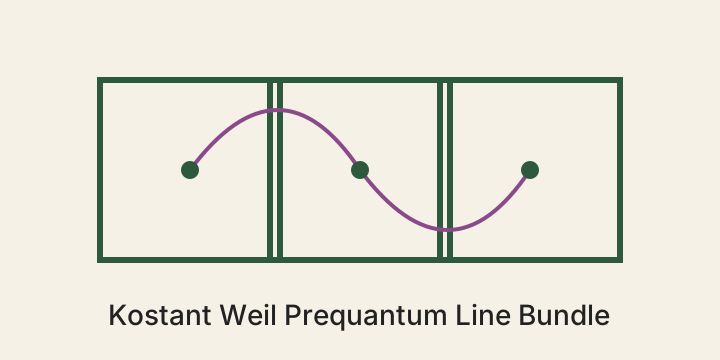
The picture captures the essential constraint. A prequantum line bundle exists when, on every closed surface inside , the integral of the symplectic form is an integer. This integer is the winding number of the line bundle around that surface — its first Chern number.
Worked example [Beginner]
The standard sphere carries a symplectic form given by the area form. The total area of the sphere is if we use the standard round metric of radius one. Scale the form so the total area equals an integer . Then .
Step 1. Compute the integral of over the whole sphere. The integral equals . The integrality condition is that this number must be an integer for every closed surface in . On the only closed surface is the sphere itself, so the condition reduces to being an integer.
Step 2. For each , the corresponding prequantum line bundle is the holomorphic line bundle over . The bundle is the dual of the tautological bundle; is its -th tensor power; is the dual.
Step 3. The geometric-quantisation Hilbert space is the space of holomorphic sections of the prequantum line bundle. For on , this is the space of homogeneous polynomials of degree in two variables — a vector space of dimension .
Step 4. The rotation group acts on and lifts to an action on . The Hilbert space inherits an -action, and the answer is the spin- representation: the irreducible representation of dimension . This is the Borel-Weil construction.
What this tells us: integrality of the symplectic form is the condition for a prequantum line bundle to exist; the bundle is unique up to torsion; and the irreducible representations of compact Lie groups arise as quantisations of integral coadjoint orbits.
Check your understanding [Beginner]
Formal definition [Intermediate+]
Let be a symplectic manifold. A prequantum line bundle over consists of:
- A smooth complex line bundle ;
- A Hermitian metric on (a smoothly varying positive-definite Hermitian inner product on each fibre);
- A unitary connection on , meaning for all local sections of ;
- The curvature condition , equivalently .
Here is the curvature 2-form of , an imaginary-valued closed 2-form on . The sign and factor of follow the Brylinski normalisation; some authors absorb the into the symplectic form. The first Chern class of in real cohomology is the de Rham class $$ c_1(L)\mathbb{R} = \left[\frac{i}{2\pi} F\nabla\right]_{\mathrm{dR}} \in H^2(M, \mathbb{R}), $$ which equals by the curvature condition. The integer first Chern class maps to this under the natural map .
A symplectic form is integral if lies in the image of . Equivalently, for every closed oriented 2-cycle in . This is the Kostant-Weil integrality condition.
The set of isomorphism classes of Hermitian line bundles with unitary connection over has a natural group structure under tensor product. Forgetting the connection yields the smooth Picard group , where the second equality comes from the exponential sheaf sequence.
Counterexamples to common slips
- The sign convention versus varies across textbooks. Brylinski, Woodhouse, and Kostant use opposite conventions in places. The Chern-class identification is the convention-independent statement.
- Integrality of over means the class lies in the image of . The kernel of this map is the torsion subgroup of , so two distinct integer lifts give the same real class iff they differ by torsion. The set of prequantum line bundles is therefore a torsor over the torsion of , not over the full integer cohomology.
- A connection is more data than a line bundle. Two isomorphic line bundles can carry inequivalent connections. The space of unitary connections on a fixed is an affine space modelled on , and two connections give the same curvature iff they differ by a closed real 1-form. So the set of connections with curvature on a fixed is a torsor over — the Jacobian torus in the Kähler setting.
- The Hilbert space of all smooth sections is too large for quantum mechanics: it has the wrong functional dimension. The geometric-quantisation Hilbert space requires a polarisation — a maximal Lagrangian foliation of — and the physical Hilbert space is the space of polarised sections.
Key theorem with proof [Intermediate+]
Theorem (Kostant-Weil integrality, Kostant 1970 / Souriau 1970 / Weil 1958). Let be a symplectic manifold. A prequantum line bundle over exists if and only if is integral, i.e. lies in the image of . When prequantum line bundles exist, the set of their isomorphism classes (as Hermitian line bundles with unitary connection) is a torsor over .
Proof. Consider the exponential short exact sequence of sheaves on : $$ 0 \to \underline{\mathbb{Z}} \to \mathcal{O}_M^\infty \xrightarrow{\exp(2\pi i \cdot)} \mathcal{O}_M^{\infty,} \to 0, $$ where is the sheaf of smooth -valued functions, $\mathcal{O}_M^{\infty,}\mathbb{C}^*\underline{\mathbb{Z}}f \mapsto \exp(2\pi i f)$, which is surjective on stalks because any nonvanishing smooth function has a local logarithm. The kernel is exactly the integer-valued constants.
The long exact sequence in sheaf cohomology reads $$ \cdots \to H^1(M, \mathcal{O}_M^\infty) \to H^1(M, \mathcal{O}_M^{\infty,}) \xrightarrow{\delta} H^2(M, \underline{\mathbb{Z}}) \to H^2(M, \mathcal{O}_M^\infty) \to \cdots. $$ The sheaf is a fine sheaf (admits smooth partitions of unity), so its higher sheaf cohomology vanishes: for . The connecting homomorphism is therefore an isomorphism $$ \delta: H^1(M, \mathcal{O}_M^{\infty,}) \xrightarrow{\sim} H^2(M, \mathbb{Z}). $$ The left-hand side classifies smooth complex line bundles up to isomorphism (Čech 1-cocycles in are precisely transition functions). The right-hand side is integer cohomology. The map is the first Chern class: it sends a line bundle to its integer first Chern class.
Step 1: Necessity. Suppose a prequantum line bundle exists. The Chern-Weil construction (see unit 03.06.06) gives the de Rham class . The integer Chern class maps to under the change-of-coefficients map . So lies in the image, i.e. is integral.
Step 2: Sufficiency. Suppose is integral. Choose an integer lift with image in . By the exponential isomorphism , there is a smooth Hermitian line bundle with . Equip with any Hermitian metric and any unitary connection ; the Chern-Weil curvature represents in de Rham cohomology, so for some real 1-form . Replace by (an additive shift in the affine space of unitary connections on ): the new curvature is . So is a prequantum line bundle.
Step 3: Classification. Two prequantum line bundles and with the same curvature differ by a Hermitian line bundle with flat unitary connection. Flat Hermitian line bundles up to isomorphism are classified by via the holonomy character. Hence the set of isomorphism classes of prequantum line bundles, when nonempty, is a torsor over . By the universal coefficient theorem applied to , this fits into a short exact sequence $$ 0 \to H^1(M, \mathbb{R}) / H^1(M, \mathbb{Z}) \to H^1(M, U(1)) \to H^2(M, \mathbb{Z})_{\text{tor}} \to 0. $$ The continuous part is the Jacobian torus of ; the discrete part is the torsion of .
Bridge. The Kostant-Weil theorem builds toward the entire framework of geometric quantisation and, beyond it, toward higher gerbes and Deligne cohomology. The foundational reason it holds is exactly that the exponential sheaf sequence packages the integer-lift question and the curvature-prescription question into a single piece of homological data: the connecting map is the first Chern class, and its existence is governed by the vanishing of the fine sheaf in positive cohomological degree. This is the central insight, and the same insight appears again in 03.04.14 (hypercohomology of a complex of sheaves), where the Deligne complex has second hypercohomology that identifies with isomorphism classes of Hermitian line bundles with unitary connection — putting these together, prequantum line bundles are geometric realisations of degree-two Deligne cohomology classes, and the integrality theorem is the geometric face of a hypercohomological calculation. The bridge is the recognition that the Chern class is dual to the connecting homomorphism of the exponential sequence, and the curvature is the de Rham reduction of the Deligne class. This pattern generalises to higher gerbes (degree-three Deligne cohomology classifies bundle gerbes with connective structure), and it appears again in 03.06.04 (Pontryagin and Chern classes) where the Chern-Weil and Čech-theoretic definitions are identified via the same exponential machinery.
Exercises [Intermediate+]
Advanced results [Master]
Theorem (Souriau 1970, parallel formulation). Let be a symplectic manifold. A prequantum line bundle exists iff the de Rham period homomorphism , defined by on any representing 2-sphere, takes values in .
Souriau's formulation is dual to Kostant's via the universal coefficient theorem: the homomorphism factors through the Hurewicz map , and integrality of on is the integrality of via the natural pairing.
Theorem (Weil 1958, Kähler case). Let be a compact Kähler manifold. The class is integral iff there exists a holomorphic Hermitian line bundle with . When this holds, is unique up to tensoring with flat holomorphic line bundles, which form the Jacobian .
Weil's theorem is the algebraic-geometric version of Kostant-Weil. The classifying space switches from (smooth nonvanishing functions) to (holomorphic nonvanishing functions), and the exponential sequence becomes the holomorphic exponential sequence with replacing . The intermediate no longer vanishes — it produces the Jacobian.
Theorem (Brylinski 1993, Deligne reformulation). The set of isomorphism classes of Hermitian line bundles with unitary connection over is naturally isomorphic to the smooth Deligne cohomology , where is the smooth Deligne complex of weight two. Forgetting the connection gives the projection to the Picard group; the curvature gives the projection to closed 2-forms; the two projections fit into a pullback square classifying compatible (Chern, curvature) pairs.
This reformulation packages prequantisation into a single cohomological invariant. It generalises immediately to gerbes (degree three) and higher gerbes (higher degrees): degree- smooth Deligne cohomology classifies -gerbes with connective structure, and the Kostant-Weil integrality theorem extends to a Bohr-Sommerfeld-type criterion for the existence of higher gerbes prequantising higher closed forms.
Theorem (geometric quantisation Hilbert space). Let be a prequantum line bundle over . The prequantum Hilbert space is the -completion of square-integrable sections with respect to and the Liouville measure . A polarisation is a smoothly varying choice of Lagrangian subspace, integrable in the sense that sections of are closed under bracket. The geometric quantisation Hilbert space is $$ \mathcal{H} = {s \in L^2(M, L) : \nabla_X s = 0 \text{ for all } X \in \Gamma(P)}. $$ For a Kähler polarisation, is the space of holomorphic sections. For a real polarisation (Lagrangian foliation), is the space of sections covariantly constant along the leaves — which generically requires half-density corrections.
This is the second half of the geometric quantisation programme: Kostant-Weil produces the prequantum line bundle; the polarisation selects a Lagrangian subspace of phase space (canonically, "position" or "holomorphic" coordinates); the Hilbert space is the polarised sections. The full theory is presented in Woodhouse 1992.
Theorem (Bohr-Sommerfeld condition). Let be a smooth closed loop in bounding a 2-chain . The holonomy of the prequantum connection around is $$ \mathrm{hol}\nabla(\gamma) = \exp\left(2\pi i \int\Sigma \omega \right) \in U(1). $$ For a Lagrangian submanifold and a closed loop , the holonomy is equivalent to , the Bohr-Sommerfeld quantisation condition. The Bohr-Sommerfeld locus is the union of Lagrangian submanifolds on which the prequantum connection has identity holonomy.
In one degree of freedom, this reproduces the original Bohr-Sommerfeld rule from 1916, with Planck's constant absorbed into the normalisation. The integrality of is the universal Bohr-Sommerfeld condition; specific Lagrangian leaves carrying integer flux contribute basis vectors to the quantum Hilbert space.
Theorem (Borel-Weil 1954 / Bott 1957). Let be a compact connected simply-connected Lie group, a maximal torus, and $\lambda \in \mathfrak{t}^\mathcal{O}\lambda = G \cdot \lambda\omega\lambda\mathcal{O}\lambda \cong G/T\lambdaL\lambda$ is holomorphic with respect to this structure, and* $$ H^0(\mathcal{O}\lambda, L\lambda) = V_\lambda $$ is the irreducible representation of with highest weight . Higher cohomology vanishes.
The Borel-Weil construction is the geometric quantisation of integral coadjoint orbits. It produces every irreducible representation of from a symplectic manifold and a Kähler polarisation. Bott (1957) extended this to non-dominant : is either zero in all degrees or concentrated in one degree, computable from Weyl-group combinatorics. This is the Borel-Weil-Bott theorem.
Theorem (functoriality and equivariance). The prequantisation construction is functorial: a symplectomorphism pulls back a prequantum line bundle to a prequantum line bundle $(\phi^ L_2, \phi^* h_2, \phi^* \nabla_2)(M_1, \omega_1)G(M, \omega)GM$, provided the moment map satisfies an integrality condition for the lift to exist on the bundle level.*
The lifting condition is the prequantum lifting obstruction: the moment map must take values in the integer lattice of on fixed loci, or more generally must satisfy an integrality condition on flux. Symplectic actions on that do not lift to the prequantum bundle correspond to genuine projective representations of on the quantum Hilbert space — the topological origin of anomalies in quantum field theory.
Synthesis. The Kostant-Weil isomorphism is the foundational reason that classical symplectic geometry produces well-defined quantum Hilbert spaces only under a discrete cohomological condition. The central insight is that the existence question — does a Hermitian line bundle with prescribed curvature exist? — factors through the connecting homomorphism of the exponential sheaf sequence, identifying the obstruction with the first Chern class, an integer cohomology class. Putting these together, classical phase spaces with integer symplectic flux admit canonical quantisations, and the discreteness of quantum spectra (charge, spin, angular momentum) is the geometric face of integer cohomology. The Souriau parallel reformulation, the Weil Kähler version, and the Brylinski Deligne-cohomology reformulation are three faces of the same theorem, identifying prequantum line bundles with , with the Picard group , and with respectively. Each face exposes different further structure: Souriau brings the homotopy-theoretic period morphism; Weil brings the Kähler-geometric Jacobian and the Hodge filtration; Brylinski brings the higher-gerbe generalisation.
This same algebraic mechanism appears again in 03.04.14 (hypercohomology) where smooth Deligne cohomology computes exactly the obstruction classes that prequantise higher-degree closed forms, and it appears again in 03.06.04 (Pontryagin and Chern classes) as the dictionary between curvature representatives and integer Chern numbers. The pattern recurs: every prequantisation question in geometry — line bundles, gerbes, higher gerbes, B-field backgrounds in string theory — is governed by an integrality condition on a closed differential form, with the integrality datum living in an appropriate Deligne-cohomology group. The Borel-Weil construction shows this is exactly the way irreducible representations of compact Lie groups are constructed; the Bohr-Sommerfeld condition shows it is exactly the way classical quantum numbers acquire their integer values; the prequantum lifting obstruction shows it is exactly the way symplectic actions that do not extend to the quantum bundle produce anomalies in quantum field theory.
Full proof set [Master]
Proposition 1 (the exponential sheaf sequence is exact). The sequence of sheaves of abelian groups $$ 0 \to \underline{\mathbb{Z}} \to \mathcal{O}_M^\infty \xrightarrow{\exp(2\pi i \cdot)} \mathcal{O}_M^{\infty,*} \to 0 $$ on a smooth manifold is exact.
Proof. Exactness is checked stalkwise. At a point , the stalk is the ring of germs of smooth complex-valued functions at , and is its group of units (germs of smooth nonvanishing functions). The map sends a germ to .
Kernel of : A germ satisfies iff takes integer values pointwise in a neighbourhood. Smoothness forces to be locally constant; connectedness of stalks forces to be a constant integer. So the kernel is .
Surjectivity of : Given a nonvanishing smooth on a contractible open around , the function lifts to a smooth via (smoothness of the lift uses contractibility and the smoothness of the covering map ). Then and is smooth on (since ); set . Then . So every stalk germ in lifts.
The sequence is exact at every stalk; sheaf exactness follows.
Proposition 2 (vanishing of higher cohomology of ). On a paracompact smooth manifold , for all .
Proof. The sheaf admits smooth partitions of unity: for any open cover of , there exist smooth functions supported in with . A sheaf admitting partitions of unity is fine; fine sheaves are acyclic for paracompact-Hausdorff bases. Specifically, given a Čech 1-cocycle with , define on . The cocycle condition gives . So trivialises the cocycle as a Čech coboundary. The argument extends to all by induction on the degree.
Proposition 3 (the connecting homomorphism is the first Chern class). Under the exponential sheaf sequence, the connecting homomorphism $\delta: H^1(M, \mathcal{O}_M^{\infty,}) \to H^2(M, \mathbb{Z})c_1$.*
Proof. A line bundle over corresponds to a Čech 1-cocycle — its transition functions. The connecting map lifts locally as for (possible by surjectivity of the exponential on stalks, after refining the cover), and defines — a Čech 2-cocycle in .
By the standard Čech-de Rham comparison (see 03.04.11), this Čech class corresponds under the de Rham isomorphism to the curvature class for any unitary connection on . The latter is the definition of the first real Chern class. The integer Čech class is its canonical integer lift; this is precisely the integer first Chern class as defined in 03.06.04.
Proposition 4 (Kostant-Weil integrality theorem). A symplectic manifold admits a prequantum line bundle iff lies in the image of .
Proof. Necessity. Suppose is prequantum. By Proposition 3 and the Chern-Weil construction, lies in the image of . The curvature condition gives , so is integral.
Sufficiency. Suppose . Choose an integer lift . By the inverse of the isomorphism from Propositions 1-3, there is a smooth complex line bundle with . Pick any Hermitian metric on (exists by partitions of unity) and any unitary connection on (exists by partitions of unity applied to the affine space of connections). The Chern-Weil class in de Rham cohomology, so there is a real 1-form with . Define : this is again a unitary connection on (the imaginary 1-form is the standard form of a unitary connection's affine shift). The new curvature is , so . Equivalently . So is a prequantum line bundle.
Proposition 5 (classification of prequantum line bundles). When prequantum line bundles over exist, the set of their isomorphism classes is a torsor over .
Proof. Let and be prequantum line bundles. The tensor product inherits a Hermitian metric and a unitary connection with curvature . So is a flat Hermitian line bundle.
Flat Hermitian line bundles on are classified by their monodromy: a homomorphism , equivalently a class in (using Hom for connected with abelianisation matching , and for non-abelian via the universal coefficient theorem applied to ).
Conversely, every flat Hermitian line bundle produces a new prequantum line bundle with the same curvature as . The action is free: implies is the identity bundle. So the action is free and transitive — a torsor.
Proposition 6 (Bohr-Sommerfeld holonomy formula). Let be a prequantum line bundle and a smooth loop bounding a 2-chain in . Then .
Proof. Locally write where . The curvature is . Holonomy along is . For and inside a single local frame chart, Stokes gives . So . For requiring multiple charts, patch via the transition data; the same formula holds globally because the integer Chern class of corrects any chart-overlap monodromy.
Proposition 7 (Borel-Weil identification on ). On with the Fubini-Study form normalised so , the prequantum line bundle has , the spin- representation of , of dimension .
Proof. Sections of over are precisely homogeneous polynomials of degree in the homogeneous coordinates : a polynomial of degree gives a section in any local trivialisation , transforming as a section of under coordinate changes.
The space of homogeneous polynomials of degree in two variables has dimension , with basis . The natural -action by preserves degree and is irreducible — it is the spin- representation, characterised by highest weight under the maximal torus . The character at is , the Weyl character formula in this case.
Connections [Master]
Pontryagin and Chern classes
03.06.04. The first Chern class is the central character of the Kostant-Weil theorem: the connecting homomorphism of the exponential sheaf sequence is identified as , and the integrality condition on is the condition that some element of maps to . The prequantum line bundle is then a chosen integer lift, and the Chern-Weil curvature representative is exactly the prequantum connection's curvature. The unit on Chern classes provides the cohomological framework; this unit specialises it to the symplectic-geometric question.Chern-Weil homomorphism
03.06.06. The curvature representative of via the Chern-Weil construction is , and this identification underlies the necessity direction of the Kostant-Weil theorem: if is prequantum, the Chern-Weil construction gives a closed 2-form integer-cohomology lift of . The Kostant-Weil theorem is, in this sense, a corollary of Chern-Weil applied to line bundles, plus the observation that line bundles are classified by their first Chern class.Hypercohomology of a complex of sheaves
03.04.14. The Brylinski reformulation identifies the set of isomorphism classes of Hermitian line bundles with unitary connection with the second smooth Deligne hypercohomology . The exponential sheaf sequence, the de Rham complex, and the integer constants assemble into the Deligne complex, and its hypercohomology computes the prequantum-bundle classification. The hypercohomology framework is what generalises Kostant-Weil to higher gerbes and higher-degree closed forms.Delzant theorem
05.04.04. Symplectic toric manifolds classified by Delzant polytopes are integral when the polytope is rational with integer normals — exactly the condition for the symplectic form on the corresponding symplectic-quotient construction to be integral. The Borel-Weil quantisation of an integral toric manifold gives a representation of the torus that decomposes via the polytope's integer lattice points (Riemann-Roch / Atiyah-Bott counting). Every Delzant polytope produces a prequantisable symplectic manifold; the prequantum bundle is the relative-dualising sheaf of the toric variety.Compact Lie group representations
07.07.01. The Borel-Weil construction realises every irreducible representation of a compact connected simply-connected Lie group as the space of holomorphic sections of a prequantum line bundle over an integral coadjoint orbit. Integrality of the orbit corresponds to integrality of the highest weight in the weight lattice. Geometric quantisation of integral coadjoint orbits is therefore the geometric face of representation theory — Kirillov's orbit method in the compact-group setting.Symplectic manifold
05.01.02. The Kostant-Weil theorem refines the symplectic-manifold structure with a cohomological condition that selects which symplectic manifolds support geometric quantisation. The classification of integer symplectic manifolds is therefore a substantive refinement of the classification of symplectic manifolds; this is sometimes called the classification of polarised symplectic manifolds by analogy with polarised algebraic varieties.Singular cohomology and de Rham theorem
03.04.13. The integer/real comparison map used in the Kostant-Weil theorem is the standard change-of-coefficients map; integrality of is membership in its image. The de Rham theorem identifies with the cohomology of closed 2-forms modulo exact forms, making the integrality condition computable as a periods question: for every integer 2-cycle .
Historical & philosophical context [Master]
The integrality condition for prequantisation has its earliest precursor in Niels Bohr's 1913 quantisation of the hydrogen atom (Phil. Mag. 26, 1-25, 1913), which posited that classical orbits of integer angular momentum are the physical ones. Arnold Sommerfeld extended this to multidimensional integrable systems in 1916 (Ann. Phys. 51, 1-94) [pending]. The condition , with Planck's constant, became known as the Bohr-Sommerfeld quantisation condition.
The modern reformulation as an integrality condition on the symplectic form, with the prequantum line bundle realised as the geometric object whose existence is obstructed by non-integrality, was developed independently by Bertram Kostant and Jean-Marie Souriau around 1970. Kostant's lectures Quantization and unitary representations (LNM 170, Springer 1970) [Kostant 1970] introduced the prequantum line bundle, proved the integrality theorem, and connected the construction to the representation theory of compact Lie groups via the Borel-Weil construction. Souriau's Structure des systèmes dynamiques (Dunod 1970) [Souriau 1970] developed the parallel theory from the symplectic-geometry side, with the integrality condition phrased in terms of the de Rham periods over 2-cycles.
The Kähler-geometric precursor was due to André Weil in his 1958 monograph Variétés Kählériennes (Hermann, Paris) [Weil 1958]: on a compact Kähler manifold, the integrality of is equivalent to the existence of a holomorphic Hermitian line bundle with prescribed Chern class. Weil's theorem was itself the modern reformulation of an older question going back to the Italian school of algebraic geometry and the Hodge theorem on the existence of meromorphic functions with prescribed divisors.
The hypercohomological reformulation was developed by Jean-Luc Brylinski in Loop Spaces, Characteristic Classes and Geometric Quantization (Birkhäuser 1993) [Brylinski 1993], identifying prequantum line bundles with classes in smooth Deligne cohomology and opening the path to higher gerbes — degree-three Deligne cohomology classifies bundle gerbes with connective structure, prequantising closed 3-forms (the B-field of string theory and the Dixmier-Douady class of bundle gerbes). The Brylinski reformulation also connects to the differential characters of Jeff Cheeger and Jim Simons (Differential characters and geometric invariants, in Geometry and Topology LNM 1167, Springer 1985), an equivalent formulation in terms of holonomy functionals on closed cycles.
The full theory of geometric quantisation — Hilbert space construction via polarised sections — was developed primarily by Kostant and Souriau (continuing the 1970 work), refined by David Simms and Nicholas Woodhouse in the 1970s, and given the modern textbook treatment in Woodhouse's Geometric Quantization (Oxford University Press, 1st ed. 1980, 2nd ed. 1992) [Woodhouse 1992]. The orbit-method face — that integral coadjoint orbits parametrise irreducible representations — was developed in parallel by Alexander Kirillov (Unitary representations of nilpotent Lie groups, Uspekhi Mat. Nauk 17 (1962), 57-110), extended to compact groups by Kirillov-Kostant-Souriau, and given its canonical modern treatment in Kirillov's Lectures on the Orbit Method (AMS 2004).
Bibliography [Master]
@incollection{Kostant1970,
  author    = {Kostant, Bertram},
  title     = {Quantization and unitary representations},
  booktitle = {Lectures in Modern Analysis and Applications III},
  series    = {Lecture Notes in Mathematics},
  volume    = {170},
  publisher = {Springer},
  year      = {1970},
  pages     = {87--208}
}

@book{Souriau1970,
  author    = {Souriau, Jean-Marie},
  title     = {Structure des syst{\`e}mes dynamiques},
  publisher = {Dunod},
  address   = {Paris},
  year      = {1970},
  note      = {English transl.: \emph{Structure of Dynamical Systems}, Birkh\"auser, 1997}
}

@book{Weil1958,
  author    = {Weil, Andr{\'e}},
  title     = {Vari{\'e}t{\'e}s K{\"a}hl{\'e}riennes},
  publisher = {Hermann},
  address   = {Paris},
  year      = {1958}
}

@book{Woodhouse1992,
  author    = {Woodhouse, Nicholas M. J.},
  title     = {Geometric Quantization},
  edition   = {2nd},
  publisher = {Oxford University Press},
  year      = {1992}
}

@book{Brylinski1993,
  author    = {Brylinski, Jean-Luc},
  title     = {Loop Spaces, Characteristic Classes and Geometric Quantization},
  series    = {Progress in Mathematics},
  volume    = {107},
  publisher = {Birkh{\"a}user},
  year      = {1993}
}

@book{CannasDaSilva2001,
  author    = {Cannas da Silva, Ana},
  title     = {Lectures on Symplectic Geometry},
  series    = {Lecture Notes in Mathematics},
  volume    = {1764},
  publisher = {Springer},
  year      = {2001}
}

@book{BatesWeinstein1997,
  author    = {Bates, Sean and Weinstein, Alan},
  title     = {Lectures on the Geometry of Quantization},
  series    = {Berkeley Mathematics Lecture Notes},
  volume    = {8},
  publisher = {American Mathematical Society},
  year      = {1997}
}

@book{Kirillov2004,
  author    = {Kirillov, Alexander A.},
  title     = {Lectures on the Orbit Method},
  series    = {Graduate Studies in Mathematics},
  volume    = {64},
  publisher = {American Mathematical Society},
  year      = {2004}
}

@article{Bott1957,
  author  = {Bott, Raoul},
  title   = {Homogeneous vector bundles},
  journal = {Annals of Mathematics},
  volume  = {66},
  year    = {1957},
  pages   = {203--248}
}

@article{CheegerSimons1985,
  author    = {Cheeger, Jeff and Simons, James},
  title     = {Differential characters and geometric invariants},
  booktitle = {Geometry and Topology},
  series    = {Lecture Notes in Mathematics},
  volume    = {1167},
  publisher = {Springer},
  year      = {1985},
  pages     = {50--80}
}

@article{Sommerfeld1916,
  author  = {Sommerfeld, Arnold},
  title   = {Zur Quantentheorie der Spektrallinien},
  journal = {Annalen der Physik},
  volume  = {51},
  year    = {1916},
  pages   = {1--94}
}