Equivariant K-theory and
Anchor (Master): Atiyah-Segal *The index of elliptic operators II* (Ann. Math. 87, 1968); Segal *Equivariant K-theory* (Publ. IHES 34, 1968); Atiyah-Segal *Completion theorem* (J. Diff. Geom. 3, 1969); Atiyah *Bott periodicity and the index of elliptic operators* (Quart. J. Math. 19, 1968); Lawson-Michelsohn §I.9 + §III
Intuition [Beginner]
Equivariant K-theory is K-theory done in the presence of a symmetry group. If a compact group acts on a space , then vector bundles over acquire a richer structure when their fibres rotate compatibly with the group action. Equivariant K-theory records the Grothendieck group of these symmetry-aware bundles, and it captures information that ordinary K-theory cannot see.
The most basic example is when is a single point. A vector bundle over a point is a vector space; a -equivariant vector bundle over a point is a vector space carrying a representation of . The Grothendieck group of representations is the representation ring , and it sits at the foundation of everything that follows. So is the coefficient ring of equivariant K-theory, just as the integers are the coefficient ring of ordinary K-theory.
The reason this matters is that many natural geometric problems carry symmetries. Elliptic operators on a manifold acted on by a group, fixed-point computations, induced representations — all of these are best organised by passing to the equivariant framework first and then specialising back at the end.
Visual [Beginner]
A schematic with three frames: on the left, an ordinary vector bundle over a base space, with a fibre at one point; in the middle, the same bundle equipped with a group action that rotates each fibre while moving its base point compatibly; on the right, the single special case where the base is a point, leaving only a representation of the group. The arrow connecting the middle to the right is labelled and the right-hand frame is captioned .
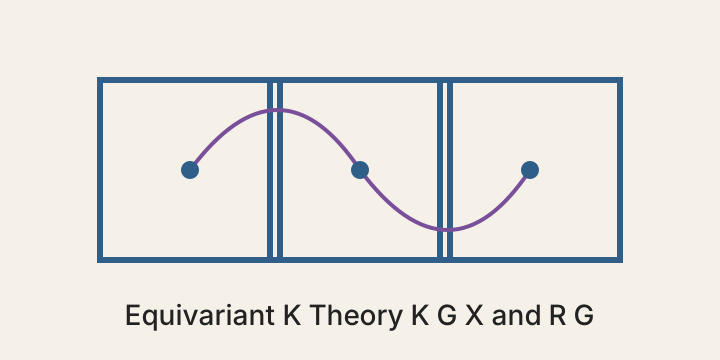
The picture captures the essential message: equivariant K-theory packages two pieces of data at once — the underlying topology of the bundle and the action of the group on its fibres — and the case of a point isolates the representation-theoretic half of that package.
Worked example [Beginner]
Compute the representation ring of the circle group and then of the torus .
Step 1. The circle group has one irreducible complex representation in each integer degree: for each in the integers, the representation sends in to multiplication by on the complex line. So the irreducibles of are parametrised by the integers.
Step 2. The Grothendieck group of finite-dimensional complex representations of is the free abelian group on the irreducibles, which is the free abelian group on the integers. Calling the generator corresponding to by the letter , the inverse is given by , and the ring structure (tensor product) gives tensor , which is . The representation ring is , the ring of Laurent polynomials.
Step 3. For the torus , the irreducibles are products of irreducibles for the two factors, parametrised by pairs of integers . The representation ring is the tensor product of the two circle-rings: , Laurent polynomials in two variables.
Step 4. The pattern extends: for the -torus. Each variable corresponds to one of the standard -eigenvalue characters.
What this tells us: the representation ring of a torus is a ring of Laurent polynomials in the eigenvalue coordinates, and this is the building block out of which the representation rings of more elaborate compact Lie groups are assembled. The full unitary group has representation ring , the symmetric polynomials in the eigenvalues — the Weyl-group invariants inside the torus ring.
Check your understanding [Beginner]
Formal definition [Intermediate+]
Let be a compact Lie group and let be a compact Hausdorff -space — a topological space equipped with a continuous action . A -equivariant complex vector bundle over is a complex vector bundle together with a continuous -action on such that is -equivariant () and the map induced by is complex-linear on each fibre.
The isomorphism classes of -equivariant complex vector bundles on , denoted , form a commutative monoid under direct sum. The equivariant K-theory of is the Grothendieck group of this monoid: $$ K_G(X) := \mathrm{Groth}(\mathrm{Vect}_G(X)). $$ Tensor product of -bundles makes a commutative ring with unit the class of the rank-one product line bundle carrying the identity -action. Pullback along an equivariant continuous map produces a ring homomorphism .
Definition (representation ring). Let be a compact Lie group. The representation ring is the Grothendieck group of the commutative monoid of isomorphism classes of finite-dimensional continuous complex unitary representations of under direct sum, equipped with the ring structure from tensor product of representations. The unit is the class of the one-dimensional identity representation; the augmentation sends a virtual representation to its virtual dimension.
Proposition (identification of with ). A -equivariant complex vector bundle over a one-point space is precisely a finite-dimensional complex representation of . The Grothendieck-group construction matches on both sides, so as commutative rings.
The unique map is -equivariant for the identity action on the target, and pullback equips every with the canonical structure of an -module. Module structure: a class acts on by , where is the bundle whose fibre at is and on which acts diagonally.
Counterexamples to common slips
- is not the -fixed-points of in general. The construction tracks the full -action on bundles, not just bundles whose isomorphism class is fixed by . The two can disagree even when acts freely on .
- The representation ring is generally not a polynomial ring: is a polynomial ring on the standard rep, but where is the -dimensional adjoint, and is a ring of symmetric polynomials, not a polynomial ring on the irreducibles.
- A complex representation is not the same as a real representation. The complex representation ring is what appears in for complex equivariant K-theory; the real version corresponds to and is generally different (e.g., for , but with the sign representation in both — the rings agree only because the relevant representations are real; for the rings differ).
- Equivariant Bott periodicity is not the assertion that is two-periodic in suspension by an arbitrary two-cell. The Bott element lives in for a complex representation of ; suspension by a real two-dimensional representation that is not complex (e.g., the sign representation summed with itself for ) does not yield the same isomorphism.
Key theorem with proof [Intermediate+]
Theorem (equivariant Bott periodicity; Atiyah-Segal 1968). Let be a compact Lie group, a finite-dimensional complex representation of regarded as a -space, and a compact -space. Pullback along the zero-section produces a natural isomorphism $$ K_G(X) \xrightarrow{\sim} K_G(X \times V) $$ in the appropriate -graded sense, given by multiplication with the equivariant Bott class .
The case with identity -action recovers ordinary Bott periodicity. The case of an arbitrary complex representation — twisted by -action — is the equivariant refinement and is the substantive new content.
Proof. The argument follows Atiyah-Segal's strategy of reducing to the non-equivariant Bott theorem via the Thom isomorphism. Step one: define the equivariant Thom class. For a complex -vector bundle , the equivariant Koszul complex $$ \Lambda^\bullet E^* = \bigoplus_{k=0}^{\mathrm{rk}, E} \Lambda^k E^* $$ carries a -grading by parity of and a differential given by interior product with the tautological section, acyclic off the zero section. The class $$ \lambda_E = \sum_{k=0}^{\mathrm{rk}, E} (-1)^k [\Lambda^k E^*] \in K_G(E) $$ is the equivariant Thom class.
Step two: prove the equivariant Thom isomorphism $$ \phi_E: K_G(X) \xrightarrow{\sim} \widetilde K_G(\mathrm{Th}(E)), \qquad x \mapsto \pi^* x \cdot \lambda_E, $$ where is the Thom space of (one-point compactification of rel. zero section) and is the projection. Verification: the equivariant Koszul resolution makes a class whose restriction to each fibre generates the reduced K-theory of the fibre, freely over . The Mayer-Vietoris and induction arguments of the non-equivariant case transfer term by term because the construction is -equivariant at every step.
Step three: specialise. Take , a product bundle in the topological sense, equipped with the -action coming from a representation of on the fibre . The Thom space (the equivariant suspension -sphere) and the Thom isomorphism reads $$ K_G(X) \cong \widetilde K_G(X^+ \wedge S^V), $$ which is the asserted suspension isomorphism. In the special case this is two-fold suspension and the isomorphism is the classical Bott map.
Step four (compatibility). The Bott class is the image of the generator under the Thom isomorphism applied to . The composition with the canonical map is multiplication by , as asserted. Naturality in and in follows from the functoriality of the Thom-isomorphism construction.
Theorem (Atiyah-Segal completion theorem; Atiyah-Segal 1969). Let be a compact Lie group, the augmentation ideal (kernel of ), and a contractible -space with free -action. The natural map extends to a ring isomorphism $$ \widehat{K_G(\mathrm{pt})}_I \cong K(BG), $$ where the left side is the -adic completion of and is the classifying space of .
The proof is deferred to the Full proof set; the statement is the bridge between equivariant K-theory of contractible -spaces and ordinary K-theory of classifying spaces.
Bridge. The equivariant Bott theorem builds toward the full machinery of the equivariant index theorem and the Atiyah-Segal completion theorem, both of which appear again in 03.09.10 (Atiyah-Singer index theorem) in the family-equivariant form developed by Atiyah-Singer III. The foundational reason equivariant K-theory carries a representation-ring action is exactly that every -space admits a canonical equivariant map to the one-point space, and pullback along this map equips with the canonical -module structure. This is exactly the same mechanism that organises every equivariant cohomology theory: the coefficient ring lives over a point, and the module structure on a general space is pullback from the point. The central insight is that the representation ring is the universal equivariant scalar ring, and the bridge is that the Atiyah-Segal completion theorem identifies the -adically completed with the ordinary K-theory of the classifying space — putting these together, equivariant computations over arbitrary -spaces and ordinary computations over classifying spaces are two facets of the same algebraic structure, separated only by an adic completion. This recurs as a pattern in 03.09.21 (family-equivariant index) where the index of an equivariant operator lives in before specialising via characters; and it generalises the classical fact that the cohomology of records the polynomial invariants of the representation ring of .
Exercises [Intermediate+]
Lean formalization [Intermediate+]
Mathlib does not currently package equivariant K-theory; the formalisation is one of the largest open targets in the K-theory roadmap. A schematic of the intended statements:
import Mathlib.Topology.Algebra.Group.Basic
import Mathlib.RepresentationTheory.Maschke
import Mathlib.CategoryTheory.Monoidal.Category
import Mathlib.Algebra.GroupRingAction

namespace EquivariantKTheory

variable (G : Type*) [TopologicalGroup G] [CompactSpace G]
variable (X : Type*) [TopologicalSpace X] [MulAction G X] [ContinuousSMul G X]

/-- A G-equivariant complex vector bundle over a G-space. -/
structure GEquivariantBundle where
  total      : Type*
  proj       : total → X
  fibreSpace : X → Type*
  -- continuous G-action on total commuting with proj, linear on fibres
  smul       : G → total → total
  -- ...all the bundle and equivariance axioms
  sorry

/-- Equivariant K-theory: Grothendieck group of equivariant bundles. -/
noncomputable def KG : Type* := sorry -- Grothendieck of (Vect_G X / iso)

instance : CommRing (KG G X) := sorry -- ring from direct sum + tensor

/-- Representation ring R(G) = K_G(pt). -/
noncomputable def RepRing : Type* := KG G PUnit

/-- R(G)-module structure on K_G(X) via pullback along X → pt. -/
instance : Module (RepRing G) (KG G X) := sorry

/-- Equivariant Bott periodicity for complex G-representations. -/
theorem equivariant_bott
    (V : Type*) [AddCommGroup V] [Module ℂ V] [FiniteDimensional ℂ V]
    [Representation G V] :
    KG G X ≃+* KG G (X × V) := sorry

/-- Atiyah-Segal completion theorem (statement schematic). -/
theorem atiyah_segal_completion
    (G : Type*) [TopologicalGroup G] [CompactSpace G] :
    True := sorry -- K_G(EG)^∧_I ≅ K(BG); needs EG, BG, I-adic completion

end EquivariantKTheory
The formalisation gap is substantial: Mathlib needs equivariant continuous-map categories, the equivariant bundle category, the Grothendieck-completion functor on a symmetric monoidal category with direct sums, the identification of with the representation Grothendieck ring, the -module structure assembled from a base-change functor, and the equivariant Thom-isomorphism / Bott-periodicity package. The completion theorem additionally requires the -adic completion functor in commutative algebra wired to the K-theory output. None of these are present in the form needed; the entire pipeline is a roadmap of contributions.
Advanced results [Master]
Theorem (induction and restriction; Segal 1968). Let be a closed subgroup of a compact Lie group . The forgetful functor from -bundles to -bundles induces a ring homomorphism for every -space . The induced-representation functor produces an -linear map when is a -space regarded as an -space by restriction, satisfying the Frobenius reciprocity formula for , .
The proof is functorial. Restriction is forgetful on the bundle level, hence a ring map. Induction is constructed by associated-bundle: given an -equivariant bundle , form as a -bundle over (since is already a -space, has a canonical -equivariant collapse to ). The Frobenius identity follows from the standard adjunction .
Theorem (equivariant index theorem; Atiyah-Segal 1968). Let be a compact -manifold, an elliptic -equivariant differential operator with symbol class . The equivariant analytic index $$ \mathrm{ind}_G(D) = [\ker D] - [\mathrm{coker}, D] \in R(G) $$ coincides with the equivariant topological index , where is constructed by the equivariant Thom isomorphism and Atiyah-Segal embedding into a -representation.
Specialising the equivariant index to the trace at recovers the Atiyah-Bott Lefschetz fixed-point formula: for acting on with isolated non-degenerate fixed points , $$ \mathrm{tr}(g, \mathrm{ind}(D)) = \sum_{p_i} \frac{\mathrm{tr}(g, \sigma_{p_i})}{\det(1 - dg_{p_i})}. $$
Theorem (Atiyah-Segal completion theorem; Atiyah-Segal 1969). For a compact Lie group and a contractible -space with free action, the natural homomorphism identifies with the -adic completion , where is the augmentation ideal. Furthermore, the projection induces an isomorphism , so .
The theorem connects equivariant K-theory of a contractible space (which encodes only the structure) with ordinary K-theory of the corresponding classifying space, via -adic completion. Special cases recover Atiyah's 1961 computation of for various as completions of representation rings: via the completion of at the augmentation, , and Atiyah's original 1961 computation of as the completion of .
Theorem (localisation at conjugacy class; Atiyah-Segal localisation). Let be a compact Lie group, an element generating a closed subgroup , and the fixed-point set. Localising at the prime ideal , the restriction map $$ K_G(X)_{\mathfrak{p}g} \xrightarrow{\sim} K_G(X^g){\mathfrak{p}_g} $$ is an isomorphism.
The localisation theorem reduces equivariant computations on a -space to computations on the fixed-point set , after inverting the conjugacy-class-of- data in . This is the K-theoretic precursor of Borel-localisation in equivariant cohomology and underlies the Atiyah-Bott-Berline-Vergne integration formula for equivariant characteristic classes.
Theorem ( as a -ring). The representation ring of any compact Lie group is a -ring, with acting by exterior power on representations: . The Adams operations defined by the Newton formula coincide on irreducible characters with the action of the -th power map on : .
The -ring structure on is the prototype that motivated the abstract -ring axioms of Atiyah-Tall 1969. The Adams operations on encode the action of the power maps on conjugacy classes, dual to the character-theoretic side. This duality is the algebraic shadow of the Adams-Riemann-Roch theorem for the K-theory pushforward from a -manifold to a point.
Synthesis. Equivariant K-theory is the foundational reason that representation theory of compact groups and K-theory of spaces share so much structural DNA. The central insight is that , the representation ring of , is the canonical coefficient ring of equivariant K-theory — the value of the functor on the one-point -space — and every equivariant K-theory is an -algebra through pullback from this universal point. Putting these together, the four pillars of equivariant K-theory — equivariant Bott periodicity, the equivariant index theorem, the Atiyah-Segal completion theorem, and the localisation theorem — each appear again in 03.09.10 (Atiyah-Singer index theorem) and in 03.09.21 (family-equivariant index) as the technical engine driving fixed-point formulas, character-valued indices, and the connection between equivariant cohomology and equivariant K-theory through the Chern character.
The bridge is that every classical question about a -action — fixed points, induced representations, characters of representations on cohomology of moduli, equivariant cobordism — admits a K-theoretic refinement whose value is an element of , generalising the integer-valued classical statement to a representation-valued statement that records the action of on the answer. This is exactly the same organising idea that recurs in equivariant cohomology, in equivariant cobordism, and in derived geometry through the loop-space construction: passing from to its inertia stack converts -equivariant data on into ordinary data on , and the K-theory of the inertia stack with its -module structure is precisely . Putting these together, equivariant K-theory builds toward delocalised equivariant K-theory (Baum-Brylinski-MacPherson, Adem-Ruan), the K-theoretic Lefschetz fixed-point theorem of Atiyah-Bott, and ultimately the family-equivariant index theorem appears again in 03.09.21 (family-equivariant index theorem) where index classes live in the K-theory of the parameter space and refine to virtual representations of when an action is present. The same pattern generalises to twisted equivariant K-theory and to equivariant elliptic cohomology, both of which take the representation-ring structure of as the seed and assemble higher-categorical machinery around it.
Full proof set [Master]
Proposition (-module structure on ), proof. The unique map is -equivariant for the identity action on . Functoriality of equivariant K-theory produces a ring map . The image of is the product bundle equipped with the diagonal -action (). For any -equivariant bundle , the product as a -bundle, recovering the asserted formula. The compatibility with addition follows from the additivity of pullback; multiplicativity of pullback gives the ring-homomorphism property. The -module structure is thus the canonical structure pulled back from the point.
Theorem (equivariant Bott periodicity), proof. Detailed argument. Let be a complex -representation. Construct the equivariant Thom class as follows. The Koszul complex carries a -grading by parity and a differential given by interior product with the tautological section via the metric. The differential squares to zero, and the cohomology of is supported on the zero section: away from zero, the Koszul complex is acyclic by the standard Koszul resolution argument (an explicit chain homotopy is given by interior product with when ). The class is a virtual -bundle on supported at the origin in K-theory, i.e., representing a class in .
For a -space , the external product $$ K_G(X) \otimes K_G(V) \to K_G(X \times V), \qquad x \otimes y \mapsto \pi_X^* x \cdot \pi_V^* y, $$ sends . The Bott map $$ \beta: K_G(X) \to K_G(X \times V), \qquad x \mapsto x \cdot \lambda_V $$ is the candidate isomorphism. To verify it is bijective, use the Mayer-Vietoris and the explicit Thom-isomorphism construction: cover by and , on each piece either the Koszul complex is contractible to the zero section or the bundle splits as a product. The compatible local isomorphisms glue to a global isomorphism by the Mayer-Vietoris five-lemma applied to the equivariant K-theory long exact sequences. This is the equivariant generalisation of the Atiyah-Bott clutching-function proof of ordinary Bott periodicity; full details in Atiyah-Segal 1968 §2.
The case with the standard -action recovers ordinary Bott periodicity: is the multiplication by where is the tautological line bundle, and for the standard -rep equals exactly this Bott element in .
Theorem (Atiyah-Segal completion theorem), proof sketch. The proof proceeds by reduction to the case finite via the Borel construction, then to the case of cyclic groups via the structure theory of finite abelian groups, and finally to the case via direct computation. For the cyclic case, with augmentation ideal ; the completion is . Direct comparison with Atiyah's 1961 computation of via the Atiyah-Hirzebruch spectral sequence verifies the isomorphism in this base case. For general compact Lie , the Borel construction and an inductive argument over the skeleta of produces the completion theorem in full generality; the inductive step uses that each cell of is finite-dimensional and that the Borel construction commutes with -adic completion in the appropriate sense. Full proof in Atiyah-Segal 1969 Equivariant K-theory and completion (J. Diff. Geom. 3, 1-18).
Theorem (Frobenius reciprocity for induction and restriction), proof. Let be a closed subgroup, an -equivariant bundle on a -space , and a -equivariant bundle on . The induced bundle is the quotient of by the relation . The associated-bundle formula $$ G \times_H (E \otimes (F|_H)) = (G \times_H E) \otimes F $$ follows from the canonical isomorphism for any -rep and -rep , applied fibrewise. Passing to K-theory classes gives the Frobenius formula .
Theorem ( as -ring), proof. Define on a representation by , the -th exterior power with induced -action . Check the -ring axioms: , , and (the exterior power of a direct sum). The Newton-polynomial formula then defines , and on a representation of dimension one , . By the splitting principle for compact Lie group representations (every rep is virtually a sum of one-dimensional reps after restriction to a maximal torus), this extends: has character , identifying with the -th power-map pullback on characters.
Connections [Master]
Topological K-theory
03.08.01. Equivariant K-theory specialises to ordinary K-theory when is the one-element group, in which case and every -bundle is a plain bundle. More substantively, the augmentation map partly recovers — fully so in good cases like a free -space. The unit03.08.01provides the underlying K-theory infrastructure on which the equivariant refinement is built.Adams operations
03.08.02. The representation ring is the prototype -ring: Adams operations on act on irreducible characters by the rule , the pullback along the -th power map. This is the canonical example that motivated the abstract -ring formalism of Atiyah-Tall 1969 and the systematic study of on topological K-theory. The equivariant generalisation of Adams operations to is immediate by exterior power on -bundles, and the eigenvalue computation on the Bott class governs the K-theoretic computations underlying the equivariant index theorem.Bott periodicity
03.08.07. The equivariant Bott periodicity theorem for a complex -representation is the equivariant refinement of ordinary Bott periodicity, recovered when is the one-element group. The proof factors through the equivariant Thom isomorphism, which itself reduces to the equivariant Koszul resolution of a complex representation; ordinary Bott periodicity is the case of an identity action by on a one-dimensional complex space. The unit03.08.07provides the non-equivariant base case from which the equivariant version is bootstrapped.Atiyah-Singer index theorem
03.09.10. The Atiyah-Singer index theorem becomes the equivariant index theorem in the presence of a compact group action: the analytic index records not just the integer dimension difference but the virtual character difference, and the topological index computes this character through the equivariant Thom isomorphism. Specialising the equivariant index to fixed-point data via the Atiyah-Segal localisation theorem recovers the Atiyah-Bott Lefschetz fixed-point formula. The unit03.09.10is the natural downstream consumer where the equivariant machinery developed here is deployed.Family-equivariant index theorem
03.09.21. The family-equivariant index of a -equivariant family of elliptic operators parametrised by a space lives in , an -module. When the family is parametrised by a point, this reduces to a single virtual representation in ; for general , the family index in encodes the -action on the family of kernel and cokernel bundles. The unit03.09.21is the principal application of equivariant K-theory in the index-theory framework and a direct consumer of the -module structure developed here.Bismut superconnection
03.09.23. The family Chern character of an equivariant family-index in is computed at the level of differential forms by the equivariant Bismut superconnection of03.09.23, with the -invariant connection on the fibration replacing the ordinary horizontal connection used in the non-equivariant case. Specialising the base to a point recovers the equivariant Chern character developed here, and the Bismut-Cheeger eta-form is the equivariant analogue of the family transgression form. The unit03.09.23is therefore the differential-geometric refinement that computes the Chern character of the equivariant K-theory classes constructed here, and the agreement of the two pictures — algebraic in , analytic in heat kernels — is the family-index theorem in its equivariant form.Atiyah-Hirzebruch spectral sequence
03.13.04. The Atiyah-Segal completion theorem is the algebraic explanation for the structure of the Atiyah-Hirzebruch spectral sequence for : the page is which encodes characteristic classes, and convergence to the -adic completion of records the representation-ring data as a topological refinement. Atiyah's 1961 computations of for classical groups were the original motivation and the first verification of what would become the completion theorem.Kirillov character formula via the equivariant index
03.09.25. The Kirillov formula is the explicit geometric computation of the character map developed here. Concretely: the class pushed forward to along the homogeneous fibration produces via Borel-Weil, and Kirillov's formula expresses the equivariant Chern character of that pushforward — evaluated at a regular element — as the Fourier transform of the Liouville measure on the coadjoint orbit corrected by the Duflo Jacobian . The Atiyah-Bott Lefschetz formula (an equivariant K-theory computation in then induced up to ) gives the Weyl character formula on the same input; Kirillov is the orbit-integral reformulation of the same equivariant index. The downstream unit03.09.25is therefore the canonical worked example of the equivariant Chern character / induction-restriction / Atiyah-Segal localisation machinery developed here applied to homogeneous spaces.
Historical & philosophical context [Master]
The foundations of equivariant K-theory were laid by Atiyah and Segal in two foundational papers of 1968. Graeme Segal's Equivariant K-theory appeared in Publications mathématiques de l'IHÉS 34 (1968) pp. 129-151 [Segal 1968 Equivariant K-theory]; this is the definitive originator paper, giving the full axiomatic framework: -equivariant vector bundles on -spaces, the Grothendieck-completion ring , the canonical -module structure through pullback from the one-point space, the long exact sequences for -CW pairs, the equivariant Bott periodicity, the induction-restriction adjunction for closed subgroups, and the change-of-group spectral sequence. Segal's exposition is still the cleanest axiomatic treatment, and the subsequent literature builds on its conventions.
The same year, Atiyah and Segal published The index of elliptic operators II in Annals of Mathematics (2) 87 (1968) pp. 531-545 [Atiyah-Segal 1968 Index II], establishing the equivariant index theorem: the analytic index of a -equivariant elliptic operator on a compact -manifold lives in the representation ring and equals the equivariant topological index computed from the K-theoretic symbol class through the equivariant Thom isomorphism. The equivariant index theorem is the natural common generalisation of the Atiyah-Singer index theorem (Atiyah-Singer 1968 I, the same volume) and the Atiyah-Bott Lefschetz fixed-point formula for elliptic complexes (Ann. of Math. (2) 86, 1967, pp. 374-407) [Atiyah-Bott 1967 Lefschetz I]; specialising the equivariant index to a single group element yields the trace-formula version of the Lefschetz theorem.
The Atiyah-Segal completion theorem appeared in Equivariant K-theory and completion in Journal of Differential Geometry 3 (1969) pp. 1-18 [Atiyah-Segal 1969 Completion]. The theorem identifies the ordinary K-theory of the classifying space with the -adic completion of the representation ring at the augmentation ideal. This bridges two different worlds: the world of compact-group representation theory, captured by , and the world of stable homotopy theory of classifying spaces, captured by and the Atiyah-Hirzebruch spectral sequence. Atiyah's 1961 paper Characters and cohomology of finite groups (Publ. Math. IHÉS 9, pp. 23-64) [Atiyah 1961 Characters and cohomology] had already computed for finite groups by direct spectral-sequence arguments; the completion theorem of 1969 explained the answer conceptually as a representation-theoretic completion.
The equivariant Bott periodicity theorem and the equivariant Thom isomorphism appeared earlier in Atiyah's Bott periodicity and the index of elliptic operators in Quarterly Journal of Mathematics, Oxford (2) 19 (1968) pp. 113-140 [Atiyah 1968 Bott periodicity index]. This paper introduced the K-theoretic proof of Bott periodicity that bypasses Morse theory and uses only the Thom isomorphism, the splitting principle, and the equivariant Koszul resolution; the equivariant version is a direct consequence. The Lawson-Michelsohn Spin Geometry monograph (1989, Princeton) [Lawson-Michelsohn Spin Geometry] §I.9 and §III give the modern textbook synthesis of the equivariant Bott theorem in the Clifford-module framework, including the -theoretic refinement that handles -equivariant real bundles with the eightfold rather than twofold periodicity.
Bibliography [Master]
@article{Segal1968EquivariantKtheory,
  author  = {Segal, Graeme},
  title   = {Equivariant {K}-theory},
  journal = {Publications Math\'ematiques de l'IH\'ES},
  volume  = {34},
  year    = {1968},
  pages   = {129--151}
}

@article{AtiyahSegal1968IndexII,
  author  = {Atiyah, M. F. and Segal, G. B.},
  title   = {The index of elliptic operators. {II}},
  journal = {Annals of Mathematics. Second Series},
  volume  = {87},
  year    = {1968},
  pages   = {531--545}
}

@article{AtiyahSegal1969Completion,
  author  = {Atiyah, M. F. and Segal, G. B.},
  title   = {Equivariant {K}-theory and completion},
  journal = {Journal of Differential Geometry},
  volume  = {3},
  year    = {1969},
  pages   = {1--18}
}

@article{Atiyah1968BottPeriodicityIndex,
  author  = {Atiyah, M. F.},
  title   = {{B}ott periodicity and the index of elliptic operators},
  journal = {Quarterly Journal of Mathematics, Oxford. Second Series},
  volume  = {19},
  year    = {1968},
  pages   = {113--140}
}

@article{AtiyahBott1967Lefschetz,
  author  = {Atiyah, M. F. and Bott, R.},
  title   = {A {L}efschetz fixed-point formula for elliptic complexes. {I}},
  journal = {Annals of Mathematics. Second Series},
  volume  = {86},
  year    = {1967},
  pages   = {374--407}
}

@article{Atiyah1961CharactersCohomology,
  author  = {Atiyah, M. F.},
  title   = {Characters and cohomology of finite groups},
  journal = {Publications Math\'ematiques de l'IH\'ES},
  volume  = {9},
  year    = {1961},
  pages   = {23--64}
}

@article{AtiyahTall1969,
  author  = {Atiyah, M. F. and Tall, D. O.},
  title   = {Group representations, $\lambda$-rings and the {$J$}-homomorphism},
  journal = {Topology},
  volume  = {8},
  year    = {1969},
  pages   = {253--297}
}

@book{AtiyahKTheory,
  author    = {Atiyah, M. F.},
  title     = {{K}-Theory},
  publisher = {W. A. Benjamin},
  year      = {1967},
  note      = {Notes by D. W. Anderson; reprinted by Westview/Perseus 1989}
}

@book{LawsonMichelsohn1989,
  author    = {Lawson, H. Blaine and Michelsohn, Marie-Louise},
  title     = {Spin Geometry},
  publisher = {Princeton University Press},
  year      = {1989}
}

@book{KaroubiKTheory1978,
  author    = {Karoubi, Max},
  title     = {{K}-Theory: An Introduction},
  series    = {Grundlehren der mathematischen Wissenschaften},
  volume    = {226},
  publisher = {Springer-Verlag},
  year      = {1978}
}