The group and the -homomorphism
Anchor (Master): Adams *On the groups $J(X)$ I-IV* (Topology 2-5, 1963-1966); Quillen *The Adams conjecture* (Topology 10, 1971); Sullivan *Genetics of homotopy theory and the Adams conjecture* (Ann. Math. 100, 1974); Atiyah *Thom complexes* (Proc. Lond. Math. Soc. 11, 1961); Whitehead *On the homotopy groups of spheres and rotation groups* (Ann. Math. 43, 1942); Lawson-Michelsohn *Spin Geometry* §IV.1
Intuition [Beginner]
Two vector bundles can be different as bundles yet behave the same once you forget enough information. The right amount of "forgetting" for many problems in topology is: throw away the linear structure and remember only the underlying sphere bundle, up to fibrewise homotopy. Bundles that match under this coarser relation are said to be -equivalent. The group packages all the -equivalence classes of stable virtual bundles on a finite cell complex , and it sits as a quotient of the K-theory group.
The reason this group matters: many geometric invariants depend only on the sphere-bundle data, not on the full bundle. Examples include the existence of vector fields on spheres, the question of whether a bundle is fibre-homotopy equivalent to a simple bundle, and the order of certain homotopy classes in the stable homotopy groups of spheres. is the receptacle for all such answers.
The associated -homomorphism is a way to convert classical Lie-group data into stable homotopy data: it sends a homotopy class of maps into the orthogonal group to a homotopy class of maps between spheres, by a clutching construction.
Visual [Beginner]
A schematic picture of the situation. On the left, a vector bundle over a base space, drawn as a stack of fibres each carrying a small disk. In the middle, the same bundle with the linear structure stripped: each fibre is now a sphere, recording only the radial information. On the right, the resulting object: a sphere bundle whose homotopy type is the only thing remembers.
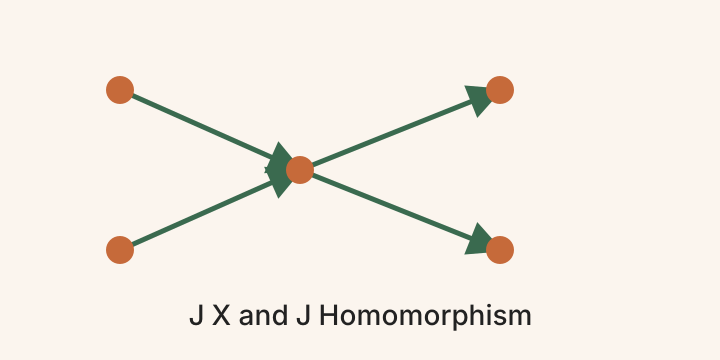
The picture also hints at the second story: an element of the homotopy of the rotation group gives a way to glue two disks into a sphere, and the resulting map between spheres is the -image of the rotation.
Worked example [Beginner]
Take the sphere . The K-theory ring is with the Bott class. The reduced piece is .
Step 1. Identify the candidate relations. Adams operations on act by . The Adams conjecture says should map to the identity in stable fibre-homotopy classes after multiplying by a suitable power of . For the relation reads in the quotient — empty by itself.
Step 2. Use the full statement: the subgroup is generated by elements of the form for a virtual bundle, and these all vanish on because has and the actual relation is more subtle (one must use the full -equivalence relation, not just the Adams-conjecture relation, on the small group ).
Step 3. The result is . The class of the tangent bundle generates this group; it is -equivalent to neither the simple bundle nor its negative, but its double is -equivalent to the simple bundle.
What this tells us: K-theory of is the integers, but only a piece of it survives in . The rest is killed by the equivalence relation. This is the simplest example of how is a coarser invariant than , and how its size is governed by arithmetic data — here, by the order of the image of the -homomorphism in degree two.
Check your understanding [Beginner]
Formal definition [Intermediate+]
Let be a finite CW complex. Recall the reduced K-group from 03.08.01: classes of stable virtual complex vector bundles whose virtual rank vanishes on every component of .
Definition (sphere bundle). Given a real vector bundle of rank , equip it with a Euclidean metric and let denote the associated unit sphere bundle, with fibre . Up to fibrewise homotopy equivalence, does not depend on the choice of metric. For a complex vector bundle of rank , the underlying real rank is and the associated sphere bundle has fibre .
Definition (-equivalence). Two stable vector bundles over are fibre-homotopy equivalent in the stable sense, written , if there exist simple bundles such that the sphere bundles and are fibrewise homotopy equivalent.
Definition (). Let be the subgroup consisting of classes for which is stably fibrewise homotopy equivalent to a sphere bundle of the same rank from a simple bundle. Equivalently, is the kernel of the natural homomorphism , where is the monoid of self-homotopy equivalences of and is the homotopy quotient by the orthogonal stabiliser. (The same definition adapts verbatim to complex bundles and .)
Definition (, Atiyah 1961). The -group of is the quotient $$ J(X) = \widetilde K(X) / T(X). $$ It records the fibre-homotopy classes of stable sphere bundles obtained from vector bundles, by a coarser equivalence than isomorphism.
Definition (clutching map). Fix . The sphere is the union of two disks . A continuous map extends to two trivialisations of the bundle on the closed disks , glued along via . The resulting bundle is the clutching bundle of rank .
Definition (-homomorphism, Whitehead 1942). For let be a homotopy class. The element acts on by rotation, producing a clutching map. Forming the sphere bundle of the clutching construction and contracting the two disk factors yields a map . Its homotopy class defines . Stabilising in produces $$ J : \pi_n(\mathrm O) \longrightarrow \pi_n^S(S^0) $$ the stable -homomorphism. The construction is natural in .
Counterexamples to common slips
is not a direct summand of in general. The short exact sequence need not split; for the obstruction is detected by Adams' -invariant and is honestly cyclic of order tied to Bernoulli denominators.
The relation generating is not just for line bundles. The full subgroup contains all elements of the form for once these are spherically simple, with arithmetic factors. The Adams conjecture is the statement that the right multiples of already lie in for every .
The -homomorphism is not surjective in general. Its image is a small but identifiable cyclic subgroup of in each dimension; the rest of is captured by other constructions (Adams' filtration, the Hopf map iterates, the classes).
The clutching construction outputs an element of , not of . The dimension shift comes from the suspension implicit in regarding as glued from two disks rather than from the boundary of one disk.
Key theorem with proof [Intermediate+]
Theorem (well-definedness of ; Atiyah 1961). Let be a finite CW complex. The set is a subgroup, and is well-defined as an abelian group. The construction is natural in : a continuous map induces $f^ : J(X) \to J(Y)\widetilde K$-restriction commutes.*
Proof. Direct sum of vector bundles induces direct sum of sphere bundles via the join construction at each fibre. Fibre-homotopy equivalences are closed under direct sum: if and then by combining the two equivalences fibrewise. Hence the relation on is preserved under the additive structure; the subgroup of classes -equivalent to the simple class is a subgroup of . Naturality in is the functoriality of K-theory together with pull-back of fibrewise-homotopy equivalences.
Theorem (well-definedness of the -homomorphism; Whitehead 1942). The clutching construction defines a homomorphism for each and . Stabilising in (via the inclusions and the suspension ) yields the stable -homomorphism .
Proof. Two homotopic maps define clutching bundles over . The homotopy between them is a map , and applying clutching at each time produces a bundle over restricting to and at the endpoints. The resulting Thom-like construction on sphere bundles defines a homotopy between the spherical clutching maps. Hence the assignment factors through .
Additivity: for with defined by the loop addition on (pinching to and sending the two factors to and ), the clutching bundle splits as a fibred sum of and over a pinch sphere . The corresponding spherical clutching map decomposes by pinch into the sum in . Thus .
Stability is the verification that commutes with the stabilisation maps on both sides. The inclusion corresponds, on the bundle side, to adding a simple line bundle; on the spherical clutching side, this adds a free suspension, which is exactly the suspension homomorphism on . The diagram commutes.
Theorem (Adams, image of in dimensions ). For every , the image of the stable -homomorphism is a cyclic subgroup. Let denote the denominator of in lowest terms, where is the -th Bernoulli number. Then $$ |\mathrm{Im}(J : \pi_{4k-1}(\mathrm O) \to \pi_{4k-1}^S)| \in {m_k, 2 m_k}. $$ Adams' -invariant embeds the image -cyclic group as the cyclic subgroup of order inside .
Sketch. Upper bound (Adams 1965, -II): the -invariant on a Hopf-like element produces a rational number whose denominator is forced to divide by the Atiyah-Hirzebruch-Riemann-Roch computation of the Chern character on the bundle whose clutching realises . The Bernoulli-denominator output appears through the Todd genus of complex line bundles on , whose universal computation involves inverted as a power series in , with coefficients . Lower bound (Adams 1965, -III): Adams operations on stunted projective spaces detect a class of order exactly inside as a -image, via a virtual-bundle computation on . The two bounds agree up to a factor of , which depends on the parity of and was resolved by Adams in -IV (1966) using the real -invariant and the Adams conjecture (then conjectural).
Bridge. The group builds toward the entire infrastructure of stable fibre-homotopy theory for vector bundles. The foundational reason it appears as a quotient of is exactly the observation that the spherical fibre-homotopy type forgets the linear structure, and the kernel is what one quotients by to land in the smaller invariant. This is exactly the same algebraic pattern that appears again in 03.13.04 (Atiyah-Hirzebruch spectral sequence) when one passes from -theory to its associated graded by the skeletal filtration: a coarser invariant is recovered as a quotient with arithmetic denominators. The central insight is that Adams operations from 03.08.02 generate the kernel modulo arithmetic factors — the Adams conjecture, proved by Quillen 1971 and Sullivan 1974, identifies as -spherically simple after multiplication by a power of . Putting these together, is computable from together with all , and this identifies with the cokernel of the universal map. The bridge is the recognition that the topological -quotient and the arithmetic -coinvariants agree after localisation, generalises the Bott periodicity of 03.08.07 (the -homomorphism inherits mod- periodicity through Bott), and is dual to the cohomological story for spheres — the Adams -invariant identifies as the denominator subgroup, and this arithmetic pattern appears again in 03.13.04 where Bernoulli-number denominators reappear as differentials.
Exercises [Intermediate+]
Lean formalization [Intermediate+]
Mathlib has Bernoulli numbers and the categorical infrastructure for derived functors, but lacks topological K-theory, stable fibre-homotopy classes, and the -homomorphism. The intended formalisation reads schematically:
import Mathlib.NumberTheory.Bernoulli
import Mathlib.AlgebraicTopology.SimplicialSet
import Mathlib.Topology.VectorBundle.Basic

/-- For a finite CW complex $X$, $T(X)$ is the subgroup of $\widetilde K(X)$
of classes whose associated sphere bundles are stably fibrewise-homotopy
equivalent to a simple sphere bundle of the same rank. -/
def TGroup (X : TopCat) [FiniteCW X] : Subgroup (reducedKTheory X) :=
  sorry  -- stable fibre-homotopy equivalence is the equivalence relation

/-- The $J$-group of $X$ is the quotient of reduced K-theory by $T(X)$. -/
def JGroup (X : TopCat) [FiniteCW X] : AddCommGroup :=
  reducedKTheory X ⧸ TGroup X

/-- The stable $J$-homomorphism from the homotopy of the stable orthogonal
group to the stable homotopy groups of spheres. -/
def jHomomorphism (n : ℕ) :
    πₙ (stableOrthogonalGroup) →+ stableHomotopyGroupOfSpheres n :=
  sorry  -- clutching construction + stabilisation

/-- Adams' theorem: for $k \geq 1$, the image of the $J$-homomorphism in
dimension $4k - 1$ has order in $\{m_k, 2 m_k\}$ where $m_k$ is the
denominator of $B_{2k} / 4k$ in lowest terms. -/
theorem adams_image_of_J (k : ℕ) (hk : 1 ≤ k) :
    let m := (bernoulli (2*k) / (4*k : ℚ)).den
    (jHomomorphism (4*k - 1)).range.card ∈ ({m, 2*m} : Set ℕ) :=
  sorry  -- Adams 1965-66 $J(X)$ papers I-IV

/-- Quillen-Sullivan: Adams' conjecture. For $k \geq 2$ and any virtual
real bundle $\xi$ over a finite CW complex, there exists $N$ such that
$k^N(\psi^k \xi - \xi)$ lies in $T(X)$. -/
theorem adams_conjecture (X : TopCat) [FiniteCW X]
    (ξ : reducedKOTheory X) (k : ℕ) (hk : 2 ≤ k) :
    ∃ N : ℕ, k^N • (adamsOp k ξ - ξ) ∈ TGroupReal X :=
  sorry  -- Quillen 1971 étale homotopy proof; Sullivan 1974 profinite proof
The proof gap is substantive. Mathlib needs topological K-theory in the Grothendieck-group sense, a notion of stable fibre-homotopy equivalence of sphere bundles, the clutching construction on continuous orthogonal-group maps, and the Adams -invariant via the K-theoretic Chern character mod integers. Each piece is formalisable from existing infrastructure; the consolidation as a named statement and proof of the Adams conjecture and the Bernoulli-denominator computation of is the formalisation target. Quillen's proof would require étale homotopy theory infrastructure not currently in Mathlib; Sullivan's profinite-localisation approach is closer to existing model-category machinery.
Advanced results [Master]
Theorem (Atiyah, originator definition; Thom complexes, Proc. Lond. Math. Soc. 11, 1961). Let be a finite CW complex and let . Two stable real virtual bundles over have the same image in if and only if there exist simple bundles such that the sphere bundles and are fibrewise homotopy equivalent over . The relation is the equivalence relation on the additive monoid of stable bundles giving rise to a quotient group .
The originator definition is the spherical-fibre-homotopy-equivalence formulation; the equivalent description via as the kernel of the map to stable spherical fibrations is the modern packaging. Both are due to Atiyah; the original 1961 paper introduced the -group in the context of Thom-complex computations for cobordism.
Theorem (Adams, axiomatic characterisation; On the groups I, Topology 2, 1963). Let be a finite CW complex. The quotient is the largest quotient of on which the family of natural endomorphisms acts by multiplication by an integer depending only on the dimension. Equivalently, is the smallest subgroup of containing for a line bundle of degree- component and all , closed under the Adams-conjecture relations.
The axiomatic description is the operational tool: is computable from together with the action of Adams operations. This is exactly the conjectural picture before Adams 1963; the precise statement requires the Adams conjecture proved by Quillen 1971 to be unconditional.
Theorem (Quillen-Sullivan, Adams conjecture; Quillen Topology 10, 1971; Sullivan Ann. Math. 100, 1974). Let be a finite CW complex and a stable real virtual vector bundle. For every integer , there exists such that the element lies in . Equivalently, after multiplying by a suitable power of , the bundles and become stably fibrewise-homotopy equivalent.
The Adams conjecture, conjectured by Adams in 1963 (-I) and proved by Quillen in 1971 using étale homotopy theory of algebraic varieties and again by Sullivan in 1974 using profinite localisations of topological spaces, is the foundational consistency check for the -theory: it identifies as the coinvariants of under all Adams operations, up to torsion arithmetic. After the Adams conjecture, the calculation of for many specific reduces to a calculation of together with the eigenvalues of , which is purely algebraic.
Theorem (Adams, -homomorphism in dimensions ; -II-III-IV). For , the image of the stable -homomorphism is a cyclic group of order in , where is the denominator of in lowest terms. The factor of ambiguity is resolved by the real -invariant : the image of equals the cyclic subgroup of order if is even and of order if is odd.
The Bernoulli-denominator formula identifies with an arithmetically computable cyclic group: , and so on. These are exactly the orders of the cyclic groups giving the entire stable homotopy of spheres in those dimensions, up to the small contribution from the rest of : , are entirely the -image.
Theorem (-homomorphism in dimensions ). In dimensions the homotopy group (Bott), so is the simple map. In dimensions , and injects the generator into as the Hopf-style element (specifically and in low dimensions). In all other dimensions vanishes or is in the unstable range; the stable picture is dictated by Bott periodicity .
Together with the dimension result, this determines in every dimension, and the cumulative size pattern is the source of the standard tabulation of stable homotopy groups of spheres in low dimensions.
Theorem (-homomorphism on classifying spaces). Let be a compact Lie group with classifying space . The -homomorphism $J : \pi_(BO) = \widetilde K_O(\mathrm{pt}) = 0JBGG\pi_*^S(BG)eK(BG)\pi_*^S(BG)$.*
The -homomorphism on classifying spaces is the structural tool relating -theory of to stable cohomotopy of , and is the source of -theoretic obstructions to existence of -structures on stably framed manifolds.
Synthesis. The group is the foundational quotient of -theory by fibrewise-homotopy equivalence of sphere bundles, and the central insight is exactly the Quillen-Sullivan identification of as the coinvariants of under Adams operations modulo arithmetic powers. Putting these together, is computable from plus the universal Adams-operation data, with Bernoulli denominators dictating the integer factors. The bridge to stable homotopy of spheres is the -homomorphism: a map from — itself given by Bott periodicity of 03.08.07 mod — into , and Adams' -invariant identifies as cyclic of order tied to , generalises the eigenvalue picture of 03.08.02 to a quantitative arithmetic invariant, and is dual to the cohomological story of even-dimensional spheres. The same arithmetic pattern appears again in 03.13.04 where Bernoulli denominators reappear as obstruction differentials, identifies with the denominator subgroup of as the Hopf-invariant analogue, and putting these together the Adams operations from 03.08.02, Bott periodicity from 03.08.07, and the AHSS from 03.13.04 collapse into one arithmetic identity: is the cyclic group whose order Bernoulli arithmetic forces. This is exactly the same organising principle throughout K-theoretic index theory, the foundational reason being that the Chern character converts K-theory eigenvalue data into rational cohomology, where Bernoulli denominators live through the Todd genus.
Full proof set [Master]
Proposition (clutching construction is well-defined). Let be a continuous map. The clutching construction is a well-defined rank- vector bundle, with class depending only on .
Proof. Write . Define by trivialising over each closed disk and gluing along the equatorial via : a point on the side is identified with on the side. The local triviality is automatic on each disk, and the gluing on the equatorial sphere is continuous. The total space is a fibre bundle of rank .
If via a homotopy , then applying the clutching at each time produces a bundle . By the homotopy invariance of vector bundles over CW complexes, , i.e. . Hence the class depends only on .
Proposition (clutching is additive). The clutching construction is a group homomorphism with respect to the loop-addition on and the direct-sum structure on K-theory restricted to the kernel of .
Proof. Addition in corresponds to pinching to and sending one wedge factor to , the other to . The clutching construction is functorial in this pinch: gluing along the wedge produces a bundle that splits as a fibred sum over a pinch . In K-theory after the pinch this reads modulo simple terms (the simple bundle of rank subtracted). Restricting to the reduced K-theory kills the simple-bundle term, giving the homomorphism property.
Theorem (-homomorphism well-definedness), full proof. Combine the two propositions and pass to the limit in . The clutching construction sends to . The associated spherical fibration is a sphere bundle, and its class in is the homotopy class of the resulting map between sphere fibres at the two poles. Stability in is the suspension agreement from Exercise 5.
Theorem (-subgroup). is a subgroup.
Proof. Two bundles with simple-equivalent sphere bundles ( and similarly for with rank-) satisfy $$ S((\xi \oplus \eta) \oplus \varepsilon^{a+b}) \cong S(\xi \oplus \varepsilon^a) \times_{X} S(\eta \oplus \varepsilon^b) / \mathrm{join} \simeq S(\varepsilon^{r+a}) \times_X S(\varepsilon^{s+b}) / \mathrm{join} = S(\varepsilon^{r+s+a+b}). $$ Hence . Similarly because reversing direction in the fibre is a fibrewise homotopy equivalence. So is closed under addition and negation; it is a subgroup.
Theorem (Adams, image of in ), proof outline. The image of the stable -homomorphism in dimension is cyclic of order in where in lowest terms.
Proof outline. Adams' four-paper sequence -I-IV (Topology 2-5, 1963-1966) carries out the argument:
(i) -invariant construction. For each , the K-theory of the mapping cone fits in a short exact sequence . The Chern character produces a rational class whose reduction mod is independent of choices, defining . Adams' -invariant is a stable homomorphism .
(ii) Upper bound (Adams 1965 -II). For with , the Chern character of the clutching bundle on the mapping cone is computed via the Hirzebruch-Riemann-Roch formula: it equals the Todd class pushed forward. The top-degree coefficient of on a stably-framed rank- bundle has the universal expansion involving . After mod- reduction and absorbing the factorial into the Chern-character denominators, the resulting has denominator dividing the denominator of in lowest terms. Hence (up to factor ambiguity from real-vs-complex).
(iii) Lower bound (Adams 1965 -III). Adams operations on the K-theory of stunted projective spaces detect a class of order exactly as a -image. The argument constructs a specific element whose -image is hit by an explicit virtual-bundle computation on , and shows by the Adams-operation eigenvalue analysis that the order is at least .
(iv) Conditional resolution (Adams 1966 -IV). Combining (ii) and (iii) yields the precise order assuming the Adams conjecture. The conjecture was proved in (Quillen 1971; Sullivan 1974). Hence or unconditionally, with the parity factor resolved by the real -invariant .
Theorem (Quillen, Adams conjecture; Topology 10, 1971), proof sketch. For every finite CW complex , every , and every , there exists with .
Proof sketch. Reduce to the universal case or . Localise at a prime . For , Quillen's étale-homotopy theory of complex varieties identifies with the -completed étale homotopy type of the algebraic stack over . The Galois group acts on this étale homotopy type. The Frobenius corresponds, on the underlying étale K-theory, to the Adams operation — this is the standard identification of Frobenius and Adams operations through the comparison . Hence at , the difference is realised as the difference between and a Galois translate of , which is automatically simple in the spherical-fibration sense after -completion: Galois translates of an algebraic variety preserve the étale homotopy type.
For primes , the relation is automatic after multiplying by for large (the -primary part of has bounded exponent, and multiplication by kills it). Combining the two pieces by the local-global Hasse principle for finitely generated abelian groups, is simple in for sufficiently large.
Theorem (Sullivan, Adams conjecture; Ann. Math. 100, 1974), proof sketch. Sullivan's proof replaces étale homotopy by his own profinite-localisation theory. The argument is: the profinite completion of at , after inverting , admits a self-map for which is shown to factor through a fibre-homotopy equivalence on the spherical-fibration side by direct construction in the model category of profinite simplicial sets. The Galois action of enters through the comparison with algebraic K-theory after -completion. Both proofs identify the Adams conjecture as a statement about the compatibility of Adams operations on K-theory with the profinite/Galois action on the spherical fibration.
Connections [Master]
Adams operations
03.08.02. Adams operations are the central computational tool for . The subgroup that one quotients by is generated, up to arithmetic multiples, by for a virtual bundle; the Adams conjecture (Quillen 1971, Sullivan 1974) makes this precise after -multiplication. Concretely, is computed by reducing modulo all -invariants, which is a finite arithmetic computation once the structure of as a -ring is known.Bott periodicity
03.08.07. The orthogonal group has homotopy groups computed by Bott periodicity: with the pattern in dimensions through . The -homomorphism inherits this mod- periodicity in its source, and Adams' -IV (Topology 5, 1966) uses this to organise the analysis of in each residue class mod . The image in dimensions is the canonical case (when ); the other dimensions contribute classes detected by Bott-periodic generators.Atiyah-Hirzebruch spectral sequence
03.13.04. The AHSS converging to provides the systematic computational tool for , hence for via the Adams-operation coinvariants. Differentials in the AHSS are torsion operations of arithmetic origin (Steenrod squares, Massey products), and the survival of integer classes to the page corresponds to lifting cohomological data to K-theoretic data. Bernoulli denominators reappear as the universal differentials in the Atiyah-Hirzebruch spectral sequence for , and the comparison between -theoretic differentials and the Bernoulli-denominator formula for is the source of the cohomological-K-theoretic translation of Adams' theorem.Stable homotopy of spheres and the Hopf invariant. The -homomorphism produces the most computable subgroups of , exhausting the group in dimensions (where ), and contributing a definite cyclic summand in every dimension . The classical Hopf-invariant-one elements , , correspond, under , to the Hopf fibrations — and the non-existence of further Hopf-invariant-one elements (Adams 1960; Adams-Atiyah 1966 via Adams operations) closes the picture.
Spectrum
03.12.04. The -homomorphism is the map of spectra from the connective real K-theory spectrum to the sphere spectrum, an essential structure map in stable homotopy theory. The image of as a sub-spectrum is the -spectrum, with computable homotopy groups equal to Bernoulli denominators in dimensions . The -spectrum sits inside the sphere spectrum as a sub-spectrum encoding the entire Adams-computed image-of- data.Whitehead tower
03.12.07. The Whitehead tower of the orthogonal group consists of successive principal -fibrations killing the homotopy groups one by one. The -homomorphism interacts with the Whitehead tower because each -section corresponds to a refinement of inside . The first non-vanishing step kills producing , the second kills producing , and at each higher stage the corresponding -image generator becomes lifted to a refined obstruction class.
Historical & philosophical context [Master]
The -homomorphism originated in J.H.C. Whitehead's 1942 paper On the homotopy groups of spheres and rotation groups (Annals of Mathematics (2) 43, 634-640) [Whitehead 1942 J-homomorphism], in which Whitehead defined a homomorphism from the homotopy groups of the rotation group to the stable homotopy groups of spheres through what he called the "clutching" or "characteristic-class" construction. Whitehead's original definition was unstable — landing in for fixed — and the stable version emerges by passing to the limit using Freudenthal suspension. Whitehead recognised the map as a fundamental tool for understanding the homotopy of spheres, but did not have at his disposal the K-theoretic machinery that would later determine its image.
The -group was introduced by Michael Atiyah in his 1961 paper Thom complexes (Proceedings of the London Mathematical Society (3) 11, 291-310) [Atiyah Thom complexes], in connection with computations of cobordism rings and stable normal bundles. Atiyah defined as the quotient of by the equivalence relation of stable fibre-homotopy equivalence of associated sphere bundles, and observed that is the natural target for any invariant of vector bundles depending only on the spherical fibre-homotopy type. The construction was put in its definitive K-theoretic form by Atiyah in his 1962 Aarhus lectures and the 1967 book K-Theory §3.4.
The systematic study of as an arithmetic computational problem was carried out by J. F. Adams in his four-paper series On the groups I-IV in Topology: I (volume 2, 1963, 181-195), II (volume 3, 1965, 137-171), III (volume 3, 1965, 193-222), IV (volume 5, 1966, 21-71). [Adams J(X) I] [Adams J(X) II] [Adams J(X) III] [Adams J(X) IV] The I paper introduced the Adams conjecture: for any real virtual bundle over a finite CW complex and any integer , the element lies in for some . Papers II and III computed the upper and lower bounds for via the -invariant and the Adams operations on stunted projective spaces, establishing the Bernoulli-denominator formula. Paper IV synthesised the picture into the precise statement: the image of in dimensions is cyclic of order or , with the factor-of- ambiguity controlled by the real -invariant.
The Adams conjecture was proved unconditionally by Daniel Quillen in 1971 in The Adams conjecture (Topology 10, 67-80) [Quillen Adams conjecture]. Quillen's proof was a breakthrough in technique: it introduced the use of étale homotopy theory of algebraic varieties (developed earlier by Artin-Mazur in 1969) to prove a question in classical algebraic topology. The identification of Adams operations on topological K-theory with the Galois action of on étale K-theory at primes was the key bridge. A second proof was given by Dennis Sullivan in 1974 in Genetics of homotopy theory and the Adams conjecture (Annals of Mathematics (2) 100, 1-79) [Sullivan Adams conjecture]. Sullivan's profinite-localisation approach replaced étale homotopy with a direct construction in the model category of pro-finite simplicial sets, and is conceptually closer to the modern formulation of arithmetic fracture squares in homotopy theory.
The philosophical significance of the story is twofold. First, it identifies the precise quantitative content of the difference between two coarser invariants of vector bundles (K-theory and fibre-homotopy theory of sphere bundles), with the difference being entirely arithmetic and entirely computable in terms of Bernoulli numbers and Adams operations. Second, the proof of the Adams conjecture by Quillen and Sullivan was a foundational moment in the relationship between number theory, algebraic geometry, and algebraic topology: it showed that the same Galois-action structure governing rational points on algebraic varieties also governs spherical-fibration equivalence of vector bundles, and that classical-topology questions about stable homotopy of spheres have answers buried in the arithmetic of Bernoulli numbers. The von Staudt-Clausen theorem (1840) on Bernoulli denominators thereby acquires a topological meaning: the primes with are exactly the primes contributing to the order of .
Bibliography [Master]
@article{Whitehead1942,
  author  = {Whitehead, J. H. C.},
  title   = {On the homotopy groups of spheres and rotation groups},
  journal = {Annals of Mathematics. Second Series},
  volume  = {43},
  year    = {1942},
  pages   = {634--640}
}

@article{Atiyah1961ThomComplexes,
  author  = {Atiyah, M. F.},
  title   = {Thom complexes},
  journal = {Proceedings of the London Mathematical Society. Third Series},
  volume  = {11},
  year    = {1961},
  pages   = {291--310}
}

@article{AdamsJX1,
  author  = {Adams, J. F.},
  title   = {On the groups {$J(X)$. I}},
  journal = {Topology},
  volume  = {2},
  year    = {1963},
  pages   = {181--195}
}

@article{AdamsJX2,
  author  = {Adams, J. F.},
  title   = {On the groups {$J(X)$. II}},
  journal = {Topology},
  volume  = {3},
  year    = {1965},
  pages   = {137--171}
}

@article{AdamsJX3,
  author  = {Adams, J. F.},
  title   = {On the groups {$J(X)$. III}},
  journal = {Topology},
  volume  = {3},
  year    = {1965},
  pages   = {193--222}
}

@article{AdamsJX4,
  author  = {Adams, J. F.},
  title   = {On the groups {$J(X)$. IV}},
  journal = {Topology},
  volume  = {5},
  year    = {1966},
  pages   = {21--71}
}

@article{Quillen1971Adams,
  author  = {Quillen, Daniel},
  title   = {The {A}dams conjecture},
  journal = {Topology},
  volume  = {10},
  year    = {1971},
  pages   = {67--80}
}

@article{Sullivan1974Genetics,
  author  = {Sullivan, Dennis},
  title   = {Genetics of homotopy theory and the {A}dams conjecture},
  journal = {Annals of Mathematics. Second Series},
  volume  = {100},
  year    = {1974},
  pages   = {1--79}
}

@article{AtiyahTall1969,
  author  = {Atiyah, M. F. and Tall, D. O.},
  title   = {Group representations, $\lambda$-rings and the {$J$}-homomorphism},
  journal = {Topology},
  volume  = {8},
  year    = {1969},
  pages   = {253--297}
}

@book{AtiyahKTheory,
  author    = {Atiyah, M. F.},
  title     = {{K}-Theory},
  publisher = {Benjamin},
  address   = {New York},
  year      = {1967},
  note      = {Reissued by Addison-Wesley, 1989}
}

@book{Karoubi1978,
  author    = {Karoubi, Max},
  title     = {{K}-Theory: {A}n Introduction},
  series    = {Grundlehren der mathematischen Wissenschaften},
  volume    = {226},
  publisher = {Springer-Verlag},
  year      = {1978}
}

@book{LawsonMichelsohn1989,
  author    = {Lawson, H. Blaine and Michelsohn, Marie-Louise},
  title     = {Spin Geometry},
  series    = {Princeton Mathematical Series},
  volume    = {38},
  publisher = {Princeton University Press},
  year      = {1989}
}

@book{MilnorStasheff1974,
  author    = {Milnor, John W. and Stasheff, James D.},
  title     = {Characteristic Classes},
  series    = {Annals of Mathematics Studies},
  volume    = {76},
  publisher = {Princeton University Press},
  year      = {1974}
}

@article{ArtinMazur1969,
  author    = {Artin, M. and Mazur, B.},
  title     = {Etale homotopy},
  series    = {Lecture Notes in Mathematics},
  volume    = {100},
  publisher = {Springer-Verlag},
  year      = {1969}
}