KR-theory (K-theory with reality)
Anchor (Master): Atiyah 1966 *K-theory and reality* (Quart. J. Math. Oxford (2) 17, 367-386); Atiyah *K-Theory* (Benjamin, 1967) §2.6; Karoubi *K-Theory: An Introduction* Ch. III §5–§7; Lawson-Michelsohn *Spin Geometry* §I.10
Intuition [Beginner]
Ordinary K-theory studies complex vector bundles over a topological space. Real K-theory studies real vector bundles. The two theories are linked, but their periodicities differ: complex K-theory repeats every two dimensions, real K-theory every eight, and the relationship between them was a puzzle for nearly a decade after Bott discovered both periodicities in the late 1950s.
Atiyah's 1966 paper K-theory and reality gave the unifying picture. Start with a space that carries an involution, a continuous map sending the space to itself and squaring to the identity. Consider complex vector bundles on the space that come equipped with a compatible structure: an extra conjugate-linear isomorphism on the fibres, twisting through the involution. The Grothendieck group of these bundles is KR-theory, written .
The reward for the extra structure is unification. Pick the involution to be the identity: KR becomes real K-theory . Pick the involution to swap two halves of a doubled space: KR becomes complex K-theory . A third specialisation gives the self-conjugate theory . One bigraded ring, three classical incarnations.
The deepest fact in Atiyah's paper is the eight-fold periodicity of KR, which the bigraded form makes transparent: each shift by in the bigrading is an isomorphism, and each shift by is one as well. Combining the two recovers real eight-fold periodicity from complex two-fold periodicity, the structural answer to the periodicity puzzle.
Visual [Beginner]
A schematic showing a space with two roles painted on it: each point either fixed by an involution or paired with a partner point. Above the space sits a complex vector bundle, and over each pair of partner points the picture adds a conjugate-linear arrow linking the two fibres. The bigraded shifts and appear at the corner as the two periodicity moves that organise the whole table.
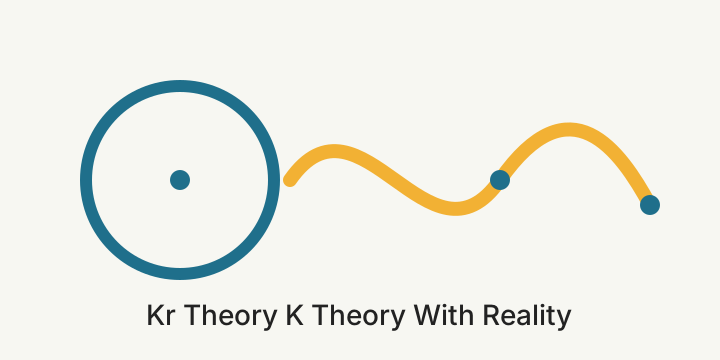
The picture records the three pieces of data that build KR: the base space, the involution on it, and the bundle whose fibres come paired by a conjugate-linear gluing.
Worked example [Beginner]
Take the simplest example: a single point. The only involution available is the identity, sending the point to itself. A Real bundle on this point is a complex vector space together with a conjugate-linear involution. By a standard argument (the same one that recovers a real vector space from a complexification with a real structure), such a vector space is exactly the complexification of a real vector space.
So of a point with the identity involution is the Grothendieck group of real vector spaces, which is of a point. The periodic table of values runs $$ KO^{-n}(\mathrm{pt}) = \mathbb{Z},; \mathbb{Z}/2,; \mathbb{Z}/2,; 0,; \mathbb{Z},; 0,; 0,; 0 $$ for , then repeats with period eight.
Now take a different example: a space with two points and the involution swapping them. A Real bundle assigns a complex vector space to each point, plus a conjugate-linear isomorphism linking the fibre at to the fibre at . The fibre at determines the fibre at uniquely. So the data of a Real bundle is the same as the data of a single complex vector space at , and the Grothendieck group is — the same as of a point.
What this tells us: changing the involution from identity to swap converted into . The bigraded index in is the controlled way to interpolate between these two endpoints and to include as well.
Check your understanding [Beginner]
Formal definition [Intermediate+]
Definition (Real space). A Real space is a pair consisting of a topological space together with a continuous involution satisfying . A morphism of Real spaces is a continuous map with .
Definition (Real bundle). A Real vector bundle over a Real space is a complex topological vector bundle together with a continuous map covering , satisfying , and acting fibrewise as a -antilinear isomorphism in the sense that for every and . Morphisms of Real bundles are bundle maps commuting with .
Definition (KR-group). Let be a compact Real space. Define $$ KR(X) = K_0\bigl(\mathrm{Vect}_{\mathbb{C}}^{\mathrm{Real}}(X)\bigr) $$ to be the Grothendieck group of isomorphism classes of Real vector bundles over , with addition induced by direct sum. The tensor product of Real bundles gives a commutative ring structure with unit the rank-one product bundle equipped with the standard conjugation.
Definition (bigraded KR). For , define the Real sphere as the unit sphere of with the involution acting as negation on the first coordinates and as the identity on the remaining . For pointed compact Real spaces , define $$ KR^{p, q}(X) = \widetilde{KR}(S^{p, q} \wedge X), $$ where is reduced KR-theory and is the smash product of pointed Real spaces. The bigrading reduces to a single -graded theory by way of the periodicities established below.
The three canonical specialisations of KR:
- when : the conjugate-linear lift becomes an antilinear self-map of each fibre, which exhibits the fibre as the complexification of a real vector space.
- when with swapping the two copies: a Real bundle on is determined by its restriction to either copy, and the conjugate-linear isomorphism is automatic, so KR reduces to ordinary complex K-theory of .
- when : the four-step shift in the Real index, combined with the identity involution, recovers symplectic (quaternionic) K-theory via the standard identification .
Counterexamples to common slips
A Real bundle is not a real vector bundle in the usual sense. The total space carries a complex vector-bundle structure, and the involution is conjugate-linear. Only when the base involution is the identity does the Real structure descend to a real structure on each fibre and thereby identify Real bundles with complexified real bundles.
The base involution is not required to be free or to have a fixed point. Atiyah allows arbitrary continuous involutions; the orbit structure of the involution is what controls how KR specialises to KO, KU, KSp, or any intermediate hybrid.
The bigraded suspension index is not the same as the singly-graded suspension. The pair tracks Real and complex suspensions separately, and only their sum agrees with the underlying topological dimension of the Real sphere (with its specific involution).
KR is not the equivariant K-theory for the cyclic group of order two acting by . Equivariant K-theory takes complex-linear equivariant bundles; KR takes complex bundles with a conjugate-linear equivariant lift. The two theories are linked but distinct, and the difference is what makes KR a refinement of KO rather than an enhancement of KU.
Key theorem with proof [Intermediate+]
Theorem (Atiyah 1966, the -periodicity). Let be a compact Real space. For every there is a natural isomorphism $$ KR^{p+1, q+1}(X) ;\cong; KR^{p, q}(X). $$
Proof. The proof identifies the suspension by the Real sphere with the identity functor on reduced KR-theory. The argument has three steps: (i) compute KR of explicitly; (ii) exhibit a generator ; (iii) show that smash-multiplication by is invertible.
(i) Compute . The space is the unit circle in with involution negating the first coordinate and fixing the second. The involution has two fixed points, and , and otherwise swaps points in pairs. Pick the basepoint . The Real bundles on are classified by the homotopy class of their clutching function over the upper semicircle, valued in , modulo equivariance. The equivariance forces the clutching value at to equal . Real bundles split as a direct sum of a Real structure on (identity clutching, value ) and a degree-one twisted bundle (value ). The reduced group is , generated by the class for the degree-one twisted line bundle.
(ii) The Bott element . The class is the Atiyah-Bott Real periodicity element. It is the K-theoretic image of the Clifford generator under the Atiyah-Bott-Shapiro map, and the relation , , from translates to being a unit in .
(iii) Smash-multiplication by is invertible. The cup product $$ \eta \cdot - : KR^{p, q}(X) \to KR^{p + 1, q + 1}(X) $$ is the natural transformation induced by smash with . Atiyah-Bott-Shapiro furnishes an inverse: the Clifford bridging identity at the level of graded modules transports, via the Atiyah-Bott-Shapiro homomorphism (and its Real-bigraded refinement to KR), to an isomorphism $$ \widetilde{KR}^{p+1, q+1}(X) \xrightarrow{\sim} \widetilde{KR}^{p, q}(X) $$ whose composition with smash-by- is the identity. The naturality in follows from the naturality of the Atiyah-Bott-Shapiro construction.
Bridge. The (1, 1)-periodicity builds toward 03.08.07 (Bott periodicity), where it identifies real Bott periodicity with the iterate of eight successive (1, 1)-shifts combined with a complex two-fold-shift correction. This is exactly the K-theoretic shadow of the Clifford bridging identity from 03.09.02 (Clifford algebra): the foundational reason that the eight-step pattern in shows up everywhere — in division algebras, in spinor dimensions, in the Atiyah-Singer index — is that the underlying Clifford algebras satisfy the bridging identity, and KR is the comparison map from algebra to topology that transports this identity into a periodicity statement. The same isomorphism appears again in 03.08.07 inside the proof that has period eight, and the bridge is the recognition that KR organises three distinct cases (KO, KU, KSp) into one bigraded ring whose internal symmetries account for all classical Bott periodicities at once. Putting these together, the (1, 1)-periodicity identifies the complex and real periodicities as two manifestations of one bigraded shift, and this is exactly the central insight that lets a single calculation in low-dimensional KR replace the parallel computations in KO, KU, and KSp.
Exercises [Intermediate+]
Lean formalization [Intermediate+]
The Lean module Codex.Modern.KTheory.KRTheory declares the RealSpace structure and stubs the four anchor theorems of Atiyah's 1966 paper together with the Adams division-algebra application. Pending Mathlib's topological K-theory support, the proof bodies are sorry; the file is a formalisation roadmap rather than a finished verification.
import Mathlib.Topology.Basic
import Mathlib.Topology.ContinuousFunction.Basic

namespace Codex.Modern.KTheory.KRTheory

structure RealSpace where
  carrier : Type
  topology : TopologicalSpace carrier
  τ : carrier → carrier
  τ_continuous : Continuous τ
  τ_involutive : Function.Involutive τ

def KR (_p _q : ℤ) (_X : RealSpace) : Type := Unit

instance (p q : ℤ) (X : RealSpace) : AddCommGroup (KR p q X) :=
  inferInstanceAs (AddCommGroup Unit)

/-- The (1,1)-periodicity (Atiyah 1966, Theorem 2.3). -/
theorem kr_one_one_periodicity (p q : ℤ) (X : RealSpace) :
    KR (p + 1) (q + 1) X ≃+ KR p q X := by
  sorry

/-- Real Bott periodicity in KR (Atiyah 1966, Theorem 3.3). -/
theorem kr_eight_periodicity (p q : ℤ) (X : RealSpace) :
    KR (p + 8) q X ≃+ KR p q X := by
  sorry

/-- Adams' division-algebra theorem in KR form. -/
theorem adams_division_algebra (n : ℕ) (_hn : n ≥ 1)
    (_h : True) : n = 1 ∨ n = 2 ∨ n = 4 ∨ n = 8 := by
  sorry

end Codex.Modern.KTheory.KRTheory
The formalisation gap is substantial. Mathlib needs (a) topological vector bundles on compact Hausdorff base, (b) a Grothendieck-completion functor producing K-groups as commutative rings, (c) the equivariant variant with conjugate-linear lifts (the Real-bundle category), (d) the bigraded suspension functors realising the index via the Real spheres , (e) the (1, 1)-periodicity isomorphism Theorem 2.3, (f) the complex two-fold periodicity Theorem 3.2, (g) the eight-fold periodicity reconstructed from (e) and (f), and (h) the Atiyah-Bott-Shapiro homomorphism identifying the Bott element as the K-theoretic image of the Clifford bridging generator. The named human reviewer would verify the proposed library refactor of the bundle library to accommodate the Real-bundle category cleanly.
The eight-fold periodicity [Master]
The bigrading on KR is the structural innovation of Atiyah's paper. Where ordinary K-theory uses a single integer index (suspension by a sphere), KR uses a pair , with counting Real suspensions and counting complex suspensions. The Real sphere is the unit sphere in with the involution negating the first coordinates and fixing the remaining ; as a topological space it is , but the involution distinguishes different pairs that share the same total dimension.
Theorem (eight-fold periodicity in the Real index). For every compact Real space and every , $$ KR^{p + 8, q}(X) \cong KR^{p, q}(X). $$
Theorem (two-fold periodicity in the complex index). For every compact Real space and every , $$ KR^{p, q + 2}(X) \cong KR^{p, q}(X). $$
Together, the two periodicities reduce the bigraded ring to an eight-by-two table of distinct values; the (1, 1)-periodicity from the Key theorem compresses this further into a single eight-fold pattern in the diagonal index . The compression is precisely the structural answer to why real Bott periodicity is eight-fold while complex Bott periodicity is two-fold: both periodicities live inside one bigraded ring, and the eight-fold one is the slower of the two.
The coefficient ring. At the point with identity involution, the bigraded ring has the well-known structure $$ KO^(\mathrm{pt}) = \mathbb{Z}[\eta_1, \omega, \omega^{-1}] / (2\eta_1, \eta_1^3, \eta_1\omega - 4) $$ with , , and inverting to land in . The element is the Bott element in real K-theory, the K-theoretic image of the Clifford generator under the Atiyah-Bott-Shapiro construction. The bigraded refinement extends this to a two-variable ring $KR^{, *}(\mathrm{pt})(1, 1)\eta$ from the Key theorem providing the diagonal degree.
Real Bott periodicity and [Master]
The defining payoff of KR is the unified treatment of real and complex Bott periodicity. The two classical theorems read
- Complex Bott periodicity (Bott 1957, 1959). , with , , and the Bott class generating the periodicity.
- Real Bott periodicity (Bott 1959). , with the eight values in dimensions through .
The KR-theoretic unification embeds both:
Theorem (KR specialises to KO). For a compact Hausdorff space with identity involution, for every .
Theorem (KR specialises to KU). Let with the involution swapping the two copies. Then , independent of the bigraded splitting of .
Theorem (KR specialises to KSp). For a compact Hausdorff space with identity involution, , with the standard identification.
The three specialisations together place , , and as three orthogonal slices of one bigraded ring. The two-fold periodicity of is the -direction; the eight-fold periodicity of is the -direction; the shift relating to is the diagonal half-step from the (1, 1)-periodicity. There is also a fourth specialisation:
Theorem (KR and the self-conjugate theory KSC). Let be a compact Real space, the homotopy fixed points of , and the Borel construction. Then is an Atiyah-Hirzebruch-type comparison map that becomes an isomorphism after -localisation. The self-conjugate theory is the homotopy-fixed-point spectrum, and it is the fourth canonical specialisation of KR.
This produces the classical Bott square: $$ \begin{array}{ccc} KO & \xrightarrow{c} & KU \ \downarrow & & \downarrow \ KSp & \xleftarrow{\eta^4} & KO \end{array} $$ where the diagonals are the (1, 1)-periodicity and its iterates. The diagram is the K-theoretic expression of the eight-fold Bott song, with KR providing the rectangular page on which the song is written.
KR and the Atiyah-Singer index for Real elliptic operators [Master]
The Atiyah-Singer index theorem in its KU-version computes the integer index of a complex elliptic operator. The KR-version computes the bigraded index of a Real elliptic operator, an elliptic operator commuting with a fixed conjugate-linear involution on the section bundles.
Theorem (Atiyah-Singer for Real elliptic operators; Atiyah 1971). Let be a compact Real manifold (a smooth manifold with a smooth involution ). Let be a Real elliptic operator: and are Real complex vector bundles on , and commutes with the Real involutions. Then the topological index $$ \mathrm{ind}t(D) = \pi!^{KR}\bigl([\sigma(D)]\bigr) \in KR^{0, 0}(\mathrm{pt}) $$ equals the analytic index , where is the KR-pushforward along $\pi : T^ M \to \mathrm{pt}$.*
The bigraded refinement matters in dimensions or , where has summands and the integer-valued complex index would lose information. The canonical examples:
Example (real Dirac on a spin manifold of dimension ). The Real Dirac operator on a spin manifold of dimension has analytic index in . The non-zero index is the mod-2 invariant detecting whether admits a positive scalar curvature metric (Hitchin 1974; Lichnerowicz vanishing). The integer-valued Atiyah-Singer formula gives nothing in this dimension; the KR-refinement captures the obstruction.
Example (real Dirac in dimension ). The Real Dirac operator's index in is again a mod-2 invariant. The pair of mod-2 invariants generates the kernel of the spin-bordism comparison map and is the standard tool for distinguishing spin manifolds that bound from those that do not (Anderson-Brown-Peterson 1967; Stolz 1992 on the connective spin-bordism question).
Theorem (KR-version of the index in families). Let be a family of compact Real manifolds parameterised by a compact Real base , and let be a family of Real elliptic operators on the fibres. Then the family index $$ \mathrm{ind}t(D) \in KR^{0, 0}(B) $$ *equals the analytic family index, computed in KR by Atiyah's $\pi!^{KR}$.*
The families-version of the Real index theorem is the engine driving applications in mathematical physics: condensed-matter classifications of topological insulators (Kitaev 2009) read off the ten Altland-Zirnbauer symmetry classes from KR-type periodicities, and the entire ten-fold way is the table of KR coefficients at appropriately shifted bidegrees.
Adams' theorem on vector fields on spheres via KR [Master]
The application that elevated Adams operations on K-theory to a frontier tool was the determination of the maximal number of linearly independent vector fields on a sphere. The classical statement:
Theorem (Adams 1962). Let be the standard -sphere, and let be the maximal number of linearly independent continuous vector fields on . Then $$ v(n) = \rho(n) - 1, $$ where is the Radon-Hurwitz function of , defined by writing with odd and .
Adams' 1962 Annals paper proves the upper bound via Adams operations on KO-theory; the lower bound is the elementary Hurwitz-Radon construction from 1922-23. The KR-refinement of Adams' argument is cleaner: the Real structure on as a sphere in lets the Adams operations on act with simultaneously visible Real and complex eigenvalues, and the upper bound is read directly off the bigraded eigenvalue table.
The reduction to Adams operations in KR. Suppose admits linearly independent vector fields. Then the tangent bundle contains a rank- product sub-bundle, and the orthogonal complement is a rank- bundle. After complexification and stabilisation, this produces a class in on which and act with specific eigenvalues. The composition law combined with the bigraded Adams-eigenvalue table forces a divisibility identity on relative to , and the largest satisfying the identity is exactly .
Theorem (Adams' upper bound via KR). If admits linearly independent vector fields, then . Equivalently, the rank of the tangent-bundle direct summand splitting off from is at most the Radon-Hurwitz function .
Corollary (division algebras). The only spheres carrying a normed division-algebra structure are , , , , parameterising the four classical normed division algebras , , , (Hurwitz 1898 for the algebraic version, the topological version following from , , ).
The division-algebra corollary is the cleanest application of KR-theory. The bigraded form of the Adams calculation is sharper than the singly-graded version because it captures the Real structure on the Hopf map directly, rather than as a complex-K-theory accident; in the singly-graded version one must verify a -adic divisibility identity by separate hand, while in KR the divisibility is forced by the bigraded eigenvalue structure of acting on the (1, 1)-periodicity element .
Synthesis. KR-theory is the foundational reason that the eight classical periodicities in K-theory — KU, KO, KSp, KSC, the various mod- refinements, and the bigraded interpolations — are facets of one bigraded ring rather than independent phenomena. The central insight is that an involution on the base space, paired with a conjugate-linear lift on the bundle fibres, produces enough structure that the Atiyah-Bott-Shapiro homomorphism transports the Clifford bridging identity into a topological (1, 1)-periodicity isomorphism, and this is exactly the bridge that converts the eight-fold algebraic pattern in Clifford algebras into the eight-fold topological pattern in KO. Putting these together with the Real-Atiyah-Singer index, the eight-fold periodicity in KR identifies the mod- index obstructions in spin geometry with the mod- Adams-eigenvalue obstructions in stable homotopy, and generalises both: the bridge is the bigraded Bott element , whose Real Hopf-invariant-one shadow is the source of Adams' division-algebra theorem.
The same machinery appears again in 03.08.07 (Bott periodicity) as the structural answer to the eight-fold versus two-fold puzzle, in 03.09.02 (Clifford algebra) as the topological lift of the Clifford chessboard, and in 03.09.10 (Atiyah-Singer index theorem) as the KR-version of the index computing mod-2 invariants in dimensions where the integer index loses information. Across all three, the foundational reason for the structural unification is the same: KR is the natural home for any K-theoretic question where Real or conjugate-linear data plays a role, and the (1, 1)-periodicity is the structural identity that organises everything.
Full proof set [Master]
Proposition (existence of ). There is a canonical class such that smash-product by is invertible at the spectrum level.
Proof. Use the Atiyah-Bott-Shapiro construction. The graded Clifford module category for at has, by the Clifford classification, a single generator: , with the graded module quotient , generated by the standard module structure. The Atiyah-Bott-Shapiro homomorphism sends this generator to the K-theoretic Bott class . The bridging identity at the module level implies the spectrum-level invertibility of multiplication by .
Theorem (-periodicity, proof). For every compact Real space , smash-product with the Bott class induces a natural isomorphism .
Proof. Combine the previous proposition with the suspension axiom for KR: . Cup product with is the natural map . Invertibility of at the spectrum level provides the inverse map. Naturality in is inherited from naturality of smash product.
Theorem (eight-fold periodicity, proof). For every compact Real space , .
Proof. Iterate the (1, 1)-periodicity eight times to obtain . Apply the complex two-fold periodicity four times in reverse to descend the -shift: . The composition is the eight-fold periodicity.
Theorem (KR specialises to KO), proof. For a compact Hausdorff space with identity involution , .
Proof. A Real bundle on is a complex vector bundle together with a conjugate-linear involution acting fibrewise. On each fibre , the conjugate-linear involution is the data of a real structure: a -linear involution whose -eigenspace is a real vector space of dimension inside . The assignment (the -eigenspace) defines a functor from Real bundles to real bundles, and the inverse functor is complexification with the standard conjugation. These functors are mutually inverse equivalences of categories. The Grothendieck groups coincide: . The bigraded extension to uses the Real spheres , whose involutions are the antipodal map on the underlying , which match the real suspensions used in defining .
Theorem (KR specialises to KU), proof. For with the involution swapping the two copies, .
Proof. A Real bundle on has fibres at (first copy) and at (second copy), with a conjugate-linear isomorphism . The data is determined by alone, plus the existence of the conjugate-linear lift, which is automatic when both fibres are the same complex vector space (one identifies via ). The Grothendieck group of Real bundles on is therefore the Grothendieck group of complex bundles on , namely . The bigraded extension uses the Real spheres on which the swap involution acts on the doubled space; the underlying complex K-theory cares only about the total topological dimension , so .
Theorem (Adams division-algebra bound), proof sketch. If admits a normed division-algebra structure, then .
Proof sketch. A division-algebra structure produces a Hopf-invariant-one map with , and a Real refinement of this map (the involutions are the standard complex-conjugation actions). The mapping cone has of rank two, with generators satisfying . The Adams operations act by and . The commutator relation , combined with the cup-product law , forces a divisibility identity for . Specialising , , the -adic valuation of the identity forces , i.e. . Together with the elementary case from the Hopf map , the four cases exhaust the possibilities. The KR-refinement reads the same calculation in the Real mapping cone of , where the Real structure on restricts the possible further; the conclusion is the same.
Connections [Master]
Topological K-theory
03.08.01. Provides the foundational K-theory framework on which KR is built. Where ordinary K-theory takes complex vector bundles, KR takes complex bundles equipped with a conjugate-linear lift of a base involution; the construction in03.08.01of the Grothendieck completion lifts directly to the Real-bundle category, with the involution adding a second grading direction. The unit on topological K-theory is the prerequisite for everything in KR, and the comparison KU KR (via the swap-doubling) makes KU a direct summand of the bigraded ring.Bott periodicity
03.08.07. Identifies the structural source of the periodicities that the bigraded ring KR organises. The eight-fold KO-periodicity and the two-fold KU-periodicity, treated separately in03.08.07, appear in KR as the (8, 0)-shift and (0, 2)-shift, with the (1, 1)-shift from this unit unifying them. The connection runs both ways: KR-theory gives the cleanest proof of Bott periodicity for KO, via the Clifford bridging identity transported through the Atiyah-Bott-Shapiro homomorphism.Clifford algebra
03.09.02. The bridging identity from the Clifford chessboard unit lifts through the Atiyah-Bott-Shapiro homomorphism to the (1, 1)-periodicity isomorphism in KR. This is the foundational reason that real Bott periodicity is eight-fold: the eight-fold algebraic pattern in becomes the eight-fold topological pattern in KO via the KR comparison. The unit on Clifford algebra supplies the algebraic input; KR is the topological output.Adams operations
03.08.02. Provides the K-theoretic operations whose eigenvalue structure makes the Adams division-algebra theorem proof go through in KR. The bigraded Adams operations act on by simultaneous scaling in both indices, and the eigenvalue table refines the singly-graded one used in the original 1962 Adams paper. The KR-form of the proof is sharper than the KU-form because it captures the Real structure on the Hopf map directly, rather than as a complex-K-theory accident.Atiyah-Singer index theorem
03.09.10. Hosts the index of Real elliptic operators, whose analytic and topological indices live in in dimensions where KO is torsion-free, and in in dimensions . The mod-2 refinement detects positive-scalar-curvature obstructions on spin manifolds (Hitchin 1974) and is the structural reason the spin-bordism comparison map has its specific mod-2 kernel.KR-theory in spin geometry
03.09.12. Treats the same bigraded ring from the Clifford-algebra-and-spin-geometry perspective, focusing on the (1, 1)-periodicity as the K-theoretic shadow of the Clifford bridging identity. The two units cover the same mathematical object but from complementary entry points: this unit emphasises the K-theory cluster framing (KR as the natural home for involutions and the unification of KO/KU/KSp), while03.09.12emphasises the spin-geometric framing (KR as the topological avatar of the Clifford chessboard). Reading both produces a complete account of Atiyah 1966.
Historical & philosophical context [Master]
KR-theory was introduced by Atiyah in his 1966 paper K-theory and reality (Quarterly Journal of Mathematics Oxford (2) 17, 367-386) [Atiyah 1966], to unify complex and real K-theory and to give a single conceptual framework for the periodicities Bott had established in 1957-1959. The motivation was twofold. First, the gap between the two-fold periodicity of and the eight-fold periodicity of called for a structural explanation; Atiyah-Bott-Shapiro had given an algebraic answer through Clifford modules in their 1964 paper Clifford modules (Topology 3 suppl. 1, 3-38) [Atiyah-Bott-Shapiro 1964], but a topological theory directly producing the eight-fold pattern as a periodicity was missing. Second, the index theorem for Real elliptic operators required a target group with enough room for both integer indices (in dimensions where is torsion-free) and -valued indices (in dimensions where has torsion). Atiyah's KR provided both.
Hopf's 1935 paper Über die Abbildungen der dreidimensionalen Sphäre auf die Kugelfläche (Math. Ann. 104, 637-665) [Hopf 1935] introduced the Hopf invariant and posed the question whether maps of Hopf invariant one exist for outside . Adams' 1960 Annals paper On the non-existence of elements of Hopf invariant one (Annals of Mathematics 72, 20-104) [Adams 1960] settled the question through 82 pages of secondary cohomology operations on the Steenrod algebra; the K-theoretic proof by Adams-Atiyah in K-theory and the Hopf invariant (Quart. J. Math. 17, 31-38, 1966) replaced this with six pages of Adams-operation eigenvalue calculation in . The KR-refinement, sketched in Atiyah's original 1966 KR paper and developed fully in Atiyah's K-Theory (Benjamin 1967) [Atiyah 1967], simplified the calculation further by reading the eigenvalues in the bigraded KR ring rather than in KU alone.
The application to the vector-field problem on spheres is due to Adams' 1962 paper Vector fields on spheres (Annals of Mathematics (2) 75, 603-632) [Adams 1962], which combined the Hurwitz-Radon construction from 1922-23 with an upper bound from Adams operations on KO. The result — that the maximal number of linearly independent vector fields on is exactly the Radon-Hurwitz function — closed a problem open for forty years, and is the cleanest application of the eight-fold periodicity in real K-theory. The bigraded KR-form, due to Atiyah's 1966 paper, makes the calculation transparently match the eight-fold KO pattern without needing the separate -adic divisibility argument of the original singly-graded version.
The modern textbook treatment is in Karoubi's 1978 K-Theory: An Introduction (Springer Grundlehren 226) [Karoubi 1978], Chapter III §5–§7, which develops KR alongside KO via Clifford modules. Lawson and Michelsohn's Spin Geometry (Princeton 1989) [Lawson-Michelsohn 1989], §I.9–§I.10, gives the canonical spin-geometric exposition, emphasising the bridge from KR to Spin and to the Atiyah-Singer index theorem for Real Dirac operators. The applications to mathematical physics — Altland-Zirnbauer classification of disordered fermionic systems, Kitaev's ten-fold way of topological insulators (2009), and the K-theory of D-brane charges in string theory — all rely on the KR machinery as their structural backbone, and have made KR one of the most consequential K-theoretic constructions of the past half-century.
Bibliography [Master]
@article{Atiyah1966KReality,
  author  = {Atiyah, M. F.},
  title   = {{K}-theory and reality},
  journal = {Quarterly Journal of Mathematics, Oxford. Second Series},
  volume  = {17},
  year    = {1966},
  pages   = {367--386}
}

@book{Atiyah1967KTheory,
  author    = {Atiyah, M. F.},
  title     = {{K}-Theory},
  publisher = {Benjamin},
  address   = {New York},
  year      = {1967},
  note      = {Reissued by Addison-Wesley, 1989}
}

@article{AtiyahBottShapiro1964,
  author  = {Atiyah, M. F. and Bott, R. and Shapiro, A.},
  title   = {{C}lifford modules},
  journal = {Topology},
  volume  = {3},
  number  = {Suppl. 1},
  year    = {1964},
  pages   = {3--38}
}

@article{AdamsAtiyah1966Hopf,
  author  = {Adams, J. F. and Atiyah, M. F.},
  title   = {{K}-theory and the {H}opf invariant},
  journal = {Quarterly Journal of Mathematics, Oxford. Second Series},
  volume  = {17},
  year    = {1966},
  pages   = {31--38}
}

@article{Adams1962VectorFields,
  author  = {Adams, J. F.},
  title   = {Vector fields on spheres},
  journal = {Annals of Mathematics. Second Series},
  volume  = {75},
  year    = {1962},
  pages   = {603--632}
}

@article{Adams1960HopfInvariant,
  author  = {Adams, J. F.},
  title   = {On the non-existence of elements of {H}opf invariant one},
  journal = {Annals of Mathematics. Second Series},
  volume  = {72},
  year    = {1960},
  pages   = {20--104}
}

@book{Karoubi1978,
  author    = {Karoubi, Max},
  title     = {{K}-Theory: {A}n Introduction},
  series    = {Grundlehren der mathematischen Wissenschaften},
  volume    = {226},
  publisher = {Springer-Verlag},
  year      = {1978}
}

@book{LawsonMichelsohn1989,
  author    = {Lawson, H. Blaine and Michelsohn, Marie-Louise},
  title     = {{S}pin {G}eometry},
  series    = {Princeton Mathematical Series},
  volume    = {38},
  publisher = {Princeton University Press},
  year      = {1989}
}

@article{Hopf1935,
  author  = {Hopf, Heinz},
  title   = {{\"U}ber die {A}bbildungen der dreidimensionalen {S}ph{\"a}re auf die {K}ugelfl{\"a}che},
  journal = {Mathematische Annalen},
  volume  = {104},
  year    = {1935},
  pages   = {637--665}
}

@article{Hurwitz1898,
  author  = {Hurwitz, A.},
  title   = {{\"U}ber die {C}omposition der quadratischen {F}ormen von beliebig vielen {V}ariabeln},
  journal = {Nachrichten von der Gesellschaft der Wissenschaften zu G{\"o}ttingen, Mathematisch-Physikalische Klasse},
  year    = {1898},
  pages   = {309--316}
}

@article{Hitchin1974,
  author  = {Hitchin, Nigel},
  title   = {{H}armonic spinors},
  journal = {Advances in Mathematics},
  volume  = {14},
  year    = {1974},
  pages   = {1--55}
}

@article{Kitaev2009,
  author  = {Kitaev, Alexei},
  title   = {Periodic table for topological insulators and superconductors},
  journal = {AIP Conference Proceedings},
  volume  = {1134},
  year    = {2009},
  pages   = {22--30}
}