Infinite-dimensional Lie algebra representations
Anchor (Master): Kac §2-§9; Pressley-Segal §11
Intuition [Beginner]
A representation lets an abstract symmetry act on a space of states. For a finite-dimensional Lie algebra, the state space may be a small vector space. For infinite-dimensional symmetry algebras, the state space often has infinitely many independent directions.
This is common in field theory. A field has modes of many energies, so its symmetry algebra acts on a large state space rather than on a short list of coordinates.
Central extensions add a special symmetry that commutes with all the others 03.11.01. In an irreducible representation, that central part often acts like a single scalar called the central charge.
Visual [Beginner]
An infinite-dimensional Lie algebra acts by moving states among many levels. The central direction acts uniformly.
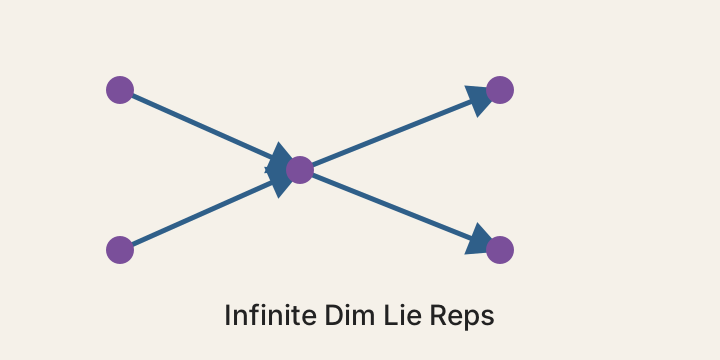
The picture is a state tower: symmetry operators move between states, while the central term labels the whole representation.
Worked example [Beginner]
Imagine a space with one state at energy , two states at energy , three states at energy , and so on. The whole space is infinite because the energy ladder never ends.
A symmetry operator might raise a state by one level, lower it by one level, or mix states inside the same level. A representation is the rule assigning such state-moving operations to the symmetry algebra.
What this tells us: infinite-dimensional representations are the natural home for symmetries of systems with infinitely many modes.
Check your understanding [Beginner]
Formal definition [Intermediate+]
Let be a Lie algebra over a field . A representation of on a vector space is a Lie algebra homomorphism
where is the Lie algebra of linear endomorphisms of with bracket [quantum-well Lie algebras.md]. Equivalently, is a -module with action satisfying
In the infinite-dimensional setting, may be an algebraic direct sum of graded pieces, a Hilbert space, or a completed topological vector space. The precise category matters: domains, continuity, and energy bounds are extra structure in analytic representation theory [Pressley-Segal §11].
Key theorem with proof [Intermediate+]
Theorem (Central elements act by scalars in irreducible finite-dimensional modules). Let be algebraically closed, let be a finite-dimensional irreducible representation of a Lie algebra , and let . Then for some .
Proof. Since is central, for every . Applying the representation gives
Thus commutes with every operator . Because is algebraically closed and is finite-dimensional, has an eigenvalue . The eigenspace is nonzero.
This eigenspace is stable under every , since commutes with . Irreducibility forces the eigenspace to be all of . Therefore .
Bridge. The construction here builds toward 03.11.03 (virasoro algebra), where the same data is upgraded, and the symmetry side is taken up in 03.10.02 (cft basics). The defining pattern appears again in those units in a sharpened form, where the local data is glued or quotiented. Putting these together, the foundational insight is that the data of this unit gives the structural signature that the rest of the strand reads off.
Exercises [Intermediate+]
Lean formalization [Intermediate+]
lean_status: none is recorded because the unit needs infinite-dimensional representation categories, central charges, graded modules, and positive-energy conditions beyond the basic Lie-module API.
Advanced results [Master]
Representations of infinite-dimensional Lie algebras require a specified category. Algebraic highest-weight modules, smooth representations of loop groups, and Hilbert-space positive-energy representations have different morphisms and different irreducibility notions [Kac §2-§9; ref: TODO_REF Pressley-Segal §11].
For central extensions, the central summand acts by a scalar on irreducible objects under Schur-type hypotheses. That scalar is part of the representation datum. In affine Kac-Moody theory it is the level; in Virasoro representation theory it is the central charge.
Synthesis. Infinite-dimensional Lie algebra representations require specification of the analytic category — algebraic highest-weight modules, Hilbert-space positive-energy representations, and smooth loop-group representations have different morphisms and irreducibility criteria — but share the structural pattern that central elements act by scalars on irreducible objects (Schur's lemma), the central charge or level labels the representation, grading by energy or weight organizes the state space into finite-dimensional pieces, and descendant spaces generated by lowering operators produce Verma-type modules. The passage from finite-dimensional representation theory (complete reducibility, eigenvalue arguments) to the infinite-dimensional setting introduces domain and closure issues that mirror those in unbounded operator theory 02.11.03. In CFT 03.10.02, the Virasoro representation theory built here determines the operator product expansion, the partition function, and the full algebraic structure of the conformal bootstrap.
Full proof set [Master]
The finite-dimensional Schur argument given above proves the scalar action of central elements under algebraically closed finite-dimensional hypotheses. In the categories used for affine and Virasoro algebras, one replaces the eigenvalue argument with the appropriate version of Schur's lemma for the chosen module category.
For a one-dimensional central extension , a representation of central charge satisfies . The bracket relation
records how the 2-cocycle modifies the represented commutator 03.11.01.
Connections [Master]
This unit depends on Lie algebras
03.04.01, Hilbert-space language02.11.08, and central extensions03.11.01. It feeds Virasoro algebra03.11.03, where highest-weight and positive-energy representations are primary examples. It also feeds CFT basics03.10.02, where the central charge labels sectors of the stress-tensor symmetry.The same representation-theoretic caution appears in unbounded self-adjoint operators
02.11.03: infinite-dimensional state spaces require domain and topology choices that finite-dimensional algebra suppresses.
Historical & philosophical context [Master]
Kac's text systematized infinite-dimensional Lie algebras and their representation theory, especially affine Kac-Moody algebras and highest-weight modules [Kac §2-§9]. These methods became standard in the algebraic treatment of two-dimensional conformal symmetry.
Pressley and Segal developed loop-group representations and their relation to positive energy, central extensions, and conformal field theory [Pressley-Segal §11].
Bibliography [Master]
- Victor Kac, Infinite-Dimensional Lie Algebras, §2-§9. [Kac §2]
- Andrew Pressley and Graeme Segal, Loop Groups, §11. [Pressley-Segal §11]
- Brian Hall, Lie Groups, Lie Algebras, and Representations, for finite-dimensional representation background. [quantum-well Hall reference note]