Simplicial set and the simplicial category Delta
Anchor (Master): Goerss-Jardine Ch. I-III; Gabriel-Zisman 1967 Calculus of Fractions and Homotopy Theory
Intuition [Beginner]
A simplicial set is a combinatorial way to describe a shape built from points, lines, triangles, tetrahedra, and their higher-dimensional analogues. Instead of working with continuous spaces directly, you work with a recipe that tells you how many simplices of each dimension there are and how their faces are glued together.
Think of building a triangle from parts. You have three vertices, three edges, and one filled-in triangle. A simplicial set keeps track of all these pieces and how they connect. Each edge has two boundary vertices, and the triangle has three boundary edges.
The "simplicial category" Delta is the index system: it encodes all the ways you can map a smaller simplex into a larger one. A face map skips one vertex of a simplex. A degeneracy map repeats one vertex, creating a collapsed copy. Every simplicial set is a contravariant functor from Delta to sets, meaning it reads off how many simplices of each dimension sit inside the space and how they relate.
Visual [Beginner]
A single 2-simplex (filled triangle) with its three face maps each selecting one of the three boundary edges. Below it, three degeneracy maps each collapsing the triangle back onto one of its three edges. On the right, a simplicial circle built from one vertex and one edge whose two faces both land on that same vertex.
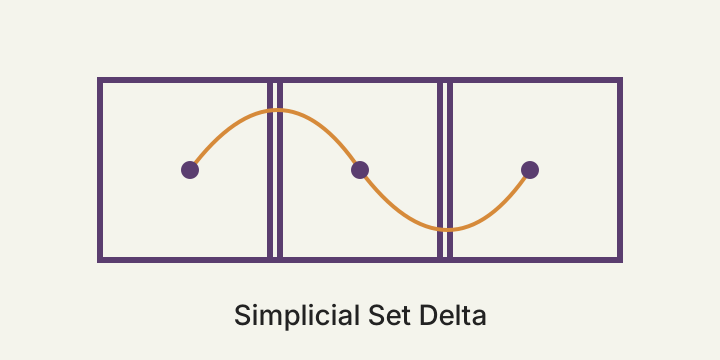
The key picture: face maps shrink a simplex by dropping a vertex; degeneracy maps inflate a simplex by repeating a vertex.
Worked example [Beginner]
The simplicial circle. Define a simplicial set with one 0-simplex and one non-degenerate 1-simplex . The two face maps both send to : and . The degeneracy gives a degenerate 1-simplex at . In dimension 2, all simplices are degenerate (built by applying degeneracy maps to lower-dimensional simplices).
This simplicial set has the homotopy type of a circle. Its homology groups are and , computed from the simplicial chain complex with (generated by ) and (generated by ), and boundary operator sending to .
Check your understanding [Beginner]
Formal definition [Intermediate+]
Definition (The simplicial category ). The category has objects the finite ordered sets for , with morphisms the order-preserving (weakly monotone) maps .
The category is generated by two families of maps:
- Face maps for , the injection skipping .
- Degeneracy maps for , the surjection repeating .
These satisfy the simplicial identities: for ,
- (composing face maps)
- (composing degeneracy maps)
- if
- if or
- if
Definition (Simplicial set). A simplicial set is a contravariant functor . Equivalently, is a sequence of sets () together with face operators and degeneracy operators satisfying the dual simplicial identities. The category of simplicial sets is .
The standard -simplex is the representable simplicial set . By the Yoneda lemma, .
Key theorem with proof [Intermediate+]
Theorem (Geometric realisation). There is a left adjoint functor sending to the topological -simplex , and for a general simplicial set , the space is computed as the coend , where the relation identifies and . This realisation preserves finite products: when is locally compact.
Proof sketch. The coend formula is forced by the requirement that be a left Kan extension of the cosimplicial space along the Yoneda embedding. For the product preservation, the key input is that the topological simplices form a cosimplicial space admitting a Reedy-style decomposition, and the shuffle map provides an explicit homeomorphism built from the Eilenberg-Zilber shuffle decomposition of products of simplices.
Bridge. The geometric-realisation construction connects simplicial combinatorics back to topology; the coend formula is a categorical refinement of the CW-attachment process seen in [topology.cw-complex], where cells are glued along their boundary maps. The representable simplices play the role of universal building blocks, analogous to the universal covering maps in [topology.fibration], and the Yoneda-lemma identification mirrors how singular chains were defined in [topology.singular-homology]. The simplicial identities themselves encode the same boundary-square-to-zero relation that powers the homology long exact sequence.
Exercises [Intermediate+]
Advanced results [Master]
Eilenberg-Zilber lemma. Every simplex can be written uniquely as where is non-degenerate (no degeneracy operator applied) and . This gives the skeletal decomposition where consists of all simplices of dimension at most together with their degeneracies.
Quillen model structure. The category carries a cofibrantly generated proper model structure (Quillen 1967) where: cofibrations are monomorphisms, weak equivalences are maps whose geometric realisation is a homotopy equivalence (equivalently, maps inducing isomorphisms on all homotopy groups after realisation), and fibrations are Kan fibrations (maps with the right lifting property against all horn inclusions ). The geometric-realisation--singular-complex adjunction is a Quillen equivalence between and .
Synthesis. Simplicial sets mediate between combinatorial algebra and homotopy theory; the skeletal filtration refines the CW structure of [topology.cw-complex] into a purely algebraic decomposition indexed by dimension, the Eilenberg-Zilber uniqueness result ensures that every simplex has a canonical non-degenerate core just as every homology class in [topology.singular-homology] has a canonical cycle representative modulo boundaries, and the Quillen model structure lifts the homotopy theory of [topology.homotopy] into a categorical framework where cofibrations and fibrations interact functorially. The nerve construction translates category theory into homotopy theory, and the realisation functor translates it back to topology, forming the bridge between algebraic and topological viewpoints that underpins all of modern homotopical algebra.
Full proof set [Master]
Proposition (Skeletal filtration via pushouts). For any simplicial set , the -skeleton is obtained from by attaching -simplices along their boundaries. Concretely, there is a pushout square:
$$\begin{CD} \bigsqcup_{\sigma \in NX_n} \partial \Delta^n @>>> \bigsqcup_{\sigma \in NX_n} \Delta^n \ @VVV @VVV \ \mathrm{sk}_{n-1} X @>>> \mathrm{sk}_n X \end{CD}$$
where denotes the set of non-degenerate -simplices of .
Proof. By the Eilenberg-Zilber lemma, every -simplex is either non-degenerate or of the form for some degeneracy operator and simplex of lower dimension. The degenerate simplices already live in (they are images of lower-dimensional simplices under degeneracy maps). The non-degenerate -simplices are attached along their boundary maps, which land in because each face of a non-degenerate simplex is either non-degenerate of dimension or degenerate (hence in ). The pushout gluing is free because degeneracy operators are injective on representables. Induction on gives the full skeletal decomposition.
Connections [Master]
The CW-structure attachment process [topology.cw-complex] is the topological shadow of the skeletal filtration of a simplicial set; geometric realisation converts the combinatorial pushout into a topological one.
Singular chains [topology.singular-homology] are instances of simplicial-set maps , and the singular complex is the simplicial set whose realisation returns a CW approximation of , as developed in 03.12.26.
The nerve of a category, built from composable sequences of morphisms, underpins the classifying-space construction for groups [topology.fibration], and the bar construction for simplicial groups 03.12.39 generalises this to loop-space recognition.
Bibliography [Master]
@article{eilenberg1944,
  author = {Eilenberg, Samuel},
  title = {Singular homology theory},
  journal = {Ann. Math.},
  volume = {45},
  pages = {407--447},
  year = {1944}
}

@book{gabriel-zisman1967,
  author = {Gabriel, Peter and Zisman, Michel},
  title = {Calculus of Fractions and Homotopy Theory},
  publisher = {Springer},
  year = {1967}
}

@book{may-simplicial,
  author = {May, J. Peter},
  title = {Simplicial Objects in Algebraic Topology},
  publisher = {University of Chicago Press},
  year = {1967}
}

@book{goerss-jardine1999,
  author = {Goerss, Paul G. and Jardine, John F.},
  title = {Simplicial Homotopy Theory},
  publisher = {Birkh{\"a}user},
  year = {1999}
}

@article{quillen1967,
  author = {Quillen, Daniel},
  title = {Homotopical algebra},
  journal = {Lecture Notes in Mathematics},
  volume = {43},
  publisher = {Springer},
  year = {1967}
}
Historical & philosophical context [Master]
Simplicial sets emerged from the intersection of combinatorial topology and category theory in the mid-20th century. Eilenberg's 1944 singular homology theory [Eilenberg 1944] used maps from standard simplices into spaces, and the formalisation of this idea as a contravariant functor on crystallised in the work of Eilenberg and Zilber around 1950.
The categorical viewpoint was developed by Gabriel and Zisman in their 1967 monograph [Gabriel-Zisman 1967], which introduced the calculus of fractions and the localisation framework that underpins modern homotopy theory. Quillen's 1967 "Homotopical Algebra" [Quillen 1967] placed simplicial sets at the foundation of abstract homotopy theory by defining the model structure on , making simplicial sets the default setting for much of algebraic topology.
Philosophically, simplicial sets replace continuous geometry with discrete combinatorics while preserving homotopical information. This "combinatorial replacement" strategy has proven extraordinarily powerful: it enables inductive constructions, algorithmic computation, and categorical algebra that would be impossible in the continuous setting. The simplicial approach underpins modern developments including -categories (Lurie), derived algebraic geometry, and computer-verified homotopy theory (homotopy type theory).