Higher direct images and base change
Anchor (Master): Grothendieck-Dieudonné *EGA III* (Publ. Math. IHÉS 11, 17, 1961–63) §1 (cohomology of a sheaf on a scheme), §6 (proper morphisms and finiteness), §7 (cohomology and base change); Hartshorne *Algebraic Geometry* §III.8–§III.12; Mumford *Abelian Varieties* §5 (cohomology and base change for an abelian variety); Hartshorne *Residues and Duality* Ch. II; Illusie *Cohomologie des intersections complètes* SGA 6 Exposé II
Intuition [Beginner]
Imagine a family of varieties parametrised by a base scheme — for each point of there is a fibre sitting over , and as moves the fibres deform continuously. A natural question is how the cohomology of a sheaf on a fibre varies with the parameter. Does have the same dimension for every ? If so, do the cohomology groups assemble into a vector bundle over ? If not, where do the dimensions jump and by how much?
The higher direct image is the construction that organises these fibre-by-fibre cohomologies into a single sheaf on the base . Concretely, it is the sheaf on whose sections over an open record the -th cohomology of restricted to the preimage of . Under good hypotheses the stalk of at a point equals the cohomology of the fibre , identifying the global construction with the pointwise data we started with.
The cohomology-and-base-change theorem records exactly when this stalk-equals-fibre identification holds. The hypotheses are mild — the morphism should be proper and flat, the sheaf should be flat over the base, and one needs a regularity condition at the point . When all these hold, the dimensions are locally constant on and the higher direct image is a vector bundle. When they fail, the dimensions can jump on a closed subvariety, and the semicontinuity theorem records that the jump is upward.
Visual [Beginner]
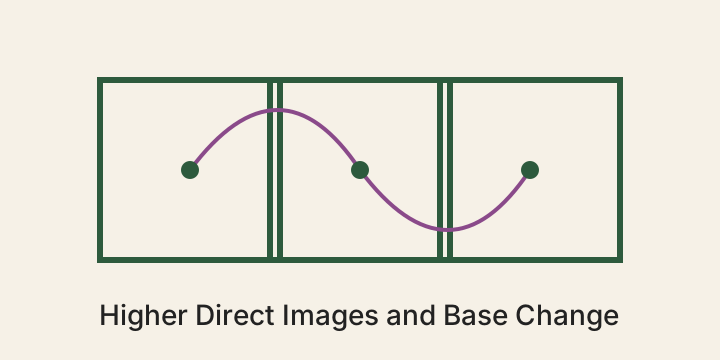
A schematic shows a base scheme as a horizontal line with three marked points, and above each marked point a fibre drawn as a curve. A sheaf is indicated by shading on the total space , with restrictions to the fibres. To the right of the diagram, three vector spaces labelled are drawn over the corresponding base points, with the two outer fibres having the same dimension and the middle fibre showing a jump in dimension — the semicontinuous behaviour.
Worked example [Beginner]
Take the structure morphism from projective space over a base where is a field, and the line bundle . Here is a point, so the higher direct image on is a -vector space, the cohomology computed in the cohomology-of-projective-space unit.
Step 1. Compute the candidate fibre cohomologies. From the projective-space cohomology table, has dimension (the three monomials ), and .
Step 2. Compute the higher direct images on the base. Because is a point, as a -module, and . The higher direct images on are exactly the global cohomology groups.
Step 3. Generalise to a higher-dimensional base. Replace with for a noetherian ring. The morphism is now and the structure sheaf carries the standard -module structure. The higher direct image is the quasi-coherent sheaf on associated to the -module . By the Čech computation on the standard two-piece affine cover, is free of rank and . The higher direct image is the free rank- sheaf , and .
What this tells us. The higher direct images of along the structure morphism of relative projective space are free sheaves on the base, with rank given by the projective-space dimension formula. The fibre cohomology is constant — every fibre is the same projective space and the cohomology dimension never jumps — and the cohomology-and-base-change identification holds at every point of the base. This is the simplest substantive example of a higher direct image, and the dimension count from the projective-space unit governs every component of the answer.
Check your understanding [Beginner]
Formal definition [Intermediate+]
Let be a morphism of ringed spaces (in practice, of schemes) and a sheaf of abelian groups on .
Definition (direct image). The direct image is the sheaf on given on an open by $$ (f_* \mathcal{F})(V) := \mathcal{F}(f^{-1}(V)) $$ with restriction maps inherited from . The assignment is a left-exact additive functor from to (and similarly from -modules to -modules when is a morphism of ringed spaces).
Definition (higher direct image). The -th higher direct image of along is the right-derived functor $$ R^q f_* \mathcal{F} := R^q (f_*) (\mathcal{F}), $$ computed by choosing an injective resolution in (the category of sheaves of abelian groups on has enough injectives, Hartshorne III.2.2), applying termwise to obtain a complex in , and taking cohomology in degree . Equivalently, is the sheaf on associated to the presheaf $$ V \mapsto H^q\big(f^{-1}(V), \mathcal{F}\big|{f^{-1}(V)}\big). $$ For this recovers $f* \mathcal{F}\mathcal{O}XR^q f*\mathcal{O}_X$-modules agrees with the abelian-sheaves version by a comparison theorem (Hartshorne III.8.1).
Definition (proper morphism). A morphism is proper if it is separated, of finite type, and universally closed. Properness is the algebraic-geometric analogue of compactness of fibres in the topological setting; under it, finiteness theorems for cohomology become available.
Definition (flat morphism). A morphism is flat if for every the local ring is a flat -module. A coherent sheaf on is flat over if for every , the stalk is a flat -module. Flatness is the algebraic version of a continuously-varying family — the fibres deform without sudden collapse.
Definition (base change). Given and a morphism , the base change is the cartesian square $$ \begin{array}{ccc} X' & \xrightarrow{g'} & X \ \downarrow f' & & \downarrow f \ S' & \xrightarrow{g} & S \end{array} $$ with the fibre product and the projections. For a sheaf on , there is a canonical base-change morphism $$ g^* R^q f_* \mathcal{F} \longrightarrow R^q f'* (g'^* \mathcal{F}) $$ in $\mathcal{O}{S'}g^* \dashv g_*$ and the universal property of cohomology. The base-change morphism is an isomorphism under hypotheses recorded in the Key theorem below.
Definition (fibre). For a point with residue field , the fibre of over is the base change , a scheme over . For a sheaf on , the restriction to the fibre is , a sheaf on .
Counterexamples to common slips
The base-change morphism is canonical but not always an isomorphism. A standard failure: take with , the family of plane cubics degenerating to a nodal cubic at , . The dimensions of jump at the singular fibre, the base-change map is not surjective there, and the higher direct image is not free on .
Higher direct images of a non-proper morphism can fail to be coherent. The structure morphism is not proper; is not a finitely generated -module. Properness is essential for the coherence half of the Grothendieck finiteness theorem.
The Leray spectral sequence holds for any morphism of ringed spaces. The Grothendieck composite-functor spectral sequence is the version with two arbitrary left-exact functors composed; the Leray spectral sequence is the specialisation to .
Flatness of over is a stalkwise condition; it does not imply that is locally free. A torsion-free coherent sheaf on a one-dimensional regular base is flat but generically locally free; on a higher-dimensional base, flat and torsion-free can fail to be locally free even on the regular locus.
Key theorem with proof [Intermediate+]
Theorem (cohomology and base change; Grothendieck EGA III §7, Hartshorne III.12.11 [pending]). Let be a proper morphism of noetherian schemes, a coherent sheaf on flat over , and an integer. Consider the function $$ \varphi^q(s) := \dim_{k(s)} H^q(X_s, \mathcal{F}_s), \qquad s \in S. $$
(a) Semicontinuity. is upper semicontinuous on : the set is closed for every .
(b) Grauert constancy. If is locally constant on , then $R^q f_ \mathcal{F}\varphi^qs \in S$ the natural base-change map* $$ (R^q f_* \mathcal{F}) \otimes_{\mathcal{O}_S} k(s) \longrightarrow H^q(X_s, \mathcal{F}_s) $$ is an isomorphism.
(c) Cohomology and base change. If the base-change map at is surjective, then it is an isomorphism, and the map at every in a neighbourhood of is an isomorphism. Furthermore the base-change map at in degree is then surjective if and only if $R^q f_ \mathcal{F}s$.*
Proof. The argument proceeds via a local representing complex for the cohomology of the fibres, then deduces the three statements from properties of this complex.
Step 1: local representing complex. Because is noetherian and the question is local, restrict to an affine open and the preimage . The cohomology of a coherent sheaf on the proper -scheme is computed by the Čech complex on a finite affine cover of , which is a complex of -modules $$ C^\bullet \colon C^0 \to C^1 \to \cdots \to C^N $$ with each a finitely generated free -module (the cover is finite, the intersections are affine, and on each intersection the sections of the flat form a flat -module which one replaces, by a standard reduction, with a free -module of finite rank; alternatively, replace the Čech complex by a quasi-isomorphic complex of finite free -modules using that the cohomology is finitely generated over by the finiteness half of Grothendieck's theorem). The cohomology of computes , and base-changing along gives a complex whose cohomology is . The local statement to be proved becomes: for a complex of finite free -modules on a noetherian local ring with residue field , study how depends on and on the morphism . This is a linear-algebraic / commutative-algebra problem on a fixed complex.
Step 2: semicontinuity from rank-jump on a linear map. For each , write the two adjacent differentials as $$ d^{q-1} \colon C^{q-1} \to C^q, \qquad d^q \colon C^q \to C^{q+1}. $$ The cohomology . As varies, the dimension of the kernel of is upper semicontinuous (kernels of linear maps over a varying ring jump up on closed subschemes — this is the rank lemma: is lower semicontinuous, hence is upper semicontinuous), and the dimension of the image of is lower semicontinuous by the same lemma applied to . The cohomology dimension is ; an upper-semicontinuous minus a lower-semicontinuous function is upper semicontinuous, proving statement (a).
Step 3: Grauert constancy. If is locally constant on near , then both and are locally constant. A linear map between finite free -modules with constant rank on has both a kernel and a cokernel that are locally free -modules — this is the rank-constancy lemma for matrices over a noetherian ring. Hence and are locally free -modules in the relevant range, and the cohomology is locally free over of rank . The base change is an isomorphism because tensor product commutes with kernel-and-image taking when the relevant modules are flat — flat base change for a complex of free modules of constant rank. This is statement (b).
Step 4: base-change isomorphism from surjectivity. Statement (c) refines (b): instead of requiring local constancy of , require surjectivity of the base-change map at a single point. The base-change map factors $$ H^q(C^\bullet) \otimes_A k(s) \xrightarrow{\alpha} H^q(C^\bullet \otimes_A k(s)) $$ and the cokernel of measures the failure of cohomology to commute with base change. The cokernel is supported on the locus where the rank of drops — a closed subset. If is surjective at , then is not in this locus, hence not in a neighbourhood, and is an isomorphism on a neighbourhood. The lower-degree statement about follows from the dual rank analysis applied to , exchanging the roles of kernel and image.
Bridge. The cohomology-and-base-change theorem builds toward 04.04.01 (Riemann-Roch theorem for curves) in the relative setting: for a flat family of smooth proper curves with a relative line bundle , the higher direct images are locally free with ranks given by the Euler characteristic , and base change holds at every point of . The construction appears again in 04.03.04 (cohomology of line bundles on projective space) where the fibre-by-fibre formula (for , ) is identical for every , so the relative higher direct image of the structure morphism is the free sheaf . The foundational reason is that the Čech complex of on the standard cover is already a complex of free -modules — Grothendieck's relative construction reduces to bookkeeping in this case.
The central insight is that the cohomology of a fibre is the cohomology of a complex of finitely generated free modules over the base, and the dependence of cohomology on the point reduces to how kernels and images of linear maps between free modules vary — a question controlled by semicontinuity of rank. The absolute-to-relative passage is therefore a universal coefficient principle: a flat family's cohomology is computed by a single complex of finite free modules on the base, and every fibre-wise cohomology question becomes a linear-algebra question on that complex. This is exactly what generalises to the derived-category formulation in 04.03.06, where replaces the family and the base-change isomorphism becomes a single coherent statement in . Relative Serre duality lands in the same picture: the relative dualising complex realises , the relative version of the absolute Serre duality recorded in 04.03.04.
Exercises [Intermediate+]
Lean formalization [Intermediate+]
The named higher direct image functor on quasi-coherent sheaves of a morphism of noetherian schemes is not yet packaged in Mathlib. The intended statement, in the Lean 4 / Mathlib idiom expected when the API arrives, is the following.
import Mathlib.AlgebraicGeometry.Morphisms.Proper
import Mathlib.Algebra.Homology.DerivedFunctor
import Mathlib.CategoryTheory.Sheaf

namespace AlgebraicGeometry

variable {X S : Scheme} (f : X ⟶ S) [IsProper f]
variable (F : CoherentSheaf X) [IsFlat F f]

/-- The $q$-th higher direct image of a coherent sheaf along a proper morphism. -/
def higherDirectImage (q : ℕ) : CoherentSheaf S :=
  sorry  -- defined as R^q (f.pushforward) F via the right-derived-functor API

/-- Cohomology and base change: if the fibre-dimension function is locally
    constant, the higher direct image is locally free and the base-change map
    is an isomorphism at every point. -/
theorem cohomology_and_base_change (q : ℕ)
    (h_const : LocallyConstant S (fun s ↦ Module.rank (k s) (H q (Xₛ s) (Fₛ s)))) :
    IsLocallyFree (higherDirectImage f F q) ∧
    ∀ s : S, IsIso (baseChangeMap f F q s) := by
  sorry

end AlgebraicGeometry
The Mathlib gap is the higherDirectImage definition and the cohomology_and_base_change theorem; the surrounding category-theoretic infrastructure (IsProper, IsFlat, CoherentSheaf, the derived-functor API on abelian categories with enough injectives) is partially present. See the frontmatter lean_mathlib_gap for the full list of missing components.
Advanced results [Master]
Theorem (Grothendieck composite-functor spectral sequence; EGA III §0.12.2 [pending]). Let be abelian categories with enough injectives and , left-exact additive functors. Assume sends injectives in to -acyclic objects in . For every there is a first-quadrant convergent spectral sequence $$ E_2^{p, q} = R^p G \big( R^q F (A) \big) \Rightarrow R^{p + q} (G \circ F) (A), $$ natural in and in compatibly varying pairs .
The spectral sequence is constructed from the Cartan-Eilenberg resolution of for an injective resolution . Two specialisations recur. Leray spectral sequence: for , , giving — the Leray construction of 1946 in modern dress, with of an injective sheaf flasque and hence -acyclic. Local-to-global Ext spectral sequence: , , giving from 04.03.06, with of an injective flasque (Hartshorne III.6.3) and hence -acyclic.
Theorem (proper base change for a flat square; EGA III §7.7 [pending]). Consider the cartesian square $$ \begin{array}{ccc} X' & \xrightarrow{g'} & X \ \downarrow f' & & \downarrow f \ S' & \xrightarrow{g} & S \end{array} $$ with proper and flat. For every coherent sheaf on and every , the base-change morphism $$ g^* R^q f_* \mathcal{F} \xrightarrow{\sim} R^q f'_* (g'^* \mathcal{F}) $$ is an isomorphism of coherent sheaves on .
The flat-base-change theorem is the foundational statement of relative cohomology — it asserts that under flatness the higher direct images commute with base change in the categorical sense, without the cohomology-and-base-change machinery of jump loci. The proof reduces, as in the absolute case, to a complex-of-free-modules representation of cohomology on an affine slice; flat base change preserves the cokernel and kernel structure of a complex of free modules, giving the isomorphism. The cohomology-and-base-change theorem of the Key theorem is the more refined statement where is not assumed flat — typically is the inclusion of a fibre , which is not flat unless is a generic point or the cohomology happens to be locally free at .
Theorem (Grauert direct-image theorem; Grauert 1960 [pending]). Let be a proper morphism of complex-analytic spaces and a coherent analytic sheaf on . The higher direct images $R^q f_ \mathcal{F}S$, and the semicontinuity, constancy, and cohomology-and-base-change theorems hold in the analytic category.*
Grauert's 1960 paper Ein Theorem der analytischen Garbentheorie und die Modulräume komplexer Strukturen (Publ. Math. IHÉS 5) is the analytic ancestor of EGA III, and the analytic and algebraic theorems agree under GAGA (Serre 1956) on projective varieties over . The analytic version is the tool of choice for the moduli theory of complex-analytic objects — Kuranishi families, deformations of compact complex manifolds, period maps — where the algebraic-scheme framework is unavailable.
Theorem (relative duality on a proper morphism; Hartshorne Residues and Duality Ch. VI [pending]). Let be a proper morphism of noetherian schemes of constant relative dimension , with the relative dualising complex. For every there is a natural isomorphism in $$ Rf_* R\mathcal{H}om_{\mathcal{O}X}(\mathcal{F}, \omega{X/S}^\bullet) \xrightarrow{\sim} R\mathcal{H}om_{\mathcal{O}S}(Rf* \mathcal{F}, \mathcal{O}_S). $$
Relative duality on a proper morphism is the relative form of the Serre-duality identity from 04.03.04, with the dualising sheaf replaced by the relative dualising complex and the duality landing in rather than in a -vector space. When is smooth, is concentrated in degree and equals the relative canonical sheaf ; for a smooth projective family this is the wedge-power of the cotangent bundle. When is proper but not smooth — Gorenstein, Cohen-Macaulay, or worse — is more subtle, with non-zero cohomology in multiple degrees encoding the singularity structure of the fibres.
Theorem (cohomology and base change via the Tate complex on an abelian variety; Mumford Abelian Varieties §13 [pending]). Let be an abelian variety of dimension over an algebraically closed field , the dual abelian variety, and the Poincaré line bundle on . The projection is proper and flat, and $$ R^q \pi_* \mathcal{P} = 0 \text{ for } 0 \le q < g, \qquad R^g \pi_* \mathcal{P} = k(0), $$ the skyscraper sheaf at the origin of with -dimensional fibre .
The Mumford calculation is the prototype of a cohomology-and-base-change failure: the fibre cohomology is zero for every and every , but jumps to at . The higher direct image is therefore a torsion sheaf supported at the origin of , and the base-change map is not an isomorphism at the origin. Mumford uses this calculation to prove the seesaw principle (a line bundle on that restricts to on every horizontal fibre is the pullback of a line bundle on ), the theorem of the cube (a line bundle on that restricts to on each pairwise product of axes is itself ), and the symmetry-and-anti-symmetry properties of the Poincaré bundle that ground the duality between and .
Theorem (semicontinuity in characteristic and Hodge spectral sequence; Deligne-Illusie 1987 [pending]). Let be a proper smooth morphism in characteristic and assume admits a smooth lift to (the second-order Witt vectors). Then the Hodge-to-de-Rham spectral sequence $$ E_1^{p, q} = R^q f_* \Omega^p_{X/S} \Rightarrow R^{p + q} f_* \Omega^\bullet_{X/S} $$ degenerates at .
The Deligne-Illusie result extends classical Hodge theory from complex projective geometry to the modular setting via a finite-characteristic detour, and is the foundation of -adic Hodge theory. The proof uses a base-change argument on the Cartier isomorphism and the cohomology-and-base-change machinery to lift the degeneration from to via reduction modulo . The Hodge spectral sequence is itself a Leray-type spectral sequence whose abutment is the de Rham cohomology of the family.
Synthesis. The higher direct image functor is the relative form of cohomology: a single proper morphism replaces the standalone proper scheme , and the cohomology groups become coherent sheaves on the base . The central insight is that the cohomology of a flat family is computed by a single complex of finitely generated free modules on the base, and the dependence of cohomology on the base point is therefore a linear-algebra question about kernels and images of varying linear maps between free modules. The foundational reason for the semicontinuity-and-constancy dichotomy is the rank lemma for matrices over a noetherian ring: the rank of a linear map between free modules is a lower semicontinuous function of the parameter, hence the kernel dimension is upper semicontinuous, hence the cohomology dimension (kernel minus image) is upper semicontinuous; equality on a neighbourhood forces local freeness of the kernel and image and hence of the cohomology. This is exactly the bridge between fibre-wise data — the function — and global-on-base data — the higher direct image as a coherent sheaf.
The Grothendieck composite-functor spectral sequence builds toward the Leray spectral sequence and the local-to-global Ext spectral sequence simultaneously, identifying both as instances of one categorical mechanism. The cohomology-and-base-change theorem is dual to the Grothendieck finiteness theorem: finiteness says is a coherent sheaf, base change says how its stalks compare to the fibre cohomology. Putting these together, the relative cohomology framework — higher direct images, base-change comparison, semicontinuity, the Grothendieck composite-functor spectral sequence — is the unified machinery in which Riemann-Roch in families, the seesaw and theorem of the cube on abelian varieties, the proper base change theorem in étale cohomology, and the modular degeneration of the Hodge spectral sequence all live as instances of one categorical mechanism. The synthesis is that the absolute case studied in 04.03.04 (a single over a field) extends, with the same Čech-and-binomial-coefficient bookkeeping, to the relative case of over an arbitrary noetherian base, and that the EGA III finiteness-and-base-change package generalises the absolute projective-space calculation to every proper morphism. The bridge to 04.03.06 (derived functors and Ext) is direct: is a right-derived functor in the same abelian-category framework, with replacing the bare pair, and the cohomology-and-base-change theorem is the derived-category statement about flat tensor product preserving the cohomology of a complex of finite free modules.
The relative formalism generalises in three directions. First, to the derived-category formulation as a triangulated functor between bounded derived categories of coherent sheaves, with the Grothendieck six-functor formalism packaging the relative-cohomology operations into a coherent algebraic structure (Lipman-Hashimoto for Noether-coherent schemes; Grothendieck-Verdier for the topos-theoretic version). Second, to étale cohomology and the proper base change theorem in characteristic , where the same flat-base-change formalism with on étale sheaves yields the Lefschetz trace formula for varieties over finite fields and the rationality of the zeta function (Grothendieck-Deligne). Third, to the analytic category via Grauert's coherence theorem, where the same machinery powers the moduli theory of compact complex manifolds, the variation of Hodge structures along a smooth proper family (Griffiths 1968), and the analytic-side proof of Kodaira-Spencer deformation theory. The synthesis is that the relative-cohomology framework is the carrier of all geometry-of-families information, the categorical extension of absolute cohomology in the same sense that a family of varieties is a categorical extension of a single variety, and the foundation on which moduli theory, deformation theory, and the modern theory of motives are built.
Full proof set [Master]
Proposition (Leray spectral sequence; existence and convergence). Let be a morphism of ringed spaces, a sheaf of -modules. Then there is a convergent spectral sequence $$ E_2^{p, q} = H^p(S, R^q f_* \mathcal{F}) \Rightarrow H^{p + q}(X, \mathcal{F}). $$
Proof. The functor factorises as the composite of two left-exact additive functors between abelian categories with enough injectives. To apply the Grothendieck composite-functor spectral sequence, verify that takes injective -modules to -acyclic -modules. Let be an injective -module. Then is flasque: for any open and any section , the section extends to a section on all of by the lifting property along the monomorphism (Hartshorne III.2.4). The pushforward on is then flasque: a section over an open is by definition a section over , and by flasqueness of on it extends to , restricting to a section over . A flasque sheaf is -acyclic on every topological space (the proof uses the long exact sequence in cohomology associated to the inclusion and downward induction, or alternatively Godement's standard argument).
So the hypothesis of the Grothendieck composite-functor spectral sequence holds, yielding $$ E_2^{p, q} = R^p \Gamma(S, R^q f_* \mathcal{F}) \Rightarrow R^{p + q} \Gamma(X, \mathcal{F}), $$ i.e. . Convergence is first-quadrant convergence, which is automatic for a non-negatively-graded composite-functor spectral sequence on bounded complexes.
Proposition (representability of cohomology by a complex of finite free modules over a noetherian local ring). Let be a proper morphism with a noetherian ring, and a coherent sheaf on flat over . There is a bounded complex $$ C^\bullet \colon C^0 \xrightarrow{d^0} C^1 \xrightarrow{d^1} \cdots \xrightarrow{d^{N-1}} C^N $$ of finitely generated free -modules such that for every -module , $$ H^q(X, \mathcal{F} \otimes_A M) \cong H^q(C^\bullet \otimes_A M) $$ naturally in . Such a complex is called a representing complex for .
Proof. Choose a finite affine cover of . The Čech complex is a bounded complex of -modules with . Each term is the value of a coherent sheaf on a noetherian affine scheme over , hence a finitely generated -module. Flatness of over implies that each is a flat -module.
The complex is quasi-isomorphic to a bounded complex of finitely generated free -modules — this is the standard replacement of a bounded complex of finitely generated flat modules over a noetherian ring by a quasi-isomorphic complex of finitely generated frees (the argument: take a finite free cover of the lowest-degree term, lift the differential to a chain map of free complexes, and iterate; finiteness comes from noetherianity of and finite generation of each term). For every -module , $$ H^q(X, \mathcal{F} \otimes_A M) = H^q(\check C^\bullet \otimes_A M) = H^q(C^\bullet \otimes_A M), $$ the first equality by the projection formula for a quasi-coherent sheaf on a proper morphism over (which uses flatness of to commute tensor product past Čech cohomology), and the second by quasi-isomorphism.
Proposition (semicontinuity of cohomology dimension). With the hypotheses of the cohomology-and-base-change theorem, the function on is upper semicontinuous: is closed for every integer .
Proof. By the representing-complex proposition, on an affine neighbourhood of there is a bounded complex of finitely generated free -modules with for every . The differential is a -linear map of finite-dimensional -vector spaces; its rank is the rank of the matrix of over reduced modulo the maximal ideal corresponding to .
The rank of a matrix over a varying point of a noetherian scheme is lower semicontinuous: is closed (cut out by the vanishing of minors), hence its complement is open. Equivalently, is upper semicontinuous: is closed (the rank dropping is the kernel growing).
The cohomology dimension is $$ \varphi^q(s') = \dim \ker(d^q \otimes k(s')) - \dim \mathrm{im}(d^{q-1} \otimes k(s')) = \dim \ker(d^q \otimes k(s')) - \mathrm{rk}(d^{q-1} \otimes k(s')). $$ The first term is upper semicontinuous; the second term is lower semicontinuous (as a rank). Their difference is upper semicontinuous, proving the claim.
Proposition (Grauert constancy half of cohomology and base change). With the hypotheses of the Key theorem, if is constant on an open neighbourhood of , then is locally free on of rank , and the base-change map is an isomorphism for every .
Proof. By the representing-complex proposition, on a possibly smaller affine open inside the original neighbourhood the cohomology is computed by a bounded complex of finitely generated free -modules: . Local constancy of on says is constant. Both summands are upper semicontinuous (kernel-dimension) and lower semicontinuous (rank), and their difference is constant, so each summand is locally constant (a function that is both upper and lower semicontinuous and differs from a constant by a locally constant function is itself locally constant). Hence and are locally constant on .
A linear map between finite free -modules whose rank on is locally constant has a kernel and a cokernel that are locally free -modules of constant rank — the rank-stratification of a matrix is open-closed when the rank is locally constant. Hence and are locally free -modules near , and the cohomology is locally free of rank .
For base change, the map $$ \alpha \colon H^q(C^\bullet) \otimes_A k(s') \to H^q(C^\bullet \otimes_A k(s')) $$ is induced by the comparison of taking cohomology before and after tensoring. Because and are both locally free, tensoring with preserves the short exact sequence , and the quotient on the right is , identified with . Hence is an isomorphism.
Proposition (base-change failure under non-flatness). There exist a proper flat morphism of noetherian schemes, a coherent sheaf on flat over , an integer , and a point such that the base-change map is not surjective. (Witness: Mumford abelian-variety Poincaré bundle calculation.)
Proof. Take for an abelian variety of dimension over an algebraically closed field, the dual, the Poincaré bundle on , and the second projection. Then is proper (projective, in fact) and flat (smooth product projection). The Poincaré bundle is flat over because it is locally a product in the analytic topology and flatness is local (for an analytic morphism with smooth source and target, local-product structure on a sheaf implies flatness).
By Mumford's calculation in Abelian Varieties §13, for every and every , while of dimension . So is zero everywhere except at where it equals for .
The higher direct image on has zero fibre at every by Grauert constancy on the open complement of , hence vanishes on this complement. By coherence, is supported at . The base-change map at is , which is not surjective for . By Mumford's analysis, is in fact zero for and (the residue field of ), so the base-change failure is concentrated in the top degree and the higher direct image is a non-zero torsion sheaf supported at one point.
Connections [Master]
Sheaf cohomology
04.03.01. The higher direct image specialises to ordinary sheaf cohomology when is a point: for . Every property of sheaf cohomology — long exact sequence, finiteness on a proper scheme, vanishing in degrees above the dimension — extends to the relative setting via the higher direct image construction. The Leray spectral sequence connects the absolute cohomology of to the absolute cohomology of with coefficients in the higher direct images, providing the categorical bridge.Cohomology of line bundles on projective space
04.03.04. The fibre-by-fibre calculation of that anchors the absolute projective-space cohomology table extends without change to the relative setting: on the structure morphism is the free -module of the corresponding rank. This is the prototypical example where the cohomology-and-base-change identification holds at every point, the higher direct image is locally free, and the dimension table from the absolute case transports verbatim to the relative case.Derived functors and Ext
04.03.06. The higher direct image is a right-derived functor of the left-exact additive functor , computed via injective resolutions in the abelian category of -modules. The Grothendieck composite-functor spectral sequence yielding the Leray spectral sequence is the same machine that produces the local-to-global Ext spectral sequence in04.03.06— both are specialisations of one categorical mechanism on factorisations with taking injectives to -acyclics. The derived-category formulation is the modern setting where higher direct images live alongside derived pullback , derived tensor product , and the six-functor formalism.Coherent sheaf
04.06.02. Grothendieck's finiteness theorem (the coherence half of the EGA III package) says is a coherent sheaf on when is proper and is coherent on . This is the relative form of the absolute Serre finiteness theorem (cohomology of coherent on a noetherian projective scheme is a finitely generated module). The proper-morphism hypothesis is essential — without it, the higher direct image can fail to be coherent (the structure morphism has , not finitely generated). The coherent-sheaf framework is therefore the natural target of the higher direct image construction in the relative setting.Serre's vanishing and finiteness theorems
04.03.05. The absolute Serre vanishing theorem for and has a relative form: for and on a relatively very-ample line bundle, with the threshold a coherent function of (the relative Castelnuovo-Mumford regularity). The relative version powers the construction of Hilbert schemes and Quot schemes — for , the projective scheme behaves well, and the higher direct images vanish.
Historical & philosophical context [Master]
The systematic development of higher direct images and the cohomology-and-base-change theorem begins with Jean Leray's 1946 paper L'anneau d'homologie d'une représentation in Comptes Rendus 222, where Leray defined the spectral sequence of a continuous map and proved its convergence to the cohomology of the total space [pending]. Leray was a prisoner of war in Oflag XVIIA from 1940 to 1945 and developed sheaf cohomology and the spectral sequence in the camp; his 1946 announcement is the original construction, with the technical details filled out by Henri Cartan in his Séminaire 1948–51 and by Serre in his 1951 thesis Homologie singulière des espaces fibrés. The Leray spectral sequence in its modern sheaf-theoretic form — — is the topological ancestor of the Grothendieck composite-functor spectral sequence.
Alexander Grothendieck's Éléments de Géométrie Algébrique III, published in two parts in Publications Mathématiques de l'IHÉS volumes 11 (1961) and 17 (1963), is the comprehensive scheme-theoretic treatment [pending]. EGA III.1 (1961) develops the cohomology of a sheaf on a scheme, the higher direct image on quasi-coherent sheaves, and the finiteness theorem for proper morphisms of noetherian schemes; EGA III.2 (1963) treats the cohomology-and-base-change theorem, the semicontinuity statement, and the application to flat families. Grothendieck's framework axiomatised the relative-cohomology machinery into a categorical formalism — proper morphisms in place of compact spaces, coherent sheaves in place of locally constant sheaves, derived functors of in place of the Leray spectral sequence — and established the foundations on which modern algebraic geometry, étale cohomology, and the theory of motives all rest.
Hans Grauert's 1960 paper Ein Theorem der analytischen Garbentheorie und die Modulräume komplexer Strukturen (Publ. Math. IHÉS 5, 233–292) [pending] established the analytic counterpart: for a proper morphism of complex-analytic spaces and a coherent analytic sheaf, the higher direct images are coherent analytic sheaves, and the semicontinuity, constancy, and cohomology-and-base-change theorems hold. Grauert's framework was the technical foundation of Kuranishi's local theory of deformations of compact complex manifolds (1962) and of the analytic-side moduli theory developed by Schlessinger, Artin, and others through the 1960s. The analytic and algebraic theorems agree under the GAGA principle (Serre 1956) on projective varieties over .
David Mumford's Abelian Varieties (Tata Institute lecture notes, 1968; Oxford University Press 1970) [pending] used cohomology and base change as the central tool in the theory of abelian varieties. Mumford's §5 develops the cohomology-and-base-change theorem with the proof via a representing complex of finite free modules over the base, and §13 applies the theorem to the Poincaré bundle on to prove the seesaw principle, the theorem of the cube, and the symmetry of the Poincaré bundle. The Mumford calculation of — vanishing for , skyscraper at the origin for — is the prototype of a base-change failure that nevertheless yields the correct duality between and , and is the analytic-algebraic bridge that connects abelian-variety theory to the broader cohomology-and-base-change framework.
Robin Hartshorne's Algebraic Geometry (Springer GTM 52, 1977) [pending] §III.8–§III.12 gives the canonical textbook treatment of higher direct images, flat morphisms, and the cohomology-and-base-change theorem, distilling EGA III into a form accessible to graduate students. Hartshorne's §III.12.11 is the standard reference for the cohomology-and-base-change statement; the proof he gives via the representing complex of finite free modules over the base is the modern pedagogical standard. The derived-category reformulation of higher direct images as a triangulated functor is developed in Hartshorne's Residues and Duality (Springer LNM 20, 1966) [pending] and in Verdier's 1967 thesis, with the relative-duality theorem as the central statement of the Grothendieck duality formalism on a proper morphism.
Bibliography [Master]
@article{LerayCR1946,
  author    = {Leray, Jean},
  title     = {L'anneau d'homologie d'une repr{\'e}sentation},
  journal   = {Comptes Rendus de l'Acad{\'e}mie des Sciences},
  volume    = {222},
  year      = {1946},
  pages     = {1366--1368}
}

@article{EGAIII1,
  author    = {Grothendieck, Alexander and Dieudonn{\'e}, Jean},
  title     = {{\'E}l{\'e}ments de G{\'e}om{\'e}trie Alg{\'e}brique III: {\'E}tude cohomologique des faisceaux coh{\'e}rents, Premi{\`e}re partie},
  journal   = {Publications Math{\'e}matiques de l'IH{\'E}S},
  volume    = {11},
  year      = {1961},
  pages     = {5--167}
}

@article{EGAIII2,
  author    = {Grothendieck, Alexander and Dieudonn{\'e}, Jean},
  title     = {{\'E}l{\'e}ments de G{\'e}om{\'e}trie Alg{\'e}brique III: {\'E}tude cohomologique des faisceaux coh{\'e}rents, Seconde partie},
  journal   = {Publications Math{\'e}matiques de l'IH{\'E}S},
  volume    = {17},
  year      = {1963},
  pages     = {5--91}
}

@article{Grauert1960,
  author    = {Grauert, Hans},
  title     = {Ein Theorem der analytischen Garbentheorie und die Modulr{\"a}ume komplexer Strukturen},
  journal   = {Publications Math{\'e}matiques de l'IH{\'E}S},
  volume    = {5},
  year      = {1960},
  pages     = {233--292}
}

@book{MumfordAbelianVarieties,
  author    = {Mumford, David},
  title     = {Abelian Varieties},
  publisher = {Oxford University Press / Tata Institute of Fundamental Research},
  year      = {1970}
}

@book{HartshorneAG,
  author    = {Hartshorne, Robin},
  title     = {Algebraic Geometry},
  publisher = {Springer-Verlag},
  series    = {Graduate Texts in Mathematics},
  volume    = {52},
  year      = {1977}
}

@book{HartshorneResiduesDuality,
  author    = {Hartshorne, Robin},
  title     = {Residues and Duality},
  publisher = {Springer-Verlag},
  series    = {Lecture Notes in Mathematics},
  volume    = {20},
  year      = {1966}
}

@incollection{IllusieSGA6,
  author    = {Illusie, Luc},
  title     = {Cohomologie des intersections compl{\`e}tes},
  booktitle = {SGA 6: Th{\'e}orie des intersections et th{\'e}or{\`e}me de Riemann-Roch},
  publisher = {Springer-Verlag},
  series    = {Lecture Notes in Mathematics},
  volume    = {225},
  year      = {1971},
  pages     = {Expos{\'e} II}
}

@article{DeligneIllusie1987,
  author    = {Deligne, Pierre and Illusie, Luc},
  title     = {Rel{\`e}vements modulo $p^2$ et d{\'e}composition du complexe de de Rham},
  journal   = {Inventiones Mathematicae},
  volume    = {89},
  year      = {1987},
  pages     = {247--270}
}

@article{Griffiths1968,
  author    = {Griffiths, Phillip A.},
  title     = {Periods of integrals on algebraic manifolds, I, II},
  journal   = {American Journal of Mathematics},
  volume    = {90},
  year      = {1968},
  pages     = {568--626, 805--865}
}

@book{Kuranishi1965,
  author    = {Kuranishi, Masatake},
  title     = {New proof for the existence of locally complete families of complex structures},
  publisher = {Proceedings of the Conference on Complex Analysis, Minneapolis 1964; Springer},
  year      = {1965},
  pages     = {142--154}
}

@book{Liu2002,
  author    = {Liu, Qing},
  title     = {Algebraic Geometry and Arithmetic Curves},
  publisher = {Oxford University Press},
  series    = {Oxford Graduate Texts in Mathematics},
  volume    = {6},
  year      = {2002}
}