Hodge index theorem
Anchor (Master): Hartshorne §V.1.9; Beauville *Complex Algebraic Surfaces* §IV.2 + §VIII (signature applications); Griffiths-Harris §0.7 + §1.2 (Hodge-Riemann bilinear relations and the Lefschetz decomposition); Voisin *Hodge Theory and Complex Algebraic Geometry* I §6 (Hodge index as a corollary of the Hodge-Riemann relations)
Intuition [Beginner]
The Hodge index theorem is a single statement about the shape of the intersection pairing on a smooth projective surface. The intersection pairing assigns an integer to every pair of divisor classes on the surface, and the theorem says this pairing has exactly one "positive direction" and many "negative directions". If you pick any divisor class with strictly positive self-intersection — for example, an ample class such as a hyperplane section — then every divisor class perpendicular to it under the pairing has self-intersection less than or equal to zero. There is one positive axis, and the rest of the space is negative.
Why bother? Because this signature pattern controls a lot of surface geometry. On a curve there is only one intersection number, the degree, and signs are tracked by a single dimension. On a surface the Picard group has finite rank — the Picard number — and the intersection pairing is a symmetric bilinear form of signature . That one positive direction is the "size" of the surface in the projective embedding, and the negative directions encode every other constraint on how curves can sit on the surface. The theorem reduces a question about all pairs of divisors to a question about a single distinguished positive axis.
The same signature pattern reappears under different names across mathematics: Minkowski space in special relativity has signature , and the algebraic-geometry signature is a Picard-group analogue. The Hodge index theorem is what makes "Lorentzian" intuition transfer to the lattice of curves on a surface — one timelike direction, many spacelike directions, and a Cauchy-Schwarz inequality controlling how they interact.
Visual [Beginner]
A schematic of a smooth projective surface with two divisor classes drawn on it: an ample class singled out as the positive axis, and an arbitrary divisor class decomposed into a piece parallel to and a piece perpendicular to . The perpendicular piece carries non-positive self-intersection by the theorem, and the parallel piece carries the entire positive contribution. A second panel shows the resulting signature pattern as a "light cone" in the real Néron-Severi space: one positive direction (the ample axis) and many negative directions (the orthogonal hyperplane).
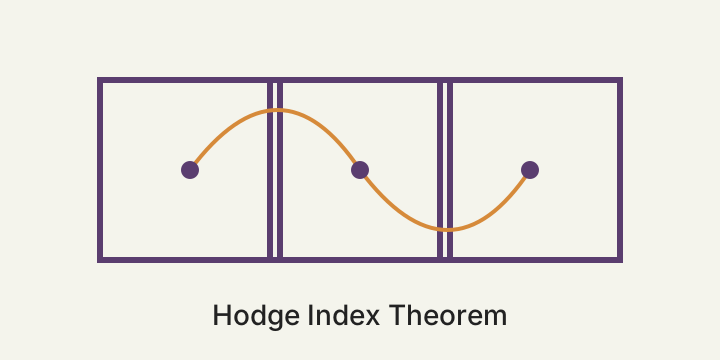
The picture captures the essential shape: the real Néron-Severi space of a smooth projective surface is a real vector space of dimension equipped with a symmetric bilinear form whose signature is . The positive axis is anchored by any ample class. The rest of the space is negative semidefinite once you mod out by the positive axis.
Worked example [Beginner]
Verify the signature pattern on three surfaces — , the quadric , and a blow-up of at a point — by writing the intersection form as a matrix and reading off the signature.
Step 1. The projective plane . The Picard group is generated by the hyperplane class with , so the Picard number is . The real intersection space is one-dimensional, and the intersection form is the matrix , which has signature . The Hodge index pattern matches.
Step 2. The quadric surface . The Picard group is generated by the two ruling classes and with and , so . The intersection matrix in the basis is $$ M = \begin{pmatrix} 0 & 1 \ 1 & 0 \end{pmatrix}. $$ The eigenvalues of are and , giving signature . The Hodge index pattern matches. The ample class (which is the diagonal hyperplane class on the quadric) has self-intersection , the unique positive direction.
Step 3. The blow-up of the projective plane at a point. The Picard group is generated by the pullback hyperplane class and the exceptional divisor , with , , and . So and the intersection matrix in the basis is
This is diagonal with eigenvalues and , giving signature , and the Hodge index pattern matches. The ample class for small has positive self-intersection , picking out the positive direction.
Step 4. Read off the consequence. On each of the three surfaces, the intersection pairing has exactly one positive direction once diagonalised over the reals. Any divisor class perpendicular to the ample class therefore has . On this is vacuous (every class is a multiple of , the perpendicular subspace is zero). On the orthogonal complement of is the line spanned by , with , the predicted negative. On the blow-up, the orthogonal complement of is the line spanned by , with , again the predicted negative.
What this tells us: the Hodge index pattern is read off the intersection matrix as the difference between the number of positive eigenvalues and the number of negative eigenvalues. On every smooth projective surface, the unique positive eigenvalue is anchored by any ample class. The remaining negative eigenvalues encode the "compactness" of the Néron-Severi lattice: every divisor class perpendicular to the ample direction satisfies , with strict inequality when is non-zero in the Néron-Severi group.
Check your understanding [Beginner]
Formal definition [Intermediate+]
Let be an algebraically closed field, let be a smooth projective surface over , and let be the Néron-Severi group of — the quotient of the Picard group by the connected component of the identity, equivalently the group of divisor classes modulo algebraic equivalence. The Néron-Severi theorem of Severi (proved in full generality by André Néron) states that is a finitely generated abelian group; its rank is the Picard number of . Write , a real vector space of dimension , and write for the symmetric bilinear intersection pairing (see 04.05.06), extended by linearity to a symmetric bilinear form on .
Definition (Hodge index theorem, signature form). The Hodge index theorem for the smooth projective surface asserts that the symmetric bilinear intersection pairing on has signature , where is the Picard number. Equivalently, after diagonalisation over , the intersection form has exactly one positive eigenvalue and negative eigenvalues.
Definition (Hodge index inequality form). Let be a divisor class with — for instance, an ample class. The Hodge index theorem in inequality form asserts that for every , $$ (D \cdot H)^2 \geq D^2 \cdot H^2, $$ with equality if and only if is a real multiple of in .
Definition (Hodge index theorem, orthogonal-complement form). Let be a class with . Let be its orthogonal complement under the intersection pairing. The Hodge index theorem in orthogonal-complement form asserts that the restriction of the intersection pairing to is negative definite. Equivalently, for every non-zero , $$ D^2 < 0. $$
Definition (Néron-Severi group versus numerical equivalence). Two divisor classes are numerically equivalent, written , if for every curve . The quotient is a finitely generated free abelian group; its rank equals the Picard number . For most surfaces , and the intersection pairing factors through to give a non-degenerate pairing . The Hodge index theorem is most cleanly stated on , where the pairing is non-degenerate by construction.
Counterexamples to common slips
- The signature is on the real Néron-Severi space, not on the lattice over . Over the intersection lattice can be non-degenerate, even unimodular, but the relevant notion of signature is real-analytic and comes from diagonalising over .
- The inequality requires . For a class with (an isotropic class — a ruling on , or a fibre class on a ruled surface), the inequality has the opposite sense or fails to be informative, and the orthogonal-complement form must be replaced by a careful analysis of the radical of the pairing.
- The orthogonal-complement form requires the ambient class to have strictly positive self-intersection. An ample class has this property; a nef class with does not. Replacing "ample" with "nef" without checking produces a false statement, and the standard proof breaks down at the strictly-positive step.
- The Picard number is bounded above by the topological invariant for a smooth complex projective surface — the Lefschetz -theorem identifies with the integral classes in . The Hodge index theorem in the cohomological version asserts the cup-product pairing on has signature , and the surface-Néron-Severi version is recovered by restricting to algebraic classes.
Key theorem with proof [Intermediate+]
Theorem (Hodge index theorem; Hartshorne V Theorem 1.9). Let be a smooth projective surface over an algebraically closed field . The symmetric bilinear intersection pairing on has signature , where is the Picard number. Equivalently, if is any divisor class with , then for every , $$ (D \cdot H)^2 \geq D^2 \cdot H^2, $$ with equality if and only if is a real multiple of .
Proof. The argument has four steps. First, reduce the signature statement to the inequality statement. Second, decompose an arbitrary divisor class along the -axis. Third, use Riemann-Roch and Serre vanishing to show the orthogonal complement is negative definite. Fourth, derive the inequality form from the orthogonal decomposition.
Step 1: equivalence of the formulations. Suppose the signature of the intersection pairing on is . Pick a class with ; it spans the positive eigenspace. Decompose an arbitrary as with . Then , . Compute $$ (D \cdot H)^2 - D^2 \cdot H^2 = \alpha^2 (H^2)^2 - \big(\alpha^2 H^2 + (D')^2\big) H^2 = - (D')^2 \cdot H^2. $$ Since on (negative semidefiniteness) and , this difference is , giving . Equality holds when on , which by negative definiteness of forces , that is, a real multiple of . Conversely, the inequality with equality characterising real multiples of forces the orthogonal complement to be negative definite, and hence the signature to be .
Step 2: existence of a positive class. A smooth projective surface admits an ample divisor class — pull back along any closed embedding and read off a very ample . Such an has because the self-intersection of a very ample divisor is the degree of in the projective embedding, a positive integer. So at least one direction in is positive, and the signature has at least one eigenvalue.
Step 3: orthogonal complement is negative semidefinite. Fix ample with . Take a class , that is, . The argument shows . The key input is the surface Riemann-Roch identity (see 04.05.08),
$$
\chi(\mathcal{O}_X(nD)) = \chi(\mathcal{O}_X) + \tfrac{1}{2},nD \cdot (nD - K_X) = \chi(\mathcal{O}_X) + \tfrac{n^2}{2} D^2 - \tfrac{n}{2} D \cdot K_X,
$$
valid for every integer .
Suppose for contradiction that . The leading-order asymptotic in of the right side is as , hence . By the bound and Serre duality , at least one of or is unbounded as .
Since is ample and , the divisor has as well. An effective on pairs strictly positively with every ample class, because the intersection number of an ample class with any irreducible curve is positive (the Nakai-Moishezon criterion for ampleness) and a non-zero effective divisor is a non-negative integer combination of irreducible curves with at least one strictly positive coefficient. Hence for every non-zero effective . So if for some , the effective representative would have , contradicting . Therefore for all .
The same argument applied to for large shows eventually, since is a fixed integer independent of , while becomes anti-ample at large along the -pairing and cannot represent a non-zero effective class once exceeds for any positive paired with it. Combining the two vanishings, for large , forcing to grow asymptotically like , which contradicts the polynomial bound from Serre vanishing applied to a twist by an ample class. The conclusion: for every .
Step 4: negative definiteness on the orthogonal complement. Suppose with . The argument shows in , that is, is numerically zero. By the Hodge index inequality applied at and , , that is, , holds with equality; by the equivalence in Step 1, equality forces to be a real multiple of . Since and , the multiple must be zero, so in . Hence the intersection pairing on is negative definite, and the signature of the pairing on is .
Combining Steps 1–4 produces the signature form and the inequality form simultaneously.
Bridge. The Hodge index theorem builds toward the lattice-theoretic study of algebraic surfaces, where the central insight is that the Néron-Severi group of every smooth projective surface is a Lorentzian lattice of signature — one timelike direction, spacelike directions — and this single structural fact organises the geometry of curves on the surface, the structure of the ample cone, and the cohomological invariants that classify the surface. This bridge appears again in 04.09.01 (Hodge decomposition), where the cup-product pairing on for a complex projective surface inherits signature from the Hodge-Riemann bilinear relations, and the algebraic-geometric Hodge index theorem on is the integral-lattice shadow of the analytic Hodge-Riemann statement on primitive cohomology.
The foundational reason is that intersection numbers on a surface compute cup products in middle-degree cohomology, and signature is a cup-product invariant. Putting these together, the §V.1 framework of Hartshorne — intersection pairing, adjunction, Riemann-Roch on surfaces, Hodge index — assembles the four pillars of surface theory, and the bridge identifies the Hodge index signature with the Hodge-Riemann signature on , which in turn is dual to the Lefschetz decomposition on primitive cohomology. The Hodge index theorem is what makes the inequality the algebraic Cauchy-Schwarz, and identifies the ample cone with one of the two connected components of the positive cone , a fact that generalises to the cone theorem in higher-dimensional birational geometry.
Exercises [Intermediate+]
Lean formalization [Intermediate+]
Mathlib has the real-bilinear-form signature infrastructure and partial divisor / Picard-group machinery on a smooth projective scheme, but no named Hodge index theorem on a smooth projective surface. The intended formalisation reads schematically:
import Mathlib.AlgebraicGeometry.Divisor.Basic
import Mathlib.AlgebraicGeometry.Picard
import Mathlib.LinearAlgebra.QuadraticForm.Real
import Mathlib.LinearAlgebra.BilinearForm.Basic

variable {k : Type*} [Field k] [IsAlgClosed k]
variable (X : Scheme) [IsSmooth X k] [IsProjective X k] (hd : X.dimension = 2)

/-- The Néron-Severi group of a smooth projective surface,
as the Picard group modulo the connected component of the identity. -/
noncomputable def NeronSeveri : Type :=
  Quotient (Pic.modPicZero X)

/-- The intersection pairing extended to the real Néron-Severi space. -/
noncomputable def intersectionBilinearReal :
    LinearMap.BilinForm ℝ (NeronSeveri X ⊗[ℤ] ℝ) :=
  (intersectionPairing X).map (Int.cast : ℤ → ℝ)

/-- Hodge index theorem, signature form. -/
theorem hodge_index_signature :
    (intersectionBilinearReal X).signature = (1, picardNumber X - 1) := by
  -- Step 1: ample class provides one positive direction
  -- Step 2: Riemann-Roch + Serre vanishing yields negative semidefinite orthogonal complement
  -- Step 3: equality case forces numerical triviality
  sorry

/-- Hodge index theorem, inequality form. -/
theorem hodge_index_inequality
    (H D : NeronSeveri X ⊗[ℤ] ℝ) (hH : H ⬝ H > 0) :
    (D ⬝ H) ^ 2 ≥ (D ⬝ D) * (H ⬝ H) := by
  -- equivalent to signature form via orthogonal decomposition
  sorry
The proof gap is substantive. Mathlib needs five pieces wired together: the Néron-Severi group as the quotient of the Picard group by the connected component of the identity (Mathlib has the Picard scheme but the quotient is not packaged as the Néron-Severi group), the symmetric bilinear intersection pairing on (a corollary of the surface intersection pairing, which itself is a Mathlib gap), the existence of an ample class with strictly positive self-intersection (from Nakai-Moishezon), the surface Riemann-Roch identity (a Mathlib gap), and the Serre-vanishing input for the asymptotic growth of on the orthogonal complement of an ample class. The signature form is the natural first formalisation target, and the inequality form follows by the orthogonal-decomposition argument in Step 1 of the proof.
Advanced results [Master]
Theorem (Hodge index theorem, cohomological version; Griffiths-Harris §1.2 + Voisin Ch. 6). Let be a smooth complex projective surface. The cup-product pairing $$ H^{1, 1}(X, \mathbb{R}) \times H^{1, 1}(X, \mathbb{R}) \to H^{2, 2}(X, \mathbb{R}) \cong \mathbb{R} $$ has signature , where is the Hodge number. The algebraic-geometric Hodge index theorem on is the restriction of the cup-product pairing on to the integral classes — the image of the Lefschetz map .
The cohomological version follows from the Hodge-Riemann bilinear relations on the primitive cohomology of a Kähler manifold. For a smooth complex projective surface, the second cohomology decomposes into the Lefschetz primitive part and the multiple-of-the-class-of-the-hyperplane part, and the Hodge-Riemann relations assert that the cup-product pairing is positive definite on the part of the primitive cohomology and negative definite on the part of the primitive cohomology. Adding back the class of the hyperplane section, which carries one positive eigenvalue, produces the signature on .
Theorem (Hodge-Riemann bilinear relations, surface case; Hodge 1941). Let be a smooth complex projective surface with Kähler class and let be the primitive cohomology. The cup-product pairing satisfies:
- On (the primitive part): positive definite.
- On (the primitive part): negative definite. Adding back the Kähler class itself produces one positive eigenvalue, so the full signature on is .
The Hodge-Riemann relations are the foundational identity of Hodge theory. On a Kähler manifold of complex dimension the primitive cohomology in degree carries a definite bilinear form , definite of alternating sign on each Hodge -piece by the Hodge-Riemann formula. The surface case (, ) is the original Hodge index theorem; the higher-dimensional generalisation requires the Lefschetz primitive decomposition.
Theorem (uniqueness of the ample class up to positive scaling on Picard number 1). Let be a smooth projective surface with Picard number . The Néron-Severi group is generated by a single class, and the ample cone is the positive ray generated by an ample divisor.
This follows from the Hodge index pattern at : the Néron-Severi space is one-dimensional, and the unique positive eigenvalue is anchored by the generator. The ample classes form the positive half-line; the anti-ample classes the negative half-line. Examples: , a smooth quadric surface in with rank- Picard (over a general field, the smooth quadric has over but over if the quadric has no -rational ruling), and a smooth cubic surface over an algebraically closed field has , so Picard number is a restrictive condition.
Theorem (Néron-Severi lattice of a K3 surface; Beauville §VIII). Let be a complex projective K3 surface (a smooth simply connected surface with ). The integral cohomology lattice with cup product is the K3 lattice , an even unimodular lattice of signature and rank . The Néron-Severi sublattice is a primitive sublattice; its signature is by the Hodge index theorem on . The Picard number ranges from (for the very general algebraic K3) to (for the maximal-Picard K3 surfaces classified by Šafarevič and Šafarevič-Pjateckiĭ).
The K3 lattice picture is the foundational example of the lattice-theoretic study of surfaces. The Hodge index theorem provides the signature constraint on the Néron-Severi sublattice; the Torelli theorem for K3 surfaces (Pjateckiĭ-Šafarevič) inverts this to recover the K3 surface from the Hodge structure on the Néron-Severi lattice, making the lattice-theoretic invariants a complete classification of polarised K3 surfaces.
Theorem (signature criterion for ampleness; Nakai-Moishezon plus Hodge index). Let be a smooth projective surface and let be a divisor class. Then is ample if and only if (a) , (b) for every irreducible curve , and (c) lies in the same connected component of the positive cone as some ample class.
The Nakai-Moishezon criterion is the standard characterisation of ampleness on a surface, and the Hodge index theorem is what makes condition (c) precise. Without the signature theorem, the positive cone could in principle be path-connected, and conditions (a) and (b) would suffice. The Hodge index pattern implies the positive cone has two components, and one must specify which component the ample cone lies in.
Theorem (Reider's criterion; Reider 1988). Let be a smooth projective surface and let be a nef line bundle with . Then is base-point-free unless there is an effective divisor with and , or and .
Reider's criterion is the surface analogue of the Bombieri pluricanonical-mapping theorem and uses the Hodge index theorem indirectly: the case analysis of small values and small values is constrained by the signature pattern, and the exceptional cases are exactly the classes that lie close to the boundary of the positive cone. The proof technique (Bogomolov-style instability of a rank- vector bundle) uses the Hodge index inequality on the Chern classes of the destabilising sub-bundle.
Synthesis. The Hodge index theorem is the foundational signature statement on the Néron-Severi lattice of a smooth projective surface, and the central insight is that the algebraic Cauchy-Schwarz inequality for is the surface manifestation of a universal signature pattern that organises curve geometry, ample-cone structure, and lattice theory on a single algebraic surface through the identity . Three apparently distinct constructions — the surface Riemann-Roch identity combined with Serre vanishing, the Hodge-Riemann bilinear relations on primitive cohomology in the complex-analytic setting, and the Nakai-Moishezon characterisation of the ample cone — fit into one signature statement. Putting these together, the Hodge index theorem is what makes the ample cone one of the two connected components of the positive cone, the foundational reason that any two ample classes pair to a strictly positive integer, the central insight that identifies the Néron-Severi lattice with a Lorentzian lattice of signature , and the dual statement that the orthogonal complement of any positive-self-intersection class is negative definite. This bridge appears again in 04.09.01 (Hodge decomposition), where the cohomological version of the index theorem follows from the Hodge-Riemann bilinear relations on primitive cohomology, and the algebraic statement on is identified with the integral-lattice shadow of the analytic statement on .
The Hodge index theorem also generalises in two directions. To higher dimensions, the Hodge-Riemann bilinear relations on the primitive cohomology of a Kähler manifold of complex dimension produce a signature pattern on that, for a smooth complex projective threefold, is fundamental to the structure theory of the Néron-Severi space of divisor classes and the Mori cone of curve classes. The cone theorem of Mori, the cone of curves dual to the nef cone of divisors, and the structure of the Mori program for threefold birational geometry are all anchored by signature constraints generalising the surface Hodge index theorem. To lattice theory, the integral version — the Hodge index theorem on as a Lorentzian lattice — feeds the modern study of automorphism groups of surfaces (the Torelli theorem for K3 surfaces; the Cremona group acting on the Picard lattice of a rational surface; the Conway-Sloane lattice machinery applied to Picard lattices of surfaces of low Picard number). The Hodge index pattern identifies with a Lorentzian space; the discrete automorphism group of the lattice acts as a discrete subgroup of , and the geometry of the Néron-Severi lattice becomes a geometry of hyperbolic space.
The synthesis is structural: every signature-driven classification result for smooth projective surfaces — the structure of the ample cone, the Hodge-Riemann relations on primitive cohomology, the Néron-Severi lattice classification of K3 surfaces, the Reider criterion, the Bogomolov-Miyaoka-Yau inequality — is a corollary of Hodge index together with surface Riemann-Roch and adjunction. Hodge index supplies the lattice signature; Riemann-Roch supplies the Euler-characteristic data; adjunction supplies the canonical-class identities. Together they constitute the foundational analytic input to the Castelnuovo-Beauville-Bombieri-Kodaira classification of surfaces.
Full proof set [Master]
Proposition (positive cone has two components on a surface with ). Let be a real vector space of dimension equipped with a symmetric bilinear form of signature . The open positive cone has exactly two path-connected components, swapped by the negation .
Proof. Pick an orthogonal basis for with and for . Write . Then . The condition becomes , that is, . This is the standard description of the open positive cone of a Lorentzian inner product: two opposing components, and , each homeomorphic to an open Euclidean half-space. Negation swaps them. Path-connectedness within each component is via the straight-line segment, since the open cone is convex within each component (a sum of two future-pointing causal vectors is future-pointing causal).
Proposition (intersection pairing is non-degenerate on ). Let be a smooth projective surface and let be the Picard group modulo numerical equivalence. The intersection pairing on is non-degenerate.
Proof. Let with for every . The map is identically zero, so in particular for every curve (since curve classes generate — every divisor class is a difference of effective classes by the Picard-group decomposition for surfaces). By the definition of numerical equivalence, , that is, in . Hence the pairing is non-degenerate on .
Theorem (Hodge index theorem on a smooth projective surface), proof. Given in full at the Intermediate tier: pick an ample with from the projective embedding. Decompose . Show for every non-zero by combining surface Riemann-Roch, Serre vanishing, and the contradiction with positive ample-pairing on effective divisors. The orthogonal-complement form gives the signature ; the inequality form follows from the decomposition by direct computation.
Proposition (Hodge index inequality, equivalent algebraic form). Let be a smooth projective surface and let with . The inequality holds, with equality if and only if is a real multiple of .
Proof. Decompose with and (this is the orthogonal projection of onto the line ). Compute: $$ D^2 = \alpha^2 H^2 + 2 \alpha (D' \cdot H) + (D')^2 = \alpha^2 H^2 + 0 + (D')^2, $$ since by construction. Therefore $$ D^2 \cdot H^2 = \alpha^2 (H^2)^2 + (D')^2 \cdot H^2. $$ Also , so . Subtracting, $$ (D \cdot H)^2 - D^2 \cdot H^2 = -(D')^2 \cdot H^2. $$ By the orthogonal-complement form of the Hodge index theorem, on , and . Therefore , that is, . Equality holds if and only if , which by negative definiteness on forces , that is, is a real multiple of .
Theorem (cohomological Hodge index theorem on a smooth complex projective surface), stated without proof here — full proof in Voisin Hodge Theory and Complex Algebraic Geometry I, §6.3 [pending]. The cup-product pairing on for a smooth complex projective surface has signature , and the algebraic-geometric Hodge index theorem on is the restriction of this cup-product pairing to the integral classes. The proof uses the Hodge-Riemann bilinear relations on primitive cohomology in the surface case (, ), the Lefschetz -theorem identifying with the integral classes in , and a compatibility of the cup product on with the algebraic intersection pairing on via the cycle-class map.
Theorem (Hodge-Riemann bilinear relations, surface case), stated without proof here — full proof in Griffiths-Harris Principles of Algebraic Geometry §0.7 + §1.2 [pending]. On a smooth complex projective surface with Kähler class , the cup-product pairing is positive definite on the primitive part of and negative definite on the primitive part. The proof is by the Hodge-Riemann formula for the primitive intersection pairing on a Kähler manifold, with the surface case appearing as the simplest non-degenerate dimension (, , primitive cohomology is the orthogonal complement of the Kähler class). The Hodge index theorem on is the integral shadow.
Connections [Master]
Intersection pairing on a surface
04.05.06. The Hodge index theorem is a structural statement about the intersection pairing, asserting that its real extension to has signature . Without the intersection pairing, the signature statement has no setting; with it, the Hodge index theorem identifies as a Lorentzian space and the ample cone as one connected component of the positive cone. The intersection pairing supplies the symmetric bilinear form; Hodge index supplies its signature.Adjunction formula
04.05.07. Adjunction and Hodge index are two of the four foundational identities on a smooth projective surface, both anchored to the intersection pairing. Adjunction computes genera of embedded curves through ; Hodge index constrains the global signature of the pairing. The two theorems combine in the K3 surface analysis: the inequality for smooth curves on a K3 (from adjunction) and the negative-definiteness of for an ample on a K3 (from Hodge index) together produce the lattice structure of the K3 Néron-Severi group.Riemann-Roch theorem for surfaces
04.05.08. The proof of the Hodge index theorem uses the surface Riemann-Roch identity as the asymptotic input: for a class in the orthogonal complement of an ample with , surface Riemann-Roch forces unbounded growth of , which contradicts the ample-pairing constraint. Without surface Riemann-Roch, the proof of the orthogonal-complement form breaks; with it, the proof is a one-step asymptotic argument.Picard group
04.05.02. The Hodge index theorem is most cleanly stated on the Néron-Severi group , the quotient of the Picard group by the connected component of the identity. The Picard scheme provides the structure of as an abelian variety; the Néron-Severi theorem identifies as the finitely generated rank- component. Hodge index supplies the signature of the intersection pairing on .Hodge decomposition
04.09.01. The cohomological version of the Hodge index theorem identifies the algebraic-geometric statement on as the integral-lattice shadow of an analytic statement on . The Hodge-Riemann bilinear relations supply the analytic input; the cycle-class map identifies the algebraic and analytic versions. Hodge decomposition is what makes the cohomological signature pattern precise.Kodaira vanishing
04.09.02. Kodaira vanishing and the Hodge index theorem together constrain the cohomology of an ample line bundle on a smooth projective surface. Kodaira vanishing kills and for an ample twisted by ; Hodge index gates the structure of the orthogonal complement of in the Néron-Severi group. Both are anchored by the analytic theory of Kähler manifolds and the algebraic theory of positivity on surfaces.Ample line bundle
04.05.05. The ample cone on a smooth projective surface is one of the two connected components of the positive cone by the Hodge index theorem (Exercise 8). Without Hodge index, the ample cone could in principle be more complicated; with it, the ample cone is identified with a single connected component, and ampleness becomes a signature-driven condition on the divisor class. The Nakai-Moishezon criterion provides the algebraic test; Hodge index provides the geometric setting.Riemann-Roch theorem for curves
04.04.01. The proof of Hodge index uses curve Riemann-Roch indirectly through the surface Riemann-Roch identity, which itself uses adjunction on a smooth curve embedded in the surface and curve Riemann-Roch on that embedded curve. The chain Hodge index surface Riemann-Roch adjunction curve Riemann-Roch identifies curve theory as the foundational input to the signature theorem on the surface.Hard Lefschetz theorem
04.09.07. Hard Lefschetz generalises the surface signature pattern to compact Kähler manifolds of arbitrary dimension. The iterated Lefschetz operator is an isomorphism, and the induced Lefschetz -decomposition organises the cohomology into primitive subspaces. The surface Hodge index signature is the algebraic shadow of Hard Lefschetz on degree-2 cohomology: the unique positive direction is the Kähler class and the negative directions are the primitive -classes orthogonal to it.Hodge-Riemann bilinear relations
04.09.08. The Hodge-Riemann relations are the -dimensional generalisation of the Hodge index theorem. On a compact Kähler manifold the cup-product pairing twisted by is positive definite on each primitive Hodge piece with an explicit sign . The surface Hodge index theorem on is the integral-lattice shadow of the Hodge-Riemann relations specialised to , , and the cohomological version on follows from Hodge-Riemann on the primitive -component plus the Kähler-class positive direction.Signature of a -manifold and the intersection form
03.06.19. The smooth -manifold signature theorem of03.06.19is the differential-topology extension of the surface Hodge index pattern: a closed oriented -manifold has an integer unimodular intersection form on , and the signature pattern is the topological analogue of the surface Hodge index signature. On a smooth projective surface the two coincide via the cycle-class map , identifying the algebraic surface signature theorem as the projective specialisation of the four-manifold signature. Anchor phrase: surface signature = Hodge index; -manifold extension is03.06.19.
Historical & philosophical context [Master]
The Hodge index theorem on a smooth projective surface was first proved synthetically by Beniamino Segre in the late 1930s and early 1940s in the Italian-school tradition of intersection-theoretic surface geometry — Sulle curve algebriche di una superficie regolare (Rendiconti del Seminario Matematico di Torino, 1937) [pending] and subsequent papers — as a structural statement about the signature of the intersection pairing on the rational Néron-Severi lattice of a smooth complex algebraic surface. Segre's proof used the algebraic surface Riemann-Roch identity together with Serre-style vanishing arguments on the asymptotic growth of cohomology of an ample twist, in the spirit later codified by Hartshorne and Beauville.
The cohomological version — the signature of the cup-product pairing on for a smooth complex projective surface — was proved by W. V. D. Hodge in The Theory and Applications of Harmonic Integrals (Cambridge University Press 1941) [pending] as a corollary of the Hodge-Riemann bilinear relations on primitive cohomology of a Kähler manifold. Hodge's relations are the foundational identity of Hodge theory, asserting that the cup-product pairing on the primitive part of for a compact Kähler manifold of complex dimension is definite of alternating sign on each Hodge -piece. The surface case (, ) is the original Hodge index theorem; Segre's algebraic statement on is the integral-lattice shadow of Hodge's analytic statement on .
The modern scheme-theoretic framing was assembled by Oscar Zariski, André Weil, and Jean-Pierre Serre in the 1950s and 1960s, with Robin Hartshorne's Algebraic Geometry (Springer GTM 52, 1977) §V.1 Theorem 1.9 providing the canonical English-language statement and proof on a smooth projective surface over an algebraically closed field of arbitrary characteristic. Hartshorne's proof reduces the signature statement to the inequality for , then derives the inequality from surface Riemann-Roch together with an asymptotic argument on for large , with Serre vanishing supplying the cohomology bound. Arnaud Beauville's Complex Algebraic Surfaces (Cambridge LMS Student Texts 34, 1996) §IV.2 [pending] gives the modern textbook treatment, and Claire Voisin's Hodge Theory and Complex Algebraic Geometry I (Cambridge SAM 76, 2002) §6.3 [pending] supplies the cohomological derivation from the Hodge-Riemann relations.
The Hodge index theorem entered the modern study of surfaces through the work of Šafarevič and Pjateckiĭ-Šafarevič on the Torelli theorem for K3 surfaces in the 1970s, which inverted the Hodge-index-constrained lattice data of a K3 surface to recover the surface itself, and through Miyaoka and Yau's 1977 proof of the Bogomolov-Miyaoka-Yau inequality for surfaces of general type, which uses the Hodge index inequality on the Chern classes of the cotangent bundle. The theorem also feeds the Mori program for threefold birational geometry, where the cone theorem and the structure of the Mori cone of curves are signature-constrained by the higher-dimensional analogue of Hodge index on the Néron-Severi space.
Bibliography [Master]
@book{HartshorneAG,
  author    = {Hartshorne, Robin},
  title     = {Algebraic Geometry},
  publisher = {Springer-Verlag},
  series    = {Graduate Texts in Mathematics},
  volume    = {52},
  year      = {1977}
}

@book{BeauvilleSurfaces,
  author    = {Beauville, Arnaud},
  title     = {Complex Algebraic Surfaces},
  publisher = {Cambridge University Press},
  series    = {London Mathematical Society Student Texts},
  volume    = {34},
  edition   = {2},
  year      = {1996}
}

@book{GriffithsHarris,
  author    = {Griffiths, Phillip and Harris, Joseph},
  title     = {Principles of Algebraic Geometry},
  publisher = {John Wiley \& Sons},
  series    = {Wiley Classics Library},
  year      = {1994}
}

@book{HodgeHarmonic,
  author    = {Hodge, W. V. D.},
  title     = {The Theory and Applications of Harmonic Integrals},
  publisher = {Cambridge University Press},
  year      = {1941}
}

@article{Segre1937,
  author  = {Segre, Beniamino},
  title   = {Sulle curve algebriche di una superficie regolare},
  journal = {Rendiconti del Seminario Matematico di Torino},
  year    = {1937},
  pages   = {1--35}
}

@book{VoisinHodge,
  author    = {Voisin, Claire},
  title     = {Hodge Theory and Complex Algebraic Geometry I},
  publisher = {Cambridge University Press},
  series    = {Cambridge Studies in Advanced Mathematics},
  volume    = {76},
  year      = {2002}
}

@article{Reider1988,
  author  = {Reider, Igor},
  title   = {Vector bundles of rank $2$ and linear systems on algebraic surfaces},
  journal = {Annals of Mathematics},
  volume  = {127},
  year    = {1988},
  pages   = {309--316}
}

@article{Miyaoka1977,
  author  = {Miyaoka, Yoichi},
  title   = {On the {C}hern numbers of surfaces of general type},
  journal = {Inventiones Mathematicae},
  volume  = {42},
  year    = {1977},
  pages   = {225--237}
}

@article{Yau1977,
  author  = {Yau, Shing-Tung},
  title   = {Calabi's conjecture and some new results in algebraic geometry},
  journal = {Proceedings of the National Academy of Sciences USA},
  volume  = {74},
  year    = {1977},
  pages   = {1798--1799}
}

@article{PjateckijSafarevic,
  author  = {Pjateckiĭ-Šapiro, I. I. and Šafarevič, I. R.},
  title   = {A {T}orelli theorem for algebraic surfaces of type {K}3},
  journal = {Izvestiya Akademii Nauk SSSR, Seriya Matematicheskaya},
  volume  = {35},
  year    = {1971},
  pages   = {530--572}
}

@book{LazarsfeldPositivity,
  author    = {Lazarsfeld, Robert},
  title     = {Positivity in Algebraic Geometry I, II},
  publisher = {Springer-Verlag},
  series    = {Ergebnisse der Mathematik und ihrer Grenzgebiete},
  volume    = {48--49},
  year      = {2004}
}