Mechanical similarity / virial theorem
Anchor (Master): Clausius 1870 *Phil. Mag.* (originator, virial theorem); Landau-Lifshitz *Mechanics* §10; Arnold *Mathematical Methods* §22 + Appendix 1; Pollard 1964 *Mathematical Introduction to Celestial Mechanics*
Intuition [Beginner]
Different physical systems often turn out to be the same problem at different scales. A planet orbiting the Sun a hundred times farther away takes longer to complete its orbit, and the relationship between the radius and the period is not arbitrary — it is forced by the shape of the gravitational force law. Mechanical similarity is the rule that converts the shape of the potential energy into the rule that connects the size of an orbit to the time it takes.
The rule is simple to state. If you rescale every position by a factor , time stretches by a related factor that depends on how strongly the potential responds to rescaling. For Newtonian gravity the potential weakens as one over the distance, so doubling every distance weakens the force by a factor of four; to keep the dynamics consistent, time must stretch by a particular amount, and the resulting law is Kepler's third law. For a spring, the potential strengthens quadratically with distance, and the calculation gives a different answer: doubling the amplitude leaves the period unchanged.
The virial theorem is the time-averaged shadow of this same scaling. For a bounded orbit, twice the average kinetic energy equals a particular multiple of the average potential energy, with the multiplier coming from the same exponent that governs the scaling. It is the equation that lets astronomers weigh galaxies and that lets engineers estimate the temperature of a confined gas.
Visual [Beginner]
A diagram of three orbits in a power-law potential: a small one, a medium one, and a large one. Each orbit is geometrically similar to the others — same shape, different size — and the period grows with the size of the orbit at a rate determined by the exponent of the potential. A second panel shows the average kinetic and potential energies on a bounded orbit as horizontal lines, with the ratio between them fixed by the same exponent.
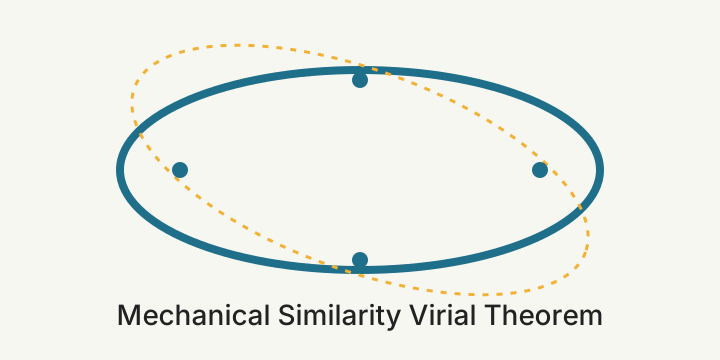
The picture to keep in mind: power-law potentials have a built-in scaling symmetry; orbits at different amplitudes are related by a stretch in space and a stretch in time, and the long-time average of kinetic energy equals a fixed fraction of the long-time average of potential energy.
Worked example [Beginner]
A planet orbits the Sun in a Newtonian gravitational potential . Two orbits are observed: one with a semi-major axis of astronomical unit and period year (Earth), and one with semi-major axis astronomical units. What is the second orbit's period?
The potential is a power of the distance with exponent . Mechanical similarity says that if you stretch every distance by a factor , time stretches by . Setting (the stretch in distance from to astronomical units), the time stretch is . So the second orbit's period is years.
Now check the virial theorem on the original orbit. The exponent of the potential is , so , equivalently . The total energy on a bound orbit is the average of , which equals . Since for an attractive gravitational potential, the average total energy is negative — exactly the signature of a bound orbit. The numerical value recovers the standard "the kinetic energy on a bound Keplerian orbit averages to the negative of the total energy".
What this tells us: the scaling rule predicts Kepler's third law from the inverse-square force alone, and the virial theorem connects the average kinetic energy of a bound system to its total energy — both consequences of a single homogeneity property of the potential.
Check your understanding [Beginner]
Formal definition [Intermediate+]
Homogeneous potential. A smooth function is homogeneous of degree if for every and every , where . The defining identity differentiated in at is the Euler identity
valid on the open set where is smooth. Standard examples: (Newtonian gravity, ); (harmonic oscillator, ); for any real (); free particle (homogeneous of every degree, a degenerate case excluded from what follows).
Scaling transformation. For and , the -rescaling acts on a parametrised curve by
Each particle's position is stretched by and the time parameter is stretched by . The velocity scales as and the acceleration as .
Mechanical similarity. A Lagrangian of the form with and homogeneous of degree is mechanically similar under the rescaling iff the rescaled curve satisfies the Euler-Lagrange equations whenever does. The compatibility condition (derived in the Key theorem below) is
Time average. For a continuous function , the long-time average is
when the limit exists. For a bounded periodic trajectory of period the average coincides with the period-average ; for a bounded non-periodic trajectory the existence of the limit is a delicate analytic property which holds for any continuous function evaluated along a bounded trajectory in an autonomous Hamiltonian system whose orbit closure carries an invariant probability measure (a standing assumption in what follows).
Bounded trajectory. A trajectory of an autonomous Hamiltonian system is bounded if there is a constant such that and for all . Boundedness is automatic on energy levels at which the level set is compact; for homogeneous of degree with or with and , the bounded-trajectory hypothesis is satisfied by the orbits of physical interest.
Sign convention. Throughout this unit, time-averages are denoted by overbars: is the long-time average of the kinetic energy , and the long-time average of the potential energy . The Lagrangian sign convention is with and the potential energy (positive for repulsive, negative for attractive at long range).
Counterexamples to common slips
- The Euler identity needs differentiability at . For the Kepler potential , homogeneity holds on but not at the origin; both mechanical-similarity scaling and the virial theorem are statements about trajectories that avoid the singular point, equivalently about orbits with strictly positive angular momentum. The collision orbit is a singular limit and must be excised.
- Boundedness is essential for the virial theorem. A particle in with confines orbits for every energy, so the virial theorem applies; the same potential with confines orbits only for (Kepler-type) — the scattering trajectories with escape to infinity and the virial theorem does not apply.
- Mechanical similarity is not a Galilean symmetry. The scaling is not an element of the Galilean group
05.00.06; it is a discrete-parameter rescaling of the Lagrangian that maps solutions to solutions of a rescaled Lagrangian . The action rescales by , not by unity. The Euler-Lagrange equations are unchanged because they are insensitive to overall scaling of , but the Noether procedure of05.00.04does not apply directly.
Key theorem with proof [Intermediate+]
Theorem (Landau-Lifshitz §10 — mechanical similarity). Let on with and a smooth function homogeneous of degree on . Under the rescaling , the rescaled curve solves the Euler-Lagrange equations of iff does, provided
Consequently, for any family of geometrically similar bounded orbits (orbits related by an overall spatial rescaling), the period scales as where is a characteristic length scale. Equivalently, using the energy as the family parameter, , which specialises to Kepler's third law when and to isochronism independent of amplitude when .
Proof of the scaling rule. The Euler-Lagrange equations of are . Apply the chain rule to : and . By the homogeneity of in the position argument, (differentiating the homogeneity identity in ). Substitute:
and
The rescaled equations of motion agree iff , equivalently , equivalently (taking positive roots since ).
Proof of the period-amplitude relation. Let be a periodic solution of period on a bounded orbit of characteristic length (e.g., the maximum of over a period). The rescaled curve is then a periodic solution of period on an orbit of length . With , the period and length transform as
Eliminating via gives , i.e. within the family.
The energy along an orbit of length scales as (since is homogeneous of degree and is comparable to on a typical orbit). Hence , and substituting yields .
Specialisations. For (Newtonian gravity): , , recovering Kepler's third law . For (harmonic oscillator): , independent of — isochronism. For (inverse-cube potential): , . For (linear potential, uniform gravity): , , the pendulum-fall scaling.
Bridge. The mechanical-similarity argument here builds toward the virial theorem in the Master tier: both rest on the same Euler identity for a homogeneous potential of degree , but where similarity extracts the period-amplitude relation by rescaling a single orbit, the virial theorem extracts the energy partition by time-averaging along one. The bridge is the Lagrange identity , which is exactly the second time derivative of along a Newtonian trajectory; applying Euler's identity to the right side and time-averaging on a bounded orbit identifies with . This is exactly the foundational reason the same homogeneity exponent governs both Kepler's third law and the energy partition on bound orbits: the central insight is that homogeneity of controls how the equations of motion respond to rescaling, and this single property generalises to the moment-map and dilation-invariance arguments that appear again in 05.00.04 (Noether's theorem) and in conformal-symplectic geometry. Putting these together one sees that the period-amplitude scaling, the virial energy partition, and Kepler's third law are three faces of one underlying scaling identity; the bridge is the Euler identity for homogeneous functions, and this is exactly what makes the inverse-square law special as the unique power-law force whose orbits close.
Exercises [Intermediate+]
Advanced results [Master]
Mechanical similarity and the virial theorem are two consequences of a single algebraic property: the Euler identity for a function homogeneous of degree . Read in one direction, the identity says that an infinitesimal dilation of position by changes by , and tracking this through the Lagrangian reproduces the scaling rule . Read in the other, it says that contracting the position against the force — the virial of Clausius — is proportional to , and time-averaging along a bounded trajectory converts this into the energy partition.
Theorem (Lagrange-Jacobi identity). For an -particle Newtonian system with potential on , the polar moment satisfies
where is the force on particle . The expression is the virial of Clausius. For homogeneous of degree , the Lagrange-Jacobi identity simplifies to .
Theorem (Clausius virial theorem). Let on with the standard kinetic energy and a smooth function homogeneous of degree on . For any bounded trajectory whose long-time averages and exist (e.g., by Birkhoff ergodic theorem applied to the closed-orbit invariant measure),
Equivalently, the average total energy satisfies .
Kepler problem in detail. For the virial theorem gives , hence . On a bound elliptical Kepler orbit of semi-major axis the total energy is the constant (Kepler's energy formula), and the virial theorem produces and , the latter agreeing with the direct calculation once for a Kepler ellipse is recognised (a classical orbital-mechanics identity). Combined with Kepler's third law from mechanical similarity, the unit hand-builds the entire energy-period-orbit-size phenomenology of the Kepler problem from the single homogeneity exponent .
Stellar-dynamical virial theorem. Chandrasekhar (1942) extended the virial theorem to a continuous gravitating fluid: for a self-gravitating star or galaxy in dynamical equilibrium, where is the bulk kinetic energy, the gravitational self-energy (negative), and the internal thermal energy with adiabatic index . For a cold (), purely gravitating system, recovers . For an isothermal sphere (), the thermal term vanishes too. The application to the Coma galaxy cluster by Fritz Zwicky in 1933 was the first quantitative evidence that the gravitating mass of a galaxy cluster exceeds its luminous mass by a large factor — what we now call dark matter.
Tensor virial theorem. Sharpening the scalar virial to a Cartesian-component identity, the tensor virial theorem (Parker 1954, Chandrasekhar-Lebovitz 1962) states where , , and . Time-averaging on a bounded trajectory gives . Equilibrium configurations of rotating stars (Maclaurin and Jacobi ellipsoids) are classified by the eigenvalue spectrum of the tensor virial.
Quantum virial theorem. For a quantum-mechanical Hamiltonian with homogeneous of degree , the expectation value in any bound stationary state satisfies . Proof: for a stationary state, and by direct commutator calculation using and Euler's identity for . The hydrogen atom ground state with has eV and eV — exact ratios that follow from the Coulomb potential's homogeneity alone, without ever solving the Schrödinger equation.
Statistical-mechanical virial expansion. Clausius's original 1870 application of the virial theorem was to the statistical mechanics of a gas: averaging over a thermal ensemble produces the virial equation of state relating pressure, volume, temperature, and the cluster integrals governed by inter-particle forces. The ideal-gas law is the leading term; the virial coefficients encode the deviations from ideality and are computable as integrals over pair, triplet, and higher correlation functions. This is the direct ancestor of the modern statistical-mechanics treatment of imperfect gases (Mayer 1937, Ursell 1927).
Bertrand's theorem and the special status of and . Mechanical similarity tells us that the period of an orbit depends on its amplitude through . A central-force potential produces closed bound orbits for every initial condition in precisely two cases: (Kepler, ) and (harmonic, ). This is Bertrand's theorem (1873). The proof uses a perturbative analysis of the apsidal angle (the angle traversed between perihelion and aphelion) as a function of energy and angular momentum: closure requires the apsidal angle to be a rational multiple of independent of the orbit, which forces the potential to one of these two forms. Mechanical similarity does not alone explain Bertrand; it sets the stage. The Kepler problem's superintegrability (the extra Laplace-Runge-Lenz conserved vector) and the harmonic oscillator's superintegrability (the Fradkin tensor) are the algebraic shadows of Bertrand closure.
Generalised virial in field theory. The Lagrange-Jacobi identity generalises to relativistic field theories: the trace of the stress-energy tensor plays the role of , and the virial theorem becomes the statement that on stationary classical configurations. For a scale-invariant theory (conformal field theory in the classical sense), identically, and the virial relation is automatic. The trace anomaly of quantum field theory measures the breaking of this scale invariance under renormalisation; the Coleman-Weinberg mechanism and dimensional transmutation in QCD are downstream consequences.
Synthesis. Mechanical similarity and the virial theorem are the two algebraic faces of the homogeneity property of the potential energy. The foundational reason these results organise so much of mechanics is that the Euler identity for homogeneous functions is exactly the response of to the one-parameter group of position dilations, and this dilation is exactly the symmetry that maps an orbit at one amplitude to a geometrically similar orbit at another. The bridge is the Lagrange-Jacobi identity in the homogeneous case, which is exactly the second moment of the equations of motion under the dilation generator. The central insight is that the period-amplitude relation, the kinetic-potential energy partition, Kepler's third law, the Zwicky virial mass of a galaxy cluster, and the quantum-virial ratio for a Coulomb bound state are five specialisations of one identity.
Putting these together generalises to a moment-map picture: position dilation is not a Hamiltonian symmetry in the strict sense (it does not preserve the symplectic form on phase space; it rescales it), but it is a conformal symplectic symmetry, and the virial identity is exactly the moment-map equation for the dilation generator on the conformal symplectic group. The bridge is that conformal-symplectic structures admit moment-map theories in their own right, with the virial functional playing the role of the moment map; this pattern recurs in 05.00.04 (Noether's theorem applied to genuine symmetries) and in conformal-Hamiltonian dynamics. The foundational reason the same homogeneity exponent appears in both the period-amplitude relation and the virial energy partition is that both are descended from a single first-integral relation along the dilation flow; this is exactly the kind of organising identity that the Lagrange-Jacobi framework makes manifest, and the synthesis identifies the virial relation with the dilation moment-map equation in a way that generalises far beyond Newtonian point-mass systems.
Full proof set [Master]
Proposition (Euler identity for homogeneous functions). Let be smooth and homogeneous of degree : for . Then
Proof. Fix . The function vanishes identically on . Differentiate in at : .
Proposition (Lagrange-Jacobi identity). For an -particle Newtonian system on with the polar moment along a solution,
If furthermore is homogeneous of degree , the identity simplifies to .
Proof. Differentiate once: , using symmetry of the inner product. Differentiate again: . Substitute Newton's law: . When is homogeneous of degree , apply the Euler identity to the second term: , yielding .
Proposition (Clausius virial theorem). Let with and smooth and homogeneous of degree on . Suppose is a solution of the Euler-Lagrange equations, that the trajectory is bounded ( and for some and all ), and that the long-time averages and exist. Then
Proof. By the Lagrange-Jacobi identity (homogeneous case), . Integrate from to and divide by :
where and are the truncated averages.
Now is uniformly bounded under the boundedness hypothesis, so the boundary term tends to as . By hypothesis the truncated averages converge: and as . The limit of the equation reads , equivalently .
Proposition (mechanical similarity, full form). Let on with smooth and homogeneous of degree on , and let be a solution of the Euler-Lagrange equations. For any , define on with . Then is a solution of the Euler-Lagrange equations of the same Lagrangian, and the action transforms as .
Proof of the solution-mapping. Done in the Intermediate Key theorem; the substitution converts the rescaled Newton equation into the original Newton equation along .
Proof of the action-scaling. The action of the rescaled trajectory is
Substitute and :
Change variables , :
The kinetic-energy coefficient is ; the potential-energy coefficient is . With , both coefficients equal :
Therefore , completing the action-scaling claim. The matching of the two coefficients to the same power of is exactly the algebraic content of mechanical similarity.
Proposition (period-amplitude scaling for homogeneous potentials). Under the hypotheses of the preceding proposition, suppose is a periodic solution of period with characteristic length scale . Then for any , with is a periodic solution of period with characteristic length , and .
Proof. The solution-mapping proposition gives that is a solution. Periodicity: , so . The maximum: , so . The ratio .
Connections [Master]
Lagrangian on
05.00.01. Mechanical similarity is a statement about Lagrangian systems of the form on the tangent bundle of configuration space, and the proof of the scaling rule is a direct calculation in the Euler-Lagrange equations of05.00.01. The Lagrange-Jacobi identity used in the virial theorem is the second time derivative of the polar moment along a solution of the Euler-Lagrange equations, with Newton's law substituted in.Noether's theorem
05.00.04. Position dilation is not a genuine symmetry of the action — it rescales by rather than leaving it invariant — but in the conformal sense (rescaling by a constant leaves the equations of motion unchanged) it generates a conformal Noether-like conservation law. The virial integral is the conformal-Noether charge of the dilation generator, and its non-conservation along trajectories is exactly — the integrated form of the Lagrange-Jacobi identity. The genuine-Noether framework of05.00.04handles strict symmetries; mechanical similarity sits one level up.Galilean-Newtonian setup
05.00.06. The Galilean group is the symmetry group of the spacetime stage; the position-dilation symmetry of mechanical similarity is not in the Galilean group — it is a separate one-parameter family of rescalings that depends on the homogeneity exponent of the specific potential, and that maps trajectories to trajectories of a rescaled (but Galilean-equivalent) Lagrangian. The contrast between Galilean covariance (universal, kinematic) and similarity (potential-dependent, dynamical) is the structural distinction between the two notions of "symmetry" relevant to Newtonian mechanics.Hamilton's principle
05.00.02. The action-scaling identity shows that mechanical similarity rescales the action by a -dependent constant but does not depend on the path within a family of similar orbits. The variational principle is therefore equally satisfied by all orbits in the family, and the period-amplitude relation is a consequence of evaluating the action functional on the similar-orbit family.First integrals and the conserved-quantity catalogue
02.12.12. The virial theorem is a long-time-averaged version of a non-conserved quantity ( — the dilation generator); its time-average partitions the conserved energy among kinetic and potential components in a fixed ratio dictated by the homogeneity exponent. Energy conservation along Hamiltonian flows is the most basic first integral catalogued in02.12.12, and the virial relation is the leading statistical-mechanical consequence of energy conservation when the potential is homogeneous.Kepler problem and Bertrand's theorem. The combination of Kepler's third law (from mechanical similarity at ) and the closure of bound orbits in Kepler () and harmonic-oscillator () potentials is Bertrand's theorem (1873): these are the only two central-force potentials with all bound orbits closed. The mechanical-similarity scaling sets up the calculation; Bertrand's argument fills in the apsidal-angle analysis. The Kepler problem also possesses an extra conserved Laplace-Runge-Lenz vector beyond the angular momentum, and the harmonic oscillator possesses the Fradkin tensor; both are signatures of the superintegrability that the homogeneity-exponent specialisations and enable.
Historical & philosophical context [Master]
Johannes Kepler's Astronomia Nova (1609) [pending] and Harmonices Mundi (1619) [pending] established the three planetary laws from Tycho Brahe's observations of Mars and the other planets. The third law, , was the empirical period-amplitude relation; Kepler had no theoretical derivation, and the law was an inductive generalisation across the six known planets. Isaac Newton's Principia (1687) [Newton 1687] derived the third law from the inverse-square gravitational force, in what is now recognised as the prototypical mechanical-similarity calculation: the homogeneity exponent of the Newtonian potential forces the period-amplitude relation , and the constant of proportionality involves as the only dimensional parameter. The reading of Newton's argument as a consequence of homogeneity rather than as a special calculation is a later organisational insight, due primarily to Lagrange (Mécanique analytique, 1788) and made fully explicit in the 20th-century geometric-mechanics literature.
Rudolf Clausius's On a mechanical theorem applicable to heat (1870) [pending] introduced the virial theorem in the kinetic theory of gases. Clausius coined the term virial (from Latin vis, force) for the time-averaged quantity , and proved that for any bounded mechanical system in thermal equilibrium, the time-averaged kinetic energy equals the virial. Specialising to a homogeneous force law of degree recovers the modern form , though Clausius's original interest was the application to imperfect gases. The connection between the Clausius virial and the equation of state — leading to the virial expansion — was the central application; the gravitational and astrophysical applications came later.
The systematic Lagrangian formulation of mechanical similarity belongs to Landau and Lifshitz's Mechanics §10 (first Russian edition 1940) [pending], which presents the scaling argument and the virial theorem as twin consequences of the same homogeneity property of . Arnold's Mathematical Methods of Classical Mechanics §22 (first Russian edition 1974) [pending] further geometrised the picture, framing the dilation as a one-parameter family of rescalings of the configuration manifold and the virial theorem as a long-time-average identity for the moment .
Fritz Zwicky's 1933 application of the virial theorem to the Coma galaxy cluster ([pending]) yielded a virial mass roughly times larger than the luminous mass — the first quantitative evidence for non-baryonic gravitating matter. The interpretation has fluctuated over the decades (initial reception was sceptical; Vera Rubin's 1970s rotation-curve measurements of individual galaxies reinforced the conclusion; modern cosmological measurements via the cosmic microwave background converge on of which is baryonic), but the virial mass remains a standard order-of-magnitude diagnostic for self-gravitating systems. Subrahmanyan Chandrasekhar's Principles of Stellar Dynamics (1942) [pending] developed the tensor virial theorem and applied it to rotating self-gravitating equilibria (Maclaurin and Jacobi ellipsoids), and his later collaboration with Lebovitz (1962-1969) extended the tensor virial to higher-moment virial theorems and to general-relativistic generalisations.
Bibliography [Master]
@article{Clausius1870Virial,
  author    = {Clausius, Rudolf},
  title     = {On a mechanical theorem applicable to heat},
  journal   = {The London, Edinburgh, and Dublin Philosophical Magazine and Journal of Science (4th series)},
  volume    = {40},
  pages     = {122--127},
  year      = {1870},
  note      = {Originator of the virial theorem}
}

@book{Kepler1609AstronomiaNova,
  author    = {Kepler, Johannes},
  title     = {Astronomia Nova},
  year      = {1609},
  address   = {Heidelberg},
  note      = {Originator of Kepler's laws I and II (elliptical orbits, equal areas)}
}

@book{Kepler1619HarmonicesMundi,
  author    = {Kepler, Johannes},
  title     = {Harmonices Mundi},
  year      = {1619},
  address   = {Linz},
  note      = {Originator of Kepler's third law $T^2 \propto a^3$ in Book V}
}

@book{Newton1687Principia,
  author    = {Newton, Isaac},
  title     = {Philosophiae Naturalis Principia Mathematica},
  year      = {1687},
  publisher = {Royal Society},
  address   = {London},
  note      = {First derivation of Kepler's third law from the inverse-square gravitational force; prototype mechanical-similarity calculation in Book III}
}

@book{LandauLifshitz1976Mechanics,
  author    = {Landau, L. D. and Lifshitz, E. M.},
  title     = {Mechanics},
  series    = {Course of Theoretical Physics, Volume 1},
  edition   = {3rd},
  publisher = {Pergamon Press},
  address   = {Oxford},
  year      = {1976},
  note      = {§10 Mechanical similarity --- the modern Lagrangian formulation of both the scaling rule and the virial theorem}
}

@book{Arnold1989Mathematical,
  author    = {Arnold, V. I.},
  title     = {Mathematical Methods of Classical Mechanics},
  series    = {Graduate Texts in Mathematics},
  volume    = {60},
  publisher = {Springer},
  edition   = {2nd},
  year      = {1989}
}

@article{Zwicky1933Coma,
  author    = {Zwicky, Fritz},
  title     = {Die Rotverschiebung von extragalaktischen Nebeln},
  journal   = {Helvetica Physica Acta},
  volume    = {6},
  pages     = {110--127},
  year      = {1933},
  note      = {First application of the virial theorem to a galaxy cluster (Coma); discovery of the missing-mass / dark-matter discrepancy}
}

@book{Chandrasekhar1942Stellar,
  author    = {Chandrasekhar, S.},
  title     = {Principles of Stellar Dynamics},
  publisher = {University of Chicago Press},
  address   = {Chicago},
  year      = {1942},
  note      = {Tensor virial theorem and applications to rotating self-gravitating equilibria}
}

@article{ChandrasekharLebovitz1962Tensor,
  author    = {Chandrasekhar, S. and Lebovitz, N. R.},
  title     = {On the oscillations and the stability of rotating gaseous masses. III. The distorted polytropes},
  journal   = {Astrophysical Journal},
  volume    = {136},
  pages     = {1082--1104},
  year      = {1962}
}

@article{Bertrand1873Theoreme,
  author    = {Bertrand, Joseph},
  title     = {Th{\'e}or{\`e}me relatif au mouvement d'un point attir{\'e} vers un centre fixe},
  journal   = {Comptes Rendus de l'Acad{\'e}mie des Sciences},
  volume    = {77},
  pages     = {849--853},
  year      = {1873},
  note      = {The only central-force potentials with all bound orbits closed are Kepler ($k = -1$) and harmonic ($k = 2$)}
}

@book{Pollard1966Celestial,
  author    = {Pollard, Harry},
  title     = {Mathematical Introduction to Celestial Mechanics},
  publisher = {Prentice-Hall},
  address   = {Englewood Cliffs, NJ},
  year      = {1966}
}

@book{Lagrange1788Mecanique,
  author    = {Lagrange, Joseph-Louis},
  title     = {M{\'e}canique analytique},
  publisher = {Veuve Desaint},
  address   = {Paris},
  year      = {1788}
}