Small oscillations and normal modes
Anchor (Master): Lagrange *Mecanique analytique* 1788 (originator of small-oscillation theory); Rayleigh *Theory of Sound* 1877 (originator of the Rayleigh quotient); Goldstein Ch. 6; Arnold Ch. 5
Intuition [Beginner]
When a mechanical system sits at a stable equilibrium — a pendulum hanging straight down, a mass balanced at the bottom of a bowl — small pushes make it oscillate. If the system has many moving parts (two masses connected by three springs, say), each part wiggles and pulls on its neighbours. The resulting motion looks complicated, but underneath there is a hidden simplicity.
The hidden simplicity is this: there exist special patterns of motion called normal modes in which every part oscillates at the same frequency. A two-mass system has two normal modes — one where both masses swing together, another where they swing opposite. Any motion, no matter how messy, can be decomposed into a combination of these modes, each vibrating at its own frequency.
The frequencies come from solving an eigenvalue problem involving two matrices: the mass matrix (recording the inertias) and the stiffness matrix (recording how strongly each part resists being pushed). The theorem is that every stable equilibrium produces orthogonal normal modes — a clean, decoupled set of independent oscillators hidden inside the original coupled system.
Visual [Beginner]
Two masses connected by three springs on a horizontal line. The first normal mode shows both masses moving right together then left together (low frequency). The second normal mode shows them moving in opposite directions (high frequency). A frequency spectrum below shows two sharp peaks at the two normal frequencies.
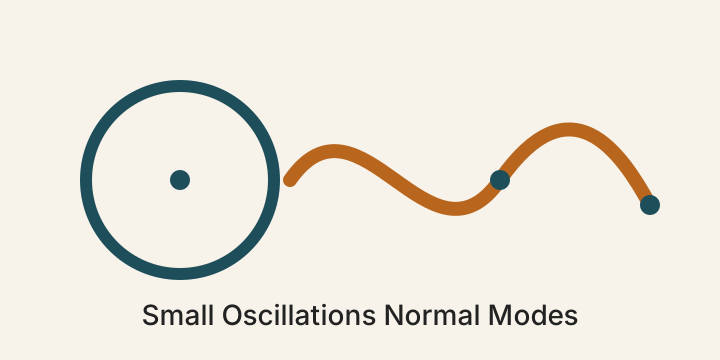
The picture to keep in mind: the coupled system's messy motion is a superposition of clean, sinusoidal normal modes, each with its own frequency and its own pattern of relative displacements.
Worked example [Beginner]
Two equal masses are connected by three identical springs with spring constant . The left spring attaches the left mass to a wall, the middle spring connects the two masses, and the right spring attaches the right mass to a second wall. Positions and measure displacements from equilibrium.
The mass matrix is (diagonal because the masses are independent). The stiffness matrix is (each mass feels its own two springs plus the coupling).
Step 1. Solve : , giving or .
Step 2. For : the eigenvector is — both masses move together.
Step 3. For : the eigenvector is — the masses move in opposite directions.
The normal frequencies are (low, in-phase) and (high, out-of-phase).
What this tells us: the coupled two-mass system hides two independent oscillators. Any motion is a mix of the in-phase mode (slow) and the out-of-phase mode (fast).
Check your understanding [Beginner]
Formal definition [Intermediate+]
Let (or a coordinate chart around an equilibrium on a manifold) and let with and . Suppose is an equilibrium: for all .
The mass matrix (or inertia matrix) at is
It is symmetric and positive-definite (since for ).
The stiffness matrix at is
It is symmetric. The equilibrium is stable if is positive-definite (strict local minimum of ).
The generalised eigenvalue problem for normal frequencies is
where is the mode shape (eigenvector) and is the normal frequency. Since is positive-definite, the problem is equivalent to the standard eigenvalue problem where .
Normal coordinates. Let be the matrix of -orthonormal eigenvectors: and . The change of coordinates transforms the Lagrangian into a decoupled sum
where . The coordinates are the normal coordinates, each satisfying an independent harmonic-oscillator equation .
Counterexamples to common slips
- The eigenvectors are not orthogonal in the Euclidean inner product unless is the identity. The correct orthogonality is — orthonormality with respect to the mass-weighted inner product. Forgetting the weighting is the most common mistake in normal-mode calculations.
- Degenerate eigenvalues do not prevent diagonalisation. When two or more eigenvalues coincide (), the corresponding eigenspace has dimension equal to the multiplicity, and any basis of the eigenspace gives valid normal modes. The decoupling still works.
- The stiffness matrix is the Hessian of , not the second derivative of . The kinetic energy is already quadratic in at (since the mass matrix is the coefficient), so it does not contribute to the restoring force. The restoring force comes entirely from .
Key theorem with proof [Intermediate+]
Theorem (orthogonal normal modes). Let be a symmetric positive-definite matrix and a symmetric matrix. The generalised eigenvalue problem has real eigenvalues with corresponding eigenvectors satisfying . If is also positive-definite, then all .
Proof. Since is symmetric positive-definite, it has a unique symmetric positive-definite square root . Define and . The generalised eigenvalue problem becomes , a standard eigenvalue problem for the real symmetric matrix .
By the spectral theorem for real symmetric matrices, has real eigenvalues (counted with multiplicity) and orthonormal eigenvectors with .
Transform back: . Then , giving the -orthonormality. The eigenvalue equation holds because translates to .
If is positive-definite, then for any : since both numerator and denominator are positive.
Bridge. The orthogonal-normal-modes theorem builds toward the symplectic normal form at an equilibrium of a general Hamiltonian system, where the quadratic Hamiltonian is brought to Williamson normal form by a symplectic transformation. The bridge between the Lagrangian eigenvalue problem and the symplectic framework is the Legendre transform: the mass matrix on becomes the inverse inertia matrix on , and the stiffness matrix becomes the Hessian of the Hamiltonian in position. This is exactly the structure that appears again in 05.09.03 (Birkhoff normal form), where the quadratic part of the Hamiltonian at an elliptic equilibrium is diagonalised by a symplectic change of variables. The foundational reason every stable equilibrium produces a decoupled oscillator system is that the quadratic form is the canonical form of a positive-definite quadratic Hamiltonian, and putting these together identifies normal-mode analysis as the linear-algebraic first step in the local qualitative theory of Hamiltonian equilibria.
Exercises [Intermediate+]
Advanced results [Master]
The Rayleigh quotient and eigenvalue bounds. The Rayleigh quotient satisfies for all , with equality at the eigenvectors. More precisely, the minimax characterisation gives
This is the Courant-Fischer theorem. It provides both upper and lower bounds on the normal frequencies from test vectors without solving the full eigenvalue problem.
Perturbation of normal frequencies. If the stiffness matrix is perturbed with symmetric, the eigenvalues shift as . The first-order shift depends only on the unperturbed mode shape — the sensitivity of each frequency to a change in stiffness is governed by the corresponding eigenvector. This is the basis of structural dynamics and vibration-based damage detection.
Forced oscillations and resonance. Adding a harmonic driving force to the decoupled system produces the equation where . The steady-state response is , which diverges as — the resonance condition. In physical systems, damping regularises this divergence, producing a finite peak of width proportional to the damping rate.
The Lagrangian at an equilibrium as a quadratic form. The second-order Taylor expansion of at a stable equilibrium is
where and are evaluated at . This is exactly the Lagrangian of coupled harmonic oscillators, and the normal-mode transformation diagonalises it. Higher-order terms in the Taylor expansion produce nonlinear couplings between normal modes, which are the starting point for the Birkhoff normal form 05.09.03.
Theorem (Williamson normal form for symplectic matrices). The linearised Hamiltonian flow at an elliptic equilibrium has a symplectic matrix whose eigenvalues come in complex-conjugate pairs on the unit circle. The quadratic Hamiltonian can be brought to the Williamson normal form by a symplectic change of coordinates.
Synthesis. Normal-mode analysis is the linear-algebraic foundation of the qualitative theory of mechanical equilibria. The foundational reason every stable equilibrium produces a decoupled oscillator system is that the Lagrangian is a quadratic form to leading order, and the spectral theorem for the symmetric matrix is exactly the algebraic content of the diagonalisation. The bridge between the mass-and-stiffness eigenvalue problem and the symplectic-geometric picture is the Legendre transform: the quadratic Lagrangian on transforms into a quadratic Hamiltonian on , and the normal-mode transformation is a symplectic change of coordinates that puts the Hamiltonian in Williamson normal form.
This is exactly the structure that appears again in 05.09.03 (Birkhoff normal form), where the nonlinear terms beyond quadratic are treated perturbatively. The central insight is that normal modes are the "correct coordinates" for the dynamics near equilibrium — they diagonalise the linear part and decouple the leading-order oscillations. Putting these together with the Rayleigh quotient identifies the lowest normal frequency as the minimum of the energy ratio , the pattern recurs in the variational characterisation of all eigenvalues (Courant-Fischer), and the foundational reason the eigenvalues are real and the eigenvectors orthogonal is the symmetry of and — a direct consequence of the variational origin of both matrices in the Lagrangian.
Full proof set [Master]
Proposition (spectral theorem for the generalised eigenvalue problem). Let be symmetric positive-definite and symmetric. Then has real eigenvalues and -orthonormal eigenvectors.
Proof. Set and . The spectral theorem for the real symmetric matrix gives real eigenvalues and orthonormal eigenvectors . Set . Then and .
Proposition (Rayleigh quotient characterisation). The smallest eigenvalue satisfies where .
Proof. Expand in the -orthonormal eigenbasis. Then . Equality at .
Proposition (normal-coordinate decoupling). The change of variables with the matrix of -orthonormal eigenvectors transforms into .
Proof. since and by the eigenvector equations.
Connections [Master]
Worked Lagrangian examples
05.00.09. The harmonic oscillator developed in05.00.09is the single-degree-of-freedom version of the normal-mode analysis. Every normal coordinate in this unit satisfies the same harmonic-oscillator equation .Lagrangian on
05.00.01. The mass and stiffness matrices are the second derivatives of the Lagrangian at equilibrium: from the fibre Hessian of and from the Hessian of . The normal-mode analysis is the quadratic approximation of the full Lagrangian framework of05.00.01.Birkhoff normal form
05.09.03. The quadratic (normal-mode) Hamiltonian is the leading term in the Taylor expansion of the full Hamiltonian at an elliptic equilibrium. The Birkhoff normal form extends the diagonalisation to higher orders by symplectic coordinate changes, treating the nonlinear couplings between normal modes perturbatively.Symplectic linear algebra
05.01.01. The normal-mode transformation is a symplectic change of coordinates on that brings the quadratic Hamiltonian to Williamson normal form. The symplectic structure developed in05.01.01is the framework within which the eigenvalue problem acquires its symplectic interpretation.Noether's theorem
05.00.04. Each decoupled normal mode has its own conserved energy , a consequence of the phase symmetry of each independent oscillator. The total energy is the sum of the modal energies.
Historical & philosophical context [Master]
Joseph-Louis Lagrange's Mecanique analytique (1788) [Lagrange 1788] introduced the systematic study of small oscillations about equilibrium, including the reduction to an eigenvalue problem for what are now called the mass and stiffness matrices. Lagrange worked in component notation and did not use matrix language, but his procedure — expand the Lagrangian to second order, compute the coefficients, and solve the resulting algebraic equation for the frequencies — is exactly the modern normal-mode analysis.
Lord Rayleigh's The Theory of Sound (1877) [Rayleigh 1877] deepened the theory considerably. Rayleigh introduced the quotient that bears his name, proved its variational characterisation, and used it to obtain upper and lower bounds on the normal frequencies of complex structures without solving the full eigenvalue problem. The Rayleigh quotient remains the standard tool in structural dynamics and finite-element analysis.
The matrix formulation of the eigenvalue problem, using the language of linear algebra, is due to the early 20th-century mechanicians (Routh, Stodola, Duncan) and was systematised by Courant and Hilbert in Methoden der mathematischen Physik (1924). The connection to the symplectic structure of Hamiltonian mechanics was made by Arnold and his school in the 1960s-70s, placing normal-mode analysis within the geometric theory of Hamiltonian systems at elliptic equilibria.
Bibliography [Master]
@book{Lagrange1788Mecanique,
  author    = {Lagrange, Joseph-Louis},
  title     = {M{\'e}canique analytique},
  year      = {1788},
  publisher = {Veuve Desaint},
  address   = {Paris}
}

@book{Rayleigh1877Sound,
  author    = {Rayleigh, J. W. S.},
  title     = {The Theory of Sound},
  publisher = {Macmillan},
  year      = {1877}
}

@book{Goldstein1980Classical,
  author    = {Goldstein, Herbert},
  title     = {Classical Mechanics},
  publisher = {Addison-Wesley},
  edition   = {2nd},
  year      = {1980}
}

@book{Arnold1989Mathematical,
  author    = {Arnold, V. I.},
  title     = {Mathematical Methods of Classical Mechanics},
  series    = {Graduate Texts in Mathematics},
  volume    = {60},
  publisher = {Springer},
  edition   = {2nd},
  year      = {1989}
}

@book{LandauLifshitz1976Mechanics,
  author    = {Landau, L. D. and Lifshitz, E. M.},
  title     = {Mechanics},
  series    = {Course of Theoretical Physics},
  volume    = {1},
  publisher = {Pergamon Press},
  edition   = {3rd},
  year      = {1976}
}