The Routhian
Anchor (Master): Routh 1877 Treatise on the Stability of a Given State of Motion; Arnold §15; Marsden-Ratiu Ch. 7; Abraham-Marsden Foundations of Mechanics §3.6
Intuition [Beginner]
Some mechanical systems have coordinates that "do not appear" in the energy function. Think of a bead sliding on a wire that is rotationally symmetric: the angle of rotation does not change the energy, even though the bead's angular speed matters. Such coordinates are called cyclic.
The Routhian is a single function that handles both kinds of coordinates at once. For each cyclic coordinate, you replace its velocity with a conserved quantity (the momentum associated with that coordinate). For the remaining coordinates, you keep the original velocity-based description. The result is a shorter, simpler equation of motion.
This idea matters because many physical systems — planets, rotating bodies, spinning tops — have one or more cyclic coordinates. The Routhian strips away the redundant information and leaves a reduced problem with fewer variables.
Visual [Beginner]
A diagram showing a two-dimensional phase space split into a cyclic block (drawn as a circular arrow, indicating rotation about a symmetry axis) and a non-cyclic block (drawn as a straight arrow with a spring or pendulum). The cyclic block feeds a conserved number into the Routhian; the non-cyclic block stays as a velocity-based variable.
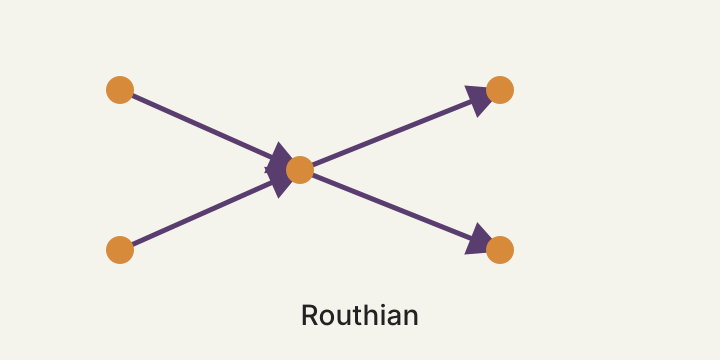
The picture highlights the asymmetry: one block contributes a fixed momentum, the other contributes a velocity that still changes with time.
Worked example [Beginner]
Consider a particle of mass moving on a flat plane with polar coordinates . The kinetic energy is and the potential energy is .
Step 1. Identify the cyclic coordinate: the angle does not appear in the energy, so it is cyclic. Its conjugate momentum is , which is constant during the motion.
Step 2. Solve for the cyclic velocity: .
Step 3. Build the Routhian for the non-cyclic coordinate . Replace by and subtract from the Lagrangian:
What this tells us: the original two-variable problem reduces to a one-variable problem in with an effective potential . This is the centrifugal barrier — the particle feels an outward push because the conserved angular momentum creates a repulsive term.
Check your understanding [Beginner]
Formal definition [Intermediate+]
Let be a smooth -dimensional configuration manifold with local coordinates . Suppose the first coordinates are cyclic for a Lagrangian : that is, for . Write for the cyclic and non-cyclic blocks and for the corresponding velocity blocks.
The conjugate momenta for the cyclic coordinates are
and since , the Euler-Lagrange equations give : the momenta are constants of motion 05.00.04.
The Routhian is the function of the non-cyclic coordinates, their velocities, and the conserved cyclic momenta defined by the partial Legendre transform:
where denotes the cyclic velocities solved in terms of the momenta via the linear system . This requires the cyclic-velocity Hessian to be invertible — the partial hyper-regularity condition.
The Routhian satisfies the Routh equations:
which are Euler-Lagrange equations in the non-cyclic variables, with the cyclic momenta treated as fixed parameters. Simultaneously, recovers the cyclic velocities from the conserved momenta.
Counterexamples to common slips
- The Routhian is not the full Hamiltonian. The Hamiltonian
05.02.01performs a Legendre transform on all coordinates. The Routhian transforms only the cyclic block; the non-cyclic block stays in Lagrangian form. - Cyclic does not mean stationary. The cyclic coordinate changes with time via . What is conserved is the momentum , not the coordinate itself.
- Partial hyper-regularity is required. If the cyclic-velocity Hessian is degenerate, the cyclic velocities cannot be solved uniquely in terms of the momenta, and the Routhian is not well-defined. This is the same regularity condition as in the Legendre transform
05.00.03but applied only to the cyclic block.
Key theorem with proof [Intermediate+]
Theorem (Routh 1877). Let be a smooth Lagrangian on with cyclic coordinates and partial hyper-regularity in the cyclic velocities. Fix constants . A curve satisfies the full Euler-Lagrange equations for with for all if and only if the non-cyclic block satisfies Routh's equations for and the cyclic velocities are recovered by evaluated at .
Proof. Decompose the Euler-Lagrange equations into the cyclic and non-cyclic blocks. For the cyclic block, gives (constant). The partial Legendre transform inverts the cyclic-velocity map: for uniquely determined functions .
Define the Routhian with replaced by and replaced by . Compute for :
Since , the second and third sums cancel. Hence . A parallel computation gives for . The Euler-Lagrange equations for in the non-cyclic block therefore coincide with the Euler-Lagrange equations for :
For the cyclic-velocity recovery, differentiate with respect to :
Collecting terms and using cancels the first and fourth sums against the second and third, leaving . Hence .
Bridge. Routh's theorem identifies the reduced dynamics on the non-cyclic block with the full dynamics modulo the conserved momenta, and this is exactly the bridge between Lagrangian mechanics 05.00.01 and Hamiltonian mechanics 05.02.01: the Routhian is the Lagrangian of the reduced system, and its conserved momenta are the Hamiltonian data eliminated from the reduced equations. The foundational reason the Routhian works is that the partial Legendre transform 05.00.03 preserves the variational structure — the Euler-Lagrange equations are invariant under the partial substitution — and this is dual to the full Legendre transform that produces the Hamiltonian. The construction builds toward symplectic reduction 05.04.02, where the Routhian appears as the Lagrangian on the quotient, and the pattern generalises to non-abelian symmetry groups via Routh reduction in the sense of Marsden-Ratiu.
Exercises [Intermediate+]
Advanced results [Master]
Theorem 1 (Routh reduction for non-abelian groups). Let be a Lie group acting freely and properly on with an invariant Lagrangian . The Routhian construction extends: the reduced dynamics on are governed by a modified Lagrangian (the Routhian for the group ) coupled to a connection-dependent curvature term, the amended potential. See Marsden-Ratiu [Marsden-Ratiu], Ch. 7.
Theorem 2 (Routhian and stability). For a mechanical system with a cyclic coordinate and conserved momentum , the equilibrium points of the Routhian system correspond to relative equilibria of the full system — trajectories that are orbits of the symmetry group. Routh 1877 [Routh] used this to study the stability of rotating rigid bodies: the Routhian effective potential determines the stability of the relative equilibrium.
Theorem 3 (Energy-momentum method). The second variation of the Routhian effective potential at a relative equilibrium, together with the locked inertia tensor , gives the definitive stability criterion. If is positive-definite on the space orthogonal to the symmetry directions, the relative equilibrium is Lyapunov-stable modulo the group action. This is the energy-momentum method of Marsden and Simo [Marsden-Simo].
Theorem 4 (Perturbation theory via the Routhian). For nearly integrable systems with slow cyclic coordinates, the Routhian provides the correct averaged system. Expand in the parameter measuring the deviation from integrability; the leading term gives the unperturbed Routhian dynamics on , and the first correction gives the secular drift of the actions. This framework underlies the Kolmogorov-Arnold-Moser (KAM) theorem's application to systems with symmetries 05.09.01.
Theorem 5 (Relation to Hamilton-Jacobi). The Routhian satisfies a reduced Hamilton-Jacobi equation. If is the non-cyclic action function with constants of integration , the Hamilton-Jacobi PDE for reads with the cyclic momenta appearing as parameters. This builds toward the full Hamilton-Jacobi theory 05.05.04.
Synthesis. The Routhian is the foundational reason that cyclic coordinates can be eliminated from a mechanical system without losing dynamical information: the partial Legendre transform 05.00.03 preserves the variational structure, and Routh's theorem identifies the reduced Euler-Lagrange equations with the full equations restricted to a momentum level set. The central insight is that conservation of momentum and the Euler-Lagrange equations are dual — one eliminates variables, the other governs the rest — and putting these together produces a self-contained reduced system. This is exactly the Lagrangian face of symplectic reduction 05.04.02: fixing the moment map level 05.04.01 and quotienting by the symmetry group is the Hamiltonian version of substituting into the Routhian. The construction generalises from abelian cyclic coordinates to non-abelian group actions via the amended potential and the mechanical connection, and the bridge between Routh's original stability analysis and the modern energy-momentum method is that both identify the second variation of the Routhian effective potential as the stability criterion. The pattern recurs throughout perturbation theory: the Routhian of a nearly integrable system gives the averaged equations, and the secular drift of the actions appears as a first-order correction.
Full proof set [Master]
Proposition 1. For a natural mechanical system with Riemannian and , and cyclic coordinates with the corresponding block of depending only on , the Routhian is
where and is the inverse of the cyclic block .
Proof. For a natural system, , so and . Then
The second term simplifies: (using ). So At , this gives the claimed form.
Proposition 2. The energy of the Routhian system equals the full mechanical energy of the original system.
Proof. Computed in Exercise 7 of the Intermediate section. The identity follows from for and the definition .
Connections [Master]
Legendre transform
05.00.03. The Routhian is the partial Legendre transform of in the cyclic velocity block; the non-cyclic block is untouched. The full Legendre transform gives the Hamiltonian; the partial version gives the Routhian. The cancellation mechanism in Routh's theorem is the same as the fibre-derivative inversion in the full transform.Noether's theorem
05.00.04. The cyclic coordinates are exactly the directions in which the Lagrangian has a continuous symmetry; Noether's theorem guarantees the conserved momenta that the Routhian exploits. The Routhian construction and Noether's theorem are two sides of the same symmetry.Symplectic reduction
05.04.02. Fixing the cyclic momenta and solving the cyclic velocities from the Routhian is the Lagrangian version of Marsden-Weinstein reduction: the moment map level corresponds to the momentum constraint, and the quotient is the reduced configuration space.Hamilton-Jacobi equation
05.05.04. The reduced Hamilton-Jacobi PDE for the Routhian governs the non-cyclic action function; the cyclic momenta appear as parameters. The full Hamilton-Jacobi theory recovers when all coordinates are treated via the full Legendre transform.Action-angle coordinates
05.02.04. For an integrable system, every coordinate can be made cyclic by the action-angle construction; the Routhian for all cyclic coordinates reduces to the Hamiltonian in action variables, and the frequency of each angle is .
Historical & philosophical context [Master]
Edward John Routh introduced the Routhian construction in his 1877 Treatise on the Stability of a Given State of Motion [Routh1877], motivated by the problem of determining the stability of rotating fluid masses and the steady motion of rigid bodies. Routh's innovation was to observe that cyclic coordinates can be eliminated from the variational principle by a partial Legendre substitution, producing a reduced Lagrangian whose equilibria are the relative equilibria of the full system. The construction was recognised by Thomson and Tait in their Treatise on Natural Philosophy and became a standard tool in British analytical mechanics.
The modern geometric formulation is due to Marsden and Ratiu [Marsden-Ratiu], who placed the Routhian inside the framework of symplectic reduction and showed that the amended potential in the Routhian is the curvature of the mechanical connection on the principal bundle . The energy-momentum method for stability (Marsden and Simo, 1990s [Marsden-Simo]) uses the second variation of the Routhian effective potential as the definitive criterion for stability of relative equilibria. Abraham-Marsden Foundations of Mechanics §3.6 [Abraham-Marsden] gives the canonical treatment of the Routhian as a partial Legendre transform.
Bibliography [Master]
@book{Routh1877,
  author    = {Routh, Edward John},
  title     = {Treatise on the Stability of a Given State of Motion},
  publisher = {Macmillan, London},
  year      = {1877}
}

@book{ArnoldClassical,
  author    = {Arnold, Vladimir I.},
  title     = {Mathematical Methods of Classical Mechanics},
  series    = {Graduate Texts in Mathematics},
  volume    = {60},
  publisher = {Springer},
  year      = {1989},
  edition   = {2nd}
}

@book{MarsdenRatiu,
  author    = {Marsden, Jerrold E. and Ratiu, Tudor S.},
  title     = {Introduction to Mechanics and Symmetry},
  publisher = {Springer},
  year      = {1999},
  edition   = {2nd}
}

@book{AbrahamMarsden,
  author    = {Abraham, Ralph and Marsden, Jerrold E.},
  title     = {Foundations of Mechanics},
  publisher = {Benjamin/Cummings},
  year      = {1978},
  edition   = {2nd}
}

@book{Goldstein,
  author    = {Goldstein, Herbert},
  title     = {Classical Mechanics},
  publisher = {Addison-Wesley},
  year      = {1980},
  edition   = {2nd}
}

@article{MarsdenSimo,
  author  = {Marsden, Jerrold E. and Simo, Jerrold C.},
  title   = {The Energy-Momentum Method},
  journal = {Acta Mechanica},
  volume  = {100},
  year    = {1993},
  pages   = {3--22}
}