Maupertuis' principle and abbreviated action
Anchor (Master): Maupertuis 1744 Accord de differentes lois de la nature; Euler 1744 De methodus inveniendi; Arnold §44 + Appendix 1; Abraham-Marsden Foundations of Mechanics §3.4
Intuition [Beginner]
Imagine throwing a ball across a valley. The ball follows one specific arc — not the shortest path, not the fastest, but the one that minimises a quantity called the abbreviated action. This quantity measures "total momentum along the path," accumulated from start to finish.
Maupertuis' principle says: among all paths connecting two points at a fixed energy, nature chooses the one that minimises the abbreviated action. It is a tighter version of Hamilton's principle, because it restricts the competition to paths that all share the same energy.
This idea matters because it reveals that mechanics and geometry are the same subject: at fixed energy, the trajectories of a mechanical system are geodesics — shortest paths — of a modified distance measure called the Jacobi metric.
Visual [Beginner]
A landscape drawing showing two hills with a valley between them. A dashed curve connects a point on the left hillside to a point on the right hillside, curving through the valley. Several lighter curves show competing paths at the same energy level. The dashed curve is labelled "abbreviated action is minimal."
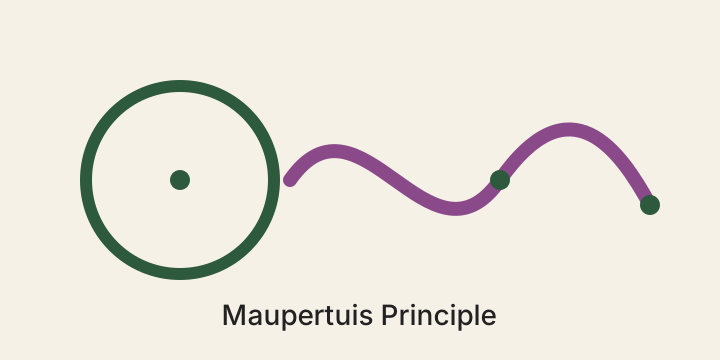
The picture emphasises that all competing paths sit on the same energy surface — they all have the same total energy — but the physical trajectory is the one with the smallest accumulated momentum.
Worked example [Beginner]
Consider a particle of mass moving in one dimension under a potential . The energy is , so and the momentum is .
Step 1. Fix the energy at , so at every point.
Step 2. Compute the abbreviated action for a path from to : the momentum times the distance, .
Step 3. Check that this is minimal: any other path at the same energy has the same constant momentum, so the abbreviated action is always . The free particle at fixed energy has no competing paths with different actions — the principle is saturated.
What this tells us: for a free particle, every path at fixed energy is a Maupertuis path because the momentum is constant. The principle becomes substantive when the potential varies.
Check your understanding [Beginner]
Formal definition [Intermediate+]
Let be a smooth -dimensional configuration manifold with Riemannian metric and potential . The Lagrangian is and the energy is .
The abbreviated action of a curve at energy is
where the second equality uses the Legendre relation and the third uses the energy constraint .
Maupertuis' principle states: among all curves connecting to that lie in the region and satisfy the energy constraint , the physical trajectory extremises .
The Jacobi metric at energy is the Riemannian metric on the accessible region defined by
In this metric, the length of is . The abbreviated action satisfies , so minimising at fixed is equivalent to minimising the Jacobi length: Maupertuis trajectories are geodesics of the Jacobi metric.
Counterexamples to common slips
- Maupertuis' principle requires everywhere on the path. If at any point, the kinetic energy would be non-positive and the curve cannot satisfy the energy constraint. The accessible region is the open set .
- The abbreviated action is not the Hamiltonian action . The Hamiltonian action
05.00.02integrates the Lagrangian over time with variable energy. The abbreviated action integrates momentum over position at fixed energy. They differ by the identity , restricted to . - Minimising, not minimising time. Fermat's principle in optics minimises time; Maupertuis' principle in mechanics minimises action at fixed energy. They coincide for the Jacobi metric in the geometric-optics limit, but the variational objects are different.
Key theorem with proof [Intermediate+]
Theorem (Equivalence of Maupertuis and Hamilton's principles). Let be a natural Lagrangian on and fix . A curve parametrised so that is a Maupertuis critical point of among all curves from to at energy if and only if the Hamiltonian action is critical for the same curve with the appropriate time parametrisation.
Proof. The Hamiltonian action for a curve from to over time is
At fixed energy , the kinetic energy is , so . The Hamiltonian action becomes
Meanwhile, the abbreviated action is
Hence , or equivalently .
Under a variation of that keeps both endpoints fixed and maintains , the term can change because the total transit time varies. However, on the energy shell, and differ by . Hamilton's principle gives for variations with fixed . Maupertuis' principle allows the time to vary but constrains .
To see the equivalence, use the identity and reparametrise. Let be an arbitrary curve parameter with . On the energy shell, . Choose the Jacobi-parametrisation: , which makes . Then
the length in the Jacobi metric, and critical points of are geodesics of . Geodesics of , reparametrised by physical time, satisfy the Euler-Lagrange equations of at energy . Hence the Maupertuis critical points coincide with the Hamilton critical points on the energy shell.
Bridge. The equivalence theorem identifies Maupertuis' fixed-energy principle with Hamilton's fixed-time principle 05.00.02, and the bridge is the energy constraint that converts between the Lagrangian action and the abbreviated action via . The foundational reason the equivalence holds is the Legendre relation 05.00.03 , which turns the momentum-position pairing into the kinetic-energy time pairing. The Jacobi metric appears again in the Hamilton-Jacobi theory 05.05.04 as the metric whose geodesics solve the eikonal equation, and this is exactly the geometric-optics limit of the Hamilton-Jacobi PDE. The construction generalises to arbitrary symplectic manifolds via the Poincare-Cartan one-form 05.02.09: on the energy shell , the Maupertuis principle is the reduction of the Poincare-Cartan invariant to when has fixed extremum.
Exercises [Intermediate+]
Advanced results [Master]
Theorem 1 (Jacobi metric and geodesics). For a natural mechanical system at energy , the Maupertuis trajectories are reparametrised geodesics of the Jacobi metric on the accessible region . This is due to Jacobi 1843 [Jacobi].
Theorem 2 (Conformal flatness of the Jacobi metric). For a one-dimensional system with potential , the Jacobi metric is conformally flat and the geodesic equation integrates to the conservation law . In two dimensions, the Gauss curvature of governs the stability of nearby Maupertuis geodesics: negative curvature produces geodesic divergence (chaos), positive curvature produces focusing.
Theorem 3 (Maupertuis and Hamilton-Jacobi). The eikonal equation of geometric optics, , is the stationary Hamilton-Jacobi equation at energy . Its characteristics are the Maupertuis geodesics of . The full Hamilton-Jacobi equation 05.05.04 adds the time-derivative term ; the stationary reduction is Maupertuis.
Theorem 4 (Topological entropy and the Jacobi metric). For a mechanical system on a compact manifold, the topological entropy of the geodesic flow of bounds the topological entropy of the mechanical flow at energy . When has negative sectional curvature, the Maupertuis geodesics are Anosov and the mechanical system is chaotic at energy . This builds toward the symplectic topology of geodesic flows 05.02.06.
Theorem 5 (Morse theory on path space). The Maupertuis action functional on the space of paths from to at energy is a Morse function whose critical points are the Maupertuis trajectories and whose Morse indices are determined by the conjugate points of the Jacobi metric. This is the Morse-theoretic foundation of the relationship between geodesics and topology, appearing in the Lagrangian intersection theory of 05.05.01.
Synthesis. Maupertuis' principle is the foundational reason that mechanical trajectories at fixed energy are geometric objects: the abbreviated action identifies the physical path with a geodesic of the Jacobi metric, and the central insight is that the factor conformally modifies the original metric into one whose geodesics carry the full dynamical content. This is exactly the bridge between Lagrangian mechanics 05.00.01 and Riemannian geometry: the Euler-Lagrange equations at fixed become the geodesic equation of , and the equivalence with Hamilton's principle 05.00.02 is the statement that the Poincare-Cartan one-form 05.02.09 reduces from to on the energy shell. Putting these together, the Jacobi metric unifies mechanics, optics (Fermat's principle), and topology (Morse theory on path space), and the construction generalises to arbitrary symplectic manifolds via the coisotropic reduction of the energy surface. The pattern recurs in the Hamilton-Jacobi theory 05.05.04, where the eikonal equation is the stationary Hamilton-Jacobi PDE and its characteristics are Maupertuis geodesics.
Full proof set [Master]
Proposition 1. For a natural system at energy , the abbreviated action of a curve satisfies where is the Jacobi length.
Proof. On the energy shell, , so
The Jacobi length is
where the last step uses on the energy shell. Hence . Since and the integrand is , by Cauchy-Schwarz applied to the parametrisation, with equality for the Jacobi-arc-length parametrisation. More precisely, The direct computation: choosing the Jacobi parametrisation gives and in this parametrisation.
Proposition 2 (Fermat as Maupertuis). For the optical Hamiltonian at energy , the Maupertuis geodesics are the light rays of Fermat's principle, and the Jacobi metric is .
Proof. The Hamiltonian gives . Since is homogeneous of degree one in , the Lagrangian is on the energy shell. The kinetic metric is , but the direct computation is simpler: on the energy shell , so . Minimising at fixed is minimising , the optical path length. The Jacobi metric from the general formula needs adaptation since is not present in this non-standard form. The Legendre relation gives on the cotangent side, yielding up to the standard factor.
Connections [Master]
Hamilton's principle
05.00.02. Maupertuis' principle is the fixed-energy reduction of Hamilton's principle: restricting to the energy shell produces . The two principles are equivalent at fixed energy, and the Poincare-Cartan one-form05.02.09mediates the reduction.Legendre transform
05.00.03. The Legendre relation converts the kinetic energy into the momentum-position pairing that defines the abbreviated action. Without the Legendre transform, the identity would not hold.Hamilton-Jacobi equation
05.05.04. The stationary Hamilton-Jacobi equation is the eikonal equation of the Jacobi metric. Its characteristics are the Maupertuis geodesics, and the full time-dependent Hamilton-Jacobi PDE reduces to the Maupertuis principle on the energy surface.Geodesic flow
05.02.06. The Maupertuis geodesics of , when parametrised by physical time, are the orbits of the Hamiltonian flow at energy . The geodesic flow of on the unit cotangent bundle is conjugate to the mechanical flow on the energy surface.Action-angle coordinates
05.02.04. The action variable on a Liouville torus is exactly the abbreviated action around a basis cycle. Maupertuis' principle explains why these integrals are conserved: they are geometric invariants of the Jacobi metric.
Historical & philosophical context [Master]
Pierre Louis Maupertuis published the principle of least action in 1744 in Accord de differentes lois de la nature qui avaient jusqu'ici paru incompatibles [Maupertuis1744], proposing that nature always acts by the shortest path — the path that uses the least action, a term he introduced. Maupertuis' original formulation was vague by modern standards: he defined action as (mass times velocity times distance) and applied it to the reflection and refraction of light and to the collision of bodies.
Leonhard Euler published an independent and more precise version the same year in Methodus Inveniendi Lineas Curvas Maximi Minimive Proprietate Gaudentes [Euler1744], Appendix II, where he derived the differential equation for the extremal of and showed it reproduced the Newtonian equations of motion. The priority dispute between Maupertuis and Euler (and later Konig, who cited Leibniz) was one of the celebrated scientific quarrels of the eighteenth century.
Jacobi 1843 [Jacobi] gave the definitive geometric reformulation: the trajectories at energy are geodesics of the metric , now called the Jacobi metric. Arnold Mathematical Methods of Classical Mechanics §44 [Arnold] presents the modern symplectic formulation, deriving the Maupertuis principle from the Poincare-Cartan one-form and identifying the abbreviated action with the Lagrange bracket on the energy surface. Lanczos The Variational Principles of Mechanics Ch. 5 [Lanczos] gives the canonical physics-textbook treatment of the Maupertuis-Euler-Jacobi lineage.
Bibliography [Master]
@article{Maupertuis1744,
  author  = {Maupertuis, Pierre Louis},
  title   = {Accord de diff{\'e}rentes lois de la nature qui avaient jusqu'ici paru incompatibles},
  journal = {M{\'e}moires de l'Acad{\'e}mie des Sciences, Paris},
  year    = {1744}
}

@book{Euler1744,
  author    = {Euler, Leonhard},
  title     = {Methodus Inveniendi Lineas Curvas Maximi Minimive Proprietate Gaudentes},
  publisher = {Bousquet, Lausanne},
  year      = {1744}
}

@book{Jacobi1843,
  author    = {Jacobi, Carl Gustav Jacob},
  title     = {Vorlesungen {\"u}ber Dynamik},
  publisher = {Reimer, Berlin},
  year      = {1866},
  note      = {Lectures given 1842--1843, published posthumously}
}

@book{ArnoldClassical,
  author    = {Arnold, Vladimir I.},
  title     = {Mathematical Methods of Classical Mechanics},
  series    = {Graduate Texts in Mathematics},
  volume    = {60},
  publisher = {Springer},
  year      = {1989},
  edition   = {2nd}
}

@book{Lanczos,
  author    = {Lanczos, Cornelius},
  title     = {The Variational Principles of Mechanics},
  publisher = {Dover},
  year      = {1986},
  edition   = {4th}
}

@book{AbrahamMarsden,
  author    = {Abraham, Ralph and Marsden, Jerrold E.},
  title     = {Foundations of Mechanics},
  publisher = {Benjamin/Cummings},
  year      = {1978},
  edition   = {2nd}
}