Mittag-Leffler theorem on C
Anchor (Master): Mittag-Leffler 1884 *Sur la representation analytique des fonctions monogenes uniformes*; Ahlfors *Complex Analysis* Ch. 5; Conway *Functions of One Complex Variable* Ch. VII; Narasimhan *Complex Analysis in One Variable*
Intuition [Beginner]
The Weierstrass factorisation theorem constructs entire functions with prescribed zeros. The Mittag-Leffler theorem does the same job for poles: given a list of locations where you want poles, together with the singular part of the function at each pole (the principal part), there exists a meromorphic function with exactly those poles and exactly those principal parts.
A pole is a point where a function blows up, like at . The principal part is the collection of negative-power terms in the Laurent expansion around that point. For at , the principal part is just itself. The Mittag-Leffler theorem says you can independently choose the location and principal part at each pole, and a single function exists realising all of them.
The naive approach would be to add up all the principal parts. But an infinite sum of terms like diverges in general. Mittag-Leffler's insight was to subtract a well-chosen polynomial from each term to force convergence, then add back the polynomial contributions separately.
Why does this concept exist? The Weierstrass factorisation handles zeros; the Mittag-Leffler theorem handles poles. Together they provide complete control over the singular structure of meromorphic functions on the complex plane.
Visual [Beginner]
A diagram showing the complex plane with marked pole locations arranged in a sequence moving outward toward infinity. At each pole, a small Laurent expansion box shows the principal part. An arrow indicates that the Mittag-Leffler theorem constructs a single meromorphic function whose pole set is exactly the marked points with the specified principal parts.
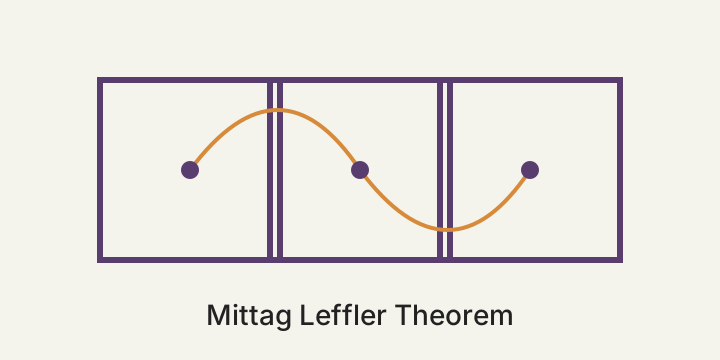
The picture shows that the Mittag-Leffler theorem assembles scattered local data (pole + principal part at each point) into a single global meromorphic function.
Worked example [Beginner]
Construct a meromorphic function with simple poles at with residue at each pole.
Step 1. The principal part at each pole is . At : the principal part is . At : the principal part is . At : the principal part is .
Step 2. With only three poles, the sum converges without correction. The function is . This is a well-defined meromorphic function on all of with poles exactly at and residue at each.
Step 3. For infinitely many poles at , the sum diverges. The Mittag-Leffler correction subtracts the Taylor polynomial of each term about : at , the term has Taylor expansion . Subtracting the constant term gives , which is small enough for convergence.
What this tells us: finitely many prescribed poles pose no problem. For infinitely many, convergence-producing corrections are needed to make the infinite sum converge.
Check your understanding [Beginner]
Formal definition [Intermediate+]
Let be a sequence of distinct complex numbers with and . At each , let
be a polynomial in (the principal part at ). The Mittag-Leffler theorem asserts the existence of a meromorphic function with exactly these poles and principal parts. [Ahlfors Ch. 5]
Definition (Convergence-producing polynomials). For each , let be the Taylor polynomial of about , truncated at degree . The polynomial is chosen so that is small on the disc , forcing the sum to converge uniformly on compact subsets of .
Counterexamples to common slips
- The naive sum of principal parts diverges in general. The series diverges when diverges (e.g., ). The convergence-producing polynomials are essential.
- The correction polynomials depend on the ordering of the poles. Different orderings of produce different corrections but yield the same global meromorphic function up to an additive entire function.
- The principal part must be a polynomial in . An infinite series of negative powers corresponds to an essential singularity, not a pole. The Mittag-Leffler theorem handles poles (finite principal parts) only.
Key theorem with proof [Intermediate+]
Theorem (Mittag-Leffler on ). Let be a sequence of distinct non-zero complex numbers with . Let be polynomials (without constant terms). Then there exists a meromorphic function on whose poles are exactly at with principal part at each , and which is holomorphic on . Explicitly,
where is a polynomial chosen so that the series converges uniformly on compact subsets of .
Proof. For each , the function is holomorphic on (since the pole is outside this disc). Its Taylor expansion about converges on . Let be the partial sum of this Taylor expansion through degree , where is chosen so that
for all . This is possible because is holomorphic on , so its Taylor series converges uniformly on compact subsets, and the remainder after degree can be made arbitrarily small on by choosing large enough.
Now fix a compact set . There exists with . For , the estimate above gives for all . The terms with are finite in number and each is meromorphic on with a pole only at . The tail converges uniformly on by the Weierstrass -test (dominated by ), and each term in the tail is holomorphic on (since ).
Therefore the full series converges uniformly on (minus any ) to a function that is meromorphic with poles exactly at and the prescribed principal parts. If a pole at is also desired, with principal part , simply add to the result.
Bridge. The Mittag-Leffler theorem builds toward 06.01.25 the Weierstrass -function, where it appears again as the construction tool for the simplest doubly-periodic meromorphic function with prescribed poles on a lattice. The foundational reason the theorem works is that convergence-producing polynomials play the same role for poles that Weierstrass primary factors play for zeros: both correct the divergence of a naive infinite sum or product. This is exactly the bridge from the additive pole-prescription problem to the multiplicative zero-prescription problem solved by 06.01.17 the Weierstrass factorisation theorem. The central insight is that local data (pole + principal part) can be patched into a global meromorphic function because the corrections carry no poles — they are entire. Putting these together identifies the Mittag-Leffler theorem as the additive half of the function-construction programme, and the pattern generalises to open Riemann surfaces via Runge approximation.
Exercises [Intermediate+]
Advanced results [Master]
Mittag-Leffler for open Riemann surfaces. Let be an open (non-compact) Riemann surface, a discrete set of points in , and prescribed principal parts at each . Then there exists a meromorphic function on with exactly these poles and principal parts. The proof uses Runge approximation on the exhaustion of by compact subsets: at each stage, the partial meromorphic function is corrected by a holomorphic function that approximates the next principal part on the compact subset. The key input is that on open Riemann surfaces, holomorphic functions separate points and give local coordinates. This result appears in [Narasimhan Ch. 2].
Partial fractions for . The identity
is the paradigmatic application of the Mittag-Leffler theorem. The function has simple poles at every integer with residue . The convergence correction makes the series converge because . This expansion is the starting point for the partial fraction expansions of (by differentiation) and (via the identity ).
Mittag-Leffler and the Weierstrass -function. The Weierstrass -function 06.01.25 is constructed via the Mittag-Leffler prescription: poles at each lattice point with principal part . The Mittag-Leffler theorem guarantees existence; the specific symmetry of the lattice ensures the resulting function is doubly periodic.
Runge approximation and Mittag-Leffler. The Runge approximation theorem 06.01.14 provides an alternative proof of the Mittag-Leffler theorem: given a meromorphic function on a compact set (consisting of principal parts at the poles), Runge's theorem produces a global meromorphic function approximating it on . Exhausting by compact sets and iterating gives the global result. This approach generalises to open Riemann surfaces, where Runge approximation with poles on an exterior disk replaces the convergence-producing polynomial technique.
Interpolation theorem. A complementary result to Mittag-Leffler: given a discrete set in and prescribed values , there exists an entire function with for all . The proof uses the Weierstrass factorisation to construct with zeros at , then applies Mittag-Leffler to construct a meromorphic function with simple poles at and residues , and sets . This is the Weierstrass interpolation theorem.
Synthesis. The Mittag-Leffler theorem is the foundational reason that the pole structure of a meromorphic function is freely prescribable, and the central insight is that convergence-producing polynomials remove the obstruction to patching local principal parts into a global function. This is exactly the additive counterpart of the Weierstrass factorisation theorem 06.01.17, where primary factors play the role of convergence corrections for zeros. Putting these together, every meromorphic function on is determined by its poles (via Mittag-Leffler) and its zeros (via Weierstrass), and the bridge is between the local principal-part data and the global function. The pattern recurs on open Riemann surfaces via Runge approximation, where Mittag-Leffler generalises to arbitrary open Riemann surfaces, and the pattern generalises through the interpolation theorem (which combines both Mittag-Leffler and Weierstrass to prescribe values at discrete points).
Full proof set [Master]
Proposition (Runge-based Mittag-Leffler). Let be an exhaustion of by compact sets with connected. Let be meromorphic on a neighbourhood of with poles and prescribed principal parts. Then there exist entire functions such that converges to a global meromorphic function with the prescribed poles and principal parts.
Proof. Construct the function by induction on the exhaustion. Set . Given meromorphic on a neighbourhood of with the correct principal parts, the difference is holomorphic on (the principal parts cancel at common poles). By Runge's theorem (since is connected), there exists an entire function such that for all . Set .
Wait — simplify. Set restricted appropriately. The precise construction: on , the function is holomorphic. By Runge, there exists an entire with on . Set . Then is meromorphic near with the correct principal parts (the approximation error is holomorphic, hence introduces no new poles).
The sequence converges uniformly on each (for , the difference converges by the Runge estimates). The limit is meromorphic on all of with the prescribed poles and principal parts.
Proposition (Mittag-Leffler with finitely many poles is rational). If is a finite set and are the prescribed principal parts, then is a rational function with the prescribed poles.
Proof. Each is a rational function (a polynomial in ). The sum of finitely many rational functions is rational. The poles of the sum are contained in , and at each the principal part is because the other terms are holomorphic at .
Connections [Master]
Weierstrass factorisation theorem
06.01.17. The Mittag-Leffler theorem is the additive counterpart of the Weierstrass factorisation theorem: Weierstrass prescribes zeros via infinite products with primary factors, while Mittag-Leffler prescribes poles via infinite sums with convergence-producing polynomials. Together they provide complete control over the singular and zero structure of meromorphic functions on .Power series and Laurent series
06.01.27. The Mittag-Leffler theorem relies on the Laurent expansion at each pole: the principal part is the negative-power portion of the Laurent series. The convergence-producing polynomials are Taylor polynomials of these principal parts, and the convergence argument uses the same Weierstrass -test that underpins the theory of power series convergence.Weierstrass -function
06.01.25. The Weierstrass -function is the most important application of the Mittag-Leffler theorem: it constructs the simplest doubly-periodic meromorphic function by prescribing double poles at each lattice point with principal part . The Mittag-Leffler theorem guarantees the existence of such a function, and the lattice symmetry ensures double periodicity.
Historical & philosophical context [Master]
Mittag-Leffler 1884 [Mittag-Leffler 1884], in Sur la representation analytique des fonctions monogenes uniformes published in the Acta Societatis Scientiarum Fennicae, established the theorem that bears his name as the additive counterpart to Weierstrass's multiplicative factorisation. Mittag-Leffler was a Swedish mathematician who founded the journal Acta Mathematica and was a central figure in the internationalisation of mathematics in the late 19th century. His theorem completed the programme, begun by Weierstrass, of constructing functions with prescribed singularities.
The generalisation to open Riemann surfaces was achieved through the Runge approximation theorem and its Riemann-surface versions, developed by Behnke and Stein 1949 [Narasimhan Ch. 2]. The canonical modern treatments are Ahlfors Complex Analysis Ch. 5 and Conway Functions of One Complex Variable Ch. VII. The Mittag-Leffler theorem, together with the Weierstrass factorisation and the Runge approximation theorem, forms the trilogy of function-existence results that underpin the theory of meromorphic functions on Riemann surfaces.
Bibliography [Master]
@article{MittagLeffler1884,
  author = {Mittag-Leffler, G\"osta},
  title = {Sur la repr\'esentation analytique des fonctions monog\`enes uniformes d'une variable ind\'ependante},
  journal = {Acta Societatis Scientiarum Fennicae},
  year = {1884},
  note = {Mittag-Leffler theorem for prescribed poles and principal parts}
}

@book{Ahlfors1979,
  author = {Ahlfors, Lars V.},
  title = {Complex Analysis},
  publisher = {McGraw-Hill},
  year = {1979},
  edition = {3rd},
  note = {Chapter 5: Mittag-Leffler theorem, partial fractions}
}

@book{Conway1978,
  author = {Conway, John B.},
  title = {Functions of One Complex Variable I},
  publisher = {Springer},
  year = {1978},
  series = {Graduate Texts in Mathematics 11},
  note = {Chapter VII: Mittag-Leffler theorem}
}

@book{SteinShakarchi2003,
  author = {Stein, Elias M. and Shakarchi, Rami},
  title = {Complex Analysis},
  publisher = {Princeton University Press},
  year = {2003},
  volume = {II},
  note = {Princeton Lectures in Analysis, Chapter 5}
}

@book{Narasimhan2001,
  author = {Narasimhan, Raghavan},
  title = {Complex Analysis in One Variable},
  publisher = {Birkh\"auser},
  year = {2001},
  edition = {2nd},
  note = {Chapter 2: Mittag-Leffler on open Riemann surfaces}
}