Phragmen-Lindelof principle
Anchor (Master): Phragmen 1885 Acta Math.; Lindelof 1908 Rend. Circ. Mat. Palermo; Titchmarsh Theory of Functions Ch. 5
Intuition [Beginner]
The maximum principle says a holomorphic function on a bounded region achieves its maximum on the boundary. But what if the region is unbounded — like a half-plane or a sector? The boundary goes to infinity, and a function might grow without bound.
The Phragmen-Lindelof principle fixes this. It says: if a function is holomorphic in an unbounded region, bounded on the finite parts of the boundary, and does not grow too fast as you go to infinity, then the function is bounded everywhere inside.
The growth rate matters. For a sector of opening angle , the function must grow slower than . If the opening is (a quarter-plane), the function must grow slower than . In the half-plane (), the function must grow slower than .
Visual [Beginner]
An infinite sector of opening angle in the complex plane. Along the two boundary rays, the function values are bounded (marked with a horizontal line at height ). Inside the sector, the function is also bounded, because the growth restriction prevents it from sneaking up to infinity.
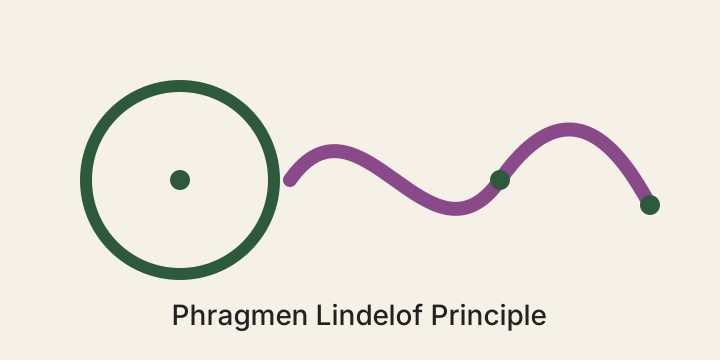
The principle extends the maximum principle from bounded to unbounded domains by adding a growth-speed limit.
Worked example [Beginner]
Consider in the right half-plane . On the boundary , we have , which is bounded by .
Does Phragmen-Lindelof apply? The sector is a half-plane (), so the growth bound is . But , which grows faster than . The growth condition is violated, so the principle does not apply.
Indeed, is unbounded in the half-plane: along the positive real axis, . This confirms that the growth restriction is necessary.
Check your understanding [Beginner]
Formal definition [Intermediate+]
Definition (Sector of opening ). The sector has opening angle .
Definition (Order of growth). An entire function has order if where .
The Phragmen-Lindelof principle constrains the behaviour of functions of finite order on unbounded regions.
Key theorem with proof [Intermediate+]
Theorem (Phragmen-Lindelof, sector version). Let be holomorphic in the sector and continuous on . Suppose on the boundary rays and in for some . Then for all .
Proof. The strategy is to build an auxiliary function that forces decay and apply the standard maximum principle on a truncated region.
Step 1: Auxiliary function. Define for . Here is the branch with on the positive real axis. For with :
Since , we have , so this factor decays exponentially in .
Step 2: Boundary estimate. On the boundary rays , we have , so . Combined with , we get on the rays.
Step 3: Truncated region. On the arc within the sector, . Since , for large the factor dominates: as . For large enough, on the arc.
Step 4: Apply maximum principle. On the truncated sector (boundary rays + arc of radius ), everywhere on the boundary. By the maximum principle for bounded domains, inside.
Step 5: Let . For any fixed , for all . Letting : .
Bridge. This argument generalises the classical maximum principle by introducing an auxiliary damping function; the central insight is that exponential decay of overwhelms any sub-exponential growth of . The same pattern appears again in the theory of entire functions where the indicator function captures directional growth. This builds toward the Hadamard factorisation theorem where growth-order constraints determine the function up to finitely many parameters. The bridge is that controlling growth at infinity and boundedness on the boundary together force boundedness everywhere — the Phragmen-Lindelof principle is the maximum principle upgraded for unbounded geometry.
Exercises [Intermediate+]
Advanced results [Master]
The indicator function. For an entire function of order and finite type, the indicator function captures the directional growth. The Phragmen-Lindelof principle constrains : if on a set of measure , then everywhere.
Beurling's version (1949) sharpens Phragmen-Lindelof by replacing the boundary estimate with an bound, showing that control on the boundary plus growth control implies pointwise bounds inside. This connects to harmonic measure and the theory of Hardy spaces.
Applications to Dirichlet series. The Phragmen-Lindelof principle is the main tool for bounding Dirichlet series in vertical strips. If converges for and extends meromorphically with known growth on and , then Phragmen-Lindelof bounds in between — the convexity bound for -functions.
Synthesis. The Phragmen-Lindelof principle is the analytic-continuation companion to the maximum principle; it appears again in the theory of entire functions of finite order where the indicator function quantifies directional growth. The central insight is that growth-rate constraints and boundary bounds together force interior bounds, even on unbounded domains. This pattern recurs in the theory of Hardy spaces on the half-plane, in the convexity bounds for -functions, and in the theory of subharmonic functions. The bridge is that Phragmen-Lindelof identifies "growth speed" as the key additional parameter for maximum principles on unbounded regions — the principle is dual to the Hadamard three-circles theorem in that both relate growth to geometry.
Full proof set [Master]
Proposition (Strip version). Let be holomorphic on the strip and continuous on . Suppose on and , and in . Then for all .
Proof. Define . For with , the function has positive real part when and large. The factor decays super-exponentially as , overwhelming the growth of . On the boundary lines , the factor has modulus (since is real), giving . Apply the maximum principle on the truncated strip and let , then .
Connections [Master]
The maximum modulus principle 06.01.12 is the bounded-domain precursor; Phragmen-Lindelof extends it to unbounded regions by adding a growth-speed condition.
Power series and Laurent series 06.01.27 determine the order of growth of entire and meromorphic functions; Phragmen-Lindelof uses growth order as the key parameter.
The Hadamard factorisation theorem (related to 06.01.17) classifies entire functions by their order; the indicator function that Phragmen-Lindelof constrains appears in the Hadamard framework as the directional component of growth.
Schottky's and Bloch's theorems 06.01.29 provide growth bounds for functions omitting values; these are complementary to Phragmen-Lindelof, which constrains growth from boundary data.
Bibliography [Master]
@article{phragmen1885,
  author = {Phragm{\'e}n, Lars Edvard},
  title = {Sur une extension d'un th{\'e}or{\`e}me classique de la th{\'e}orie des fonctions},
  journal = {Acta Math.},
  volume = {6},
  pages = {317--328},
  year = {1885}
}

@article{lindelof1908,
  author = {Lindel{\"o}f, Ernst},
  title = {Sur un principe g{\'e}n{\'e}ral de l'analyse et ses applications {\`a} la th{\'e}orie de la repr{\'e}sentation conforme},
  journal = {Rend. Circ. Mat. Palermo},
  volume = {25},
  pages = {153--179},
  year = {1908}
}

@book{stein-shakarchi-complex,
  author = {Stein, Elias M. and Shakarchi, Rami},
  title = {Complex Analysis},
  series = {Princeton Lectures in Analysis},
  volume = {II},
  publisher = {Princeton University Press},
  year = {2003}
}

@book{titchmarsh-functions,
  author = {Titchmarsh, Edward C.},
  title = {The Theory of Functions},
  edition = {2},
  publisher = {Oxford University Press},
  year = {1939}
}
Historical & philosophical context [Master]
Lars Edvard Phragmen proved the initial version in 1885 [Phragmen 1885] for half-planes. Ernst Lindelof extended it to sectors in 1908 [Lindelof 1908]. Both were Finnish mathematicians working in the tradition of Weierstrassian analysis.
The principle resolved a fundamental gap in the maximum principle: without boundedness of the domain, the maximum principle fails (consider on a half-plane). Phragmen and Lindelof showed that a growth-speed condition restores the conclusion.
The principle has become indispensable in analytic number theory (convexity bounds for -functions), harmonic analysis (Hardy spaces on half-planes), and the theory of entire functions. It represents one of the deepest examples of how quantitative growth information compensates for geometric unboundedness.