Index / winding number of a closed curve
Anchor (Master): Cauchy 1825 *Memoire sur les integrales definies*; Gauss 1813 (topological index); Ahlfors *Complex Analysis* Ch. 4; Conway *Functions of One Complex Variable* Ch. IV; Burckel *An Introduction to Classical Complex Analysis* Vol. 1
Intuition [Beginner]
Imagine walking around a tree while holding a rope tied to it. If you walk around the tree once and return to your starting point, the rope wraps around the tree exactly one time. Walk around it twice in the same direction, and the rope wraps twice. Walk around it once in the opposite direction, and the rope wraps negative one times (it unwinds).
The winding number is this rope-counting idea made precise for any closed curve in the plane around any point. Given a closed loop (a curve that returns to its starting point) and a point that does not lie on the loop, the winding number counts how many times the loop wraps around , with counterclockwise wrapping counted positively and clockwise wrapping counted negatively.
The winding number is always a whole number: or . If the point is outside the loop, the winding number is (the loop does not enclose the point). If the loop winds counterclockwise around three times, the winding number is .
Why does this concept exist? The winding number is the topological invariant underlying Cauchy's integral formula and the residue theorem. It measures the relationship between a closed curve and the points in its complement, and this measurement is the engine that powers complex integration.
Visual [Beginner]
A diagram showing a closed curve in the plane winding counterclockwise around a point exactly twice. The point is marked with a dot, and the curve is drawn so its path circles two full rotations before closing. A second point outside the curve is shown with winding number .
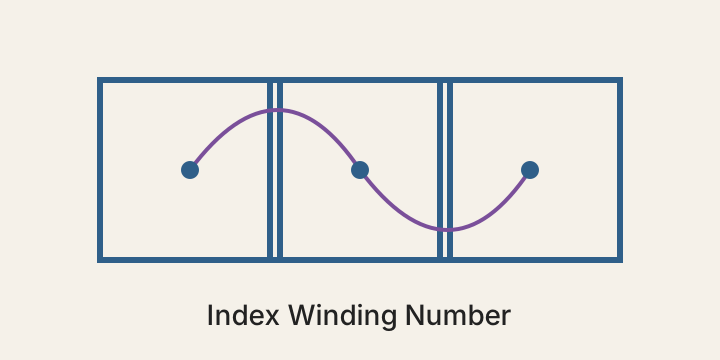
The picture shows that the winding number is a property of the pair (curve, point), not of the curve alone: different points see the same curve with different winding numbers.
Worked example [Beginner]
Consider the circle of radius centred at the origin, traversed once counterclockwise. Compute the winding number around the point (inside the circle) and around (outside the circle).
Step 1. The point lies inside the circle of radius centred at the origin, since . The circle winds once counterclockwise around , so .
Step 2. The point lies outside the circle since . The circle does not enclose , so .
Step 3. If the same circle were traversed three times counterclockwise, the winding number around would be , not .
What this tells us: the winding number counts net encirclements. A point inside a once-traversed circle gets winding number ; a point outside gets .
Check your understanding [Beginner]
Formal definition [Intermediate+]
Let be a piecewise closed curve and let with . The winding number (or index) of around is
The integral is well-defined because is continuous on the compact set and hence integrable. The factor normalises the integral so that the result is an integer.
An equivalent characterisation: writing with a continuous choice of the argument , the winding number is . This is the net change in the argument of divided by , which counts the number of full rotations of the position vector from to .
Definition (Homotopy of curves). Two closed curves in an open set are homotopic (as closed curves in ) if there exists a continuous map with , , and for all . [Ahlfors Ch. 4]
Counterexamples to common slips
- The winding number is not defined when lies on . The integrand has a pole on the contour, so the integral is not defined. The winding number requires .
- The curve must be closed. The winding number is defined only for closed curves (). For an open curve, the integral is generally not an integer.
- The winding number is not the geometric "number of crossings." A figure-eight curve crosses itself once but can have winding number around a point near the crossing, because the two lobes contribute and respectively.
Key theorem with proof [Intermediate+]
Theorem (Integer-valued and locally constant). Let be a piecewise closed curve and . Then:
(i) is an integer.
(ii) is constant on each connected component of .
Proof of (i). Parametrise by with . Define
Differentiate using the chain rule:
Now compute the derivative of :
Hence is constant. At : , so . At : since . Therefore , which means
Since if and only if , the winding number is an integer.
Proof of (ii). Let lie in the same connected component of . There exists a continuous path with and . The function
is continuous in (the denominator is bounded away from zero since ). By part (i), is integer-valued. A continuous integer-valued function on is constant, so .
Bridge. The integer-valuedness of the winding number builds toward 06.01.03 the residue theorem, where it appears again as the multiplicity factor counting how many times the contour encloses each singularity. The foundational reason the winding number is central to complex analysis is that it is exactly the topological measurement that makes Cauchy's integral formula work: the factor integrated around a loop picks up for each net encirclement of . The central insight is that the winding number identifies the homotopy class of a closed curve in with an integer, and this is the bridge from topology to analysis. The pattern generalises through the argument principle (counting zeros and poles by the winding number of around the origin) and Rouche's theorem (comparing winding numbers of two functions on the same contour).
Exercises [Intermediate+]
Advanced results [Master]
Argument principle. For meromorphic with no zeros or poles on a closed curve , the number of zeros minus poles inside is . This is the bridge from the winding number to root-counting: the winding number of the image curve around the origin encodes the zero-pole balance of inside the domain. The argument principle appears throughout complex analysis as the primary tool for localising and counting solutions to . [Conway Ch. IV]
Rouche's theorem. If on , then and have the same number of zeros inside . Rouche's theorem converts an inequality on a boundary into equality of interior root counts. The standard application is the localisation of polynomial roots: if and , then on the dominant term satisfies , so has exactly zeros inside (the fundamental theorem of algebra).
Degree of a map. For a continuous map , the winding number where is any parametrisation of , is well-defined and is called the topological degree of . Homotopic maps have the same degree, and the converse holds: two maps are homotopic if and only if they have the same degree. This is the prototypical homotopy-classification result and appears again in 06.01.07 the Riemann sphere as the degree of a rational map.
Jordan curve theorem (winding-number form). For a Jordan curve (a simple closed curve), the complement has exactly two connected components: the bounded interior (where ) and the unbounded exterior (where ). The winding number distinguishes the two components and provides the analytic characterisation of "inside" versus "outside" a Jordan curve.
Cauchy's integral formula via the winding number. If is holomorphic on an open set and is a null-homologous cycle in (a cycle with for all ), then for :
This is the general form of Cauchy's integral formula, where the winding number is the multiplicity factor that appears whenever a contour wraps around a singularity.
Synthesis. The winding number is the foundational reason that topology controls complex analysis, and the central insight is that the integer identifies the homotopy class of a closed curve in with an element of . Putting these together with the Cauchy integral formula, every contour integral of a holomorphic function is determined by the winding numbers of the contour around the singularities of the integrand. This is exactly the structure that generalises through the argument principle (where replaces and the winding number counts zeros) and Rouche's theorem (where the winding number provides stability under perturbation). The bridge is between the continuous world of curves and the discrete world of integers, and the winding number is the map that carries the topological data into the analytic formulas.
Full proof set [Master]
Proposition (Cauchy's theorem for a disc). If is holomorphic on an open set containing the closed disc , then .
Proof. Let for . Since is holomorphic on a neighbourhood of , it has a power series expansion converging uniformly on . Then
For : has the antiderivative which is single-valued, so the integral over the closed curve vanishes. For : . But does not appear in the power series (which starts at ), so every term vanishes and the integral is .
Proposition (Winding number under composition). If is holomorphic on a neighbourhood of and for all , then .
Proof. Parametrise by . Then and . By definition:
Substituting , , this becomes .
Connections [Master]
Residue theorem
06.01.03. The winding number is the multiplicity factor in the residue theorem: . Each singularity contributes its residue weighted by the number of times the contour winds around it. The residue theorem is the direct generalisation of the winding-number integral from to arbitrary meromorphic functions.Power series and Laurent series
06.01.27. The winding number integral extracts the Laurent coefficients of around . For this gives the function value via Cauchy's formula; for general it gives the coefficient in the Laurent expansion. The winding number is the normalising factor that makes these coefficient extractions work.Cauchy integral formula
06.01.02. Cauchy's integral formula is the winding-number weighted evaluation formula for holomorphic functions. When (a single counterclockwise encirclement), this reduces to the classical formula. The winding number is the geometric factor that makes the formula correct for contours of arbitrary winding.
Historical & philosophical context [Master]
Gauss 1813 [Gauss 1813], in work on hypergeometric series, implicitly used the winding number as a topological invariant counting the number of times a curve encircles a point. The concept remained informal in Gauss's work but laid the groundwork for the topological viewpoint. Cauchy 1825 [Cauchy 1825], in his Memoire sur les integrales definies, introduced the contour integral and proved Cauchy's theorem, which in its general form relies on the winding number as the multiplicity factor.
The modern formulation, with the winding number defined as and proved to be integer-valued, is due to the systematic development of complex integration in the late 19th century. The homotopy invariance and the identification of the winding number with the topological degree were crystallised in the work of Brouwer 1911 on the degree of a map. The argument principle and Rouche's theorem, which convert winding numbers into root-counting tools, were established by Rouche 1862 and are the primary computational applications. The canonical modern treatments are Ahlfors Complex Analysis Ch. 4 and Conway Functions of One Complex Variable Ch. IV [Conway Ch. IV].
Bibliography [Master]
@article{Cauchy1825,
  author = {Cauchy, Augustin-Louis},
  title = {M\'emoire sur les int\'egrales d\'efinies prises entre des limites imaginaires},
  journal = {M\'em. Sav. \'Etrang. Acad. Sci. Paris},
  year = {1825},
  note = {Foundation of contour integration and Cauchy's theorem}
}

@article{Rouche1862,
  author = {Rouch\'e, Eug\`ene},
  title = {M\'emoire sur la s\'erie de Lagrange},
  journal = {Journal de l'\'Ecole Polytechnique},
  volume = {22},
  year = {1862},
  pages = {193--425},
  note = {Rouch\'e's theorem for comparing zeros of holomorphic functions}
}

@book{Ahlfors1979,
  author = {Ahlfors, Lars V.},
  title = {Complex Analysis},
  publisher = {McGraw-Hill},
  year = {1979},
  edition = {3rd},
  note = {Chapter 4: complex integration, Cauchy's theorem, winding numbers}
}

@book{Conway1978,
  author = {Conway, John B.},
  title = {Functions of One Complex Variable I},
  publisher = {Springer},
  year = {1978},
  series = {Graduate Texts in Mathematics 11},
  note = {Chapter IV: complex integration, argument principle, Rouch\'e's theorem}
}

@book{Burckel1979,
  author = {Burckel, Robert B.},
  title = {An Introduction to Classical Complex Analysis},
  publisher = {Birkh\"auser},
  year = {1979},
  volume = {1},
  note = {Comprehensive treatment of winding numbers and Cauchy's theorem}
}

@book{SteinShakarchi2003,
  author = {Stein, Elias M. and Shakarchi, Rami},
  title = {Complex Analysis},
  publisher = {Princeton University Press},
  year = {2003},
  volume = {II},
  note = {Princeton Lectures in Analysis, Chapter 2}
}