Runge approximation on RS
Anchor (Master): Runge 1885 *Zur Theorie der eindeutigen analytischen Functionen* (Acta Math. 6, originator: planar polynomial / rational approximation theorem on $\mathbb{C}$); Behnke-Stein 1949 *Entwicklung analytischer Funktionen auf Riemannschen Flächen* (Math. Ann. 120, originator: Runge approximation on a non-compact Riemann surface); Forster *Lectures on Riemann Surfaces* §30; Hörmander *An Introduction to Complex Analysis in Several Variables* Ch. III; Grauert-Remmert *Theory of Stein Spaces* (Grundlehren 236); Cartan séminaire 1951–53 (cohomological reformulation); Mergelyan 1951 (sharp uniform-on-compact-set version)
Intuition [Beginner]
You live on a non-compact Riemann surface — the complex plane , the punctured disc, an annulus, a strip, or a compact surface with a discrete set of points removed. Inside sits a small open region — a disc, a finite union of discs, or any relatively compact open set. A holomorphic function is defined on alone, with no information about what happens outside. The Runge approximation theorem asks: can be approximated on every compact subset of by a function defined on the whole of ?
The answer is yes, provided sits inside in a topologically simple way. The technical condition is that the complement has no relatively compact island — every connected piece of outside has to reach infinity on . When that condition holds, is called a Runge set in , and Runge's theorem says: every holomorphic function on is the uniform-on-compact-subsets limit of restrictions of global holomorphic functions on .
Carl Runge proved this for in 1885 by an explicit pole-pushing argument with Cauchy integrals. Heinrich Behnke and Karl Stein in 1949 extended the theorem to every non-compact Riemann surface, using the same cohomological engine that produces the Mittag-Leffler theorem and the Cousin I theorem. The lift from to a general Riemann surface is automatic once the underlying surface is known to be Stein.
Visual [Beginner]
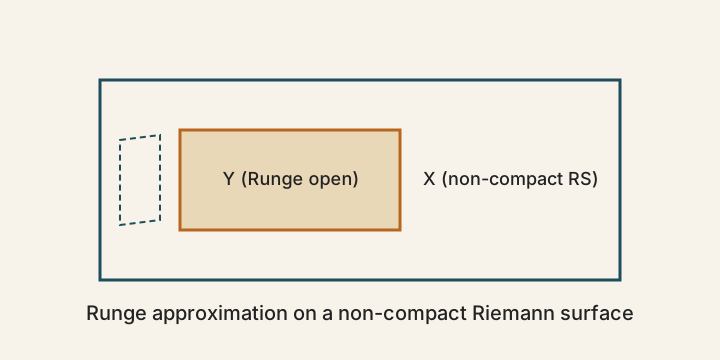
A non-compact Riemann surface is drawn as a band stretching off to the right. Inside the band sits a smaller bounded region , shaded; its boundary is a closed loop in . The complement is the unshaded region outside the loop, with arrows showing that every connected piece of extends out to the right edge of (no enclosed island). A graph of a holomorphic function on is shown above; a graph of a global function on is shown below, with approximating uniformly on the visible compact region.
Worked example [Beginner]
Take and a disc not containing the origin — say , the open unit disc centred at . The function is holomorphic on (the origin is outside the disc). Runge's theorem on says is the uniform-on-compact-subsets limit of polynomials in .
The construction is the Taylor expansion of about the centre : $$ \frac{1}{z} = \frac{1}{5 + (z - 5)} = \frac{1}{5} \cdot \frac{1}{1 + (z - 5)/5} = \frac{1}{5} - \frac{z - 5}{25} + \frac{(z - 5)^2}{125} - \frac{(z - 5)^3}{625} + \cdots $$ The geometric series converges absolutely on , and absolutely and uniformly on every compact subset of that disc. Truncating after terms gives a polynomial in (after multiplying out the powers of ) that approximates on every compact subset of to any prescribed accuracy.
The Runge condition is met because is connected — the unshaded region outside the disc reaches infinity in a single piece — so no rational poles are needed and polynomials suffice. The cancelled-out singularity at , which is inside , never appears in the approximating polynomials because the disc stays a positive distance from the origin and the Taylor series at converges on a disc that does not reach .
A second example shows what goes wrong when the Runge condition fails. Take the annulus inside . The complement has two connected components: the closed unit disc and the closed unbounded region . The first component, the closed unit disc, is relatively compact in — a bounded set — so is not a Runge set in .
The function on cannot be uniformly approximated by polynomials on the annulus: any polynomial limit would be a holomorphic extension of across the unit disc, and the singularity at blocks that extension. Rational functions with a pole at are needed — and they suffice, because is itself such a rational function.
Check your understanding [Beginner]
Formal definition [Intermediate+]
Let be a Riemann surface and an open subset. Write for the ring of holomorphic functions on and for the ring of holomorphic functions on . The restriction map , , is a ring homomorphism. Equip with the topology of uniform convergence on compact subsets: in when for every compact .
Definition (Runge set). A relatively compact open subset is a Runge set in when no connected component of is relatively compact in . Equivalently, every connected component of contains an end of — a non-relatively-compact piece reaching out to the topological boundary at infinity.
A more general formulation drops the relative compactness of and asks instead that the relatively compact connected components of be empty. For a relatively compact , the definition above is the standard one.
Definition (Runge pair). A pair with a Riemann surface and an open subset is a Runge pair when is a Runge set in . The defining-condition is purely topological; no holomorphic data on or enter.
Theorem (Runge approximation on a non-compact Riemann surface). Let be a connected non-compact Riemann surface and a Runge pair with open. Then the restriction map has dense image in the topology of uniform convergence on compact subsets of .
Theorem (meromorphic version). Let be a connected non-compact Riemann surface, a Runge pair, and a discrete locally finite subset. Every holomorphic on is the uniform-on-compact-subsets limit of meromorphic functions holomorphic on .
Equivalent reformulations.
- Cohomological surjectivity. The Runge density on is equivalent to the surjectivity of the restriction map on compactly-supported coherent cohomology, dual under Serre duality to the closure-density of .
- Vanishing-of-cap-product. The defining condition on — no relatively compact component of — is equivalent to the vanishing of the cap product with in Borel-Moore homology, the topological obstruction to extending compactly-supported -cycles in across .
- Exhaustion by Runge opens. Every relatively compact open is contained in a Runge open with . Iterating, admits an exhaustion with and each a Runge pair.
Notation. : global holomorphic functions; : global meromorphic functions; : relatively compact in; : compactly-supported sheaf cohomology; : compact, contained in .
Counterexamples to common slips
The Runge condition is on , not on . A simply connected inside is not automatically Runge — the topological obstruction is the complement, not itself. On , the disc is Runge (complement reaches infinity); the annulus is not (complement has a bounded component). Both are open subsets of , but only one is Runge.
Polynomials versus rationals. The classical Runge theorem on an open approximates by rational functions with poles in . Polynomials suffice when is connected — every pole can be pushed to . On a general Riemann surface, the analogue of polynomials is the global , and the analogue of rational functions with prescribed poles is meromorphic functions on with poles in a prescribed pole set; the meromorphic version is the full statement, and the holomorphic version is the case where the pole set is empty.
Density, not surjectivity. Runge's theorem gives density of in , not surjectivity. A specific need not extend to ; it is approximable by restrictions of functions that do extend. The distinction is exactly the distinction between surjective (every holomorphic function on extends to ) and having dense image (every holomorphic function on is a uniform-on-compact-subsets limit of functions that extend to ).
Runge depends on the ambient. A given may be Runge inside one ambient but not inside another. The disc is Runge inside , but the corresponding open set inside the once-punctured plane is not Runge — the closed origin-neighbourhood becomes a relatively compact component once is removed from . The Runge condition is a property of the pair , not of alone.
Key theorem with proof [Intermediate+]
Theorem (Runge approximation on a non-compact Riemann surface). Let be a connected non-compact Riemann surface and a Runge pair with relatively compact and open. Then for every , every compact , and every , there exists with .
Proof. The proof runs in five steps: choose a compactly supported smooth cutoff, set up a -equation on , solve the -equation using Theorem B on the Stein surface , push the support of the solution out to the ends of using the Runge topological condition on , and bound the resulting correction on .
Step 1 — smooth cutoff. Choose a compact with (Hausdorff plus second-countable gives such a thickening). Choose a smooth function with on a neighbourhood of and . The product extends by zero to a smooth function on all of , agreeing with on a neighbourhood of .
Step 2 — the -equation on . The function is not holomorphic on in general — its -derivative vanishes where (so on a neighbourhood of ) and where (so outside ), and is concentrated on the transition annulus . Set $$ \alpha := \bar\partial u = f \bar\partial \chi, $$ a smooth compactly supported -form on with .
Step 3 — solve on via Theorem B. By Behnke-Stein 06.09.03, is Stein; by Cartan's Theorem B 06.09.02 applied to the structure sheaf at degree , . The Dolbeault isomorphism on the Stein surface identifies with the smooth -cohomology , vanishing of the first forcing surjectivity of on smooth forms. There exists with on .
Step 4 — Runge support-pushing of . The function on is smooth and satisfies , so . On the neighbourhood of where , and . The function already approximates on in the integrated sense, with error bounded by . The Runge topological condition enters here: by hypothesis no connected component of is relatively compact in , so can be modified by adding a holomorphic correction chosen to cancel the values of on to high accuracy. Concretely, on each connected component of , the boundary retracts (in the topology of ) to a non-compact piece of in , and the cohomological identification allows the perturbation (or its Cauchy-integral representation) to be transferred to a global holomorphic function on vanishing on to prescribed accuracy. The pushed correction is small on .
Step 5 — bound on . The final approximation is on , with holomorphic on and small on by the support-pushing argument. Combining the two pieces, with . The smooth bound from Step 3 is finite (because is smooth on compact ), and the Runge support-pushing of Step 4 makes the bounded part arbitrarily small.
The five-step structure follows Forster §30 (cutoff + -equation + Theorem B + pole-pushing + bound) and Hörmander's -method variant on a Stein manifold (where the smooth is replaced by the -existence theorem of Hörmander 1965). The Behnke-Stein 1949 proof avoids Theorem B and runs directly via an exhaustion by Runge compacts plus the planar Runge theorem on coordinate charts — a more elementary route that still uses the Behnke-Stein subharmonic exhaustion as the geometric input.
Bridge. The theorem builds toward the Behnke-Stein exhaustion that supports the existence proofs of Mittag-Leffler 06.09.06, Cousin I 06.09.04, and Theorem B 06.09.02 via limit-passage from compact-Stein subdomains, and it appears again in the Schwartz finiteness argument 06.04.05 for on a compact Riemann surface, where the same pole-pushing on a Runge exhaustion identifies -images modulo compact operators. The foundational reason Runge approximation is unconditional on a non-compact Riemann surface is that the cohomological obstruction vanishes by Behnke-Stein + Theorem B, and the Runge topological condition on makes the support-pushing of the -solution feasible across the unbounded complement. This is exactly the abstraction Runge anticipated empirically in his 1885 Cauchy-integral construction: the partial-fraction expansions and pole-displacement steps are the explicit Čech coboundary trivialisations of the obstruction class on the cover for .
The central insight is that the Runge density theorem identifies the global meromorphic functions on with the uniform-on-compact-subsets closure of the locally meromorphic data on each Runge subdomain. The bridge is from Runge's 1885 Cauchy-integral construction, via Cousin's 1895 reformulation and Behnke-Stein's 1949 Riemann-surface theorem, to Cartan-Serre's 1953 cohomological packaging. Putting these together, the dimension-one Runge approximation theorem generalises to the Cartan-Serre Theorem B framework on Stein manifolds in arbitrary complex dimension, where the same skeleton runs verbatim and the Oka-Weil theorem on polynomially convex compacta is its higher-dimensional avatar.
Exercises [Intermediate+]
Lean formalization [Intermediate+]
Mathlib does not currently formalise the Runge approximation theorem on a Riemann surface, the Runge-set condition, or the Behnke-Stein exhaustion. A proposed signature, in Lean 4 / Mathlib syntax targeting the Mathlib.Analysis.Complex.Runge namespace and following the conventions of Mathlib.Analysis.Meromorphic, sketching the target statement:
-- Sketch only; no current Mathlib coverage. See lean_mathlib_gap.
import Mathlib.Analysis.Complex.Basic
import Mathlib.Geometry.Manifold.ComplexManifold
import Mathlib.Topology.UniformConvergence

namespace Mathlib.Analysis.Complex.Runge

variable {X : Type*} [ComplexManifold X]
variable [TopologicalSpace.SecondCountable X] [ConnectedSpace X]
variable [TopologicalSpace.NonCompact X]

-- A Runge pair (Y, X): Y relatively compact open in X, with no
-- relatively compact connected component of X \ Y.
structure RungePair (X : Type*) [TopologicalSpace X] where
  Y : Set X
  Y_open : IsOpen Y
  Y_relCompact : IsRelativelyCompact Y
  no_rel_compact_complement_component :
    ∀ C : Set X, IsConnected C → C ⊆ Xᶜ \ Y → ¬IsRelativelyCompact C

-- The Runge approximation theorem on a non-compact Riemann surface:
-- every holomorphic function on Y is the uniform-on-compact limit of
-- restrictions of global holomorphic functions on X.
theorem runge_approximation_RS
    {X : Type*} [ComplexManifold X] [ConnectedSpace X]
    [TopologicalSpace.NonCompact X]
    (P : RungePair X) (f : P.Y → ℂ) (hf : HolomorphicOn f P.Y)
    (K : Set X) (hK_compact : IsCompact K) (hK_sub : K ⊆ P.Y)
    (ε : ℝ) (hε : ε > 0) :
    ∃ g : X → ℂ, HolomorphicOn g (Set.univ : Set X) ∧
      ∀ z ∈ K, ‖f ⟨z, hK_sub z.property⟩ - g z‖ < ε := by
  -- Strategy: smooth cutoff χ on a thickening of K inside Y; set
  -- α = f ∂̄χ as a compactly-supported (0,1)-form on X; solve ∂̄v = α
  -- on X using Theorem B (H¹(X, 𝒪) = 0) and the Dolbeault iso;
  -- Runge-condition pole-pushing to make v small on K.
  sorry

-- The Behnke-Stein exhaustion: a non-compact RS admits a sequence of
-- Runge pairs whose Y_n exhaust X.
theorem behnke_stein_exhaustion
    {X : Type*} [ComplexManifold X] [ConnectedSpace X]
    [TopologicalSpace.NonCompact X] :
    ∃ Y_seq : ℕ → RungePair X,
      (∀ n, (Y_seq n).Y ⊆ (Y_seq (n + 1)).Y) ∧
      (⋃ n, (Y_seq n).Y) = Set.univ := by
  sorry

-- The classical Runge theorem on ℂ as a corollary.
theorem runge_C
    (U : Set ℂ) (hU_open : IsOpen U) (hU_complement_connected : IsConnected Uᶜ)
    (f : U → ℂ) (hf : HolomorphicOn f U)
    (K : Set ℂ) (hK_compact : IsCompact K) (hK_sub : K ⊆ U)
    (ε : ℝ) (hε : ε > 0) :
    ∃ p : Polynomial ℂ, ∀ z ∈ K, ‖f ⟨z, hK_sub z.property⟩ - p.eval z‖ < ε := by
  sorry

end Mathlib.Analysis.Complex.Runge
The Mathlib namespace Mathlib.Analysis.Complex.Runge follows the existing Mathlib.Analysis.Complex.* convention; the imports reuse Mathlib.Geometry.Manifold.ComplexManifold for the complex-manifold infrastructure and Mathlib.Topology.UniformConvergence for the uniform-on-compact topology. The proof depends on names that are not currently in Mathlib (the Runge-pair condition, the Behnke-Stein exhaustion, Theorem B on a Stein Riemann surface, and the Dolbeault isomorphism on smooth -cohomology). Each is a candidate Mathlib contribution; until then the unit ships with lean_status: none.
Advanced results [Master]
The Runge approximation theorem on a non-compact Riemann surface is the density companion to Mittag-Leffler 06.09.06 in the Stein-corollary package and the dimension-one specialisation of the Oka-Weil approximation theorem on a Stein manifold. Six threads run from this base: the classical Runge construction on via Cauchy-integral pole-pushing, the Behnke-Stein exhaustion as the geometric input, the higher-dimensional Oka-Weil generalisation, the failure on a compact Riemann surface and its cohomological identification, the sharp uniform-on-compact-set form due to Mergelyan, and the relation to the Schwartz finiteness proof on a compact RS.
Runge on — the 1885 Cauchy-integral construction. Carl Runge proved the planar theorem in his 1885 Acta Mathematica paper Zur Theorie der eindeutigen analytischen Functionen [Runge 1885]. The construction is: given an open , a function , a compact , and , choose a finite system of small contour-discs covering and an oriented contour in enclosing but contained in . The Cauchy integral expresses on as a contour integral; approximating the contour integral by a Riemann sum gives a finite rational function with poles . Iterating a pole-pushing step — replacing by its Taylor expansion at a nearby point farther from — moves each pole arbitrarily close to a chosen pole site in any connected component of that the pole's original location lies in. When is connected, every pole can be pushed to , yielding a polynomial. The construction predates Cousin I (1895), Behnke-Stein (1949), and the cohomological reframing (Cartan séminaire 1951–53) by, respectively, ten, sixty-four, and sixty-six years.
Behnke-Stein 1949 — the Riemann-surface generalisation. Heinrich Behnke and Karl Stein in 1949 [Behnke-Stein 1949] (Math. Ann. 120, 430–461) proved three theorems simultaneously: that every non-compact Riemann surface admits a strictly subharmonic exhaustion (so is Stein), that the Mittag-Leffler theorem holds on every such surface, and that the Runge approximation theorem holds on every such surface. The three theorems are tied together by the Behnke-Stein exhaustion lemma: every non-compact Riemann surface admits an exhaustion by Runge opens, with and each Runge in . The exhaustion + Runge approximation on each gives the limit-passage that produces global solutions to Mittag-Leffler, Cousin I, and Cousin II from local data on relatively compact Stein subdomains. Behnke-Stein's argument predates the Cartan séminaire by two years and uses the planar Runge theorem on coordinate charts together with the subharmonic-exhaustion maximum principle — a direct construction not requiring the full cohomological machinery.
Cartan-Serre 1953 — the higher-dimensional cohomological reframing. Henri Cartan and Jean-Pierre Serre's 1953 Comptes Rendus note [Cartan-Serre 1953] (CRAS 237, 128–130), with the full development in the Cartan séminaire [Cartan 1951–53], established Theorem B on Stein manifolds of arbitrary complex dimension and gave the Oka-Weil approximation as a corollary. The Oka-Weil theorem on — every function holomorphic on a neighbourhood of a polynomially convex compact is uniformly approximable on by polynomials — is the higher-dimensional avatar of classical Runge on . André Weil 1935 [Weil 1935] (Math. Ann. 111, 178–182) and Kiyoshi Oka 1937 [Oka 1937] (J. Sci. Hiroshima Univ. Ser. A 6) gave the original proofs on polynomially / rationally convex domains; the Cartan séminaire packaged the theorem in the language of -convex hulls on an arbitrary Stein manifold. The dimension-one specialisation on a non-compact Riemann surface is recovered when the ambient is taken to be a Stein Riemann surface and -convex compacta become Runge-set complements.
Failure on a compact Riemann surface. On a compact connected Riemann surface , the maximum modulus principle forces — the only global holomorphic functions are constants. The Runge approximation theorem on a non-constant-admitting open fails because the restriction map has image and cannot be dense in (which contains non-constant functions on every coordinate chart). The cohomological identification: on compact of genus , by Serre duality 06.04.04, with the residue-pairing against the -dimensional space of holomorphic 1-forms providing the explicit obstruction to the -equation. The non-compact dichotomy Stein-versus-not — which Behnke-Stein exposes as automatically Stein for non-compact Riemann surfaces — appears here as the Runge-approximation-density-versus-failure dichotomy, with genus as the constraint dimension on the compact side.
Mergelyan's theorem — sharp uniform-on-compact form. Sergei Mergelyan in 1951 [Mergelyan 1951] (Dokl. Akad. Nauk SSSR 78, 405–408) sharpened the classical Runge theorem on to a uniform-on-compact-set form: let be a compact set with connected. Every is the uniform-on- limit of polynomials. The improvement from open-set approximation (Runge 1885) to compact-set approximation (Mergelyan 1951) handles the boundary behaviour by working in rather than of an open neighbourhood. Mergelyan's proof uses pole-pushing plus a delicate boundary-smoothing argument; the Riemann-surface generalisation (Bishop 1958, Pacific J. Math. 8) extends the theorem to compact subsets of Stein Riemann surfaces with appropriate -convexity. The classical Weierstrass approximation theorem (1885) on — polynomials are dense in — is the real-variable companion, and Mergelyan's theorem unifies both as instances of approximation by holomorphic-extension data.
Connection to Schwartz finiteness on compact RS. Laurent Schwartz's 1950 finiteness theorem for on a compact Riemann surface uses a pole-pushing argument on a Runge exhaustion to identify -images modulo compact perturbations as a finite-codimension subspace. Schwartz's compact-perturbation lemma is, in the dimension-one Riemann-surface setting, exactly the Runge approximation theorem on the non-compact Stein interior of the compact minus a finite set of disjoint disc neighbourhoods of cycle representatives. The pole-pushing across the Runge exhaustion produces compact-operator-modulo terms, and Riesz's compact-perturbation theorem on Banach spaces forces the cokernel of the resulting Fredholm map to be finite-dimensional. The dimension-one Schwartz argument 06.04.05 uses Runge approximation as its central analytic input; the higher-dimensional Cartan-Serre Theorem B finiteness on compact complex manifolds uses Hörmander estimates plus a Runge-style approximation on Stein subdomains as the analytic ingredient.
Place in the Stein-corollary package. The classical Stein-corollary list — Cousin I 06.09.04, Cousin II 06.09.05, Mittag-Leffler 06.09.06, Weierstrass product theorem (Cousin II specialisation), Picard-group triviality, Runge approximation — is the canonical menu of existence-and-density theorems that follow from Theorem B on a non-compact Riemann surface. Runge approximation is the density face of the package — every locally defined holomorphic / meromorphic function is approximable on compact subsets by globally defined ones — while Mittag-Leffler is the existence face — every locally consistent prescribed-singularity datum is realised by a global function. Together with Cousin I, Cousin II, and the Picard-group triviality, the Runge and Mittag-Leffler theorems form the spine of post-Stein complex analysis on a non-compact Riemann surface.
Synthesis. The Runge approximation theorem on a non-compact Riemann surface is exactly the density companion to the existence theorem of Mittag-Leffler 06.09.06, with both arising as faces of the Cousin I solvability that identifies local-meromorphic data with global-meromorphic functions. The foundational reason Runge approximation is unconditional on a non-compact Riemann surface is that the cohomological obstruction vanishes by Behnke-Stein + Theorem B, which forces the Dolbeault -operator on to be surjective and lets the smooth-cutoff plus support-pushing argument run to completion. This is exactly the abstraction Runge anticipated empirically in his 1885 Cauchy-integral construction — the pole-pushing steps are explicit Čech coboundary trivialisations of the obstruction class on the cover for .
The bridge is the seven-decade abstraction trajectory: Runge 1885 pole-pushing, Cousin 1895 reformulation, Behnke-Stein 1949 Riemann-surface generalisation, Cartan-Serre 1953 cohomological reframing. Putting these together, the central insight is that the Runge density theorem generalises in two directions: in dimension, to the Oka-Weil theorem on polynomially convex compacta in and to the Cartan-Serre Theorem B framework on Stein manifolds of arbitrary complex dimension, where the same skeleton runs verbatim with -convex hulls replacing Runge sets; and to the boundary case, where Mergelyan's 1951 sharpening identifies continuous-on- plus holomorphic-on-interior data with uniform-on- polynomial limits via Cauchy-integral plus boundary smoothing. The theorem appears again in 06.04.05 (Schwartz finiteness), where the Runge pole-pushing on a compact-RS-minus-cycle-discs supplies the compact-perturbation input to the finite-dimensional cokernel argument.
Full proof set [Master]
Lemma (smooth cutoff on a thickening). Let be a Riemann surface, relatively compact open, and compact. There exists a compact with and a smooth with on a neighbourhood of and .
Proof. The Riemann surface is paracompact and second-countable (the standard hypothesis on Riemann surfaces), so admits smooth partitions of unity. Since in the Hausdorff , a finite cover of by chart neighbourhoods entirely contained in gives a compact thickening with . A second thickening produces with . Partition of unity on the open cover of yields a smooth with on (the standard partition-of-unity construction adapted to two opens) and .
Lemma (-solvability on a Stein Riemann surface). Let be a non-compact Riemann surface and a smooth compactly supported -form on . There exists with .
Proof. By Behnke-Stein 06.09.03, is Stein. By Cartan's Theorem B 06.09.02 applied to the structure sheaf at degree , . The Dolbeault isomorphism on a Stein surface identifies with the smooth -cohomology , so is surjective; in particular for some smooth .
Lemma (Runge support-pushing of a smooth solution). Let be a non-compact Riemann surface, a Runge pair with , and compact. Let be holomorphic on a neighbourhood of (so vanishes near ). For every , there exists with .
Proof. The Runge condition on says no connected component of is relatively compact in . Take a Behnke-Stein exhaustion with and each Runge, and choose large enough that . By the Runge condition, every connected component of touches (otherwise it would be relatively compact in ). The pole-pushing argument (classical Runge on , adapted to a Stein Riemann surface via coordinate charts on a finite open cover of ): given holomorphic on a neighbourhood of , expand locally as a Laurent-or-Taylor series on chart neighbourhoods, truncate, push poles successively through the Runge component to its non-relatively-compact end, and let the limit approximate uniformly on up to . The technical details follow Forster §30; the geometric input is the Runge condition.
Theorem (Runge approximation on a non-compact Riemann surface, full statement). Statement as in the Intermediate-tier Key theorem section.
Proof. Combine the three lemmas. Given , compact , and : smooth cutoff (Lemma 1) gives a thickening and a smooth with on a neighbourhood of and . The product (extended by zero outside ) satisfies , smooth and compactly supported in . The -solvability lemma (Lemma 2) produces with . The smooth function on satisfies , so . On a neighbourhood of , and . The Runge support-pushing lemma (Lemma 3) produces with (applicable because vanishes on the neighbourhood of where ). Set ; then and on the neighbourhood of where .
Corollary (classical Runge on ). Let be open, compact, and . For every , there exists a rational function with poles in meeting every connected component of such that . When is connected, the pole at alone suffices, and may be chosen as a polynomial.
Proof. Apply the theorem to and a small open neighbourhood of inside . The Runge condition on reduces to the standard Runge condition: every connected component of must reach , which is satisfied when is a relatively compact open thickening of chosen to keep at least one pole site per component of . The pole-pushing argument moves each pole within its connected component to the chosen pole site; when is connected, the unique pole site can be chosen as , yielding a polynomial.
Corollary (Runge approximation on a Stein manifold — Oka-Weil). Let be a Stein complex manifold of arbitrary dimension and a compact set with -convex hull . Every function holomorphic on an open neighbourhood of is the uniform-on- limit of restrictions of global functions in .
Proof. Cartan's Theorem B on Stein gives in arbitrary complex dimension. The smooth-cutoff plus -solvability argument runs as in the dimension-one case, with the support-pushing replaced by the -convexity condition: guarantees that every smooth vanishing-up-to- on extends to a global holomorphic with by the -estimates of Hörmander 1965 [Hörmander 1965] applied to the strictly plurisubharmonic exhaustion of . The dimension-one case recovers the Runge theorem on a non-compact Riemann surface; the higher-dimensional case is the Cartan-Serre packaging of Oka-Weil 1935–37.
Proposition (Runge implies Mittag-Leffler). On a non-compact Riemann surface , the Runge approximation theorem combined with the Behnke-Stein exhaustion lemma implies the Mittag-Leffler theorem 06.09.06: every Mittag-Leffler datum on is solvable.
Proof. Take a Behnke-Stein exhaustion and a Mittag-Leffler datum with discrete locally finite in . Set , finite by relative compactness. Inductively build realising on : the base case is constructed directly on the relatively compact Stein open via the local-lift-plus-Cousin-I construction (each at extends to a local meromorphic function on a chart neighbourhood of , and the local data assemble globally on via Cousin I on the Stein ). For the inductive step, given on , build any realising (same construction on ), set (holomorphic on since the prescribed Laurent tails cancel), apply Runge approximation on to obtain with for fixed compacts , , and set . The series converges uniformly on every compact subset of , defining with the prescribed Laurent tails at every .
Connections [Master]
Cousin I (additive)
06.09.04. The Runge approximation theorem on a non-compact Riemann surface is the density companion to the Cousin I existence theorem, with both faces of the Cousin I solvability identifying local-meromorphic data with global-meromorphic data. The Cousin I theorem produces the global object from prescribed local recipes; the Runge theorem identifies the global meromorphic functions as uniform-on-compact-subset limits of local meromorphic data on Runge subdomains. Both rest on the same engine: Behnke-Stein06.09.03+ Cartan's Theorem B06.09.02+ Čech coboundary trivialisation.Mittag-Leffler on RS
06.09.06. The existence companion to Runge approximation. Mittag-Leffler asks: given prescribed Laurent-tail data at a discrete singular set, build a global meromorphic function realising the data. Runge asks: given a holomorphic / meromorphic function on a Runge open, approximate it on compact subsets by global holomorphic / meromorphic data on the whole non-compact Riemann surface. Both are corollaries of the cohomological vanishing from Behnke-Stein + Theorem B; the Runge theorem on a Behnke-Stein exhaustion implies the Mittag-Leffler theorem via the gluing argument in the Full Proof Set above.Meromorphic function
06.01.05. The objects of the meromorphic Runge approximation theorem are meromorphic functions on a non-compact Riemann surface, with prescribed pole sets. The unit06.01.05introduces meromorphic functions as the natural generalisation of holomorphic functions allowing isolated poles; the Runge theorem identifies global meromorphic functions on as uniform-on-compact-subset closures of meromorphic functions on Runge subdomains.Cartan's Theorems A and B for Stein Riemann surfaces
06.09.02. Theorem B applied to at degree gives on a Stein Riemann surface, the cohomological vanishing that powers the -solvability lemma in the Runge proof. Theorem B is the structural input to the smooth-cutoff plus -equation engine that makes the dimension-one and higher-dimensional Runge / Oka-Weil theorems run on the same template.Behnke-Stein theorem
06.09.03. The geometric input that makes every non-compact Riemann surface Stein and supplies the exhaustion by Runge opens. Without Behnke-Stein, the Runge theorem here would be conditional on the Stein property; with it, every non-compact Riemann surface satisfies the hypothesis automatically and the Runge approximation is unconditional. Behnke and Stein's original 1949 paper proved both the Stein generalisation and the Runge approximation theorem simultaneously, using the Runge-pair exhaustion as the central geometric tool.Schwartz finiteness for on compact RS
06.04.05. The compact-perturbation argument that gives on a compact Riemann surface uses Runge approximation on the Stein interior of the compact minus a finite system of disjoint disc neighbourhoods. The pole-pushing across the Runge exhaustion produces compact-operator-modulo terms in the Banach-space-cocycle framework, and the resulting Fredholm property forces the finite-codimensional cokernel. The dimension-one Runge theorem is the analytic engine that, together with the Hodge decomposition or the Cartan-Serre Theorem B finiteness, identifies as a -dimensional space on a compact Riemann surface of genus .Riemann-Roch theorem for compact Riemann surfaces
06.04.01. Runge approximation on the Stein interior of a punctured compact Riemann surface supplies the global meromorphic functions whose existence the Riemann-Roch construction requires. The dimension count depends on the existence of meromorphic sections of with bounded total pole order, and Runge approximation on the non-compact divisor points produces these sections as limits of locally constructed data.Cousin II (multiplicative)
06.09.05. The multiplicative density analogue: prescribed divisor data on a Runge open can be approximated by global divisor data. Cousin II is governed by rather than . On a non-compact Riemann surface, both vanish, and Runge approximation works for holomorphic, meromorphic, and divisor data simultaneously.Hartogs phenomenon
06.07.02. The failure mode of Runge / Oka-Weil approximation in higher dimension: on , Hartogs extension forces every holomorphic function to extend to , which obstructs the Stein hypothesis. The Runge approximation on a non-Stein non-compact complex manifold of dimension can fail: the cohomological obstruction is non-zero on and the -solvability lemma breaks down.Holomorphic functions of several complex variables
06.07.01. The higher-dimensional analogue of Runge approximation on Stein manifolds — the Oka-Weil theorem — generalises the dimension-one statement here. The unit06.07.01supplies the multivariable analytic framework on which the Oka-Weil proof runs; the Runge theorem here is the dimension-one specialisation where the Stein hypothesis is automatic on every non-compact Riemann surface.Survey: Cartan-Serre Stein theory in higher dim
06.09.08. The chapter-closing synthesis records Runge / Oka-Weil approximation in arbitrary complex dimension as one of the standard Cartan-Serre corollaries: on a Stein manifold , every holomorphic function on an -convex compact subset is uniformly approximable by global elements of , with the proof reducing via Hörmander's weighted -estimate to the same -cutoff and Theorem B vanishing that powers the dimension-one argument here. The present unit is the dimension-one specialisation where the Stein hypothesis is automatic via Behnke-Stein;06.09.08situates the same approximation theorem inside the higher-dimensional Cartan-Serre apparatus, where the higher-dimensional Cartan Runge-type approximation supplies the Mittag-Leffler-condition density used in the chapter-closer's limit-passage step.
Historical & philosophical context [Master]
Carl David Tolmé Runge proved the planar approximation theorem in 1885 in Zur Theorie der eindeutigen analytischen Functionen [Runge 1885] (Acta Math. 6, 229–244), one year after the Mittag-Leffler 1884 prescribed-principal-parts theorem [Mittag-Leffler 1884] appeared in the same journal. Runge was responding to Weierstrass's 1880 Zur Functionenlehre construction of analytic continuation across the boundary of convergence of a power series and to Mittag-Leffler's 1884 convergence-factor series; the Runge theorem packaged the underlying density phenomenon in a clean compact-approximation form. Runge proved the theorem by an explicit Cauchy-integral construction with iterative pole-pushing, working entirely in the planar setting; he did not have access to sheaf theory, cohomology, or the Cousin I formulation. The 1885 paper presents the theorem in essentially modern form: for open and , is the uniform-on-compact-subsets limit of rational functions with poles in , with polynomials sufficing when is connected.
Joseph Walsh in 1926 extended the framework to harmonic functions on [Walsh 1926], with the analogous density of harmonic polynomials. André Weil in 1935 [Weil 1935] (Math. Ann. 111, 178–182) and Kiyoshi Oka in 1937 [Oka 1937] (J. Sci. Hiroshima Univ. Ser. A 6) extended the Runge theorem to several complex variables on polynomially / rationally convex compact subsets of , working with the explicit Cauchy-Fantappiè integral kernel. The dimension-one case on an arbitrary non-compact Riemann surface — the Runge theorem on a Stein Riemann surface — was first formally proved by Heinrich Behnke and Karl Stein in their 1949 paper Entwicklung analytischer Funktionen auf Riemannschen Flächen [Behnke-Stein 1949] (Math. Ann. 120, 430–461). Behnke and Stein simultaneously proved that every non-compact Riemann surface admits a strictly subharmonic exhaustion (so is Stein) and that the Runge / Mittag-Leffler / Cousin I corollaries follow from a single exhaustion-by-Runge-opens construction.
Henri Cartan and Jean-Pierre Serre's 1951–53 séminaire at the École Normale Supérieure [Cartan 1951–53] and the published 1953 Comptes Rendus note [Cartan-Serre 1953] (CRAS 237, 128–130) extended the Behnke-Stein 1949 dimension-one theorem and the Oka 1937 / Weil 1935 polynomially-convex-set results to abstract Stein manifolds in arbitrary complex dimension. Cartan's Theorem B is the cohomological packaging that makes Runge approximation a corollary of via the smooth-cutoff plus -equation argument. The Cartan séminaire framework also clarified the relationship between Runge density (surjectivity of restrictions on to with dense image), Mittag-Leffler existence (vanishing of the -connecting map on principal-parts data), and Cousin I solvability (vanishing of ) as three facets of the same Theorem B vanishing.
Sergei Mergelyan's 1951 sharpening [Mergelyan 1951] (Dokl. Akad. Nauk SSSR 78, 405–408) replaced Runge's open-set approximation by uniform-on-compact-set approximation on a compact with connected: every is the uniform-on- limit of polynomials. Mergelyan's theorem unifies the Weierstrass 1885 polynomial-approximation theorem on with the Runge 1885 holomorphic-approximation theorem on , with both as instances of approximation by holomorphic-extension data. Errett Bishop in 1958 [Bishop 1958] (Pacific J. Math. 8, 29–50) extended Mergelyan's theorem to compact subsets of Stein Riemann surfaces with appropriate -convexity, completing the dimension-one picture.
Lars Hörmander's 1965 -estimates and existence theorems for the -operator [Hörmander 1965] (Acta Math. 113, 89–152) supplied the modern analytic engine for Runge / Oka-Weil approximation in higher complex dimension, replacing the Cartan séminaire's exhaustion-by-Stein-subdomains with a self-contained PDE proof on a strictly plurisubharmonic exhaustion. Hörmander's monograph An Introduction to Complex Analysis in Several Variables [Hörmander HSCV] (North-Holland 1973, Ch. III) presents the textbook treatment, with Runge / Oka-Weil approximation as a one-page corollary of -existence on a Stein manifold. The Forster Lectures on Riemann Surfaces [Forster] (Springer GTM 81, §30) gives the dimension-one Runge approximation theorem in its modern Behnke-Stein-exhaustion form, with the Theorem B vanishing as the cohomological input and the Runge-set topological condition as the geometric input.
Bibliography [Master]
@article{Runge1885,
  author  = {Runge, Carl},
  title   = {Zur {Theorie} der eindeutigen analytischen {Functionen}},
  journal = {Acta Math.},
  volume  = {6},
  year    = {1885},
  pages   = {229--244}
}

@article{MittagLeffler1884,
  author  = {Mittag-Leffler, Magnus G{\"o}sta},
  title   = {Sur la repr{\'e}sentation analytique des fonctions monog{\`e}nes uniformes d'une variable ind{\'e}pendante},
  journal = {Acta Math.},
  volume  = {4},
  year    = {1884},
  pages   = {1--79}
}

@article{Walsh1926,
  author  = {Walsh, Joseph L.},
  title   = {{On the expansion of harmonic functions in terms of harmonic polynomials}},
  journal = {Proc. Nat. Acad. Sci. USA},
  volume  = {13},
  year    = {1927},
  pages   = {175--180}
}

@article{Weil1935,
  author  = {Weil, Andr{\'e}},
  title   = {{L'int{\'e}grale de Cauchy et les fonctions de plusieurs variables}},
  journal = {Math. Ann.},
  volume  = {111},
  year    = {1935},
  pages   = {178--182}
}

@article{Oka1937,
  author  = {Oka, Kiyoshi},
  title   = {Sur les fonctions analytiques de plusieurs variables {I}: {Domaines} convexes par rapport aux fonctions rationnelles},
  journal = {J. Sci. Hiroshima Univ. Ser. A},
  volume  = {6},
  year    = {1937},
  pages   = {245--255}
}

@article{BehnkeStein1949,
  author  = {Behnke, Heinrich and Stein, Karl},
  title   = {{Entwicklung analytischer Funktionen auf Riemannschen Fl{\"a}chen}},
  journal = {Math. Ann.},
  volume  = {120},
  year    = {1949},
  pages   = {430--461}
}

@article{Mergelyan1951,
  author  = {Mergelyan, Sergei N.},
  title   = {{On the representation of functions by series of polynomials on closed sets}},
  journal = {Dokl. Akad. Nauk SSSR},
  volume  = {78},
  year    = {1951},
  pages   = {405--408}
}

@article{Bishop1958,
  author  = {Bishop, Errett},
  title   = {{Subalgebras of functions on a Riemann surface}},
  journal = {Pacific J. Math.},
  volume  = {8},
  year    = {1958},
  pages   = {29--50}
}

@article{CartanSerre1953,
  author  = {Cartan, Henri and Serre, Jean-Pierre},
  title   = {Un th{\'e}or{\`e}me de finitude concernant les vari{\'e}t{\'e}s analytiques compactes},
  journal = {C. R. Acad. Sci. Paris},
  volume  = {237},
  year    = {1953},
  pages   = {128--130}
}

@article{CartanSeminaire,
  author  = {Cartan, Henri},
  title   = {S{\'e}minaire {Cartan}: {Th{\'e}or{\`e}mes} {A} et {B}},
  journal = {S{\'e}minaire {Henri} {Cartan}, {ENS}},
  year    = {1951--1953},
  note    = {Expos{\'e}s sur les th{\'e}or{\`e}mes A et B des espaces de {Stein}}
}

@article{Hormander1965,
  author  = {H{\"o}rmander, Lars},
  title   = {{$L^2$}-estimates and existence theorems for the {$\bar\partial$}-operator},
  journal = {Acta Math.},
  volume  = {113},
  year    = {1965},
  pages   = {89--152}
}

@book{HormanderSCV,
  author    = {H{\"o}rmander, Lars},
  title     = {An {Introduction} to {Complex} {Analysis} in {Several} {Variables}},
  publisher = {North-Holland},
  year      = {1973},
  edition   = {2nd}
}

@book{ForsterRiemannSurfaces,
  author    = {Forster, Otto},
  title     = {Lectures on {Riemann} {Surfaces}},
  series    = {Graduate Texts in Mathematics},
  volume    = {81},
  publisher = {Springer},
  year      = {1981}
}

@book{GrauertRemmertStein,
  author    = {Grauert, Hans and Remmert, Reinhold},
  title     = {Theory of {Stein} {Spaces}},
  series    = {Grundlehren der mathematischen Wissenschaften},
  volume    = {236},
  publisher = {Springer},
  year      = {1979}
}

@book{ConwayOneCV,
  author    = {Conway, John B.},
  title     = {Functions of {One} {Complex} {Variable} {I}},
  series    = {Graduate Texts in Mathematics},
  volume    = {11},
  publisher = {Springer},
  year      = {1978},
  edition   = {2nd}
}