Riemannian symmetric space
Anchor (Master): Cartan 1926 Bull. Soc. Math. France 54; Helgason 1978 Ch. IV-V; Besse 1987 Einstein Manifolds Ch. 7
Intuition [Beginner]
A Riemannian symmetric space is a smooth manifold where every point has a "reflection" that is a symmetry of the space. This reflection (called the geodesic symmetry) fixes the chosen point and reverses every direction --- it sends each geodesic passing through the point back along itself. The sphere, the hyperbolic plane, and flat Euclidean space are all symmetric.
The key consequence is powerful: a symmetric space is completely determined by its geometry at a single point. The reflection symmetry forces the curvature to be the same everywhere along geodesics. This is why symmetric spaces are the best-understood class of Riemannian manifolds --- they have the maximum amount of symmetry compatible with their curvature.
Examples include the sphere (reflect through the antipodal point), the hyperbolic plane (reflect through any point), and the space of all -planes in (the Grassmannian). Flat is also symmetric, with reflection about the origin.
Why does this concept exist? Symmetric spaces are the natural geometric objects associated to Lie groups. Every symmetric space is a quotient of a Lie group by a compact subgroup, and the classification of symmetric spaces mirrors the classification of real forms of semisimple Lie algebras.
Visual [Beginner]
A drawing of the 2-sphere with a point marked at the top (north pole) and arrows showing geodesics emanating from . A geodesic symmetry is depicted as a reflection that sends each geodesic back through : a point at distance along a geodesic is mapped to the point at distance in the opposite direction.
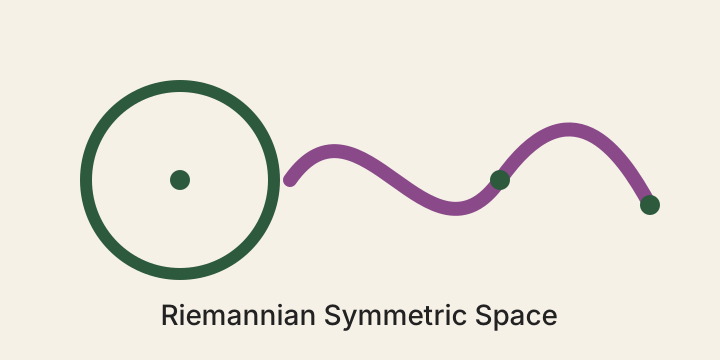
The reflection is an isometry: it preserves distances on the sphere. Every point of has such a reflection, making a symmetric space.
Worked example [Beginner]
Consider the hyperbolic plane (the upper half-plane with metric ). We verify that the reflection through the point is an isometry.
Step 1. The geodesics through are: vertical lines (parameterised as ) and semicircles centred at the origin passing through (parameterised as for ).
Step 2. The geodesic symmetry at sends a point at hyperbolic distance along a geodesic to the point at distance in the reverse direction. On the vertical geodesic: (reflection through , i.e., ). On the semicircular geodesic: (reflect the angle).
Step 3. Check that preserves the metric. At any point , the metric is . Under (the vertical reflection composed with the scaling), the differential transforms and , so . Wait --- let me use the standard map instead.
The standard geodesic symmetry at in the upper half-plane model is the inversion (where ). This is a Mobius transformation, and all Mobius transformations are isometries of .
What this tells us: the hyperbolic plane admits a geodesic symmetry at every point (by translating and rotating, which are isometries), confirming it is a Riemannian symmetric space.
Check your understanding [Beginner]
Formal definition [Intermediate+]
Let be a connected Riemannian manifold.
Definition (Geodesic symmetry). A geodesic symmetry at a point is a map satisfying:
- (the point is fixed).
- is an involutive isometry: and .
- is an isolated fixed point: there is a neighbourhood of such that implies for .
- The differential (reverses every tangent direction).
Definition (Riemannian symmetric space). A connected Riemannian manifold is a Riemannian symmetric space if for every point , there exists a geodesic symmetry .
Theorem (Symmetric implies homogeneous). If is a Riemannian symmetric space, then is a homogeneous space: where is the identity component of the isometry group and is the isotropy subgroup at a chosen base point .
The Lie algebra of carries an orthogonal symmetric Lie algebra structure 07.04.06 via the involution at the base point.
Counterexamples to common slips
A locally symmetric space is not necessarily globally symmetric. The condition (parallel curvature tensor) characterises locally symmetric spaces. Global symmetry additionally requires completeness and the existence of global geodesic symmetries (not just local ones). A compact Riemann surface of genus with constant negative curvature is locally symmetric but may not be globally symmetric (it is a quotient of by a discrete group, and the symmetries do not descend).
A homogeneous space is not automatically symmetric. The coset space is symmetric only when is an open subgroup of the fixed-point set of an involutive automorphism of . Most homogeneous spaces lack this involution.
A symmetric space need not be simply-connected. The real projective space is symmetric but not simply-connected (its fundamental group is ).
Key theorem with proof [Intermediate+]
Theorem (Cartan: correspondence between symmetric spaces and orthogonal symmetric Lie algebras). There is a bijective correspondence:
given by where is the Lie algebra of the transvection group and .
Proof.
Direction : Symmetric space to OSLA. Let be a simply-connected symmetric space with and the isotropy at . Define (conjugation by the geodesic symmetry). At the Lie algebra level, is an involutive automorphism since . The fixed-point set is the Lie algebra of .
The complement is identified with via the map where is the Killing vector field. The Killing form restricted to is positive definite (it gives the Riemannian metric at ). Compact embedding of follows from being a compact subgroup of . Effectiveness holds because is the full isotropy group, which contains no normal subgroup of acting effectively on .
Direction : OSLA to symmetric space. Let be an effective orthogonal symmetric Lie algebra with decomposition . Let be the simply-connected Lie group with Lie algebra and the connected subgroup with Lie algebra .
Step 1. is closed in . Since is compactly embedded, the image is contained in a compact subgroup of . In a connected Lie group, a subgroup whose adjoint image has compact closure is closed.
Step 2. The coset space is a smooth manifold. The involution of integrates to an involutive automorphism of (since is simply-connected). The map satisfies for and defines the geodesic symmetry at the base point .
Step 3. Define a Riemannian metric on as follows. At , set (the Killing form on , which is positive definite by the orthogonal symmetric condition). Extend to all of by -invariance: . This is well-defined because preserves (the bracket relation ensures acts on by isometries of ).
Step 4. The map is an involutive isometry of with isolated fixed point at and on . Geodesic symmetries at other points are obtained by translating: . So is a Riemannian symmetric space.
Bijectivity. The two constructions are inverse. Starting from , extracting , and rebuilding gives back (uniqueness of the simply-connected Lie group). Starting from , building , and extracting the OSLA gives back by construction.
Bridge. This correspondence builds toward the complete classification of symmetric spaces in 07.04.08, where the restricted root system of each symmetric space refines its structure. The foundational reason is that the geodesic symmetry at the base point identifies the geometric notion of reflection with the algebraic notion of involution, and this is exactly the bridge between Riemannian geometry and Lie theory. Putting these together with the classification of orthogonal symmetric Lie algebras from 07.04.06, the symmetric space classification reduces to the classification of real forms of semisimple Lie algebras, and the bridge is Cartan's insight that the curvature tensor at the base point encodes the entire Lie bracket on .
Exercises [Intermediate+]
Advanced results [Master]
Theorem 1 (Cartan's classification of irreducible symmetric spaces). The irreducible, simply-connected Riemannian symmetric spaces are classified into:
- Compact type: symmetric spaces where is a compact simple Lie group and is the fixed-point set of an involutive automorphism. These have non-negative sectional curvature.
- Non-compact type: where is a non-compact simple Lie group and is a maximal compact subgroup. These have non-positive sectional curvature and are diffeomorphic to .
- Euclidean type: with flat metric.
The compact and non-compact types come in dual pairs via the duality of 07.04.06.
Theorem 2 (Rank and root system). The rank of a symmetric space is the dimension of a maximal flat totally geodesic submanifold (maximal torus in the compact case, maximal flat in the non-compact case). The root system of is the set of restricted roots of the pair where is a maximal abelian subalgebra of .
Theorem 3 (Decomposition theorem). Every simply-connected symmetric space decomposes uniquely as where is Euclidean, is of compact type, and is of non-compact type. At the Lie algebra level, this corresponds to the decomposition of into a direct sum of an abelian algebra, compact simple algebras, and non-compact simple algebras.
Theorem 4 (Strongly orthogonal roots and polynomials). The radial part of every -invariant differential operator on a symmetric space of non-compact type reduces to a polynomial differential operator on the maximal flat . The Harish-Chandra isomorphism identifies the algebra of -invariant differential operators with the Weyl-group-invariant polynomials on .
Theorem 5 (Cartan's fixed-point theorem). If is a symmetric space of non-compact type and is a compact group acting isometrically on , then has a fixed point. In particular, every compact subgroup of is conjugate into .
Synthesis. The Riemannian symmetric space is the foundational reason that the classification of highly symmetric geometries reduces to the algebraic classification of real forms of semisimple Lie algebras. The central insight is that the geodesic reflection identifies the local geometry with the global Lie group structure, and this is exactly the bridge between Riemannian geometry and representation theory. Putting these together with the orthogonal symmetric Lie algebra of 07.04.06, every symmetric space carries a root system determined by the Lie bracket, and the bridge is the restricted root system that appears again in 07.04.08.
The pattern generalises: the rank of the symmetric space equals the dimension of the maximal flat, which identifies the symmetric space with its root-theoretic skeleton, and this is exactly the structure that governs harmonic analysis on . The duality between compact and non-compact types mirrors the duality of 07.04.06 at the geometric level: and have the same Lie-theoretic skeleton but opposite curvature signs.
Full proof set [Master]
Proposition 1 (Symmetric implies complete and ). Every Riemannian symmetric space is complete and has parallel curvature tensor.
Proof. Completeness: Let be a maximal geodesic with . Choose with close to . The geodesic symmetry sends to , extending beyond . Contradiction. So all geodesics are defined for all time, and is complete.
Parallel curvature: The geodesic symmetry at satisfies (isometry). The differential on , so (three contravariant indices pick up a sign each). But . So for every .
Proposition 2 (Transvections). The transvection group of a symmetric space (the subgroup of generated by products ) acts transitively on frames, making a reductive homogeneous space.
Proof. For , define the transvection where is the geodesic with and . The map translates along the geodesic by distance 1 in the direction of : .
The differential of at sends to (left translation by the exponential). This is because the composition of two reflections is a translation along the geodesic.
The group generated by all transvections has Lie algebra with and , making a reductive complement. Since transvections can move any frame at to any other frame at (by choosing appropriate ), acts transitively on frames.
Connections [Master]
Orthogonal symmetric Lie algebra
07.04.06. The orthogonal symmetric Lie algebra is the infinitesimal shadow of a Riemannian symmetric space. Every simply-connected symmetric space determines a unique OSLA , and the classification of symmetric spaces reduces to the classification of OSLAs. The curvature tensor, rank, and holonomy all descend from the Lie algebra structure.Restricted root system
07.04.08. The restricted root system of a non-compact symmetric space governs its fine structure. The roots are the eigenvalues of on where is a maximal abelian subalgebra of , and they form a (possibly non-reduced) root system in .Cartan involution
07.04.03. For symmetric spaces of non-compact type, the geodesic symmetry at the base point integrates the Cartan involution to the group level. The Cartan involution of07.04.03is the differential of the geodesic reflection, and the compact subgroup is the maximal compact subgroup determined by .
Historical & philosophical context [Master]
Elie Cartan introduced Riemannian symmetric spaces in his 1926 two-part memoir (Bull. Soc. Math. France 54) [Cartan1926], identifying them as the Riemannian manifolds whose curvature tensor is parallel () and classifying them completely using his earlier classification of real simple Lie algebras. Cartan's insight was that the condition forces the manifold to be homogeneous and determines its geometry from a single algebraic datum.
The modern Lie-group-theoretic formulation, establishing the precise correspondence with orthogonal symmetric Lie algebras, is due to Helgason (1962 lectures, 1978 monograph) [Helgason1978] and Kobayashi-Nomizu (Foundations Vol. II, 1969) [KobayashiNomizu1969]. The decomposition into compact, non-compact, and Euclidean types was already implicit in Cartan's work but received its definitive form in Helgason's treatment. Besse's Einstein Manifolds (1987) [Besse1987] developed the curvature and holonomy theory of symmetric spaces in the context of Einstein metrics.
Bibliography [Master]
@article{Cartan1926,
  author = {Cartan, Elie},
  title = {Sur une classe remarquable d'espaces de {R}iemann},
  journal = {Bull. Soc. Math. France},
  volume = {54},
  year = {1926},
  pages = {214--264},
}

@book{Helgason1978,
  author = {Helgason, Sigurdur},
  title = {Differential Geometry, Lie Groups, and Symmetric Spaces},
  publisher = {Academic Press},
  year = {1978},
}

@book{KobayashiNomizu1969,
  author = {Kobayashi, Shoshichi and Nomizu, Katsumi},
  title = {Foundations of Differential Geometry, Vol. II},
  publisher = {Wiley-Interscience},
  year = {1969},
}

@book{Besse1987,
  author = {Besse, Arthur L.},
  title = {Einstein Manifolds},
  publisher = {Springer},
  year = {1987},
}