Bruhat decomposition
Anchor (Master): Bruhat 1954 Bull. Soc. Math. France; Tits 1974 Buildings of Spherical Type; Humphreys 1990 Reflection Groups and Coxeter Groups
Intuition [Beginner]
The Bruhat decomposition partitions a Lie group (like ) into pieces labelled by the Weyl group . Each piece is a "double coset" : you multiply a Borel subgroup (the upper-triangular matrices, roughly) on the left by , then insert a Weyl group element (a permutation matrix), then multiply by again on the right.
For , the Borel subgroup is the group of upper-triangular matrices with determinant 1, and the Weyl group is the symmetric group (represented by permutation matrices). The decomposition says that every matrix in can be written as where are upper-triangular and is a permutation matrix. The permutation is uniquely determined by the matrix.
The Weyl group element measures how "mixed up" the columns of the matrix are relative to the flag (nested subspaces) fixed by . The identity element corresponds to matrices already in (upper-triangular). The longest element (the full reversal permutation) corresponds to the "most mixed" piece.
Why does this concept exist? The Bruhat decomposition is the combinatorial skeleton of the group. It governs the geometry of flag varieties (via Schubert cells), the representation theory (via the Borel-Weil theorem), and the structure of the spherical Hecke algebra. It is to Lie groups what the Jordan normal form is to linear algebra: a canonical decomposition into elementary pieces.
Visual [Beginner]
A diagram showing the Bruhat decomposition of into two cells: the "big cell" (upper-triangular matrices, dimension 2) and the "small cell" (where is the Weyl reflection, dimension 2). The group (dimension 3) is shown as a union of these two pieces.
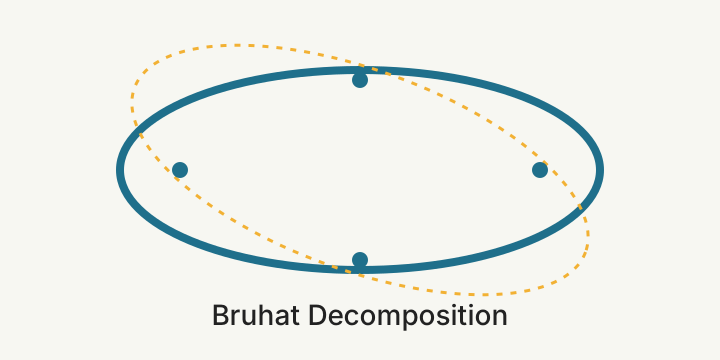
The two cells fit together like an open dense set and its complement, giving a stratification of the group by Weyl group elements.
Worked example [Beginner]
Determine the Bruhat cell of in .
Step 1. The Borel subgroup is = upper-triangular matrices with determinant 1. The Weyl group has two elements: and (the swap/reflection).
Step 2. Check if : the entry is 1, but requires the entry to be 0. So .
Step 3. Verify . Set and . Use the Weyl group representative (the permutation matrix that swaps rows). Then .
What this tells us: is itself a Weyl group element (the non-identity one), so . The cell consists of all matrices in with nonzero entry. The two Bruhat cells are (upper-triangular, ) and ().
Check your understanding [Beginner]
Formal definition [Intermediate+]
Let be a reductive algebraic group over a field (or a real semisimple Lie group). Fix a Borel subgroup and a maximal torus .
Definition (Weyl group). The Weyl group is the quotient of the normaliser of by itself. It is a finite Coxeter group generated by simple reflections corresponding to the simple roots.
Definition (Bruhat decomposition). The group decomposes as a disjoint union:
where each Bruhat cell is a locally closed subvariety (or submanifold) of .
Definition (Bruhat order). The Bruhat order on is defined by: if and only if (the closure of the Bruhat cell). Equivalently, if for every reduced expression , there exists a subexpression obtained by deleting some factors.
Definition (Length function). The length is the minimum number of simple reflections in an expression for . Equivalently, .
Counterexamples to common slips
The Bruhat decomposition depends on the choice of Borel subgroup, but the decomposition as a partition is canonical up to conjugacy. Any two Borel subgroups are conjugate, so different choices of give the same partition up to relabelling by an inner automorphism.
The closure is not a Bruhat cell in general. It is a union of Bruhat cells: . The closure relation is governed by the Bruhat order.
Not every can be written as with a unique . The Weyl group element is unique, but and are not (they are determined up to the action of ).
Key theorem with proof [Intermediate+]
Theorem (Bruhat decomposition). Let be a connected reductive group with Borel subgroup , maximal torus , and Weyl group . Then (disjoint union).
Proof.
Step 1 (Setup for ). We first prove the result for with the upper-triangular matrices and the diagonal matrices. The Weyl group acts by permutation matrices.
Step 2 (Column echelon form). For any , consider the columns of . Since is invertible, these are linearly independent. Right multiplication by (upper-triangular) replaces by a linear combination with (since is upper-triangular). So right multiplication by performs column operations that add multiples of earlier columns to later columns and rescale.
Left multiplication by performs analogous row operations. Together, performs: row operations that add multiples of earlier rows to later rows (left multiplication by ), and column operations that add multiples of earlier columns to later columns (right multiplication by ).
Step 3 (Permutation matrix reduction). For each , perform the following: scan the columns left to right. For column , find the first row such that the entry can be made nonzero by row operations (adding multiples of earlier rows). By suitable row operations (left multiplication by ), make all entries above position in column equal to zero, and make the entry equal to 1.
The permutation records the pivot positions. By construction, where is the permutation matrix with 1s in positions and . This shows (as a set union).
Step 4 (Disjointness). Suppose for . Then for some . The permutation matrix has a single 1 in each row and column. The product has the property that its "pivots" (first nonzero entries in each column, reading from top to bottom) are in the same positions as those of (since left multiplication by only adds multiples of earlier rows, preserving the pivot structure of , and right multiplication by adds multiples of earlier columns). But the pivots of are determined by the permutation , and the pivots of are determined by . Since different permutations have different pivot structures, .
Step 5 (General reductive groups). For a general reductive group , choose a split maximal torus . The Bruhat decomposition is proved by reduction to rank one: for each simple reflection , the group is isomorphic to or (modulo the center), and the Bruhat decomposition for gives .
For the general case, any can be reduced by induction on the length of the Weyl group element. Starting from (existence follows from the BN-pair axioms), the Weyl group element is determined by the coset . The BN-pair axioms guarantee that , giving the decomposition .
Bridge. The Bruhat decomposition builds toward the representation theory of reductive groups via the Borel-Weil theorem, where line bundles on the flag variety realise the irreducible representations. The foundational reason is that the Bruhat cells give a cell decomposition of into Schubert cells , and this is exactly the structure that determines the cohomology of the flag variety. The bridge is the identification of the Bruhat order with the closure relations among Schubert cells, and putting these together with the Iwasawa decomposition of 07.04.09, the Borel subgroup indexes the same subgroup in both decompositions. The Bruhat decomposition generalises the row reduction algorithm from linear algebra to arbitrary reductive groups.
Exercises [Intermediate+]
Advanced results [Master]
Theorem 1 (Schubert cells and flag varieties). The flag variety decomposes into Schubert cells , each isomorphic to affine space . The closure is the Schubert variety, whose cohomology class is the Schubert class in .
Theorem 2 (Bruhat order and Coxeter groups). The Bruhat order on a Coxeter group is determined by the reduced expressions: iff there exists a reduced expression and a subsequence obtained by deleting factors. The Bruhat order is graded by the length function.
Theorem 3 (BN-pair axioms). The pair forms a Tits system (BN-pair) satisfying: (BN1) is generated by and ; (BN2) is normal in ; (BN3) is generated by a set of involutions; (BN4) for all , ; (BN5) for all . The Bruhat decomposition follows from these axioms.
Theorem 4 (Chevalley formula). The product of a Schubert class with a divisor class (for a simple reflection ) in the cohomology ring is given by the Chevalley formula: where the sum is over with and in the Bruhat order, with coefficients determined by the root data.
Theorem 5 (Kazhdan-Lusztig theory). The Kazhdan-Lusztig polynomials for in the Bruhat order encode the intersection cohomology of Schubert varieties. The coefficients of are non-negative integers, and for all .
Synthesis. The Bruhat decomposition is the foundational reason that the geometry of flag varieties decomposes into elementary affine pieces (Schubert cells), each indexed by the Weyl group. The central insight is that the double coset decomposition identifies the group structure with the combinatorial structure of the Coxeter group, and this is exactly the bridge between algebraic geometry and combinatorics. Putting these together with the BN-pair axioms, the Bruhat decomposition axiomatises the structure of reductive groups, and the bridge is the Tits building whose apartments are indexed by the Weyl group.
The pattern generalises: the Schubert calculus on computes intersection numbers via the Bruhat order, and appears again in the Kazhdan-Lusztig conjecture where the polynomials determine the characters of irreducible representations. The Iwasawa decomposition of 07.04.09 provides the analytic realisation of the Borel subgroup , and the restricted root system of 07.04.08 determines the Weyl group that indexes the Bruhat cells. The Bruhat decomposition identifies the group-theoretic structure of with the combinatorial geometry of , and this is exactly the structure that underlies the Langlands programme.
Full proof set [Master]
Proposition 1 (BN-pair implies Bruhat decomposition). Let be a BN-pair in with Weyl group . Then .
Proof. By axiom (BN1), (as a set). For disjointness, we use (BN4): for all , .
Induction on length. For (i.e., ): . For (simple reflections): by (BN5), (since implies ), so by (BN4), giving and .
For general (reduced): by induction, . By (BN4), , so . Continuing by induction on gives where ranges over subexpressions.
For uniqueness: suppose for . Then . By the exchange axiom (which follows from BN4), this implies (since both are in reduced form and forces by the unique coset property).
Proposition 2 (Dimension of Schubert cells). The Schubert cell in has dimension .
Proof. The map given by is surjective with fibre . As computed in Exercise 5: . Since , we get .
Equivalently, the tangent space to at is (the root spaces for positive roots sent to negative by ). The number of such roots is .
Connections [Master]
Iwasawa decomposition
07.04.09. The Borel subgroup in the Bruhat decomposition coincides with from the Iwasawa decomposition (for the split real form). The Iwasawa decomposition gives the diffeomorphism , while the Bruhat decomposition refines the part into Weyl-group-indexed cells.Restricted root system
07.04.08. The Weyl group that indexes the Bruhat cells is the same as the Weyl group of the restricted root system. The length function equals the number of positive roots sent to negative by , which is read off from the restricted root system.Cartan involution
07.04.03. The Cartan involution provides the maximal compact subgroup that stabilises the symmetric space. The Bruhat decomposition of restricts to a decomposition of -orbits on , giving the real analogue of the Schubert cell decomposition. The compact subgroup acts transitively on the open Bruhat cell .
Historical & philosophical context [Master]
Francois Bruhat established the double coset decomposition in his 1954 paper on representations of locally compact groups (Bull. Soc. Math. France 82) [Bruhat1954]. Bruhat's original context was the study of induced representations and the distribution characters of -adic groups, where the double coset decomposition provides the combinatorial framework for the Hecke algebra.
Jacques Tits introduced the BN-pair axioms in the 1960s and developed the theory of buildings (Buildings of Spherical Type, Lecture Notes in Mathematics 386, 1974) [Tits1974], showing that the Bruhat decomposition is an instance of a general combinatorial structure (the building) that underlies all reductive groups. Humphreys' Linear Algebraic Groups (1975) and Reflection Groups and Coxeter Groups (1990) [Humphreys1990] gave the modern algebraic-group treatment.
Bibliography [Master]
@article{Bruhat1954,
  author = {Bruhat, Francois},
  title = {Representations des groupes localement compacts},
  journal = {Bull. Soc. Math. France},
  volume = {82},
  year = {1954},
  pages = {113--136},
}

@book{Tits1974,
  author = {Tits, Jacques},
  title = {Buildings of Spherical Type and Finite {BN}-Pairs},
  publisher = {Springer},
  year = {1974},
  series = {Lecture Notes in Mathematics},
  volume = {386},
}

@book{Humphreys1975,
  author = {Humphreys, James E.},
  title = {Linear Algebraic Groups},
  publisher = {Springer},
  year = {1975},
}

@book{Humphreys1990,
  author = {Humphreys, James E.},
  title = {Reflection Groups and Coxeter Groups},
  publisher = {Cambridge University Press},
  year = {1990},
}

@book{Knapp2002,
  author = {Knapp, Anthony W.},
  title = {Lie Groups Beyond an Introduction},
  publisher = {Birkhauser},
  year = {2002},
  edition = {2nd},
}