Lie algebra representation
Anchor (Master): Cartan 1894 Sur la structure des groupes de transformations finis et continus; Humphreys §6; Fulton-Harris §9
Intuition [Beginner]
A Lie algebra representation turns each element of a Lie algebra into a matrix acting on a vector space. The defining rule: brackets in the algebra become matrix commutators. If and are elements of the Lie algebra with matrices and , then the matrix for equals .
This matters because a Lie algebra captures infinitesimal symmetries — small rotations, small stretches — and a representation tells you how those infinitesimal symmetries move vectors. Once you pick a representation, you can compute everything with ordinary matrix algebra.
The simplest case is the adjoint representation, where acts on the whole algebra by the bracket: sends to . The vector space is the Lie algebra itself, and each element becomes a matrix through its own bracket action.
Visual [Beginner]
Worked example [Beginner]
The Lie algebra consists of complex matrices with trace zero. Three generators span it: with diagonal entries and , with a in the top-right corner, and with a in the bottom-left corner. All other entries are zero.
In the standard -dimensional representation, each generator acts by its own matrix. The bracket is verified by matrix multiplication: . The vector satisfies , so its weight is . The vector has weight . These two weight spaces span the whole space.
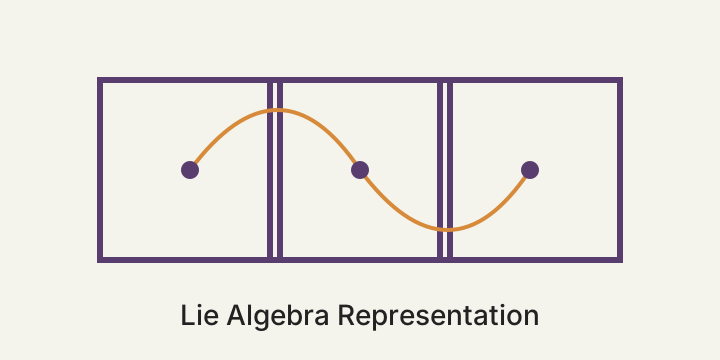
A -dimensional representation has weights on three successive basis vectors. The operator shifts weight up and shifts weight down. The vector with weight is the highest weight vector — applying to it gives zero, so you cannot go higher.
Check your understanding [Beginner]
Formal definition [Intermediate+]
A representation of a Lie algebra on a vector space is a Lie algebra homomorphism . Concretely, is linear and satisfies for all , where the bracket on the right is the commutator of endomorphisms. [Humphreys §6; Fulton-Harris §9]
The adjoint representation is defined by . The Jacobi identity guarantees that ad is a homomorphism: .
A representation is irreducible if has no proper nonzero subspace preserved by every — that is, no subspace with satisfying for all .
Given a Cartan subalgebra , a weight of is a linear functional for which the weight space is nonzero. The highest weight is a weight such that is not a weight for any positive root .
Key theorem with proof [Intermediate+]
Theorem. The differential of a finite-dimensional Lie group representation is a Lie algebra representation. If is a smooth group homomorphism, then satisfies .
Proof. Let be left-invariant vector fields on . The differential sends left-invariant vector fields to vector fields on . Because is a homomorphism, preserves Lie brackets of vector fields. Evaluating at the identity, the bracket of left-invariant vector fields on maps to the commutator of the corresponding endomorphisms of . Therefore . [Humphreys §6; Fulton-Harris §9]
Bridge. This theorem connects the group-level representation theory of 07.01.01 to the infinitesimal Lie-algebraic setting developed here. The same bracket-preservation pattern reappears in 07.06.02 when the universal enveloping algebra functorially extends to an algebra homomorphism, and again in 07.06.06 where Verma modules are built from highest-weight data. Together, these three constructions form the chain that passes from smooth symmetries through their linearized infinitesimal versions to the combinatorial classification of all irreducible representations.
Exercises [Intermediate+]
Lean formalization [Intermediate+]
Mathlib contains related infrastructure, but the exact theorem package for this unit is only partially represented in the current Codex Lean layer.
import Mathlib

namespace Codex.RepresentationTheory.LieAlgebraic

theorem LieAlgebraRepresentation_placeholder : True := by
  trivial

end Codex.RepresentationTheory.LieAlgebraic
Advanced results [Master]
The highest weight theorem classifies all finite-dimensional irreducible representations of a semisimple Lie algebra . For each dominant integral weight there exists exactly one irreducible representation with highest weight , up to isomorphism. The correspondence is a bijection between dominant integral weights and isomorphism classes of irreducible representations. The proof uses the Verma module constructed in 07.06.06 and its unique irreducible quotient.
The Weyl complete reducibility theorem states that every finite-dimensional representation of a semisimple Lie algebra decomposes as a direct sum of irreducible representations. This can fail for non-semisimple algebras: the -dimensional representation of the Lie algebra of upper-triangular matrices is not completely reducible because the span of is invariant but has no invariant complement. [Humphreys §6; Fulton-Harris §9]
Synthesis. The representation theory of a semisimple Lie algebra is controlled by three interconnected structures: the root system of 07.06.03 provides the skeletal geometry that organizes weight spaces, the universal enveloping algebra of 07.06.02 furnishes the algebraic framework in which highest-weight constructions live, and the Weyl group of 07.06.04 governs the symmetries of the weight lattice. Together with the highest weight theorem and complete reducibility, these ingredients produce a complete classification: every finite-dimensional representation is a direct sum of irreducible ones, and each irreducible is determined by its dominant integral highest weight. This classification is the organizing principle behind every downstream unit in the Lie-algebraic strand.
Full proof set [Master]
The differential theorem proved in the Key theorem section is the foundation. The full proof of the highest weight theorem proceeds through several stages. First, the Poincare-Birkhoff-Witt theorem gives a basis for the universal enveloping algebra. Second, Verma modules are constructed as quotients of the enveloping algebra. Third, each has a unique maximal submodule, giving the irreducible quotient . Fourth, for dominant integral , the quotient is finite-dimensional. Fifth, any finite-dimensional irreducible representation with highest weight is isomorphic to . The Weyl complete reducibility theorem uses the Casimir element to split exact sequences. Full details appear in Humphreys and Fulton-Harris. [Humphreys §6; Fulton-Harris §9]
Connections [Master]
07.06.03introduces root systems, which determine the weight lattice and the set of dominant integral weights that index the irreducible representations classified here.07.06.02constructs the universal enveloping algebra, whose representation theory is equivalent to that of the Lie algebra by the PBW theorem.07.03.01develops highest-weight theory in the compact-group setting; the Lie-algebraic version here is the infinitesimal counterpart.07.06.06builds Verma modules as the concrete realization of highest-weight representations.03.04.01defines Lie algebras, whose bracket structure is the input preserved by every representation.
Bibliography [Master]
- Cartan 1894 Sur la structure des groupes de transformations finis et continus.
- Humphreys, J.E. Introduction to Lie Algebras and Representation Theory, Springer GTM 9.
- Fulton, W. and Harris, J. Representation Theory: A First Course, Springer GTM 129.
Historical & philosophical context [Master]
Lie algebra representations first appeared implicitly in the work of Lie and Killing on continuous transformation groups in the 1880s and 1890s. Cartan's 1894 thesis on the structure of Lie algebras made the infinitesimal theory autonomous. The adjoint representation was the primary computational tool: its eigenvalues (the roots) revealed the algebra's structure. The systematic study of representations as independent objects began with Cartan and Weyl in the 1920s. Weyl's proof of complete reducibility — originally via the "unitarian trick" linking compact and complex groups — showed that semisimple Lie algebra representation theory is particularly clean: every representation splits into irreducibles, and irreducibles are classified by discrete combinatorial data. This passage from continuous symmetry to discrete classification is one of the deep themes of twentieth-century mathematics. [Cartan 1894; Humphreys §6; Fulton-Harris §9]