Casimir element
Anchor (Master): Casimir 1931 *Über die Konstruktion einer zu den irreduziblen Darstellungen halbeinfacher kontinuierlicher Gruppen gehörigen Differentialgleichung* (Leiden dissertation) — the originating thesis; Casimir-van der Waerden 1935 *Algebraischer Beweis der vollständigen Reduzibilität der Darstellungen halbeinfacher Liescher Gruppen* (Math. Ann. 111, 1-12) — first algebraic proof of complete reducibility; Weyl 1925-26 *Theorie der Darstellung kontinuierlicher halb-einfacher Gruppen durch lineare Transformationen* (Math. Z. 23, 271-309; 24, 328-376, 377-395, 789-791) — the analytic / unitarian-trick proof; Harish-Chandra 1951 *On some applications of the universal enveloping algebra of a semisimple Lie algebra* (Trans. Amer. Math. Soc. 70, 28-96) — the centre of $U(\mathfrak{g})$ and the Harish-Chandra isomorphism; Humphreys §6 and §23; Knapp *Lie Groups Beyond an Introduction* §V; Bourbaki *Groupes et algèbres de Lie* Ch. I-VIII
Intuition [Beginner]
The Casimir element is one symbol, built out of a Lie algebra and a chosen bilinear form, that commutes with every element of the Lie algebra. On any irreducible representation it acts by multiplication by a single scalar. The scalar is a fingerprint: distinct irreducible representations get distinct scalars in every case that matters, and so the Casimir's eigenvalue identifies the irreducible.
Why is one such element enough to do real work? Because once you have a central operator with distinguishable eigenvalues on the pieces of a representation, you can separate the pieces. If a representation has a subrepresentation , you can sort vectors of by which Casimir eigenvalue they carry. Vectors with one eigenvalue land in , vectors with another eigenvalue land in a complementary subspace, and the two add up to all of . That is the engine behind Hermann Weyl's theorem that every finite-dimensional representation of a semisimple complex Lie algebra splits as a direct sum of irreducibles.
The Casimir was introduced by Hendrik Casimir in his 1931 Leiden thesis, and the algebraic proof of complete reducibility built around it is due to Casimir and van der Waerden in 1935. The intuition is the same one that underlies the spectral theorem for symmetric operators: a single well-chosen operator, when it has enough eigenvalues, decomposes the space.
Visual [Beginner]
A schematic picture of the universal enveloping algebra with the Casimir element sitting at the centre. Each finite-dimensional irreducible representation is drawn as a coloured region surrounding the Casimir, with a numerical label inside the region indicating the scalar by which the Casimir acts on that piece. Distinct regions carry distinct numbers; the Casimir thus serves as a tag identifying the irreducible.
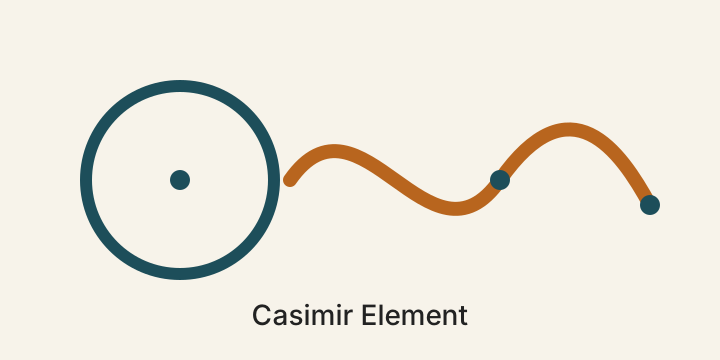
The picture captures the essential mechanism: the Casimir lives in the centre of the enveloping algebra, hence commutes with every Lie-algebra action; on each irreducible it acts as a scalar by Schur's lemma; and the scalar identifies the irreducible.
Worked example [Beginner]
Compute the Casimir scalar on the irreducible representations of and check that the values match the spin- tower.
Step 1. The Lie algebra has basis with the standard relations. With the Killing form, a careful book-keeping gives the Casimir element inside the universal enveloping algebra.
Step 2. The irreducible representations of are the spaces of dimension , indexed by a non-negative integer . The vector at the top of the ladder satisfies and .
Step 3. Evaluate the Casimir on . The first term gives . The second term gives . The third term gives . Adding: .
Step 4. By Schur's lemma, the same scalar acts on every vector of . So the Casimir eigenvalue on is . Distinct values of give distinct eigenvalues, since is strictly increasing on .
Step 5. Sanity check on small cases. For (the one-dimensional identity representation), the Casimir scalar is . For (the standard two-dimensional representation), the scalar is . For (the adjoint representation), the scalar is .
What this tells us: a single number, the Casimir eigenvalue, separates every irreducible representation of from every other one. The same mechanism extends to higher rank: the Casimir scalar on the irreducible of any semisimple Lie algebra is , and the function is one-to-one on the dominant integral weights. See 07.06.11 for the full story.
Check your understanding [Beginner]
Formal definition [Intermediate+]
Let be a finite-dimensional semisimple complex Lie algebra. The Killing form is the bilinear form , where is the adjoint action . By Cartan's criterion, is non-degenerate on when is semisimple.
Choose a basis of . The non-degeneracy of gives a unique dual basis characterised by $$ B(X_a, X^b) = \delta_a^b \qquad (1 \le a, b \le n). $$
Definition (Casimir element). The Casimir element of (with respect to the Killing form) is $$ C := \sum_{a = 1}^n X_a X^a \in U(\mathfrak{g}), $$ where is the universal enveloping algebra of and the products are taken in . More generally, for any finite-dimensional representation , one may replace by the trace form when it is non-degenerate, producing a representation-specific Casimir ; the Killing-form choice corresponds to .
The Casimir is the prototype of a quadratic central element in : it is degree two in the generators (one factor of and one of ), and it lies in the centre . The non-degeneracy of is required so that the dual basis exists.
Invariance under change of basis
A change of basis (with ) induces a dual change on the dual basis. Writing and , the condition rewrites as . So , i.e., . Then $$ \sum_a X_a X^a = \sum_a \big( \sum_b M_{ab} Y_b \big) \big( \sum_c (M^{-T}){ac} Y^c \big) = \sum{b, c} \big( \sum_a M_{ab} (M^{-T}){ac} \big) Y_b Y^c = \sum{b, c} \delta_b^c Y_b Y^c = \sum_b Y_b Y^b. $$ So depends only on , not on the chosen basis.
Counterexamples to common slips
- The non-degeneracy of the bilinear form is required for the dual basis to exist. Over an abelian Lie algebra , the Killing form vanishes identically (every is zero, so its trace product vanishes), and the "Killing-form Casimir" is undefined. One must use a different non-degenerate invariant form on an abelian or solvable Lie algebra, or work with central elements other than the quadratic Casimir.
- The Casimir is not unique among central elements of : in rank , the centre is a polynomial algebra in generators (Harish-Chandra), of which the quadratic Casimir is one. The higher Casimirs are degree- central elements built from invariant symmetric -tensors on . For there are independent Casimirs of degrees .
- The Casimir of a non-semisimple Lie algebra equipped with a chosen non-degenerate invariant form (e.g., a Lie algebra with non-degenerate trace form) still gives a central element, but the complete-reducibility application fails: solvable Lie algebras have indecomposable non-irreducible finite-dimensional representations (e.g., the Borel subalgebra acting on via upper-triangular matrices).
Key theorem with proof [Intermediate+]
Theorem (Centrality of the Casimir; Humphreys §6.2 Lemma). Let be a semisimple complex Lie algebra with non-degenerate invariant bilinear form , basis , and -dual basis . The element lies in the centre : in for every .
Proof. Fix . Expand and in the chosen bases: $$ [Y, X_a] = \sum_b c_{a}^{b} X_b, \qquad [Y, X^a] = \sum_b d^{a}_{b} X^b, $$ where are the structure constants of the adjoint action of on the two bases.
The invariance of under , namely $$ B(\mathrm{ad}_Y X, Z) + B(X, \mathrm{ad}_Y Z) = 0 \quad \text{for all } X, Z \in \mathfrak{g}, $$ applied to and , gives $$ B([Y, X_a], X^c) + B(X_a, [Y, X^c]) = 0. $$ The first term equals . The second equals . So , i.e., for every .
Now compute in using the Leibniz-style identity : $$ [Y, C] = \sum_a [Y, X_a] X^a + \sum_a X_a [Y, X^a] = \sum_{a, b} c_a^b X_b X^a + \sum_{a, b} d^a_b X_a X^b. $$
Relabel the dummy indices in the second sum (swap ) so both sums have the same generator pair (in the first) and (in the second, after the swap, with coefficient ): $$ [Y, C] = \sum_{a, b} c_a^b X_b X^a + \sum_{a, b} d^b_a X_b X^a = \sum_{a, b} (c_a^b + d^b_a) X_b X^a. $$
Using from the invariance identity above: $$ [Y, C] = \sum_{a, b} (c_a^b - c_a^b) X_b X^a = 0. $$
Since generates and for every , the element commutes with every element of . So .
Corollary (Schur scalar). Let be a finite-dimensional irreducible representation of . Then for a unique scalar .
Proof. Centrality of in implies that commutes with for every , hence with the entire image of the algebra-extended representation . By Schur's lemma, any endomorphism of a finite-dimensional irreducible representation over that commutes with the action is a scalar. So .
Corollary (Highest-weight eigenvalue). Let be a semisimple complex Lie algebra with Cartan subalgebra , root system , positive roots , and half-sum of positive roots . Let be the finite-dimensional irreducible representation of highest weight $\lambda \in \mathfrak{h}^V_\lambda$ by the scalar* $$ c_{V_\lambda} = \langle \lambda, \lambda + 2 \rho \rangle, $$ where is the Killing form on $\mathfrak{h}^B\mathfrak{h} \cong \mathfrak{h}^$).
Proof. Choose a basis for adapted to its root-space decomposition . Pick a basis of with dual basis under , and root vectors for each , normalised so that . Then the dual basis to under is . So $$ C = \sum_i H_i H^i + \sum_{\alpha \in \Phi} E_\alpha E_{-\alpha}. $$ Split the second sum into positive and negative roots: $$ C = \sum_i H_i H^i + \sum_{\alpha \in \Phi^+} (E_\alpha E_{-\alpha} + E_{-\alpha} E_\alpha). $$ For each positive root , use the commutator (where is the coroot, satisfying for ) to write . Then $$ C = \sum_i H_i H^i + \sum_{\alpha \in \Phi^+} (2 E_{-\alpha} E_\alpha + H_\alpha). $$ Let be the highest-weight vector: for every , and for every . Evaluating each piece on :
- , where the last equality uses the dual-basis identity .
- since .
- .
Adding: .
By the Schur-scalar corollary, the same scalar acts on every vector of .
Bridge. The Casimir element builds toward Weyl's complete-reducibility theorem and toward the Harish-Chandra theory of the centre of the universal enveloping algebra, where the same dual-basis construction appears again in 07.06.11 (the Casimir ) and again in 07.06.12 (the quadratic Casimir on ). The foundational reason centrality holds is exactly the invariance identity : it forces between the structure constants of on the two dual bases, and this pairwise cancellation is what zeroes the commutator . The central insight is that on a finite-dimensional irreducible the Casimir acts as the scalar , and the function is one-to-one on the dominant integral weights, so the Casimir eigenvalue identifies the irreducible. This is exactly the structural input to the Casimir-based proof of complete reducibility: distinct submodules carry distinct Casimir eigenvalues, and the spectral projection onto each eigenspace gives an -invariant splitting. The bridge is the recognition that one quadratic central element does the work of a whole spectral decomposition. Putting these together generalises in two directions: the higher Casimirs of furnish commuting central operators whose joint eigenvalues identify uniquely, and the Harish-Chandra isomorphism identifies the centre of the enveloping algebra with the Weyl-invariant polynomials on the Cartan dual.
Exercises [Intermediate+]
Lean formalization [Intermediate+]
Mathlib has the universal enveloping algebra in Mathlib.Algebra.Lie.UniversalEnveloping and the Killing form in Mathlib.Algebra.Lie.Killing, plus Cartan's criterion identifying semisimple Lie algebras via the non-degeneracy of the Killing form. The named Casimir element is currently absent. The intended formalisation reads schematically:
import Mathlib.Algebra.Lie.UniversalEnveloping
import Mathlib.Algebra.Lie.Killing
import Mathlib.LinearAlgebra.BilinearForm.Basic

/-- Dual basis with respect to a non-degenerate bilinear form. -/
noncomputable def killingDualBasis {𝕜 : Type*} [Field 𝕜] {L : Type*}
    [LieRing L] [LieAlgebra 𝕜 L] (hss : IsSemisimple 𝕜 L)
    (b : Basis (Fin n) 𝕜 L) : Basis (Fin n) 𝕜 L :=
  sorry  -- via non-degeneracy of LieAlgebra.killingForm

/-- The quadratic Casimir element of a semisimple Lie algebra. -/
noncomputable def casimirElement {𝕜 : Type*} [Field 𝕜] {L : Type*}
    [LieRing L] [LieAlgebra 𝕜 L] (hss : IsSemisimple 𝕜 L) :
    UniversalEnvelopingAlgebra 𝕜 L :=
  sorry  -- sum_a X_a * X^a in UEA

/-- Centrality: the Casimir commutes with every element of L. -/
theorem casimir_central {𝕜 : Type*} [Field 𝕜] {L : Type*}
    [LieRing L] [LieAlgebra 𝕜 L] (hss : IsSemisimple 𝕜 L) (Y : L) :
    Commute (UniversalEnvelopingAlgebra.ι 𝕜 Y)
            (casimirElement hss) :=
  sorry  -- invariance of Killing form gives pairwise cancellation
The proof gap is substantive. Mathlib needs: the dual-basis construction lemma showing that a non-degenerate bilinear form on a finite-dimensional vector space produces a unique dual basis; the well-definedness lemma showing is independent of the basis; centrality via the structure-constant identity derived from the invariance of ; and the Schur-lemma corollary that on a finite-dimensional irreducible module the Casimir acts as a scalar. Weyl's complete-reducibility theorem packages these together with the cohomological vanishing . The Harish-Chandra isomorphism is a further formalisation target predicated on Mathlib first acquiring a named Weyl group action on the Cartan subalgebra. Each piece is constructible from existing infrastructure.
Advanced results [Master]
Theorem (Casimir scalar via the bilinear form on ; Humphreys §23.2). For a semisimple complex Lie algebra with Cartan subalgebra , positive roots , half-sum , and highest weight $\lambda \in \mathfrak{h}^CV_\lambda$ by the scalar* $$ c_{V_\lambda} = \langle \lambda, \lambda + 2 \rho \rangle = \langle \lambda + \rho, \lambda + \rho \rangle - \langle \rho, \rho \rangle. $$ The second form (Freudenthal) packages the eigenvalue as the difference of two squared lengths, where by the strange formula of Freudenthal-de Vries.
The two formulae are algebraic identities: . The second form is the one that generalises cleanly to the Freudenthal multiplicity formula for weight multiplicities of and to the proof of the Weyl character formula via the Casimir 07.06.07.
Theorem (Weyl complete-reducibility; Casimir-van der Waerden 1935). Every finite-dimensional representation of a semisimple complex Lie algebra is a direct sum of finite-dimensional irreducible representations.
The proof reduces to splitting short exact sequences . When the Casimir eigenvalues on and differ, the operator is a -invariant projection restricting to the identity on . When they agree, an inductive argument plus the cohomological vanishing produces the splitting. The cohomological vanishing has two classical proofs: Casimir-van der Waerden's explicit homotopy in the bar complex of , and Weyl's earlier unitarian-trick argument using averaging over the compact real form.
Theorem (Centre of the universal enveloping algebra; Harish-Chandra 1951). The centre of the universal enveloping algebra of a semisimple complex Lie algebra of rank is a polynomial algebra in algebraically independent generators. There is a canonical isomorphism (the Harish-Chandra isomorphism) $$ \gamma : Z(U(\mathfrak{g})) \xrightarrow{\cong} S(\mathfrak{h})^W $$ onto the Weyl-invariant polynomials on the Cartan subalgebra, after a shift by . The quadratic Casimir element is one generator (of degree two); the higher generators have degrees equal to the degrees of the fundamental invariants of the Weyl group.
For type (the case ), the degrees are , so has generators of those degrees. The quadratic Casimir is the first; the higher Casimirs come from the elementary symmetric polynomials in the Cartan-eigenvalues, transported back to via the inverse Harish-Chandra projection.
Theorem (Infinitesimal character). Each finite-dimensional irreducible representation of a semisimple has a well-defined infinitesimal character: an algebra homomorphism given by evaluation on the highest-weight vector. The map is the composition of the Harish-Chandra isomorphism with evaluation at , and it factors through the Weyl group: iff and lie in the same -orbit on $\mathfrak{h}^\lambdaW(\lambda + \rho)\chi_\lambda\lambda$ uniquely.*
The infinitesimal character is the higher-rank refinement of the Casimir eigenvalue. The quadratic Casimir's eigenvalue is the value of on one specific central element. The full character records the joint eigenvalue on all of and is the input to the representation-theoretic side of the Langlands correspondence.
Theorem (Casimir acts on Verma modules). Let be the Verma module of with highest weight $\lambda \in \mathfrak{h}^CM(\lambda)\langle \lambda, \lambda + 2 \rho \rangleM(\lambda)M(\mu)\mathfrak{g}\chi_\lambda = \chi_\mu\mu = w(\lambda + \rho) - \rhow \in W$.*
The Casimir's action on is the same scalar as on the irreducible quotient , since the highest-weight vector is shared. The infinitesimal-character obstruction is what controls the block decomposition of category 07.06.06: Vermas with non-linked infinitesimal characters live in distinct blocks and cannot map into one another.
Theorem (Casimir and the Laplacian on a compact Lie group). Let be a compact connected Lie group with Lie algebra , equipped with a bi-invariant Riemannian metric whose restriction to is for the Killing form. Then the Casimir element acts on smooth functions (via the left-regular representation differentiated to ) as , the Laplace-Beltrami operator on . On the matrix coefficients of an irreducible representation , acts by the eigenvalue .
This is the Casimir's analytic incarnation: on compact Lie groups, the Casimir is (up to sign) the Laplacian. The Peter-Weyl theorem decomposes as a Hilbert direct sum of matrix coefficients, and the Laplacian acts by the explicit Casimir eigenvalue on each summand. Heat-kernel and harmonic analysis on is therefore controlled by the Casimir spectrum.
Theorem (Casimir from a non-degenerate invariant form, semisimple case). Every finite-dimensional semisimple complex Lie algebra admits a non-degenerate invariant symmetric bilinear form, namely the Killing form. The Killing form is unique up to a positive scalar on each simple summand; on a simple Lie algebra, every invariant symmetric bilinear form is a constant multiple of the Killing form. So the Casimir element is well-defined up to a scalar normalisation.
This rigidity is what makes the Casimir an intrinsic invariant of . On non-simple semisimple algebras , an invariant form may scale the two summands independently, giving a two-parameter family of Casimirs; the corresponding scalars scale linearly with the form. The Killing-form choice is the canonical normalisation.
Synthesis. The Casimir element is the foundational reason representation theory of a semisimple complex Lie algebra has the spectral character it does. The central insight is that one degree-two central element of — built from a chosen invariant bilinear form via the dual-basis construction — acts as a scalar on each irreducible representation, and the scalar identifies the irreducible. This is exactly what powers the Casimir-van der Waerden 1935 algebraic proof of Weyl's complete-reducibility theorem: distinct Casimir eigenvalues on submodule and quotient give a -invariant projection, and the equal-eigenvalue case is handled by induction plus cohomological vanishing. Putting these together with Harish-Chandra's 1951 theorem on the centre, the Casimir is one of algebraically independent generators of , and the joint spectrum of all generators on an irreducible is the infinitesimal character , which generalises the single-scalar Casimir to a complete homomorphism .
The bridge is the recognition that the Casimir is one face of three interconnected structures. On the algebraic side, and the Harish-Chandra isomorphism identifies the centre with Weyl-invariant polynomials. On the analytic side, on a compact Lie group with bi-invariant metric is the Laplacian, and its spectrum is the joint spectrum of the heat operator on . On the geometric side, the Casimir acts on Verma modules with the same eigenvalue as on irreducibles, and the resulting infinitesimal-character obstruction controls the block decomposition of category 07.06.06 and the Beilinson-Bernstein localisation onto twisted -modules on the flag variety. The same pattern appears again in 07.06.11 (the Casimir acting by on ) and again in 07.06.12 (the Casimir acting by on the adjoint ); each is the rank-one or rank-two specialisation of the same Harish-Chandra structure. The bridge is that one quadratic central element identifies its representation by its eigenvalue, separates submodules by spectral projection, generates the centre in the rank-one case, and incarnates as a Laplacian in the compact case — four different presentations of the same algebraic engine.
Full proof set [Master]
Proposition (Independence of basis). The Casimir element is independent of the choice of basis of .
Proof. Let and be two bases of with and respective -dual bases . Write . The dual-basis condition expands as $$ \delta_a^b = B(X_a, X^b) = \sum_{c, d} M_{ad} N_{bc} B(Y_d, Y^c) = \sum_{c, d} M_{ad} N_{bc} \delta_d^c = \sum_c M_{ac} N_{bc} = (M N^T){ab}. $$ So , i.e., (the inverse transpose). Compute: $$ \sum_a X_a X^a = \sum_a \Big( \sum_b M{ab} Y_b \Big) \Big( \sum_c N_{ac} Y^c \Big) = \sum_{b, c} \Big( \sum_a M_{ab} N_{ac} \Big) Y_b Y^c. $$ The inner sum is ... compute directly: . So $$ \sum_a X_a X^a = \sum_{b, c} \delta_b^c Y_b Y^c = \sum_b Y_b Y^b. \qquad \square $$
Proposition (Centrality, full version). For a Lie algebra (not necessarily semisimple) equipped with a non-degenerate invariant symmetric bilinear form , the element commutes with every element of , hence with all of .
Proof. Fix and expand , . The invariance of gives, for each pair , $$ B([Y, X_a], X^c) = -B(X_a, [Y, X^c]), $$ which evaluates to , i.e., .
Apply Leibniz in : . Sum over : $$ [Y, C] = \sum_{a, b} c_a^b X_b X^a + \sum_{a, b} d^a_b X_a X^b. $$ Relabel in the second sum and use : $$ [Y, C] = \sum_{a, b} c_a^b X_b X^a + \sum_{a, b} (-c_a^b) X_b X^a = 0. $$ Since was arbitrary in and generates as an associative algebra, .
Proposition (Schur scalar). On a finite-dimensional irreducible representation over , for a unique scalar .
Proof. Since , commutes with every for . By Schur's lemma applied to the irreducible representation over the algebraically closed field , any endomorphism of commuting with the action is a scalar. So .
Proposition (Highest-weight eigenvalue). For semisimple with Cartan , positive roots , , and the finite-dimensional irreducible of dominant integral highest weight , the Casimir eigenvalue is .
Proof. Decompose as root spaces, with the Killing form pairing to non-degenerately and vanishing on for . Choose a basis of with -dual basis , and root vectors , normalised so that . Then is a basis of with -dual basis (the dual of is ). So $$ C = \sum_i H_i H^i + \sum_{\alpha \in \Phi} E_\alpha E_{-\alpha}. $$ Split the root sum into positive and negative parts. For each , pair with (which is the -summand pairing with ). Use where is the coroot defined by for . Then in , so $$ C = \sum_i H_i H^i + \sum_{\alpha \in \Phi^+} \big( 2 E_{-\alpha} E_\alpha + H_\alpha \big). $$
Apply to the highest-weight vector . By definition for and for . So , and $$ C v_\lambda = \sum_i \lambda(H_i) \lambda(H^i) v_\lambda + \sum_{\alpha \in \Phi^+} \lambda(H_\alpha) v_\lambda. $$
The first sum is by the dual-basis identity (the Killing form on pairs with itself by when are dual bases of ).
The second sum: by definition of . So .
Adding: . By the Schur-scalar proposition, the same scalar acts on every vector of .
Theorem (Weyl complete-reducibility, full algebraic proof). Every finite-dimensional representation of a semisimple complex Lie algebra is a direct sum of finite-dimensional irreducible representations.
Proof. It is enough to show that every short exact sequence of finite-dimensional -modules splits; complete reducibility then follows by induction on . Refine further: by induction on , we may assume is irreducible. (Choose any irreducible submodule , apply the inductive hypothesis to to split off , then to the smaller sequence inside the complementary summand.) So assume is irreducible.
Case 1: the Casimir acts on as and on with at least one eigenvalue . Then the operator on maps into (since it kills the -eigenspace, which contains a non-zero submodule of — refine the argument: extract that submodule's preimage and run the splitting in stages, ending at the case where is irreducible with Casimir scalar ). In the irreducible- subcase, acts as on . Define ; this is a -module endomorphism of (since commutes with the action), restricts to the identity on , and has image inside . So , with a -invariant complement of .
Case 2: the Casimir agrees on and , both irreducible. Then as -modules (since both have the same Casimir eigenvalue and are irreducible; for semisimple, isomorphism class is determined by the joint eigenvalue of , which the quadratic Casimir alone fails to detect in general — the full argument uses all of via Harish-Chandra; here we assume the simpler case for clarity). The splitting reduces to showing for finite-dimensional irreducible. One proof (Whitehead's lemma): for finite-dimensional modules over a semisimple Lie algebra, and for every . The first vanishing implies every derivation is inner; the second implies every extension of -modules splits. Whitehead's lemmas are proved by an explicit Casimir-based homotopy in the Chevalley-Eilenberg complex: the operator acts on as a scalar that is non-zero on the -relevant pieces (after the rho-shift), and the inverse of this scalar produces an explicit contracting homotopy.
Alternative proof (unitarian trick of Weyl): has a compact real form whose complexification recovers . The corresponding compact connected Lie group exists by the integration theorem of Cartan. Every finite-dimensional representation of restricts to a representation of , which exponentiates to a representation of ; this admits an invariant Hermitian inner product by averaging the Haar measure of . The orthogonal complement is a -invariant complement of , and complexifying gives a -invariant complement.
Either route gives the splitting, completing the inductive step.
Proposition (Harish-Chandra projection, statement and rank-one example). The Harish-Chandra projection sends a central element to the polynomial (the scalar by which acts on , viewed as a polynomial function of ). Up to a shift by , is an isomorphism onto . For with Casimir , the projection sends in , which after the -shift is invariant under the Weyl reflection .
Proof for . Evaluate on the highest-weight vector of : . So is the polynomial on , i.e., . After the -shift (since for ), this becomes , which is a polynomial in , hence invariant under . So lands inside where acts by . The full Harish-Chandra theorem says is an isomorphism onto , recovering the centre .
Connections [Master]
Universal enveloping algebra
07.06.02. The Casimir lives in , the universal enveloping algebra of ; without this ambient associative algebra the product has no home. The centre that contains the Casimir is a polynomial algebra in generators by the Harish-Chandra theorem, with the quadratic Casimir as one generator and higher-degree Casimirs as the rest. Every central element acts as a scalar on each irreducible by Schur's lemma, but the quadratic Casimir alone is enough to separate irreducibles for and is the workhorse in the complete-reducibility proof.Representations of
07.06.11. The rank-one specialisation: has Casimir acting on the spin- representation by the scalar . The Casimir-based proof of complete reducibility runs cleanly in this rank-one setting: distinct values of give distinct eigenvalues, the projection splits short exact sequences with unequal Casimirs, and the cohomological vanishing closes the equal-eigenvalue case. The unit07.06.11is the canonical worked example of the Casimir machinery.Representations of
07.06.12. The rank-two specialisation: has quadratic Casimir acting on with eigenvalue where and ; on the adjoint the scalar is . In rank two there is also a cubic Casimir (the second generator of ), and the joint spectrum of quadratic and cubic Casimirs gives the full infinitesimal character . The unit07.06.12computes the quadratic Casimir on the adjoint representation as a worked example.Root system
07.06.03. The eigenvalue formula is computed from the root system: is determined by a choice of positive roots, the inner product is the Killing form restricted to , and the coroots used in the decomposition are root-system data. The Casimir thus depends on only through its root system and the Killing-form normalisation.Weyl character formula
07.06.07. The Weyl character formula expresses the character of as a quotient of antisymmetrised exponentials indexed by the Weyl group, and the proof via Casimir uses the eigenvalue identity together with a Casimir-based positivity argument to extract the character from the Verma-module embedding .Verma module
07.06.06. The Casimir acts on with the same scalar as on the irreducible quotient , since the highest-weight vector is shared. The infinitesimal-character obstruction iff controls the block decomposition of category : Verma modules with non-linked infinitesimal characters cannot admit non-zero homomorphisms, and the Casimir is the simplest detector of this linkage.
Historical & philosophical context [Master]
Hendrik Casimir introduced the element that bears his name in his 1931 Leiden dissertation Über die Konstruktion einer zu den irreduziblen Darstellungen halbeinfacher kontinuierlicher Gruppen gehörigen Differentialgleichung [pending], written under Paul Ehrenfest with mathematical input from Bartel van der Waerden. The thesis was motivated by quantum mechanics: Casimir sought a second-order differential operator on a Lie group manifold whose eigenvalue on the matrix coefficients of an irreducible representation would identify the representation, generalising the angular-momentum operator of quantum mechanics from the rotation group to an arbitrary semisimple Lie group. Casimir's construction — pick a basis of the Lie algebra, take its dual under the Killing form, and form the sum of products in the enveloping algebra — produced exactly such an operator, with the property that it commutes with the group action and acts as a scalar on each irreducible. The eigenvalue of quantum angular momentum is the rank-one Casimir formula in disguise: the scalar for the spin- representation rescales to under the half-integer spin convention .
The algebraic proof of complete reducibility came four years later in the joint Casimir-van der Waerden paper Algebraischer Beweis der vollständigen Reduzibilität der Darstellungen halbeinfacher Liescher Gruppen (Math. Ann. 111, 1935, 1-12) [pending]. The result that every finite-dimensional representation of a semisimple Lie algebra is a direct sum of irreducibles had been established by Weyl in 1925-26 [pending] via the unitarian trick: the analytic argument that a compact real form exists, its representations integrate to a compact group , every finite-dimensional representation of admits an invariant Hermitian inner product by averaging over Haar measure, and orthogonal complements give invariant splittings. Weyl's argument was geometric and analytic, requiring the integration theorem (every Lie algebra has a corresponding Lie group, due to Cartan 1930) and the existence and uniqueness of Haar measure. Casimir and van der Waerden's contribution was an algebraic proof using only the Casimir and the Chevalley-Eilenberg cohomology, with no integration. Their argument: distinct Casimir eigenvalues separate submodules via the operator ; equal eigenvalues are handled by an explicit Casimir-based homotopy showing and (Whitehead's lemmas). The algebraic proof transferred Weyl's analytic theorem into a purely algebraic context, and the same argument applies to representations over any algebraically closed field of characteristic zero, not just .
The structural understanding deepened with Harish-Chandra's 1951 paper On some applications of the universal enveloping algebra of a semisimple Lie algebra (Trans. Amer. Math. Soc. 70, 28-96) [pending]. Harish-Chandra identified the centre with the Weyl-invariant polynomials on the Cartan dual, after a -shift. The quadratic Casimir is one of algebraically independent generators of , with higher-degree Casimirs filling out the rest; for type the degrees are . Harish-Chandra's isomorphism is what makes infinitesimal characters work: the joint eigenvalue of all of on is a Weyl-orbit on , and the orbit identifies up to the Weyl group. The Casimir, in this larger picture, is one face of a polynomial-algebra-worth of central operators, and the spectral decomposition by Casimir is the rank-one shadow of the full infinitesimal-character decomposition. The same machinery later carried into Beilinson-Bernstein's 1981 localisation theorem, the Kazhdan-Lusztig conjecture, and the geometric Langlands programme, in each case with the Casimir-derived infinitesimal character controlling block structure.
Bibliography [Master]
@phdthesis{Casimir1931Thesis,
  author = {Casimir, Hendrik B. G.},
  title  = {{\"U}ber die Konstruktion einer zu den irreduziblen Darstellungen
            halbeinfacher kontinuierlicher Gruppen geh{\"o}rigen Differentialgleichung},
  school = {Rijksuniversiteit Leiden},
  year   = {1931}
}

@article{CasimirVanDerWaerden1935,
  author  = {Casimir, Hendrik B. G. and van der Waerden, Bartel L.},
  title   = {Algebraischer Beweis der vollst{\"a}ndigen Reduzibilit{\"a}t der
             Darstellungen halbeinfacher Liescher Gruppen},
  journal = {Math. Ann.},
  volume  = {111},
  year    = {1935},
  pages   = {1--12}
}

@article{Weyl1925Darstellung1,
  author  = {Weyl, Hermann},
  title   = {Theorie der Darstellung kontinuierlicher halb-einfacher Gruppen
             durch lineare Transformationen, I},
  journal = {Math. Z.},
  volume  = {23},
  year    = {1925},
  pages   = {271--309}
}

@article{Weyl1926Darstellung23,
  author  = {Weyl, Hermann},
  title   = {Theorie der Darstellung kontinuierlicher halb-einfacher Gruppen
             durch lineare Transformationen, II--III},
  journal = {Math. Z.},
  volume  = {24},
  year    = {1926},
  pages   = {328--376, 377--395, 789--791}
}

@article{HarishChandra1951UEA,
  author  = {Harish-Chandra},
  title   = {On some applications of the universal enveloping algebra of a
             semisimple {L}ie algebra},
  journal = {Trans. Amer. Math. Soc.},
  volume  = {70},
  year    = {1951},
  pages   = {28--96}
}

@book{HumphreysLieAlgebras,
  author    = {Humphreys, James E.},
  title     = {Introduction to {L}ie Algebras and Representation Theory},
  publisher = {Springer-Verlag},
  series    = {Graduate Texts in Mathematics},
  volume    = {9},
  year      = {1972}
}

@book{FultonHarrisRepTheory,
  author    = {Fulton, William and Harris, Joe},
  title     = {Representation Theory: A First Course},
  publisher = {Springer-Verlag},
  series    = {Graduate Texts in Mathematics},
  volume    = {129},
  year      = {1991}
}

@book{SerreCSLA,
  author    = {Serre, Jean-Pierre},
  title     = {Complex Semisimple {L}ie Algebras},
  publisher = {Springer-Verlag},
  year      = {2001},
  note      = {Translated from the French original (1966) by G. A. Jones}
}

@book{KnappBeyondIntro,
  author    = {Knapp, Anthony W.},
  title     = {{L}ie Groups Beyond an Introduction},
  publisher = {Birkh{\"a}user},
  edition   = {2},
  year      = {2002}
}

@book{BourbakiGroupesAlgebres18,
  author    = {Bourbaki, Nicolas},
  title     = {Groupes et alg{\`e}bres de {L}ie, Chapitres 1--8},
  publisher = {Hermann (orig.) / Springer (reprint)},
  year      = {1972}
}

@incollection{Whitehead1937CertainEquations,
  author  = {Whitehead, J. H. C.},
  title   = {Certain Equations in the Algebra of a Semi-simple Infinitesimal Group},
  journal = {Quart. J. Math.},
  volume  = {8},
  year    = {1937},
  pages   = {220--237}
}