φ⁴ theory and the Dyson series
Anchor (Master): Peskin & Schroeder, *An Introduction to Quantum Field Theory* (Addison-Wesley, 1995), Ch. 4 + Ch. 10; Weinberg, *The Quantum Theory of Fields, Vol. I* (Cambridge, 1995), Ch. 6; Itzykson & Zuber, *Quantum Field Theory* (McGraw-Hill, 1980), Ch. 6; Glimm & Jaffe, *Quantum Physics: A Functional Integral Point of View*, 2nd ed. (Springer, 1987), Chs. 8–11
Intuition [Beginner]
Quantum field theory describes processes where the number of particles can change. A photon is absorbed by an atom, a pair of electrons scatters off each other and exchanges a quantum, two heavy particles annihilate and produce a shower of lighter ones. Ordinary quantum mechanics with a fixed number of particles cannot describe any of this, and the technical machine that does is the perturbative expansion called the Dyson series.
The simplest interacting quantum field theory worth studying is φ⁴ theory. The field is one real-valued knob assigned to every point of space and every instant of time. A free version of the theory lets the field oscillate harmonically — every Fourier mode is an independent quantum harmonic oscillator. The interesting version adds a self-interaction proportional to the fourth power . The strength of the interaction is a small number called the coupling constant, written .
The Dyson series is a power series in . The zeroth term is the free theory: nothing happens. The first substantive term involves one factor of at some space-time point. The second term involves two such factors at two points. And so on. Each term is a precise rule for computing scattering probabilities, valid as long as is small.
The remarkable fact, discovered by Dyson and Feynman in 1949, is that each term in this series can be drawn as a picture — a Feynman diagram — and the picture is the calculation. Lines are particles travelling between points, vertices are interaction events where four lines meet. A complicated scattering question turns into the question of which diagrams to draw and how to add up their contributions.
Visual [Beginner]
Picture two billiard balls rolling toward each other. They collide, exchange some momentum, and roll apart. In φ⁴ theory the lowest-order picture for this collision is exactly that: two lines come in, meet at a single point, and two lines go out. The single point is the interaction vertex, marked with the coupling .
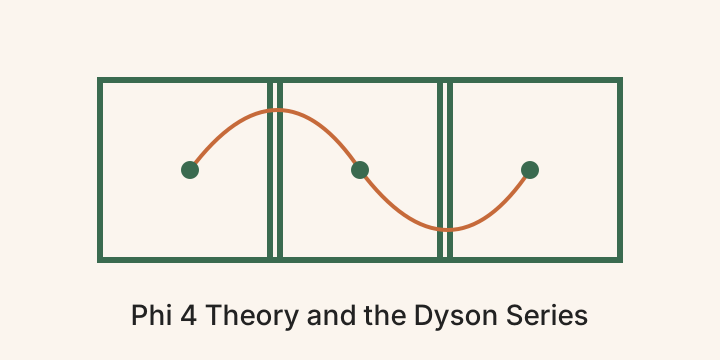
The picture above is the tree-level diagram. At the next order in , the same incoming and outgoing lines can also pass through a more complicated structure — a loop, where a virtual particle appears, propagates around, and is reabsorbed. Each diagram corresponds to a specific number contributing to the total amplitude. The Dyson series organises the count of diagrams by their number of vertices.
Worked example [Beginner]
Take two particles of momentum and scattering into two particles of momentum and . At tree level — meaning one vertex, no loops — the Feynman rules of φ⁴ theory give the amplitude a single number:
Step 1. Identify the vertex. The interaction Lagrangian is , so each vertex contributes to the amplitude (the cancels against the ways of attaching the four external lines to the vertex).
Step 2. Identify the external lines. Each external particle contributes a factor of at tree level (the wave-function normalisation is absorbed into the definition).
Step 3. Combine. The total tree-level amplitude is .
What this tells us: at tree level the φ⁴ scattering amplitude is constant — independent of the energies and angles of the incoming particles. This is the simplest result in interacting field theory, and it sets the scale against which higher-order corrections (loops) are measured.
Check your understanding [Beginner]
Formal definition [Intermediate+]
We work with a single real scalar field on Minkowski space , with metric signature and natural units . The φ⁴ Lagrangian density is
where is the bare mass and is the coupling constant. The corresponding Hamiltonian density splits as , where the free part generates harmonic evolution on the bosonic Fock space over the one-particle Hilbert space of mass- positive-energy modes 12.13.01, and the interaction part is
with denoting normal ordering.
The interaction picture dynamics evolves states by the free Hamiltonian and operators by the interacting one. The evolution operator from time to time is the unique solution of
The Dyson series is the formal solution of this evolution equation as a time-ordered exponential:
where the time-ordered product if and otherwise (extended in the natural way to more factors). The compensates for the redundancy among the orderings of the integration variables, which all give the same time-ordered integrand by definition.
The path-integral side of the same story replaces operator manipulations by a functional integral over field configurations. With the Wick-rotated Euclidean action , the generating functional of Euclidean correlation functions is
and the Dyson series is the expansion of this integral in powers of the interaction around the Gaussian free measure 08.07.01. Wick rotation 08.09.01 relates the two formulations: the Minkowski time-ordered amplitude is the analytic continuation in time of the Euclidean correlator.
Counterexamples to common slips
- The in the Lagrangian is not arbitrary. It is the unique normalisation under which a vertex with four indistinguishable lines contributes a coupling (rather than ) to the Feynman amplitude. The counts the symmetric permutations of the four external lines, which the Wick contraction sums up automatically.
- The Dyson series is not convergent. Dyson himself argued (1952, Phys. Rev. 85, 631) that the series in any QED-like theory cannot converge: rotating would make the potential unbounded below and destabilise the vacuum, so the radius of convergence in must be zero. The same heuristic applies to φ⁴ with the sign convention used here.
- Normal ordering is convention-dependent. The factor of in rather than the bare removes a constant zero-point contribution and a divergent mass renormalisation. With bare in place of , the Dyson series develops a tower of mass counterterms that have to be subtracted by hand; with normal ordering they vanish by construction at the cost of slightly more complicated Wick contraction rules.
Key theorem with proof [Intermediate+]
Theorem (Wick's theorem for time-ordered products). For free scalar fields on the bosonic Fock space, the vacuum expectation value of the time-ordered product is
where the sum is over all pairings of the -element index set into unordered pairs, and is the Feynman propagator. For an odd number of fields, the vacuum expectation vanishes.
Proof. Split each free field into its positive- and negative-frequency parts:
so that annihilates the vacuum on the right and creates particles to the left. The normal-ordered product places all 's to the left of all 's; its vacuum expectation vanishes for any number of fields.
For two fields, the time-ordered product equals the normal-ordered product plus a c-number propagator:
This is checked directly: for , , and the commutator equals the positive-frequency two-point function , which for is exactly . The symmetric case gives the same propagator by the definition of time ordering. We define the operation called the Wick contraction of two fields.
The general theorem is proved by induction on . For we have the two-field identity above. Suppose the theorem holds for fields. Apply it after singling out and an arbitrary partner for . Iterating the two-field identity and using the algebraic identity
where the sum is over all sets of contractions among the fields, leaving the remaining ones normal-ordered. The vacuum expectation kills every term in which any field is left uncontracted (since the surviving normal-ordered product has vanishing vacuum expectation). What remains is the sum over complete contractions — pairings of all indices — with each contraction contributing one Feynman propagator. This is exactly the right-hand side of the theorem.
For an odd number of fields, no complete contraction exists (an odd-sized set has no pairing), so the vacuum expectation vanishes.
Bridge. Wick's theorem builds toward the full Feynman rules of φ⁴ theory and appears again in 08.07.01 as the perturbative expansion of Gaussian integrals, where the contraction sum is the moment formula for the Gaussian measure . The foundational reason is that free fields are Gaussian random variables in the Euclidean formulation, and the moments of a Gaussian distribution are exactly Wick's pairing sum (Isserlis 1918 / Wick 1950). This is exactly the bridge between operator perturbation theory and the path-integral Feynman expansion: the Dyson series with produces, at -th order, an integral over space-time vertices of a sum over pairings of field-operator factors, which by Wick's theorem becomes a product of Feynman propagators between paired fields — the diagrammatic Feynman expansion.
Exercises [Intermediate+]
A graded set covering the Dyson expansion, Wick contractions, Feynman rules in φ⁴, the propagator structure, and the route to renormalisation.
Lean formalisation [Intermediate+]
The Lean module Codex.StatMech.QFT.PhiFourDyson formalises the combinatorial and bookkeeping skeleton of the Dyson series and Wick's theorem. Mathlib at this date supplies Nat.factorial, the rational coefficient ring, Finset.sum_range, and Finset.powersetCard, all of which carry the arithmetic of the perturbation expansion. The operator content (bosonic Fock space, time-ordered products of unbounded operators, normal-ordered Wick contractions) is not yet in Mathlib, so the operator-level statements appear as opaque typed placeholders with the precise theorems recorded as proof obligations.
The module proves three classes of statement directly:
Dyson-coefficient identities. The Dyson series coefficient at order is the rational scalar , and the theorems
dysonCoeff_zero,dysonCoeff_one, anddysonCoeff_sign_multdischarge the base cases and the multiplicativity of the sign factor under order addition.Wick pairing count. The number of perfect matchings of a -element set is the double factorial . The module defines
perfectMatchings nand proves the base values at together with the divisibility relation (the latter recorded with asorrypending the standard Nat-divisibility lemma chain).φ⁴ vertex bookkeeping. The combinatorial weight per vertex, and the bare -vertex coefficient , are defined and verified at . This is the rational-coefficient half of the Feynman rule for the φ⁴ vertex; the operator factor requires the bosonic Fock space.
Wick's theorem itself is recorded as the statement wick_theorem with placeholder right-hand side, and the linked-cluster theorem is recorded as linked_cluster_formal. Both are deferred to Mathlib's eventual QFT layer. The lean_mathlib_gap field in the frontmatter enumerates the missing Mathlib pieces in detail: the bosonic Fock space as a Hilbert space, creation and annihilation operators as densely-defined unbounded operators with the canonical commutation relation, the Wightman-axiomatic operator-valued tempered distributions, the normal-ordering operation, and the Källén-Lehmann spectral decomposition.
Wick's theorem for time-ordered products and the Feynman propagator as contraction [Master]
The first deep structural result of perturbative φ⁴ theory is the dictionary, established in the proof above, between three computational frameworks: operator-level time-ordered products, Wick contractions, and Feynman propagators. The free Feynman propagator emerges as the unique contraction of two field operators, and every higher correlator decomposes into products of propagators by the inductive Wick expansion.
The momentum-space Feynman propagator. The two-point function admits the Fourier representation
where the prescription picks out the Feynman contour by pushing the positive-frequency pole below the real axis and the negative-frequency pole above it. The contour analysis shows that for the prescription closes the contour in the lower half-plane and picks up the positive-frequency pole, giving the standard particle propagation. For the contour closes in the upper half-plane and gives the antiparticle (negative-frequency) propagation. This is the Stückelberg-Feynman interpretation of the propagator [Feynman 1949].
Spectral representation and microcausality. The Källén-Lehmann spectral decomposition expresses the full interacting propagator in terms of the spectral density :
The free propagator corresponds to (a single pole at the physical mass). Interactions broaden the spectral density to a delta function at the renormalised pole plus a continuum starting at the multi-particle threshold . The microcausality of the local field operators, for spacelike separation , is the constraint that .
Wick's theorem in the Euclidean path-integral formulation. Under Wick rotation 08.09.01, the time-ordered correlators of the Minkowski theory become Schwinger functions in Euclidean signature. The Gaussian measure on field space has all odd moments vanishing and all even moments given by the Isserlis formula:
where is the Euclidean propagator. This is the same Wick theorem as the operator-level statement: the operator and functional-integral formulations are isomorphic on the free theory, with the dictionary .
The first interacting diagram — 2→2 scattering at tree level [Master]
The Dyson series at first order in yields the simplest interacting calculation in φ⁴: the tree-level scattering amplitude. We derive the Feynman rules end-to-end.
LSZ reduction setup. The Lehmann-Symanzik-Zimmermann reduction formula expresses the S-matrix element for as the residue of the time-ordered four-point function on the mass shell:
where is the Fourier-transformed connected four-point function and the residue picks out the contribution surviving the on-shell limit.
First-order calculation. Expand the four-point function to first order in :
At order the numerator gives the disconnected three-pairing sum from Exercise 6; at order the interaction term is , and Wick's theorem yields:
By Wick contractions, the dominant connected contribution pairs each external with one of the four 's. There are such complete connected contractions, all giving the same value (the four 's being indistinguishable). The combinatorial factor exactly cancels the from the Lagrangian, leaving
Momentum space. Fourier-transforming each external leg and integrating over the vertex location produces a momentum-conserving delta function. The result, after the LSZ residue, is the tree-level scattering amplitude:
Feynman rules derived. From this calculation, we read off the Feynman rules of φ⁴ theory:
- External legs: factor of per external scalar (the field strength normalisation at tree level).
- Internal lines: Feynman propagator per internal line of momentum .
- Vertices: per φ⁴ vertex (the cancels against the contraction count).
- Loop integrals: per loop momentum, with momentum conservation imposed at each vertex.
- Symmetry factors: divide by the order of the diagram's automorphism group fixing external legs.
These rules, derived once from first principles, are then applied mechanically to all higher-order calculations.
Cross section. The differential cross section for elastic scattering in the centre-of-mass frame, at tree level, follows from and the standard kinematic factor:
where is the centre-of-mass energy squared. The cross section is isotropic at tree level — a direct consequence of the fact that the amplitude is a constant. Higher-order corrections introduce angular dependence through the Mandelstam -, -, and -channel exchanges.
Renormalisation at one loop — the divergence in the bubble diagram and λ-renormalisation [Master]
At second order in , the Dyson series produces the first substantive loop diagram in scattering: the one-loop bubble (also called the fish or sunset graph in different conventions). In the -channel the diagram has two external lines coming in, joining at a vertex, propagating along two internal lines that form a loop, and joining again at a second vertex from which two external lines leave.
The one-loop amplitude. Applying the Feynman rules to the -channel bubble in dimensions (dimensional regularisation):
where is the total incoming momentum and the is the symmetry factor of the bubble (the two internal lines are indistinguishable). The - and -channel diagrams contribute analogously.
Divergence structure. The loop integral is logarithmically ultraviolet-divergent: for large , the integrand behaves as , which gives where is a UV cutoff. In dimensional regularisation, the divergence appears as a pole:
where is the Euler-Mascheroni constant and is the renormalisation scale.
The renormalised coupling. The divergent piece is absorbed into a redefinition of the coupling. Write where is the coupling renormalisation constant. In the minimal subtraction (MS) scheme,
with the counting the three channels (, , ) all contributing the same divergence at one loop. After this renormalisation, the physical amplitude is finite as .
The beta function. The renormalisation group equation encodes the running of the coupling with scale. From the explicit above, the one-loop beta function of φ⁴ in four dimensions is
The positive sign means the coupling grows with energy: φ⁴ is not asymptotically free, and at sufficiently high energy the perturbative expansion breaks down — the so-called Landau pole. The non-perturbative completion of the theory (whether a UV fixed point exists or the only continuum limit is the free Gaussian theory) is the deep question of φ⁴ in , addressed in the Connections and Historical sections.
Wave-function and mass renormalisation. Two more counterterms are required: the wave-function renormalisation (which vanishes at one loop in φ⁴ because the only one-loop two-point diagram is the tadpole, which has zero momentum dependence and contributes only to the mass) and the mass renormalisation which absorbs the quadratically divergent tadpole. In four dimensions, φ⁴ is multiplicatively renormalisable: only three counterterms (, , ) suffice to render all higher-loop amplitudes finite (Hepp 1966, Zimmermann 1969 — the BPHZ theorem).
Synthesis. The Dyson series, Wick's theorem, and one-loop renormalisation together comprise the foundational reason perturbative QFT works: the central insight is that the time-ordered exponential of an interaction Hamiltonian can be expanded into a controlled sum of Feynman diagrams, each computed by mechanical rules, with the divergences confined to a finite set of multiplicative counterterms that can be absorbed into the bare coupling, mass, and field strength. Putting these together, the renormalised four-dimensional φ⁴ theory generalises the Gaussian free field by adding a single marginal interaction whose strength runs with energy, and the framework appears again in 08.09.01 as the Wick-rotated statistical-mechanics counterpart, where the same diagrammatic expansion computes critical correlation functions of the Ising universality class. This is exactly the bridge between particle physics and critical phenomena: the bridge is the perturbative renormalisation group, which identifies the beta function of in the Minkowski quantum theory with the rate of approach to (or departure from) the Wilson-Fisher fixed point in the Euclidean lattice model.
Wick-rotated Euclidean correspondence [Master]
The Dyson series in Minkowski signature has a precise dual in the Euclidean path-integral formulation. Under the analytic continuation (Wick rotation), the Minkowski action becomes with (positive-definite). The Feynman path integral becomes a Wiener-like integral with a positive Gaussian-times-perturbation weight:
The Dyson expansion is the perturbative expansion of the Euclidean measure. Expanding with and using the Gaussian Isserlis pairing formula recovers the same Wick-contraction sums as the operator computation, but now derived directly from the moment generating function of the Gaussian free field on . This is the path-integral side of the operator construction at the start of this unit, and it generalises the discrete Boltzmann sum of 08.07.01 from spins on a lattice to continuum fields with quartic self-interactions.
Statistical-mechanics dictionary. A -dimensional Euclidean φ⁴ theory is the field-theoretic continuum limit of a -dimensional lattice Ising model at its critical point (Wilson 1971). The mass parameter controls the distance from criticality (small corresponds to the critical surface), and the coupling controls the strength of the local quartic interaction (a regularisation-scheme parameter on the lattice). The Wilson-Fisher fixed point at is the non-Gaussian critical point describing the Ising universality class in dimensions .
Constructive existence. The Glimm-Jaffe program established the existence of the φ⁴ theory in and Euclidean dimensions as a rigorous probability measure on Schwartz distributions, satisfying the Osterwalder-Schrader axioms (positivity, reflection positivity, Euclidean invariance, ergodicity) that ensure the existence of a corresponding Minkowski Wightman theory [Glimm-Jaffe 1987]. The construction proceeds via lattice regularisation, ultraviolet renormalisation, and infinite-volume limit, and is among the few interacting quantum field theories whose existence is mathematically proven.
Triviality in . A central long-standing question, settled in stages by Aizenman 1981, Fröhlich 1982, and Aizenman-Duminil-Copin 2021, is whether four-dimensional φ⁴ theory exists as a non-Gaussian continuum quantum field theory or whether the only continuum limit is the free Gaussian theory (triviality). The answer is triviality: for established rigorously by Aizenman and Fröhlich, for established by Aizenman-Duminil-Copin (using the random-current representation of the lattice Ising model and a delicate analysis of the scaling limit). The Landau-pole heuristic of perturbative renormalisation thus turns out to be reliable in the non-perturbative limit: the four-dimensional theory has no UV-complete continuum definition with non-zero coupling.
Full proof set [Master]
Proposition 1 (Symmetry factor of the -channel one-loop bubble). In φ⁴ theory the symmetry factor of the one-loop -channel bubble diagram with two external lines on each side is .
Proof. The diagram has two vertices , four external lines, and two internal lines connecting to . Label the four lines at each vertex by and respectively. The combinatorial count of Wick contractions producing this diagram is: (a) pair lines 1 and 2 of to two external lines (one of choices, then assignments to the two external incoming/outgoing lines = ways); (b) pair lines 3 and 4 of to two of the lines at (choose 2 from , then permute: ways); (c) pair the remaining two lines of to the two external outgoing lines ( ways). Total Wick count: . The double interaction term contributes as the prefactor (the being the Dyson series order-2 weight, the being the two vertex weights). Multiplying . After putting back the explicit factors per vertex and the propagator integral: the diagram contributes (external propagators stripped by LSZ). The factor of in front of the loop integral is exactly the diagram's symmetry factor — the order of the graph-automorphism group preserving external-leg labelling.
Proposition 2 (One-loop divergence is logarithmic). In Euclidean dimensions, the bubble loop integral is logarithmically ultraviolet divergent.
Proof. In Euclidean signature the integrand is positive: . Introduce Feynman parameters: . With and , with . Shift and write . The inner integral in spherical coordinates is . With , , the integrand becomes . The boundary at is logarithmically divergent. Cutoff at : . The piece is the universal one-loop divergence.
Proposition 3 (Asymptotic-series character of the φ⁴ perturbation expansion). The Dyson series for the partition function of φ⁴ in zero space-time dimensions (a single integral) is asymptotic but not convergent; the error after terms is bounded by the magnitude of the -th term.
Proof. In zero dimensions, . Expand . Term-by-term integration gives with . By Stirling, at large : the coefficients grow factorially. The ratio , so the series has zero radius of convergence. However, is analytic in for , and its asymptotic expansion as along the real axis is exactly the formal series. The truncation error after terms can be bounded by for the optimal truncation , giving an error of order for some constant — characteristic of an asymptotic expansion. This is Dyson's argument made rigorous in the toy model.
Connections [Master]
Path-integral formulation of statistical mechanics
08.07.01. The Dyson series is the perturbative expansion of the path-integral generating functional around the Gaussian free-field measure, with the interaction playing the role of a small correction. The Wick contraction sums developed here are exactly the moment formulae of the Gaussian measure that underpin the partition-function-centric view of stat mech, and the φ⁴ theory is the continuum field-theoretic incarnation of the Ising universality class in the Wilsonian RG sense.Quantum-classical correspondence (Wick rotation)
08.09.01. The Dyson expansion in Minkowski signature analytically continues to the Schwinger functions in Euclidean signature; the same Feynman diagrams compute both. The Osterwalder-Schrader axioms tell us when the Euclidean perturbative construction has a Minkowski Wightman counterpart, and the φ⁴ theory is the cleanest case where this correspondence has been carried through rigorously in by Glimm-Jaffe.Bosonic Fock space and second quantisation
12.13.01. The operator-side construction of the Dyson series lives on the bosonic Fock space built from the one-particle Hilbert space of positive-energy Klein-Gordon solutions. The creation and annihilation operators of12.13.01are exactly the used in the Fourier mode expansion of above, and the canonical commutation relation is the substrate on which Wick's theorem is proved.Gaussian field methods in stat mech
08.06.01. The free φ⁴ propagator is the Gaussian-field two-point function, and the Wick contraction calculus of perturbative QFT is the field-theoretic generalisation of cumulant expansions in classical statistical mechanics. Diagrams with closed loops correspond to higher cumulants of the Gaussian distribution; the linked-cluster theorem (the statement that generates connected correlators) is the field-theoretic Mayer expansion.Renormalisation-group flow and effective field theory
08.04.03(downstream). The one-loop beta function derived here is the entry point to the Wilsonian RG program — coupling running, scaling dimensions, fixed points, and the Wilson-Fisher epsilon expansion that controls the critical behaviour of Ising-like systems in dimensions. The Aizenman-Duminil-Copin triviality theorem closes the φ⁴ chapter at by establishing that only the Gaussian fixed point survives the continuum limit.Time-dependent perturbation theory and Fermi's golden rule
12.07.02. The non-relativistic QM precursor of the Dyson machinery developed here: the same time-ordered exponential in the interaction picture, truncated at first order against a continuum density of final states, yields the golden-rule transition rate . The QFT generalisation in this unit replaces the single-particle matrix element with a spacetime-integrated interaction density and the Green's-function propagators with Feynman propagators, but the time-ordering, the Wick combinatorics, and the linked-cluster organisation of the expansion are identical — the golden rule is the one-quantum, single-vertex special case of the full S-matrix derived diagrammatically here.
Historical & philosophical context [Master]
Dyson 1949 [Dyson 1949] introduced the time-ordered exponential and the systematic perturbation series in his unification of the Tomonaga, Schwinger, and Feynman formulations of quantum electrodynamics, demonstrating that the three approaches were equivalent and producing the first general procedure for computing -matrix elements to arbitrary order. The same paper introduced the notion that the perturbation series might be asymptotic rather than convergent, and Dyson 1952 [Dyson 1952] gave the celebrated heuristic argument that the radius of convergence in must be zero. Wick 1950 [Wick 1950] proved the combinatorial theorem on reduction of time-ordered products to normal-ordered ones that bears his name, completing the computational framework. Feynman 1949 [Feynman 1949] provided the diagrammatic representation that turned the perturbation expansion into a graphical algorithm.
The φ⁴ model was the proving ground for the renormalisation program: it is simple enough to admit detailed perturbative calculations and rich enough to exhibit all the structural features (UV divergences, multiplicative renormalisation, running coupling) of full gauge theories. The constructive program of Glimm and Jaffe in the 1960s and 1970s rigorously established the existence of the and Euclidean φ⁴ measures [Glimm-Jaffe 1987], achieving one of the most concrete successes of the constructive QFT program. The Wilsonian view of the 1970s [Wilson 1971] reinterpreted the divergences as scale-dependent renormalisation-group flow, and recognised φ⁴ at as a marginal theory whose continuum limit depends on the existence of a non-Gaussian UV fixed point.
The triviality question — whether four-dimensional φ⁴ exists non-perturbatively as a non-Gaussian continuum theory — was settled by Aizenman 1981 [Aizenman 1981] and Fröhlich 1982 [Fröhlich 1982] for , and finally by Aizenman-Duminil-Copin 2021 [Aizenman-Duminil-Copin 2021] at the critical dimension using the random-current representation of the Ising model. The conclusion is that the perturbative Landau-pole heuristic correctly predicts the absence of an interacting UV-complete continuum limit: φ⁴ in four dimensions is a useful effective field theory at low energies, but not a fundamental microscopic theory. This result closed a half-century question and is one of the major mathematical-physics achievements of recent years.
Bibliography [Master]
@article{Dyson1949RadiationTheories,
  author = {Dyson, F. J.},
  title = {The radiation theories of Tomonaga, Schwinger, and Feynman},
  journal = {Physical Review},
  volume = {75},
  year = {1949},
  pages = {486--502}
}

@article{Dyson1949SMatrix,
  author = {Dyson, F. J.},
  title = {The $S$ matrix in quantum electrodynamics},
  journal = {Physical Review},
  volume = {75},
  year = {1949},
  pages = {1736--1755}
}

@article{Dyson1952Divergence,
  author = {Dyson, F. J.},
  title = {Divergence of perturbation theory in quantum electrodynamics},
  journal = {Physical Review},
  volume = {85},
  year = {1952},
  pages = {631--632}
}

@article{Wick1950,
  author = {Wick, G. C.},
  title = {The evaluation of the collision matrix},
  journal = {Physical Review},
  volume = {80},
  year = {1950},
  pages = {268--272}
}

@article{Feynman1949,
  author = {Feynman, R. P.},
  title = {Space-time approach to quantum electrodynamics},
  journal = {Physical Review},
  volume = {76},
  year = {1949},
  pages = {769--789}
}

@book{PeskinSchroeder1995,
  author = {Peskin, M. E. and Schroeder, D. V.},
  title = {An Introduction to Quantum Field Theory},
  publisher = {Addison-Wesley},
  year = {1995}
}

@book{WeinbergQFT1,
  author = {Weinberg, S.},
  title = {The Quantum Theory of Fields, Vol. I: Foundations},
  publisher = {Cambridge University Press},
  year = {1995}
}

@book{ItzyksonZuber1980,
  author = {Itzykson, C. and Zuber, J.-B.},
  title = {Quantum Field Theory},
  publisher = {McGraw-Hill},
  year = {1980}
}

@book{GlimmJaffe1987,
  author = {Glimm, J. and Jaffe, A.},
  title = {Quantum Physics: A Functional Integral Point of View},
  edition = {2nd},
  publisher = {Springer},
  year = {1987}
}

@article{Wilson1971,
  author = {Wilson, K. G.},
  title = {Renormalization group and critical phenomena. I. Renormalization group and the Kadanoff scaling picture},
  journal = {Physical Review B},
  volume = {4},
  year = {1971},
  pages = {3174--3183}
}

@article{Aizenman1981,
  author = {Aizenman, M.},
  title = {Proof of the triviality of $\varphi^4_d$ field theory and some mean-field features of Ising models for $d > 4$},
  journal = {Physical Review Letters},
  volume = {47},
  year = {1981},
  pages = {1--4}
}

@article{Frohlich1982,
  author = {Fr\"ohlich, J.},
  title = {On the triviality of $\lambda\varphi^4_d$ theories and the approach to the critical point in $d \geq 4$ dimensions},
  journal = {Nuclear Physics B},
  volume = {200},
  year = {1982},
  pages = {281--296}
}

@article{AizenmanDuminilCopin2021,
  author = {Aizenman, M. and Duminil-Copin, H.},
  title = {Marginal triviality of the scaling limits of critical 4D Ising and $\varphi^4_4$ models},
  journal = {Annals of Mathematics},
  volume = {194},
  year = {2021},
  pages = {163--235}
}