Integrability of continuous functions on [a,b]
Anchor (Master): Heine 1872 J. Reine Angew. Math. 74 (Heine-Cantor uniform continuity); Lebesgue 1901 C. R. Acad. Sci. Paris 132 (measure-zero criterion); Rudin Real and Complex Analysis Ch. 2
Intuition [Beginner]
A continuous curve has no jumps and no breaks. When you draw it without lifting your pen, every intermediate height gets visited. This smoothness means that the tallest and shortest rectangles in any strip stay close to each other, because the function cannot leap across a gap.
When you slice the interval into thin strips and build upper and lower rectangle stacks, the gap between overestimate and underestimate depends on how much the function wiggles inside each strip. For a continuous function, the wiggle shrinks as the strips get thinner.
This concept exists because continuity is the most natural condition that guarantees the area is well-defined. Any function you can draw as an unbroken curve has a definite area under it.
Visual [Beginner]
The picture shows a smooth curve drawn without lifting the pen over the interval from to . Two sets of rectangles sit on this interval. The dark rectangles (upper) touch the highest point of the curve in each strip. The light rectangles (lower) touch the lowest point. Because the curve has no jumps, the dark and light rectangles are nearly the same height in every thin strip.
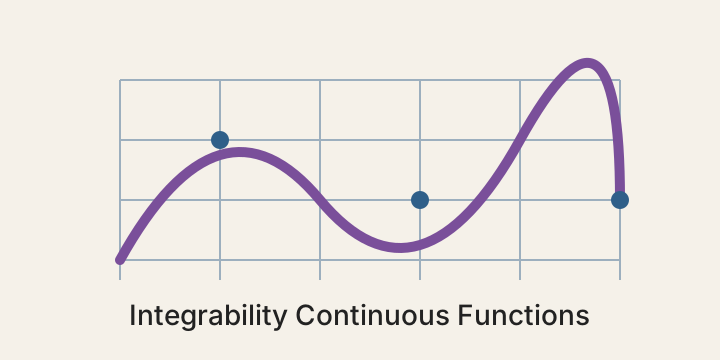
As the strips become thinner, the tallest and shortest rectangles in each strip converge to the same height, squeezing both estimates toward the true area.
Worked example [Beginner]
Consider on the interval from to . Divide into equal strips of width .
Step 1. The largest value in each strip: , , , . Upper total is .
Step 2. The smallest value in each strip: , , , . Lower total is .
Step 3. The gap is . With strips (width ) the gap halves to approximately . The exact area is .
What this tells us: the continuous function has no jumps, so the gap between upper and lower estimates shrinks predictably as strips get thinner.
Check your understanding [Beginner]
Formal definition [Intermediate+]
A function is uniformly continuous on if for every there exists such that whenever and .
Uniform continuity differs from pointwise continuity: the same works simultaneously for every point in the domain, rather than depending on the point.
Definition (Measure zero). A subset has Lebesgue measure zero if for every there exists a countable collection of open intervals such that and .
Counterexamples to common slips [Intermediate+]
Confusing pointwise and uniform continuity. The function is continuous at every point of but not uniformly continuous there. Uniform continuity fails because points near require increasingly small values.
Assuming all bounded functions are integrable. The Dirichlet function is bounded on but not integrable. Boundedness alone does not suffice; control over oscillation is required.
Conflating "measure zero" with "countable." Every countable set has measure zero, but some uncountable sets (such as the Cantor set) also have measure zero. Countability is sufficient but not necessary.
Key theorem with proof [Intermediate+]
Theorem (Continuous on implies integrable). If is continuous, then is Riemann-Darboux integrable on .
Proof. Since is a closed bounded interval and is continuous, the Heine-Cantor theorem 02.01.02 guarantees that is uniformly continuous on .
Given , uniform continuity provides such that whenever .
Choose a partition of with mesh . On each subinterval , the extreme value theorem gives points with and . Since , uniform continuity gives:
Therefore:
By the Darboux integrability criterion 02.04.01, is integrable.
Bridge. The Heine-Cantor theorem is the foundational reason that continuity on a compact interval upgrades to uniform continuity, and this is exactly the mechanism that makes the gap shrink. The central insight is that compactness transforms a pointwise property (continuity) into a global one (uniform continuity), and the bridge is from the topology of the domain to the existence of the integral. This result builds toward 02.04.04 where the fundamental theorems of calculus use integrability of continuous functions as their starting hypothesis, and appears again in the Lebesgue criterion below, which identifies the precise class of discontinuities that integrability tolerates.
Exercises [Intermediate+]
Advanced results [Master]
Theorem 1 (Lebesgue's criterion for Riemann integrability). A bounded function is Riemann integrable if and only if its set of discontinuities has Lebesgue measure zero.
The forward direction proceeds by covering the oscillation set with small intervals. The reverse direction applies the Darboux criterion on the continuity set and bounds the contribution from the discontinuity set.
Theorem 2 (Composition preserves integrability). If is integrable and is continuous, then is integrable.
The proof uses that is uniformly continuous on , so the oscillation of on any subinterval is controlled by the oscillation of . In particular, , , and are all integrable when is.
Theorem 3 (Product of integrable functions). If and are integrable on , then is integrable.
This follows from the identity and the fact that the square of an integrable function is integrable (by Theorem 2 with ).
Theorem 4 (Oscillation characterisation). The oscillation of at a point is . Then is continuous at if and only if , and is integrable on if and only if for every the set has measure zero.
This reframes Lebesgue's criterion in terms of the oscillation function, making the connection to the Darboux criterion direct: the partition construction controls the total oscillation by separating small-oscillation regions from large-oscillation regions.
Theorem 5 (Interchange of limit and integral). If is a sequence of integrable functions converging uniformly to , then is integrable and .
Uniform convergence guarantees that the gap carries over to in the limit. This is the first of the limit-interchange theorems in integration theory; the Lebesgue dominated convergence theorem 02.11.04 generalises it to pointwise convergence with an integrable bound.
Theorem 6 (Integrable functions are dense in ). The set of Riemann integrable functions on is dense in : for every and every there exists a Riemann integrable function with .
Step functions approximate from below, and continuous functions approximate step functions by the integrability result above.
Synthesis. The foundational reason that continuous functions are integrable is that compactness upgrades continuity to uniform continuity, which in turn controls oscillation. The central insight of the Lebesgue criterion is that integrability depends not on continuity everywhere but on the size of the discontinuity set, and this is exactly the condition that identifies the Riemann integrable functions as the bounded functions whose discontinuities are sparse in the measure-theoretic sense. Putting these together, the oscillation characterisation (Theorem 4) makes the bridge between the Darboux partition condition and the Lebesgue measure condition explicit, and the pattern generalises to the Lebesgue integral, where every measurable bounded function on a finite-measure set is integrable. The composition and product theorems build toward the algebraic structure of the space of integrable functions, and this space appears again in 02.11.04 as the Banach space .
Full proof set [Master]
Proposition 1 (Lebesgue's criterion, reverse direction). If is bounded and the set of discontinuities of has Lebesgue measure zero, then is Riemann integrable.
Proof. Let and let . For each , set . Then , and since has measure zero, each has measure zero.
Since has measure zero (where is chosen so that ), cover it with countably many open intervals of total length less than . By compactness of , a finite subcover suffices; call these .
On , the oscillation . By a compactness argument, there exists such that any subinterval of of length less than has oscillation less than .
Construct a partition that includes all endpoints of and has mesh less than on the complement. Then:
The bad sum (subintervals inside ) is at most . The good sum is at most . Total: . By the Darboux criterion, is integrable.
Proposition 2 (Composition preserves integrability). If is integrable and is continuous, then is integrable on .
Proof. Since is continuous on the compact interval , is uniformly continuous: for every there exists with whenever .
Let . On any subinterval where , the oscillation of satisfies , because any two values in that subinterval are within , and changes by less than over a -range.
The set where has measure zero (since is integrable, by Lebesgue's criterion). On the remaining set, . Since is bounded (by the extreme value theorem for ), the set where has oscillation is contained in , which has measure zero. By Lebesgue's criterion, is integrable.
Connections [Master]
Step-function integral and the Darboux integral
02.04.01. The Darboux criterion is the prerequisite framework: continuous functions are integrable because the gap vanishes under partition refinement. The integrability of continuous functions is the first substantial application of the Darboux machinery after its introduction.Fundamental theorems of calculus
02.04.04. FTC1 requires to be continuous on to conclude that . The integrability of continuous functions is the prerequisite that guarantees is well-defined, without which FTC1 cannot be stated.Banach spaces and bounded linear operators
02.11.04. The space is a Banach space, and the Riemann integrable functions form a dense subspace by Theorem 6. The completion of the Riemann integrable functions under the -norm yields the Lebesgue integrable functions, and this completion is the bridge from Riemann to Lebesgue integration.
Historical & philosophical context [Master]
Heine 1872, in a paper on the foundations of function theory [Heine1872], proved that a continuous function on a closed bounded interval is uniformly continuous, building on ideas from Cantor's 1870 work on trigonometric series uniqueness [Cantor1870]. The application of this result to prove integrability of continuous functions appears in standard form in the late nineteenth-century analysis textbooks.
Lebesgue 1901, in C. R. Acad. Sci. Paris 132 [Lebesgue1901], established the definitive characterisation: a bounded function is Riemann integrable if and only if its discontinuity set has measure zero. This criterion explained why continuous functions are integrable (the empty set has measure zero), why monotone functions are integrable (at most countably many discontinuities, hence measure zero), and why the Dirichlet function is not (the full interval has positive measure). The measure-zero concept introduced here became the foundation for the Lebesgue integral and, through it, for modern measure theory.
Bibliography [Master]
@article{Heine1872,
  author  = {Heine, Eduard},
  title   = {Die Elemente der Functionenlehre},
  journal = {Journal f\"ur die reine und angewandte Mathematik},
  volume  = {74},
  pages   = {172--188},
  year    = {1872}
}

@article{Cantor1870,
  author  = {Cantor, Georg},
  title   = {Beweis, dass eine f\"ur jeden reellen Werth von $x$ durch eine trigonometrische Reihe gegebene Funktion sich nur auf einzige Weise darstellen l\"asst},
  journal = {Journal f\"ur die reine und angewandte Mathematik},
  volume  = {72},
  pages   = {139--142},
  year    = {1870}
}

@article{Lebesgue1901,
  author  = {Lebesgue, Henri},
  title   = {Sur une g\'en\'eralisation de l'int\'egrale d\'efinie},
  journal = {Comptes rendus de l'Acad\'emie des Sciences Paris},
  volume  = {132},
  pages   = {1025--1028},
  year    = {1901}
}

@book{Apostol1967,
  author    = {Apostol, Tom M.},
  title     = {Calculus, Vol. 1: One-Variable Calculus, with an Introduction to Linear Algebra},
  publisher = {Wiley},
  year      = {1967}
}

@book{Rudin1976,
  author    = {Rudin, Walter},
  title     = {Principles of Mathematical Analysis},
  publisher = {McGraw-Hill},
  edition   = {3},
  year      = {1976}
}