Smooth structure and atlases
Anchor (Master): Whitney 1936 Ann. Math.; Milnor 1956 Ann. Math. (exotic spheres); Lee ISM Ch. 1
Intuition [Beginner]
A topological manifold has coordinate charts, but the charts might not fit together smoothly. Imagine two maps of the Earth that use different projections — the transition between them might stretch or twist.
A smooth atlas is a collection of charts where every transition between overlapping charts is smooth (infinitely differentiable). This means calculus works consistently across chart boundaries.
Think of it like a jigsaw puzzle: each piece (chart) is flat, and the edges between pieces must line up without kinks. A smooth atlas ensures there are no kinks at the seams.
Two atlases are equivalent if their union is still a smooth atlas — they describe the same smooth structure. A smooth manifold is a topological manifold with a chosen equivalence class of smooth atlases.
Visual [Beginner]
Two overlapping charts on a manifold, each mapping to a flat patch of . In the overlap region, the transition map goes from one flat patch to another. A smooth arrow labelled "smooth transition" connects them.
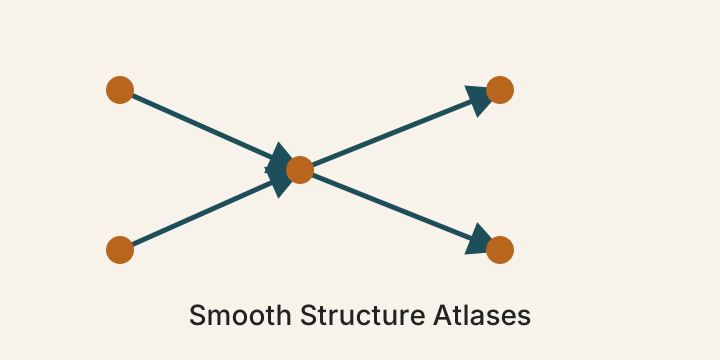
The smooth atlas: every transition between charts is a smooth map between open sets of .
Worked example [Beginner]
On the circle , use two charts: covering and covering .
In the overlap (the circle minus two points), the transition maps an angle to or (depending on the chart conventions). This is a smooth function of .
So these two charts form a smooth atlas, giving a smooth structure. This is the standard smooth structure on the circle.
Check your understanding [Beginner]
Formal definition [Intermediate+]
Definition (-compatible charts). Two charts and on a topological -manifold are smoothly compatible if either , or the transition map:
is a diffeomorphism (smooth with smooth inverse).
Definition (Smooth atlas). A smooth atlas on is a collection of pairwise smoothly compatible charts whose domains cover .
Definition (Smooth structure). A smooth structure on is a maximal smooth atlas (one that contains every chart smoothly compatible with all charts in the atlas).
Every smooth atlas is contained in a unique maximal atlas. In practice, one specifies a smooth structure by giving any smooth atlas; the maximal extension is implicit.
Key theorem with proof [Intermediate+]
Theorem (Uniqueness of the maximal atlas). Every smooth atlas on is contained in a unique maximal smooth atlas , consisting of all charts smoothly compatible with every chart in .
Proof. Let .
contains . Every chart in is smoothly compatible with every other chart in (by definition of atlas), so .
is an atlas. Let and be two charts in . For any chart , the compositions are compositions of smooth maps, hence smooth. So is pairwise compatible and covers .
Maximality. Any chart smoothly compatible with all charts in is smoothly compatible with all charts in , hence already in .
Uniqueness. If is another maximal atlas containing , then every chart in is compatible with , so . By maximality of : .
Bridge. This construction generalises the idea of extending a basis to a maximal basis; the foundational reason smooth structures work is that compatibility is transitive, allowing local conditions to patch together globally. This pattern appears again in 03.02.03 where smooth maps between manifolds are defined using compatible charts. The bridge is that the maximal atlas is the "completion" of any atlas, identifying the smooth structure as an equivalence class of atlases.
Exercises [Intermediate+]
Advanced results [Master]
Exotic spheres (Milnor, 1956). Milnor constructed a smooth 7-manifold that is homeomorphic to but not diffeomorphic to . This means the same topological manifold can carry inequivalent smooth structures. Milnor's construction used an -bundle over and showed that the resulting manifold has a non-standard Pontryagin class.
The number of exotic smooth structures on :
- : unique smooth structure (standard only)
- : unknown (the smooth Poincare conjecture in dimension 4)
- : unique
- : 28 exotic structures (oriented)
- : 2, 8, 6, 992 exotic structures respectively
Exotic . By work of Freedman and Donaldson (1982), admits exotic smooth structures — the only Euclidean space to do so. This is deeply connected to the failure of smooth Versus topological in dimension 4.
Smooth Versus topological. In dimensions , every topological manifold admits a unique smooth structure (up to diffeomorphism). In dimension , existence and classification are controlled by surgery theory. Dimension 4 is the wild case where both existence and uniqueness can fail.
Synthesis. The smooth structure is the bridge between topology and calculus on manifolds; the central insight is that smooth compatibility of charts is a local condition with global consequences — it determines which functions are smooth, which maps are diffeomorphisms, and ultimately what geometric invariants the manifold carries. This pattern recurs in the theory of exotic spheres where the same topology supports different smooth geometries. The bridge is that smooth structures are the "calculus certificates" for manifolds — they appear again in Riemannian geometry where a metric adds distance to the smooth foundation.
Full proof set [Master]
Proposition (Smooth maps are well-defined). If is represented by a smooth map in one pair of charts, then it is smooth in every pair of compatible charts.
Proof. Let and be charts on and respectively, and suppose is smooth. Let and be any other compatible charts. Then:
Since the transition maps and are smooth (by chart compatibility), and is smooth, the composition is smooth.
Connections [Master]
Topological manifolds 03.02.01 provide the underlying space on which smooth structures are built; the smooth atlas adds calculus-compatible coordinate transitions.
Smooth maps between manifolds 03.02.03 are the morphisms of the smooth category; their well-definedness depends on the chart compatibility proved here.
Exotic spheres and differential topology show that smooth structure carries information beyond topology; the invariants that detect exotic structures (Pontryagin classes, Seiberg-Witten invariants) are smooth invariants with no topological counterpart.
Bibliography [Master]
@article{whitney1936,
  author = {Whitney, Hassler},
  title = {Differentiable manifolds},
  journal = {Ann. of Math.},
  volume = {37},
  pages = {645--680},
  year = {1936}
}

@article{milnor1956,
  author = {Milnor, John},
  title = {On manifolds homeomorphic to the $7$-sphere},
  journal = {Ann. of Math.},
  volume = {64},
  pages = {399--405},
  year = {1956}
}

@book{lee-smooth,
  author = {Lee, John M.},
  title = {Introduction to Smooth Manifolds},
  edition = {2},
  publisher = {Springer},
  year = {2013}
}

@book{spivak-dg,
  author = {Spivak, Michael},
  title = {A Comprehensive Introduction to Differential Geometry},
  volume = {1},
  edition = {3},
  publisher = {Publish or Perish},
  year = {1999}
}
Historical & philosophical context [Master]
Hassler Whitney introduced the modern definition of a smooth manifold in 1936 [Whitney 1936], providing the rigorous foundation that Riemann's vision required. Whitney proved that every smooth manifold embeds in Euclidean space, showing that the abstract definition coincides with the concrete notion of a smooth surface.
John Milnor's 1956 discovery of exotic spheres [Milnor 1956] was a watershed moment. It showed that "smooth" and "topological" are genuinely different categories: the same topological space can carry inequivalent smooth structures. This result launched differential topology as a major field and earned Milnor the Fields Medal.
The philosophical lesson is that smoothness is not a property but a choice. A topological manifold does not come with a preferred smooth structure; choosing one is an additional geometric act with profound consequences for the global properties of the space.