Smooth maps between manifolds
Anchor (Master): Whitney 1936 Ann. Math.; Borel 1895; Lee ISM Ch. 1-2
Intuition [Beginner]
A smooth map between manifolds is a function that looks smooth in every coordinate chart. If you write the map in local coordinates and the result is a smooth function from to , the map is smooth.
The key point: smoothness does not depend on which charts you use. If a map is smooth in one pair of charts, it is smooth in every pair of compatible charts. This is because the transitions between charts are themselves smooth, and composing smooth maps gives smooth maps.
A diffeomorphism is a smooth map with a smooth inverse. It is the smooth version of a homeomorphism — a bijection that preserves all smooth structure. Two manifolds are "the same" from the smooth perspective if there is a diffeomorphism between them.
Visual [Beginner]
Two manifolds and , each with charts shown as flat patches. A curved arrow connects them. In the chart coordinates, the map becomes a smooth function shown as a smooth curve.
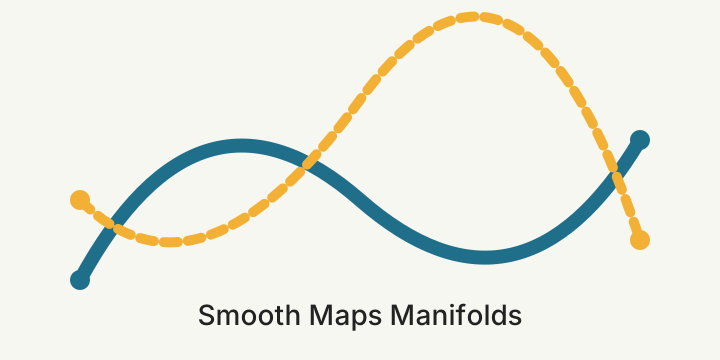
A smooth map between manifolds: smooth in local coordinates, independently of the chart choice.
Worked example [Beginner]
Consider the map given by the inclusion .
In stereographic coordinates from the north pole, a point . The composition gives the three coordinate functions, each of which is a smooth (rational) function of and .
So the inclusion map is smooth. This is the simplest example: the inclusion of a submanifold into its ambient space.
Check your understanding [Beginner]
Formal definition [Intermediate+]
Definition (Smooth map). Let and be smooth manifolds of dimensions and . A function is smooth (or ) if for every , there exist charts about and about such that the coordinate representation:
is as a map between open subsets of and .
Definition (Diffeomorphism). A smooth map is a diffeomorphism if is bijective and is also smooth.
The set of all diffeomorphisms forms a group under composition, denoted .
Key theorem with proof [Intermediate+]
Theorem (Smoothness is chart-independent). If is smooth in one pair of charts , then is smooth in every pair of compatible charts.
Proof. Let and be any other charts about and . The coordinate representation in the new charts is:
Each component is smooth: is a smooth transition (by chart compatibility), is smooth (by hypothesis), and is a smooth transition. The composition of three smooth maps is smooth.
This theorem is the foundational reason the theory works: smoothness is an intrinsic property of the map, not an artefact of the coordinates.
Bridge. The chart-independence of smoothness generalises the coordinate-freedom of linear algebra; the foundational reason is that smooth structures are defined by equivalence classes of atlases, making smoothness invariant under chart change. This pattern appears again in the theory of tensor fields where coordinate-free objects are represented by functions that transform predictably under chart transitions. The bridge is that smooth maps are the morphisms of the smooth category, and the entire differential-geometric machinery (tangent vectors, differential forms, connections) is built to be chart-independent for the same reason.
Exercises [Intermediate+]
Advanced results [Master]
Borel's theorem. For any point and any formal power series in variables, there exists a smooth function whose Taylor series at is . This means the map sending to its Taylor series is surjective. The kernel consists of flat functions (functions all of whose derivatives vanish at ).
Jet bundles. The -th jet of a smooth function at is the equivalence class of modulo functions whose derivatives of order vanish at . The -th jet bundle is a manifold that parametrises all -jets of smooth maps . Jet bundles are the coordinate-free framework for Taylor expansions.
The Fr'echet algebra . The space of smooth functions on a compact manifold is a Fr'echet space (complete metrisable locally convex topological vector space) with seminorms for compact and . The algebra structure (pointwise multiplication) is jointly continuous, making a Fr'echet algebra.
Synthesis. Smooth maps are the morphisms that make manifolds into a category; the central insight is that chart-independence ensures smooth maps are intrinsic geometric objects, not coordinate-dependent artifacts. This pattern appears again in the definition of tangent vectors as derivations of , where the algebra of smooth functions determines the entire differential topology of the manifold. The bridge is that smooth maps generalise smooth functions to inter-manifold relations — this builds toward the theory of embeddings, immersions, and submersions that classify how one manifold sits inside another.
Full proof set [Master]
Proposition (Borel's theorem, special case). For any sequence of real numbers, there exists a smooth function with for all .
Proof sketch. Let be a smooth bump function supported on with . Define where fast enough that each term and its derivatives up to order are bounded by . The series converges uniformly on compact sets along with all derivatives, giving a smooth function. At : by the choice of ensuring cross-terms vanish.
Connections [Master]
Smooth structures and atlases 03.02.02 define the smooth manifolds that smooth maps connect; the chart-compatibility proved there is what makes smoothness chart-independent.
Topological manifolds 03.02.01 are the underlying spaces; smooth maps refine continuous maps by requiring infinite differentiability in coordinates.
Exotic spheres demonstrate that the smooth map category is richer than the topological category: homeomorphic manifolds need not be diffeomorphic, meaning no smooth map with smooth inverse connects them.
Bibliography [Master]
@article{whitney1936,
  author = {Whitney, Hassler},
  title = {Differentiable manifolds},
  journal = {Ann. of Math.},
  volume = {37},
  pages = {645--680},
  year = {1936}
}

@book{lee-smooth,
  author = {Lee, John M.},
  title = {Introduction to Smooth Manifolds},
  edition = {2},
  publisher = {Springer},
  year = {2013}
}

@book{spivak-dg,
  author = {Spivak, Michael},
  title = {A Comprehensive Introduction to Differential Geometry},
  volume = {1},
  edition = {3},
  publisher = {Publish or Perish},
  year = {1999}
}
Historical & philosophical context [Master]
Whitney's 1936 paper [Whitney 1936] not only defined smooth manifolds but also proved that smooth maps between them are well-defined independently of the charts used. This resolved a fundamental tension: if smoothness depended on coordinates, the entire theory would be coordinate-dependent.
The category-theoretic viewpoint emerged in the 1940s-50s: smooth manifolds form a category whose morphisms are smooth maps, and diffeomorphisms are the isomorphisms. This perspective, championed by Eilenberg, Steenrod, and later by Lawvere, unified differential geometry with category theory and paved the way for sheaf theory and topos theory.
The philosophical point is that smooth maps encode the relationships between geometric spaces. A diffeomorphism says two manifolds are "the same"; an embedding says one sits inside another; a submersion says one fibres over another. These three types of smooth maps classify the fundamental spatial relationships in differential geometry.