Frobenius theorem
Anchor (Master): Frobenius 1877 J. Reine Angew. Math. 80; Debeuvre 1891; Lee ISM Ch. 19; Warner 1983
Intuition [Beginner]
Imagine drawing a family of curves on a surface, filling it up completely without gaps or crossings. The Frobenius theorem tells you when this is possible: when can you fill a manifold with submanifolds of a given dimension so that every point lies on exactly one?
The answer is a condition on the directions you are allowed to move. If the allowed directions at each point form a smooth family (a "distribution"), then you can find the filling submanifolds precisely when the allowed directions are closed under "mixing" --- if you move along direction A, then direction B, then back along A, then back along B, the net displacement stays within the allowed directions.
Think of it like this: a weather map shows wind directions at every point. The Frobenius theorem tells you when you can draw streamlines that are everywhere tangent to the wind. The condition is that the wind field does not create "twists" that force streamlines to leave the surface they started on.
Why does this concept exist? The Frobenius theorem is the integrability condition for differential equations on manifolds. It tells you when a system of first-order equations has solutions, and is the foundation for the theory of foliations.
Visual [Beginner]
A drawing of a torus (donut shape) sliced by horizontal circles that foliate the surface. Each circle is a "leaf" of the foliation. At each point of the torus, the tangent line to the circle through that point is the "allowed direction." The leaves fill the torus without gaps or intersections.
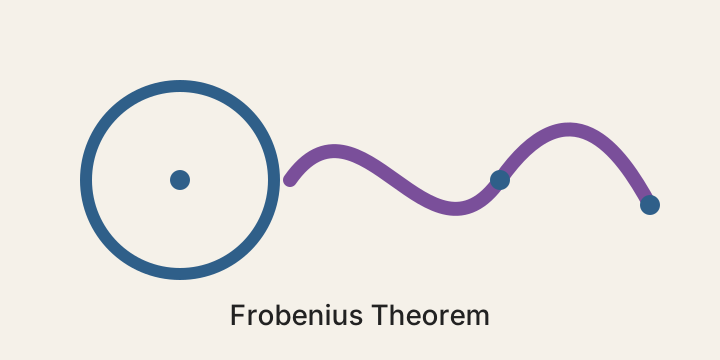
When the involutivity condition fails, the integral curves twist away from each other and cannot be assembled into coherent surfaces.
Worked example [Beginner]
Consider with coordinates . At each point, we allow motion only in two directions: the -direction and the direction that mixes and . Specifically, the allowed directions are spanned by the vectors and .
Step 1. Check the "mixing" condition (involutivity). The commutator of the two direction fields measures the failure of the two directions to close under mixing. Computing: the change in along minus the change in along . Here and . Moving along changes , so changes from to . The derivative is . Moving along does not change (since is constant). So the commutator is .
Step 2. Is in the span of and ? Yes: . Wait --- at the point , the span is all vectors of the form for real numbers . The vector requires and , so . This works for . So the distribution is involutive (at least away from ).
Step 3. The integral surfaces are for constants . On the surface , the tangent plane at is spanned by and . The second vector matches our allowed direction.
What this tells us: the involutivity condition detects when the allowed directions fit together into coherent surfaces.
Check your understanding [Beginner]
Formal definition [Intermediate+]
Let be a smooth -manifold. A distribution of rank on is a smooth assignment where each is a -dimensional subspace. Smoothness means: every point has a neighbourhood on which there exist smooth vector fields that span at each point (a local frame for ).
Definition (Involutive distribution). A distribution is involutive if for all smooth vector fields with values in (i.e., for all ), the Lie bracket also has values in .
Definition (Integral manifold). An integral manifold of is an immersed submanifold such that for all .
Definition (Foliation). A foliation of by -dimensional leaves is a decomposition into connected immersed submanifolds (the leaves) such that every point has a chart with and each leaf intersects in at most countably many slices .
Counterexamples to common slips
A rank-1 distribution is always involutive. For any vector field , , and for with , we get , which is a multiple of and hence in . So rank-1 distributions are always integrable --- this is the existence theorem for integral curves of a single vector field.
Involutivity must be checked for all pairs, not just a local frame. If is a local frame, it suffices to check for , because any section of is a linear combination of the with smooth coefficients, and the bracket satisfies .
Key theorem with proof [Intermediate+]
Theorem (Frobenius). Let be a distribution of rank on a smooth -manifold . The following are equivalent:
- is involutive: for all vector fields .
- is integrable: every point has a neighbourhood and an integral manifold of through with .
- is locally a foliation: every point has a chart with and .
Proof.
(1) implies (3). Let and let be a local frame for near . Choose coordinates near with and for . Write . The matrix is the identity at , hence invertible near . By row reduction (multiplying by the inverse matrix), we may assume .
The involutivity condition means for some smooth functions . Computing the component ():
Consider the map defined by flowing along the vector fields: . The derivative at maps to at (by definition of the flow) and to . By the involutivity condition, the correction terms are absorbed into , so is a local diffeomorphism near .
In the new coordinates , the distribution is spanned by , giving .
(3) implies (2). In the flat chart, the slices are integral manifolds of through every point of .
(2) implies (1). Let be vector fields with values in . Let be an local integral manifold through with . Both and are tangent to , so their Lie bracket is tangent to (the Lie bracket of vector fields tangent to a submanifold is tangent to the submanifold, by the formula applied to functions that vanish on ). Hence .
Bridge. This theorem builds toward the global Frobenius theorem where the maximal integral manifolds form a foliation partitioning the entire manifold, and appears again in the theory of Lie subgroups 03.03.06 where a Lie subalgebra integrates to a Lie subgroup precisely when the corresponding distribution is involutive. The foundational reason is that involutivity is the algebraic shadow of the geometric property of being tangent to a submanifold, and this is exactly the bridge between local linear algebra (the distribution at each point) and global differential topology (the foliation of the manifold). Putting these together with the dual formulation via differential forms (the distribution is the kernel of independent one-forms, and involutivity is equivalent to the ideal generated by these forms being closed under exterior differentiation), the theorem generalises to the Cartan-Kaehler theory of exterior differential systems.
Exercises [Intermediate+]
Advanced results [Master]
Theorem 1 (Global Frobenius theorem). Let be an involutive distribution of constant rank on a smooth manifold . Then is foliated by maximal connected integral manifolds of : every point lies in a unique maximal connected integral manifold , and if and only if and can be joined by a piecewise smooth curve tangent to .
Theorem 2 (Godement theorem). Let be an equivalence relation on a smooth manifold . Then is a smooth manifold (with the quotient topology and a unique smooth structure making the projection a submersion) if and only if is a closed submanifold and the two projections are surjective submersions. This is the clean algebraic criterion for when a foliation has a smooth leaf space.
Theorem 3 (Lie's third fundamental theorem via Frobenius). Let be a finite-dimensional Lie subalgebra of the Lie algebra of smooth vector fields on . Then integrates to a Lie group action: there exists a Lie group acting on such that the infinitesimal action identifies with the Lie algebra of . The proof uses Frobenius on the product to construct the graph of the action.
Theorem 4 (Cartan-Kaehler theory). An exterior differential system on a manifold (an ideal in the exterior algebra of closed under ) has integral manifolds of dimension if and only if the polar equations of are compatible at each point. The Frobenius theorem is the special case where is generated by one-forms.
Theorem 5 (Stefan-Sussmann theorem). Let be a distribution (not necessarily of constant rank) on a smooth manifold generated by a family of smooth vector fields. If is involutive modulo (meaning is a section of for all ), then is partitioned into maximal integral manifolds of , but these manifolds may have different dimensions.
Synthesis. The Frobenius theorem is the foundational reason that the local-to-global passage works for integrable distributions. The central insight is that involutivity is the algebraic condition encoding the geometric property of tangent submanifolds, and this is exactly the bridge between the infinitesimal data (the distribution) and the global structure (the foliation). Putting these together with the Godement theorem, the leaf space of a foliation is a manifold precisely when the equivalence relation is a closed submanifold, and the bridge is the quotient of by the foliation.
The pattern generalises from constant-rank distributions to the Stefan-Sussmann theorem for distributions of varying rank, and this appears again in the theory of Lie groupoids where the orbits of a Lie groupoid on a manifold form a singular foliation governed by a Frobenius-type integrability condition.
Full proof set [Master]
Proposition 1 (Global Frobenius: maximal integral manifolds are well-defined). Let be an involutive distribution of constant rank on . For each , define can be joined to by a piecewise smooth curve tangent to . Then is a connected immersed submanifold of with for all .
Proof. The set is connected by construction (it is path-connected by piecewise smooth curves tangent to ). To give a smooth structure, cover it by flat charts from the local Frobenius theorem. For each , choose a flat chart with and .
Define , the plaque through in . The plaque is an integral manifold of and for all .
Equip with the smooth structure generated by all plaques for . The compatibility of plaque charts follows from the uniqueness of integral manifolds: if two plaques and overlap, their intersection is open in both, and the transition map between the charts is smooth because both charts are restrictions of smooth charts on . This makes an immersed submanifold.
Proposition 2 (Dual Frobenius: the differential forms characterisation). A distribution (where are pointwise linearly independent one-forms and ) is involutive if and only if for all .
Proof. Let . The condition means is in the algebraic ideal generated by in .
Forward direction: if is involutive, choose local coordinates in which , so modulo the ideal. Then , and .
Converse direction: if for all , then for some one-forms . Let be vector fields in . Then . Since (both ), we get . But (since ). So for all , meaning .
Connections [Master]
Smooth maps and submanifolds
03.02.03. The Frobenius theorem produces submanifolds (integral manifolds of a distribution), and the construction relies on the smooth structure developed in03.02.03. The involutivity condition is checked using the smooth vector fields and their Lie brackets, which are smooth maps from to .Lie subgroups and subalgebras
03.03.06. The Lie correspondence (a Lie subalgebra integrates to a connected Lie subgroup) is proved via Frobenius: the left-invariant vector fields generating a subalgebra form an involutive distribution on the Lie group, and the integral manifold through the identity is the desired subgroup. The bridge is that left invariance makes the involutivity condition automatic from the subalgebra property.Differential forms and de Rham theory
03.04.01. The dual formulation of Frobenius uses differential forms: involutivity of is equivalent to the ideal being closed under exterior differentiation. This connects to de Rham cohomology and the theory of Pfaffian systems.
Historical & philosophical context [Master]
Frobenius proved his theorem in 1877 (J. Reine Angew. Math. 80) [Frobenius1877] in the context of the Pfaffian problem: when can a differential one-form be written as for a function ? Frobenius's contribution was to recognise that the integrability of a system of one-forms reduces to a purely algebraic condition on the exterior derivatives.
The geometric interpretation in terms of distributions and foliations is due to Debeuvre (1891) and was developed further by Ehresmann in the 1940s. The global version (maximal integral manifolds partitioning the manifold) appears in Chevalley's 1946 Theory of Lie Groups [Chevalley1946]. The Godement theorem on quotient manifolds was published in 1952 (Bull. Soc. Math. France 80) [Godement1952]. The Stefan-Sussmann generalisation to distributions of non-constant rank was established independently by Stefan (1974) and Sussmann (1973), extending Frobenius to singular foliations arising in control theory.
Bibliography [Master]
@article{Frobenius1877,
  author = {Frobenius, Ferdinand Georg},
  title = {Ueber das Pfaffsche Problem},
  journal = {J. Reine Angew. Math.},
  volume = {80},
  year = {1877},
  pages = {1--40},
}

@book{Chevalley1946,
  author = {Chevalley, Claude},
  title = {Theory of Lie Groups},
  publisher = {Princeton Univ. Press},
  year = {1946},
}

@article{Godement1952,
  author = {Godement, Roger},
  title = {Th\'{e}orie des faisceaux},
  journal = {Bull. Soc. Math. France},
  volume = {80},
  year = {1952},
}

@book{Lee2013,
  author = {Lee, John M.},
  title = {Introduction to Smooth Manifolds},
  edition = {2},
  publisher = {Springer},
  year = {2013},
}

@book{Warner1983,
  author = {Warner, Frank W.},
  title = {Foundations of Differentiable Manifolds and Lie Groups},
  publisher = {Springer},
  year = {1983},
}