Formal group law
Anchor (Master): Booner 1946; Lazard 1955 Ann. Sci. ENS; Quillen 1969; Hazewinkel 1978
Intuition [Beginner]
A formal group law is a rule for combining two inputs using a power series instead of a simple formula. The most familiar example is addition: is a way to combine two numbers. Another is multiplication: is also a combination rule. Both satisfy the same abstract properties: there is an identity element (zero), each input has an inverse, and the order of grouping does not matter.
A formal group law replaces the simple formula with an infinite power series . The power series must satisfy the same group axioms: an identity, inverses, and associativity. The word "formal" means we only care about the algebraic properties of the power series coefficients, not about convergence.
Why does this concept exist? Formal group laws capture the local structure of Lie groups in purely algebraic terms, without any reference to smoothness or convergence. They appear everywhere: in algebraic topology (complex cobordism), number theory (elliptic curves), and representation theory.
Visual [Beginner]
A diagram showing two inputs and entering a black box labelled , which outputs . Below, three boxes show the group axioms as wiring diagrams: identity feeds 0 into one slot, inverse feeds to recover 0, and associativity shows two wiring orders giving the same output.
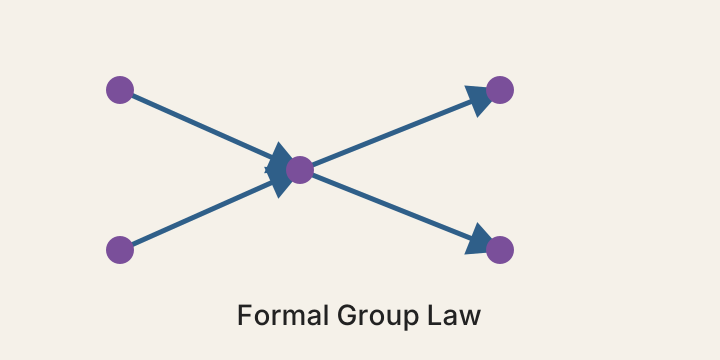
A formal group law is a power series that satisfies the group axioms algebraically.
Worked example [Beginner]
The additive formal group law. The simplest formal group law is .
Step 1. Check the identity: . The identity element is zero.
Step 2. Check the inverse: the inverse of is , since .
Step 3. Check associativity: .
The multiplicative formal group law. Define . This encodes multiplication via the substitution : . The inverse is , since .
What this tells us: even the simplest algebraic operations give rise to formal group laws, and the higher-order terms in more general laws encode richer structure.
Check your understanding [Beginner]
Formal definition [Intermediate+]
Let be a commutative ring with identity. The ring of formal power series in two variables consists of expressions with , equipped with formal addition and multiplication.
Definition (Formal group law). A (one-parameter, commutative) formal group law over is a formal power series satisfying:
- Identity: and
- Commutativity:
- Associativity: in
The identity axiom forces . A homomorphism of formal group laws is a power series with and a unit, satisfying . An isomorphism is a homomorphism with an inverse homomorphism.
Definition (Logarithm). If , every commutative formal group law over has a logarithm: a power series with and such that . This means every commutative formal group law over a -algebra is isomorphic to the additive law .
Counterexamples to common slips
- All formal group laws are isomorphic over . True, via the logarithm. Over fields of positive characteristic, formal group laws carry rich structure classified by the height invariant.
- Associativity means . False. The associativity condition is a system of polynomial equations in the coefficients, and the solutions form a rich moduli space.
- Formal group laws only exist over fields. False. They are defined over arbitrary commutative rings, and the Lazard ring parametrises the universal formal group law over the largest possible base.
Key theorem with proof [Intermediate+]
Theorem (Lazard comparison lemma). Let be a formal group law over a commutative ring . The associativity condition is equivalent to an infinite system of polynomial identities in the coefficients . These identities generate a polynomial ring such that giving a formal group law over is equivalent to giving a ring homomorphism .
Proof sketch. Expand and as power series in . Equating coefficients of each monomial gives a polynomial identity . The system of all such forms an ideal . The quotient is the Lazard ring. A formal group law over amounts to choosing images for the generators in satisfying all the relations, which is exactly a ring homomorphism .
The key step is Lazard's theorem (1955): is a polynomial ring on countably many generators, one in each positive even degree. The proof proceeds by analysing the relations degree by degree and showing each new degree introduces exactly one free parameter.
Bridge. This theorem builds toward the Lazard ring classification in the Master section and the Quillen theorem 03.03.04 identifying with the coefficient ring of complex cobordism , and the foundational reason the classification works is that the associativity condition is a recursive system of polynomial equations that unlocks one degree of freedom at each step. This is exactly the mechanism that makes the Lazard ring a polynomial ring rather than a more complicated quotient, and the bridge is that the formal group law associated to any complex-oriented cohomology theory factors through the universal law over , making the receiving object for all such theories. The result generalises to -typical formal group laws in positive characteristic, where the classification refines to the Honda theory 03.03.05.
Exercises [Intermediate+]
Advanced results [Master]
Theorem 1 (Quillen's theorem). The Lazard ring is naturally isomorphic to the coefficient ring $\pi_(MU)L$ corresponds to the formal group law of complex-oriented cohomology arising from the Thom classes of complex vector bundles.*
Theorem 2 (Lazard ring structure). The Lazard ring is with . The universal formal group law has the form where are universal polynomials in the generators.
Theorem 3 (Honda classification). Over a separably closed field of characteristic , commutative one-parameter formal group laws are classified by their height . The height is defined by the -series: with , or when .
Theorem 4 (Cartier module). The category of formal group laws over a ring is equivalent to the category of -modules equipped with Frobenius and Verschiebung operators satisfying . This Dieudonne-Cartier theory provides a linear-algebraic framework for classifying formal groups.
Theorem 5 (Height and -divisible groups). A formal group law of height over a field of characteristic gives rise to a -divisible group of height , and this correspondence preserves the height invariant. The Tate module of the -divisible group has rank over .
Synthesis. Formal group laws are the foundational algebraic objects that encode the local group structure of Lie groups in characteristic-free terms; the central insight is that the associativity condition on a power series produces the Lazard ring, a polynomial ring that also describes complex cobordism. Putting these together with Quillen's theorem, the coefficient ring of classifies formal group laws universally, which is exactly the bridge between algebraic topology and arithmetic geometry: cohomology theories are classified by their formal group laws. This pattern recurs throughout the subject, appearing in the Honda classification of formal groups over fields of positive characteristic by height, the connection to -divisible groups and Tate modules 03.03.05, and the generalisation to Lubin-Tate theory where deformations of formal group laws produce local class field theory. The result also connects to elliptic curves via the formal group law associated to the group law on an elliptic curve, where the height determines whether the curve is ordinary () or supersingular ().
Full proof set [Master]
Proposition (Existence of the logarithm over -algebras). Let be a commutative formal group law over a -algebra . Then there exists a power series with .
Proof. Define where . Since , we have . The identity follows from differentiating associativity. This gives , which upon integration with respect to yields .
Proposition (Uniqueness of -typical normal form). Over a field of characteristic , every formal group law is isomorphic to a -typical formal group law whose coefficients are determined by the -series.
Proof sketch. The Cartier module of a formal group law decomposes into -typical and non--typical parts. The non--typical part can be eliminated by an isomorphism, leaving a -typical form uniquely determined by the -series .
Connections [Master]
Lie groups and Lie algebras
03.03.01. The formal group law of a Lie group is the Taylor expansion of the multiplication map in exponential coordinates at the identity. The Baker-Campbell-Hausdorff formula from03.03.01gives the explicit power series for the formal group law of the Lie group in terms of the Lie bracket.p-adic Lie groups and the p-adic exponential
03.03.05. The formal group law of a -adic Lie group encodes the group law in the -adic analytic coordinates given by the -adic exponential map. The height of the formal group law controls the structure of the -adic group through the -adic logarithm.Hermitian and Kahler geometry
03.02.11. The formal group law of an elliptic curve, which underlies the Albanese variety of a Kahler manifold from03.02.11, connects the analytic geometry of the Kahler metric to the arithmetic geometry of the formal group law via the height invariant.
Historical & philosophical context [Master]
The theory of formal group laws originated with Booner (1946) in the context of Lie groups, but the algebraic theory proper began with Lazard's 1955 paper "Sur les groupes de Lie formels a un parametre" [Lazard 1955], published in the Annals of the Ecole Normale Superieure. Lazard proved the fundamental theorem that the Lazard ring is a polynomial ring and classified formal group laws over arbitrary commutative rings.
The connection to algebraic topology was discovered by Quillen in 1969 [Quillen 1969], who showed that the Lazard ring coincides with the complex cobordism ring . This result unified two seemingly unrelated subjects: the algebraic theory of formal group laws and the topological theory of cobordism. Quillen's theorem makes complex cobordism the universal complex-oriented cohomology theory.
Hazewinkel's 1978 monograph "Formal Groups and Applications" [Hazewinkel 1978] systematised the entire theory and connected it to number theory via Lubin-Tate theory and the explicit reciprocity laws of local class field theory.
Bibliography [Master]
@article{lazard1955,
  author = {Lazard, Michel},
  title = {Sur les groupes de {L}ie formels \`a un param\`etre},
  journal = {Ann. Sci. \'Ecole Norm. Sup.},
  volume = {72},
  pages = {251--280},
  year = {1955}
}

@article{quillen1969,
  author = {Quillen, Daniel},
  title = {On the formal group laws of unoriented and complex cobordism theory},
  journal = {Bull. Amer. Math. Soc.},
  volume = {75},
  pages = {1297--1298},
  year = {1969}
}

@book{hazewinkel1978,
  author = {Hazewinkel, Michiel},
  title = {Formal Groups and Applications},
  publisher = {Academic Press},
  year = {1978}
}

@book{silverman2009,
  author = {Silverman, Joseph H.},
  title = {The Arithmetic of Elliptic Curves},
  edition = {2},
  publisher = {Springer},
  year = {2009}
}