Vertical subbundle and fundamental vector fields
Anchor (Master): Kobayashi-Nomizu Vol. 1 Ch. 1-2; Husemoller Fibre Bundles Ch. 4
Intuition [Beginner]
A fibre bundle sits over a base . At any point in the bundle, you can move in two kinds of directions: along the fibre (vertically) or away from the fibre toward neighbouring fibers (horizontally).
The vertical directions are the ones that stay inside the current fibre. Imagine standing on a specific floor of a building (the fibre). Walking up or down the staircase is a vertical move — you stay in the same column of the building but change floors. The staircase directions form the vertical subbundle.
Every element of the structure group's Lie algebra generates a fundamental vector field on . This vector field tells you how to flow along the fibre using the group action. Think of it as the "infinitesimal version" of the group rotation: a small element in the Lie algebra pushes you a tiny amount along the fibre.
The key insight is that at each point , the vertical directions are exactly the directions generated by these fundamental vector fields. The vertical subbundle is the collection of all vertical tangent spaces at all points of .
Visual [Beginner]
A cylinder standing upright, representing a principal -bundle over a circle base. At a point on the cylinder, a vertical arrow points along the fibre direction (the circular cross-section), and a horizontal arrow points along the base direction (up the cylinder). The vertical arrow is tangent to the fibre circle.
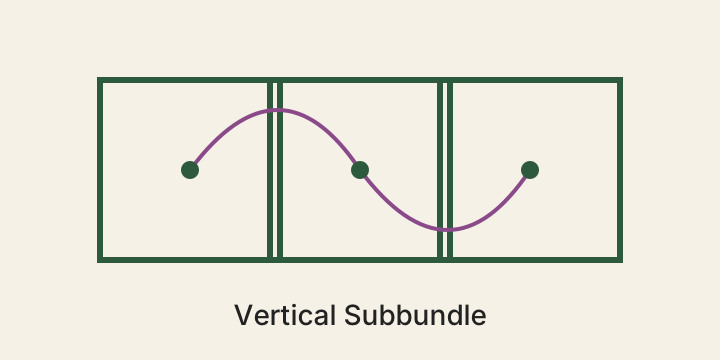
The fundamental vector field produces the rotational motion around each fibre.
Worked example [Beginner]
Consider the principal -bundle (the Hopf fibration). The Lie algebra of is , and a real number generates the fundamental vector field on .
Writing with coordinates , the right action of sends . The fundamental vector field at for is:
This vector is tangent to the fibre circle through . The vertical subspace at is the one-dimensional space spanned by .
Check your understanding [Beginner]
Formal definition [Intermediate+]
Definition (Vertical subspace). Let be a principal -bundle. At , the vertical subspace is . The vertical subbundle is .
Definition (Fundamental vector field). For , the fundamental vector field on is defined by . The map is a linear isomorphism .
Proposition. The map , , is a Lie algebra homomorphism: .
Equivariance. Right translation satisfies , linking the vertical subbundle to the adjoint action of on .
Key theorem with proof [Intermediate+]
Theorem (Structure of the vertical subbundle). Let be a principal -bundle. The vertical subbundle is a smooth subbundle of rank , and at each , the map $A \mapsto A^u\mathfrak{g} \to V_uPVP(R_g)(V_uP) = V_{ug}P$.
Proof. Since for all , the curve projects to the constant curve , so and . Injectivity of : if then is constant, so for all , giving . Surjectivity onto : , and an injective linear map between spaces of equal dimension is an isomorphism. The equivariance follows by differentiating .
Bridge. The vertical subbundle decomposes the tangent bundle of a principal bundle into fibre-direction and base-direction components; this splitting is the geometric foundation on which connections are built. The fundamental vector field isomorphism extends the correspondence between Lie groups and their Lie algebras into the bundle setting, and the adjoint equivariance of the vertical subbundle under right translation mirrors the adjoint representation of the structure group. These three structures — the vertical subbundle, the fundamental vector field map, and the adjoint action — together provide the language in which a connection is defined as a choice of horizontal complement to .
Exercises [Intermediate+]
Advanced results [Master]
Exact sequence of a submersion. For smooth and surjective, there is a short exact sequence of vector bundles over :
A connection on is a splitting of this sequence: a -equivariant choice of horizontal subbundle with .
The vertical bundle as associated bundle. There is a canonical isomorphism , where acts on via the adjoint representation. This identifies vertical vectors with equivalence classes under .
The Atiyah exact sequence. The quotient fits into:
A connection is equivalently a splitting of this sequence on the base . This formulation, due to Atiyah (1957), recasts connections as differential operators on the base rather than geometric data on the total space.
Synthesis. The vertical subbundle is the first step in decomposing the geometry of a principal bundle into its fibre-direction and base-direction components; this decomposition is the foundation on which the entire theory of connections is built. The fundamental vector field isomorphism carries the Lie algebra structure of the structure group into the tangent geometry of the bundle, and the adjoint equivariance under right translation ensures this identification varies smoothly and compatibly across the bundle. The Atiyah sequence lifts the splitting problem from the total space to the base, making the theory of connections into a problem about differential operators on the base manifold. Together, these structures link the algebraic data of the structure group to the differential topology of the bundle, establishing the framework in which curvature, holonomy, and characteristic classes are subsequently developed.
Full proof set [Master]
Proposition (Lie algebra homomorphism). The map , $A \mapsto A^\sigma([A,B]) = [\sigma(A), \sigma(B)]$.*
Proof. The flow of is . The Lie bracket of vector fields is computed from the commutator of their flows:
Using the Baker-Campbell-Hausdorff formula, the composed flow corresponds to exponentiation of to first order. Hence .
Proposition (Adjoint equivariance). $(R_g)_ A^* = (\mathrm{Ad}_{g^{-1}} A)^g \in GA \in \mathfrak{g}$.
Proof. Differentiate . The left side gives and the right side gives .
Connections [Master]
The general fibre bundle 03.05.00 provides the ambient structure; the vertical subbundle carves out the fibre-direction part of the tangent bundle, making the bundle geometry amenable to splitting.
The Lie algebra of the structure group 03.02.01 generates the vertical directions via the fundamental vector field map, identifying the vertical subbundle with the Lie algebra fibre-wise.
The adjoint representation of on governs the equivariance of the vertical subbundle under right translation, linking the bundle geometry to representation theory.
Bibliography [Master]
@book{kobayashi-nomizu,
  author = {Kobayashi, Shoshichi and Nomizu, Katsumi},
  title = {Foundations of Differential Geometry},
  volume = {1},
  publisher = {Wiley},
  year = {1963}
}

@book{husemoller,
  author = {Husemoller, Dale},
  title = {Fibre Bundles},
  edition = {3},
  publisher = {Springer},
  year = {1994}
}

@article{atiyah1957,
  author = {Atiyah, Michael F.},
  title = {Complex analytic connections in fibre bundles},
  journal = {Trans. Amer. Math. Soc.},
  volume = {85},
  year = {1957},
  pages = {181--207}
}
Historical & philosophical context [Master]
The vertical subbundle and fundamental vector fields were implicit in Cartan's work on moving frames (1920s-1930s), where the fibre directions of the frame bundle correspond to changes of frame. Ehresmann (1950) made the splitting explicit in his definition of a connection as a distribution of horizontal planes.
The fundamental vector field map is an instance of a general construction: for any Lie group action , the infinitesimal action is a Lie algebra homomorphism. In the principal bundle setting, this map is fibre-wise injective and identifies each vertical tangent space with the Lie algebra.
Atiyah's 1957 paper recast the theory by descending the connection data from to via the Atiyah exact sequence. This perspective connects principal bundle connections to jet bundles and differential operators, and it underpins the algebro-geometric treatment of connections on schemes.