Ambrose-Singer holonomy theorem
Anchor (Master): Ambrose-Singer 1958; Besse Einstein Manifolds Ch. 10; Joyce Riemannian Holonomy Groups Ch. 2
Intuition [Beginner]
The curvature of a surface tells you how much a vector rotates when you carry it around a small loop. The Ambrose-Singer theorem says that the curvature tells you everything about holonomy, not just for small loops but for loops of any size.
Think of curvature as a local "twisting rate." If you know the twisting rate everywhere on a surface, you can reconstruct the total twist accumulated along any path. The theorem makes this precise: the algebra of all possible holonomy transformations is generated entirely by curvature values, transported back to a single point.
The key idea is that big loops can be decomposed into many small ones. Each small loop contributes a curvature term, and the accumulated effect builds up the full holonomy group.
Visual [Beginner]
A manifold with a grid of small loops drawn on it. Each small loop produces a curvature endomorphism (a small rotation). Arrows show how these local rotations are transported back to a base point, where they combine to generate the full holonomy group.
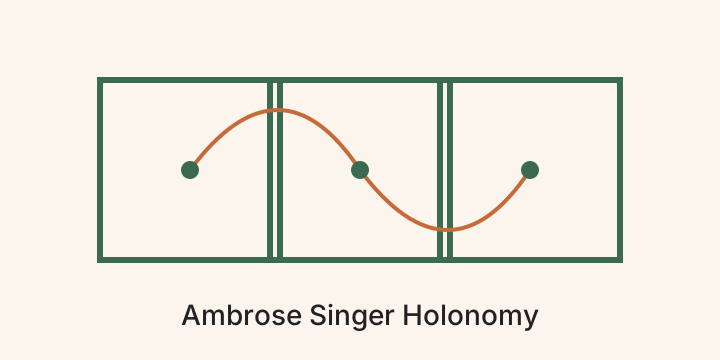
Curvature at all points generates the holonomy algebra at one point.
Worked example [Beginner]
On the sphere , the curvature is constant and positive. At any point, the curvature endomorphism is a rotation in the tangent plane. The Ambrose-Singer theorem tells us that the holonomy Lie algebra is generated by these rotations.
Since the curvature is the same everywhere, the algebra generated by a single rotation is all of , the Lie algebra of . The holonomy group is therefore the full , which agrees with the direct computation from parallel transport.
For a flat torus, the curvature is zero everywhere, so the Ambrose-Singer theorem gives a zero Lie algebra. The holonomy group is discrete, consistent with flat parallel transport.
Check your understanding [Beginner]
Formal definition [Intermediate+]
Setting. Let be a principal -bundle with connection , and let be the Lie algebra of . Fix over .
Definition (Holonomy Lie algebra). The holonomy Lie algebra is the Lie subalgebra of corresponding to the restricted holonomy group under the Lie group-Lie algebra correspondence.
Theorem (Ambrose-Singer, 1958). The holonomy Lie algebra is the Lie subalgebra of generated by the elements where ranges over all points of reachable from by horizontal curves, and are horizontal vectors at . Here is the curvature form of .
In the Riemannian case, the statement simplifies: is the Lie subalgebra of generated by all endomorphisms where ranges over paths from to any , and .
Key theorem with proof [Intermediate+]
Theorem. Let be connected with a connection on its frame bundle. Then as a Lie algebra.
Proof sketch. For a small loop at , the holonomy is approximately by the definition of curvature. So contains all such curvature values. For the reverse inclusion, any element of arises from parallel transport around a loop, which can be approximated by a product of small loops (the thin-loop decomposition). Each small loop contributes a curvature term.
Bridge. The Ambrose-Singer theorem deepens the relationship between curvature and holonomy established in the holonomy group unit 03.05.16, showing that the holonomy Lie algebra is not merely related to curvature but is entirely determined by it. This extends the local-to-global pattern seen in parallel transport, where infinitesimal data (curvature) generates global invariants (the holonomy group). The same philosophy underlies the Chern-Weil theory of characteristic classes, where curvature forms represent cohomological invariants of the bundle.
Exercises [Intermediate+]
Advanced results [Master]
Infinitesimal holonomy. Nijenhuis and Woolf (1953) introduced the infinitesimal holonomy algebra, generated by curvature and its covariant derivatives at a single point. For real-analytic Riemannian manifolds, the infinitesimal holonomy at equals , so a single point suffices.
Applications to Berger's list. The Ambrose-Singer theorem is the main computational tool in Berger's classification. One evaluates the Lie algebra generated by the curvature tensor under the representation of a candidate holonomy group . If this Lie algebra equals for generic metrics with holonomy contained in , the candidate survives; otherwise it is eliminated.
Non-abelian Ambrose-Singer. For principal -bundles, the theorem gives as the ideal in generated by the curvature of the connection, providing a direct curvature-to-holonomy bridge in the non-abelian setting.
Synthesis. The Ambrose-Singer theorem is the curvature-holonomy dictionary at the heart of modern Riemannian geometry. Extending the holonomy group framework 03.05.16, it identifies the Lie algebra of the holonomy group with the algebraic span of all curvature endomorphisms, making curvature the sole generator of holonomy. This result underpins Berger's classification by providing a computational test for admissible holonomy groups. The same Lie-algebraic generation principle appears in gauge theory, where the curvature of a Yang-Mills field determines the Wilson loop algebra, and in the Chern-Weil construction of characteristic classes from curvature polynomials.
Full proof set [Master]
Proposition (Thin-loop generation). Every element of can be approximated arbitrarily well by a product of holonomies around "thin" loops, each of which has holonomy in the image of .
Proof. Any null-homotopic loop can be filled by a smooth map from the disk. Triangulate into small triangles. The holonomy around equals the product of holonomies around the boundary triangles (cancellation on shared edges). Each small triangle contributes approximately , giving the result in the limit of fine triangulation.
Connections [Master]
The holonomy group 03.05.16 provides the group-theoretic framework that the Ambrose-Singer theorem populates with curvature data; the theorem identifies the Lie algebra of that group with the algebra generated by curvature.
General fibre bundles 03.05.00 supply the principal-bundle setting in which the connection form and its curvature live; the Ambrose-Singer theorem relates these bundle-level objects directly to holonomy.
Holonomy reduction 03.05.18 uses the Ambrose-Singer theorem as its primary computational tool, since a reduction of holonomy corresponds to a reduction of the curvature-generating Lie algebra.
Bibliography [Master]
@article{ambrose-singer1958,
  author = {Ambrose, Warren and Singer, Isadore M.},
  title = {A theorem on holonomy},
  journal = {Trans. Amer. Math. Soc.},
  volume = {85},
  year = {1958},
  pages = {436--443}
}

@book{kobayashi-nomizu-v1-hol,
  author = {Kobayashi, Shoshichi and Nomizu, Katsumi},
  title = {Foundations of Differential Geometry},
  volume = {1},
  publisher = {Wiley},
  year = {1963}
}

@book{joyce-holonomy,
  author = {Joyce, Dominic D.},
  title = {Riemannian Holonomy Groups and Calibrated Geometry},
  publisher = {Oxford Univ. Press},
  year = {2007}
}
Historical & philosophical context [Master]
The theorem was proved by Warren Ambrose and Isadore Singer in 1958, building on earlier work by Cartan on the structure of connections. Their result crystallised the intuition that curvature is the "derivative of holonomy" into a precise algebraic statement.
Philosophically, the Ambrose-Singer theorem embodies a central theme of differential geometry: global invariants are generated by local differential data. The holonomy group is a global object (it depends on all closed loops on the manifold), yet its infinitesimal structure is entirely captured by the curvature, a pointwise quantity. This parallels the way de Rham cohomology uses local differential forms to detect global topological features.
The theorem has practical importance beyond its conceptual elegance. In mathematical physics, the Ambrose-Singer theorem implies that the algebra of Wilson loop observables in gauge theory is determined by the field strength, providing a bridge between the path-integral and algebraic formulations of gauge theories.