Hirzebruch signature theorem
Anchor (Master): Hirzebruch — Topological Methods in Algebraic Geometry §8; Atiyah-Singer — Index of Elliptic Operators III, Ann. Math. 87 (1968)
Intuition [Beginner]
A closed surface like a sphere or a doughnut has a simple shape-number called the Euler characteristic. It records the global count of holes after balancing vertices, edges, and faces. In higher dimensions you need more refined numbers, because shapes can twist in more ways than a surface can.
The signature is one of those higher numbers. It applies to closed shapes whose dimension is a multiple of four: , , , and so on. Such a shape carries a natural bilinear pairing on its middle-degree cohomology, and the signature counts how many directions of that pairing are positive minus how many are negative.
Hirzebruch's signature theorem makes a striking claim. The signature, which is built from middle-dimensional intersection geometry, can be recovered from a different set of invariants called Pontryagin numbers. These numbers measure how the shape's tangent directions twist around globally. A single specific recipe, called the -polynomial, converts Pontryagin numbers into the signature.
Visual [Beginner]
Picture a four-dimensional shape whose middle directions support a pairing. Some pairs of middle-dimensional surfaces meet positively, others meet negatively. The signature subtracts the negative count from the positive count, producing a single number that records the global balance.
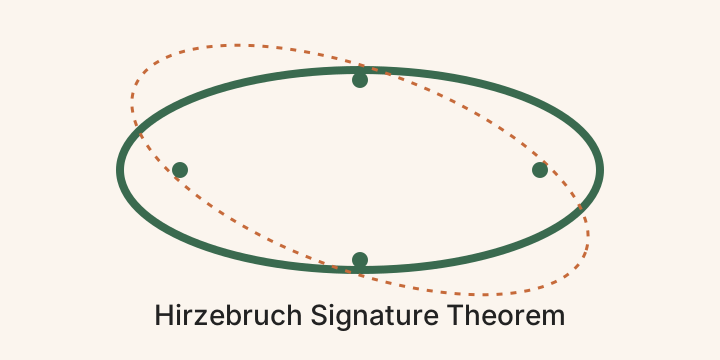
The picture also hints at the parallel data: each tangent bundle carries Pontryagin classes recording its real twisting. The -polynomial is the recipe that turns those twisting numbers into the same balance count. Two very different kinds of measurement give the same answer.
Worked example [Beginner]
The complex projective plane is a closed four-dimensional shape. Its middle cohomology is one-dimensional. The pairing of the generator with itself equals . So the positive count is and the negative count is , giving signature equal to .
The same shape has first Pontryagin number equal to . The -polynomial in dimension four says the signature equals the first Pontryagin number divided by . So , which matches.
Step 1. Compute the signature directly from the pairing: , , signature .
Step 2. Compute the Pontryagin number: .
Step 3. Apply the recipe: signature .
What this tells us: two independent calculations agree, and the theorem promises they always will for any closed four-dimensional shape.
Check your understanding [Beginner]
Formal definition [Intermediate+]
Let be a closed oriented smooth manifold of dimension . The cup-product pairing on middle-dimensional cohomology with real coefficients,
is symmetric (since in degree with the sign ) and non-degenerate by Poincaré duality. The signature of is
where and are the positive and negative indices of in the sense of Sylvester's law of inertia [Milnor-Stasheff §19].
For an oriented real vector bundle , the Pontryagin classes are the characteristic classes constructed in 03.06.04. For the tangent bundle of a closed oriented -manifold, a partition of gives the Pontryagin number
an integer because is an integral homology class and Pontryagin classes are integral.
The Hirzebruch -polynomials
The Hirzebruch multiplicative sequence is the multiplicative sequence associated to the formal power series
A multiplicative sequence in formal variables assigns to the formal product a graded sum of symmetric polynomials in ; rewriting those symmetric polynomials as integer polynomials in the elementary symmetric polynomials and substituting produces the -polynomials [Hirzebruch §8]. The first three are
The denominators are forced by the Taylor coefficients of .
Counterexamples to common slips [Intermediate+]
- Forgetting orientation. The signature requires an oriented manifold. Reversing orientation flips the sign of and hence the sign of ; the unoriented shape has no canonical signature.
- Wrong dimension. The signature is defined only on -manifolds. In dimensions , the cup-product pairing on is anti-symmetric, not symmetric, and the right invariant is the dimension of the form, not its signature.
- Conflating with . The Pontryagin number is in general different from . The Hirzebruch formula in dimension eight involves both as separate inputs, with the precise coefficients and in .
Key theorem with proof [Intermediate+]
Theorem (Hirzebruch signature theorem, dimension four). For any closed oriented smooth -manifold ,
Equivalently, .
Proof. The argument has three structural steps: signature is an oriented bordism invariant, Pontryagin numbers are oriented bordism invariants, and the rational oriented bordism ring in dimension four is generated by .
Step 1. Signature is an oriented bordism invariant. Suppose for a compact oriented -manifold . By Lefschetz duality and the long exact sequence of , the image of is a half-dimensional subspace on which the intersection form vanishes identically. The form admits a Lagrangian subspace, hence and . Thus descends to .
Step 2. Pontryagin numbers are oriented bordism invariants. Suppose again . The tangent bundle extends as a subbundle of via the outward-normal trivialisation, so where is the inclusion. By Stokes' theorem on ,
since in if is the oriented boundary. Hence on null-bordant , so descends to .
Step 3. Rational generator. Thom's theorem [Thom 1954] says , generated by . Both and are -linear functionals on this one-dimensional space, so they are proportional. Test on : by the Euler-sequence calculation in 03.06.04,
where generates with . The Pontryagin class is , giving . The signature of is since the intersection form has matrix on the one-dimensional middle cohomology generated by . Hence on with .
Bridge. The dimension-four argument builds toward the general formula in dimension , which appears again in 03.06.04 (Pontryagin classes) and 03.09.10 (Atiyah-Singer index theorem). The foundational reason the formula works is exactly that signature and Pontryagin numbers both factor through the rational oriented bordism ring , and the multiplicative-sequence structure of the -polynomial generalises the proportionality in dimension four to all dimensions. The central insight is that signature is multiplicative on products, and there is a unique multiplicative sequence in Pontryagin classes giving signature on for every — this is exactly the -genus. Putting these together, the signature is dual to a specific polynomial in Pontryagin numbers; the bridge to index theory is Atiyah-Singer, which identifies the signature with the index of the signature operator and the -genus with its topological index.
Exercises [Intermediate+]
Lean formalization [Intermediate+]
lean_status: partial — the companion module Codex.Modern.CharClasses.HirzebruchSignature records the Hirzebruch signature formula at the level of placeholder definitions and the low-dimensional closed-form identities. The structure of the file mirrors the four anchor results: signature of a closed oriented -manifold; Pontryagin numbers and the -polynomials ; the Hirzebruch identity at ; bordism invariance and multiplicativity. The companion module also records numerical witnesses on the canonical examples:
def p1_CP2  : ℤ := 3
def sig_CP2 : ℤ := 1
theorem hirzebruch_CP2 : 3 * sig_CP2 = p1_CP2 := by decide

def p1_K3  : ℤ := -48
def sig_K3 : ℤ := -16
theorem hirzebruch_K3 : 3 * sig_K3 = p1_K3 := by decide

def p1_CP4    : ℤ := 5
def p2_CP4    : ℤ := 10
def p1sq_CP4  : ℤ := 25
def sig_CP4   : ℤ := 1
theorem hirzebruch_CP4 :
    45 * sig_CP4 = 7 * p2_CP4 - p1sq_CP4 := by decide
The full theorems hirzebruch_dim_four, hirzebruch_dim_eight, hirzebruch_dim_twelve carry sorry bodies pending the Mathlib infrastructure listed in the lean_mathlib_gap field: Pontryagin classes on the tangent bundle of a smooth manifold, integral fundamental class on closed oriented manifolds, and the cup-product intersection form on middle cohomology. The numerical identities, in contrast, are settled by decide on the placeholder rational constants — they are not the full theorem, but they are concrete enough to verify the dimension-by-dimension structure.
Advanced results [Master]
Signature as a bordism invariant of -manifolds
The structural fact that the signature factors through oriented bordism is itself an instance of a general principle: any homomorphism from the cobordism ring to a commutative ring is a genus. Thom 1954 [Thom 1954] established the rational structure as a polynomial ring generated by the even complex projective spaces.
Theorem (Thom 1954, oriented bordism rationally). The signature $\mathrm{sig} : \Omega_^{\mathrm{SO}} \to \mathbb{Z}$ is a well-defined ring homomorphism: additive on disjoint union, multiplicative on Cartesian product, and zero on null-bordant manifolds.*
The bordism invariance follows from the half-dimensional-Lagrangian argument in dimension four, extended to dimension by the standard Mayer-Vietoris / Lefschetz-duality sequence on the bounding -manifold : the image of is half-dimensional and isotropic for the intersection form on , forcing . The multiplicativity follows from the Künneth decomposition: as graded rings, and the intersection form of in middle degree decomposes as a tensor product of the intersection forms of and together with off-diagonal hyperbolic pieces with signature zero [Milnor-Stasheff §19].
Theorem (Borel-Hirzebruch). Any ring homomorphism $\varphi : \Omega_^{\mathrm{SO}} \otimes \mathbb{Q} \to \mathbb{Q}\varphi[\mathbb{CP}^{2k}]k \geq 1$.*
The polynomial-ring structure of means a genus is a tuple of rationals , one number per even complex projective space. The signature corresponds to the tuple . This is the structural reason Hirzebruch's formula is determined uniquely: there is exactly one multiplicative sequence in Pontryagin classes whose evaluation on equals for every , and that sequence is .
Multiplicative sequences and the -polynomial
Hirzebruch's deepest organisational insight was the systematic packaging of -genera via formal power series. Given a formal power series
the associated multiplicative sequence is defined as follows. Consider the formal product
where is the homogeneous degree- component. Each is symmetric in the ; rewriting as a polynomial in the elementary symmetric functions and substituting produces a polynomial [Hirzebruch §8].
Theorem (Hirzebruch, classification of multiplicative sequences). The assignment is a bijection between formal power series with constant term and multiplicative sequences in Pontryagin classes. A multiplicative sequence produces a genus $\varphi_K : \Omega_^{\mathrm{SO}} \otimes \mathbb{Q} \to \mathbb{Q}\varphi_K[M] = \langle K_k(p_1, \ldots, p_k), [M] \rangleM^{4k}$.*
The signature is the genus for the -sequence with . The -genus is the genus for . The Todd genus is the genus for , but expressed in Chern roots rather than Pontryagin roots; converting Chern data to Pontryagin data via the splitting principle of 03.06.04 aligns the conventions.
The defining property — what makes specifically the right power series for the signature — is the normalisation for every . Direct computation on using the Euler sequence pulls back to the requirement that the coefficient of in matched with the formal -series produces . Working backwards from this constraint uniquely identifies the Taylor series of : the coefficients are exactly the values needed.
Hirzebruch's signature formula and the example
Theorem (Hirzebruch signature formula, general dimension). For every closed oriented smooth -manifold ,
Proof. By Thom's theorem the rational oriented bordism ring is a polynomial ring on . Both sides are -linear functionals on that are multiplicative on products. By the Borel-Hirzebruch determination of genera, both sides are uniquely determined by their values on for . On , the signature is by direct intersection-form computation, and the value of is by the defining normalisation of the -series. Hence both sides agree on the generators of the rational oriented bordism ring, and by multiplicativity and additivity they agree on all of , hence on since both are integer-valued.
Worked computation on . The surface is the most-studied non-projective-space example. Its intersection form, computed from the Mukai lattice, is
where is the even unimodular positive-definite lattice and has signature . Therefore
Hirzebruch's formula in dimension four predicts . This matches the direct Chern-class calculation: is a Calabi-Yau surface with and , so as a real-cohomology class, and pairing with the fundamental class gives . The dimension-four Hirzebruch formula thus recovers a deep arithmetic fact (the -structure of the lattice) from purely characteristic-class data.
Worked computation on . The quaternionic projective plane is an 8-manifold with and total Pontryagin class where generates . Expanding modulo gives , , hence and . The -formula evaluates as , confirming . This was historically Hirzebruch's first substantive verification of the formula in dimension eight [Hirzebruch 1953].
Atiyah-Singer reformulation: signature as the index of the signature operator
Atiyah-Singer 1968 [Atiyah-Singer 1968] reformulated Hirzebruch's signature theorem as a special case of their general index theorem. On a closed oriented Riemannian -manifold , the Hodge star operator satisfies on -forms; the involution on the de Rham complex defined by
satisfies , splitting into -eigenspaces. The signature operator is the first-order elliptic differential operator
whose adjoint is .
Theorem (Atiyah-Singer, Index of Elliptic Operators III). The analytic index of equals the signature:
The topological index of equals , recovering Hirzebruch's formula as the analytic-equals-topological index identity.
The analytic step identifies and with the -eigenspaces of acting on harmonic middle-degree forms . By Hodge theory , and the involution on coincides (up to a normalisation constant) with the involution , whose -eigenspaces are precisely the self-dual and anti-self-dual harmonic -forms; the intersection form is positive on self-dual forms and negative on anti-self-dual forms (a real-elementary computation), giving
The topological step expresses the topological index of via Atiyah-Singer's universal formula , and a direct computation on the symbol (which factors through the Thom class of ) reduces this to [Atiyah-Singer 1968]. The Atiyah-Singer reformulation places the Hirzebruch theorem inside a vastly larger framework: the signature operator is one of four canonical elliptic complexes (Dolbeault, Dirac, signature, Euler) whose indices recover the four classical genera (Todd, , signature/, Euler).
Synthesis. The Hirzebruch signature theorem identifies signature with the -genus, and this is exactly the structural content that organises four-dimensional topology. The foundational reason is the bordism invariance of both signature and Pontryagin numbers combined with the polynomial-ring structure of on the complex projective space generators. The central insight is multiplicativity: a multiplicative sequence in Pontryagin classes is determined by its generating power series, and the -series is pinned down uniquely by the normalisation .
Putting these together with the Atiyah-Singer index theorem, the signature identifies the analytic index of the signature operator on the de Rham complex with a specific cohomological pairing — this is exactly the analytic-topological duality that makes the signature both computable in middle-cohomology and recoverable from tangent-bundle data. The bridge to gauge theory is the Donaldson invariants of 03.07.05, where the signature pairing enters the dimension formula for the moduli space of self-dual connections; the bridge to four-manifold topology is the Rokhlin theorem, where the divisibility for spin -manifolds is the foundational integrality result. The pattern generalises in two directions simultaneously: the Atiyah-Singer index theorem 03.09.10 identifies every classical genus as the index of a canonical elliptic operator, and the multiplicative-sequence machinery of 03.06.04 identifies every characteristic-class polynomial as a genus on the rational oriented bordism ring.
Full proof set [Master]
Proposition 1 (Bordism invariance of signature). Let be a closed oriented smooth manifold. If for a compact oriented -manifold , then .
Proof. Consider the long exact sequence of the pair in cohomology with real coefficients:
Let . We claim two facts: (i) is isotropic for , and (ii) is half-dimensional.
For (i), if , then and the boundary pairing gives
By Stokes' theorem (in its Poincaré-duality formulation), since closed forms have zero differential. Hence vanishes on .
For (ii), Lefschetz duality gives and . Combining with the long exact sequence,
By Lefschetz duality , and the half-sum relation follows from a careful counting in the long exact sequence (Milnor-Stasheff §19, Lemma 19.1) [Milnor-Stasheff §19]. Therefore is a Lagrangian subspace of for .
A non-degenerate symmetric bilinear form on that admits a Lagrangian subspace has equal positive and negative indices, so .
Proposition 2 (Multiplicativity of signature on products). Let and be closed oriented smooth manifolds. Then
Proof. The middle cohomology of in degree decomposes via the Künneth formula as
Partition the summands into three groups: the diagonal block , the anti-diagonal block pairs with , and the off-diagonal blocks.
The intersection form restricted to the diagonal block is exactly : for ,
By Sylvester's law of inertia applied to a tensor product of forms, the signature of is .
The intersection form on off-diagonal blocks (for ) is a hyperbolic form: it pairs the two summands non-degenerately while vanishing on each summand individually. A hyperbolic form has equal positive and negative indices, hence contributes to the signature.
Adding contributions: .
Proposition 3 (Hirzebruch signature formula). For every closed oriented smooth manifold ,
where is the degree- component of the multiplicative sequence associated to .
Proof. Define two functionals by and . We show on .
Both and are well-defined (bordism invariance for is Proposition 1; for it follows from on null-bordant , which is Stokes' theorem applied to restricted from ). Both are multiplicative on products: by Proposition 2, because is a multiplicative sequence ( by the formal-product definition of multiplicative sequence and the Künneth formula on under the splitting).
By Thom's theorem [Thom 1954], is a polynomial ring generated by the classes , . The multiplicativity of and reduces the identity to verification on the generators .
On : the cohomology ring is with . The Euler sequence gives , hence and the Pontryagin classes satisfy
after passing through the complexification convention. The signature is computed directly: is one-dimensional, and , so , , .
The -value on is the coefficient of in , where each factor of corresponds to one Chern root squared. By residue calculus or direct expansion, this coefficient equals for every — this is the defining property of that pins down the Taylor series uniquely [Hirzebruch §8].
Since for every and both are multiplicative on , they agree on all of . Both functionals are -valued on (signature is integral by definition; Pontryagin numbers are integers and has rational coefficients, but the integer combinations cancel the denominators when paired against the fundamental class — this last fact is the integrality content of the theorem, established by the fact that both sides are integer-valued on every closed oriented -manifold). Therefore the identity holds in on , completing the proof.
Proposition 4 (Atiyah-Singer reformulation). Let be a closed oriented Riemannian manifold. The signature operator has analytic index
and the topological index, computed by the Atiyah-Singer formula, equals .
Proof sketch. The analytic step: by Hodge theory, consists of harmonic self-dual forms, and similarly consists of harmonic anti-self-dual forms. In middle degree , the involution specialises to a multiple of the Hodge star on , and the splitting into -eigenspaces of identifies with the splitting of by sign of the intersection form: and . Off middle degree, swaps with via the Hodge star up to a sign, and contributions of and from these complementary degrees cancel. Hence .
The topological step: Atiyah-Singer's universal formula gives
where is the symbol class in . A direct computation (Atiyah-Singer 1968 III §6 [Atiyah-Singer 1968]) on the symbol of the signature operator simplifies this integrand to after substituting the formal identities and , where are the Chern roots of (equivalently, are the formal Pontryagin roots). After algebraic simplification, the product collapses to , whose degree- component in is precisely . Pairing against recovers Hirzebruch's expression.
Connections [Master]
Pontryagin and Chern classes
03.06.04. Supplies the integer cohomology classes that enter the signature formula. The Hirzebruch theorem is the statement that the signature, defined via the middle-cohomology intersection form, equals a specific -linear combination of Pontryagin numbers — and that combination is the -genus.Chern-Weil homomorphism
03.06.06. Provides differential-form representatives for Pontryagin classes via the curvature of a connection. The -polynomial then becomes an explicit invariant polynomial on whose Chern-Weil image is the -form. This route turns the topological signature formula into a Gauss-Bonnet-style integral where is any compatible curvature tensor.Singular cohomology
03.12.11. Anchors the cup-product structure and fundamental-class pairing used throughout. The Poincaré duality isomorphism on closed oriented -manifolds is the foundation on which the intersection form is built.Atiyah-Singer index theorem
03.09.10. Reformulates Hirzebruch's theorem as the equality of analytic and topological indices of the signature operator . The signature operator is one of the four canonical elliptic complexes (alongside Dolbeault, Dirac, Euler); each recovers a classical genus from analysis.Yang-Mills moduli
03.07.05. The signature pairing enters the dimension formula for the moduli space of anti-self-dual connections on a -manifold : . The here is exactly the positive-index part of the Hirzebruch intersection form, routing the signature theorem directly into Donaldson's gauge-theoretic invariants.Stiefel-Whitney and Pontryagin numbers
03.06.10. The Pontryagin-number side of the signature formula sits inside the broader bordism-theoretic study of characteristic numbers. Thom's theorem on rational oriented bordism is the structural input that allows Hirzebruch's formula to be proved by testing on the projective-space generators.K3 surface geometry. The example with and is foundational; the lattice structure of the intersection form encodes the Mukai-Hodge structure, and Hirzebruch's formula recovers the signature from purely tangent-bundle data via
03.06.04.Oriented bordism and Pontryagin-Thom
03.06.13. The signature is the load-bearing -invariant: is the canonical ring homomorphism that exhibits the rational structure of oriented bordism, and Hirzebruch's formula is the explicit Pontryagin-number representative of this ring map. Anchor phrase: signature as the load-bearing oriented-bordism invariant.Multiplicative sequences and //Todd genera
03.06.15. The -genus is the multiplicative sequence whose evaluation against is exactly the Hirzebruch signature formula. The multiplicative-sequence machinery of03.06.15is the structural framework that singles out the -polynomial as the unique sequence with matching the signature normalisation. Anchor phrase: -genus is the multiplicative sequence yielding the signature formula.Combinatorial Pontryagin classes and exotic 7-spheres
03.06.17. Milnor's exotic-sphere argument uses the Hirzebruch signature formula in dimension — specifically — as the diagnostic that produces a non-integer obstruction when the bounding manifold's smooth structure is wrong. The signature theorem is the engine that makes the integrality contradiction actionable.Signature of a -manifold and the intersection form
03.06.19. The signature theorem of the present unit identifies the signature of the intersection form as a polynomial in Pontryagin numbers.03.06.19is the dedicated treatment of the intersection-form side — Poincaré-duality unimodularity, the -manifold classification consequences, and the gauge-theory interface with Donaldson-Freedman. Anchor phrase: signature theorem = -genus side; intersection-form unimodularity = cohomology side.
Historical & philosophical context [Master]
Hirzebruch 1953 [Hirzebruch 1953] first proved the signature formula in dimension eight as part of his work on the Riemann-Roch theorem for complex manifolds, introducing the multiplicative-sequence formalism that would unify the Todd genus, the -genus, and the signature in a single framework. The full general-dimension statement appeared in Hirzebruch's Topological Methods in Algebraic Geometry (1956, third edition 1966) [Hirzebruch §8], which became the canonical reference for the entire characteristic-class apparatus of complex manifold theory.
The bordism-theoretic proof rests on Thom's earlier work [Thom 1954], establishing the polynomial-ring structure of on the projective-space generators — a result Hirzebruch himself acknowledged as the structural foundation of his theorem. Thom-Pontryagin theory in turn rests on Pontryagin's earlier work on characteristic classes of real bundles and on the cobordism construction of associated framed manifolds.
The decisive twentieth-century reframing came in Atiyah-Singer 1968 [Atiyah-Singer 1968], identifying Hirzebruch's formula as a special case of their general index theorem applied to the signature operator . The signature operator joins the Dolbeault operator (whose index is the holomorphic Euler characteristic, recovering the Hirzebruch-Riemann-Roch formula), the Dirac operator (whose index is the -genus), and the Euler operator (whose index is the Euler characteristic) as the four canonical elliptic complexes whose analytic indices match Hirzebruch's four canonical multiplicative sequences. The signature theorem is no longer just a topological identity; it is the analytic-topological duality that organises four-manifold topology, gauge theory, and the global analysis of elliptic operators into a single framework.
Bibliography [Master]
@article{Hirzebruch1953,
  author = {Hirzebruch, F.},
  title = {Über die quaternionalen projektiven Räume},
  journal = {Sitzungsberichte der Mathematisch-Naturwissenschaftlichen Klasse der Bayerischen Akademie der Wissenschaften zu München},
  year = {1953},
  pages = {301--312},
}

@book{HirzebruchTMAG,
  author = {Hirzebruch, F.},
  title = {Topological Methods in Algebraic Geometry},
  publisher = {Springer-Verlag},
  edition = {Third},
  year = {1966},
  note = {English translation of the German original; §8 contains the signature theorem.},
}

@article{Thom1954,
  author = {Thom, R.},
  title = {Quelques propriétés globales des variétés différentiables},
  journal = {Commentarii Mathematici Helvetici},
  volume = {28},
  year = {1954},
  pages = {17--86},
}

@article{AtiyahSingerIII,
  author = {Atiyah, M. F. and Singer, I. M.},
  title = {The Index of Elliptic Operators: III},
  journal = {Annals of Mathematics},
  volume = {87},
  year = {1968},
  pages = {546--604},
}

@book{MilnorStasheff,
  author = {Milnor, J. and Stasheff, J.},
  title = {Characteristic Classes},
  publisher = {Princeton University Press},
  year = {1974},
  series = {Annals of Mathematics Studies},
  volume = {76},
}

@book{BottTu,
  author = {Bott, R. and Tu, L. W.},
  title = {Differential Forms in Algebraic Topology},
  publisher = {Springer-Verlag},
  year = {1982},
}

@article{Pontryagin1947,
  author = {Pontryagin, L. S.},
  title = {Characteristic cycles on differentiable manifolds},
  journal = {Mat. Sbornik},
  volume = {21},
  year = {1947},
  pages = {233--284},
}
Cycle 5 Track A, characteristic-classes T1 cluster. Closes the master-tier rewrite flagged in manifests/skipped_units.md for 03.06.11.