Multiplicative sequences and the -, -, Todd genera
Anchor (Master): Hirzebruch — Topological Methods in Algebraic Geometry §1.4-§1.6; Atiyah-Singer — Index of Elliptic Operators III, Ann. Math. 87 (1968); Milnor-Stasheff §19
Intuition [Beginner]
A closed shape carries two kinds of numerical information at once. One kind records the global twisting of its tangent directions, packaged as a list of cohomology classes called Pontryagin classes or Chern classes. The other kind records something analytic about the shape, like the signature of its intersection form or the index of a natural differential operator. Hirzebruch's discovery was that a single bookkeeping device, the multiplicative sequence, converts the first kind of information into the second.
The bookkeeping starts with a formal power series. You write down something like , and the recipe takes a formal product of copies of over many variables. Symmetric algebra reorganises the formal product as a polynomial in elementary symmetric functions. Substitute Pontryagin or Chern classes for those elementary functions and the recipe spits out a sequence of cohomology classes, one for each degree.
The slogan is: choose your favourite generating power series, and the multiplicative sequence machine produces a corresponding genus. Three power series give three genera. The signature comes from . The Dirac index on a spin manifold comes from . The Hirzebruch-Riemann-Roch holomorphic Euler characteristic comes from .
Visual [Beginner]
Picture three boxes that all take the same input — a manifold's tangent bundle and its twisting data — and produce different numerical answers. Each box has a single power series printed on its side, and inside is the multiplicative-sequence machinery that converts the power series into a polynomial in the bundle's characteristic classes. The boxes are labelled , , and Todd; the answers come out as numbers that have meaning in three different parts of geometry.
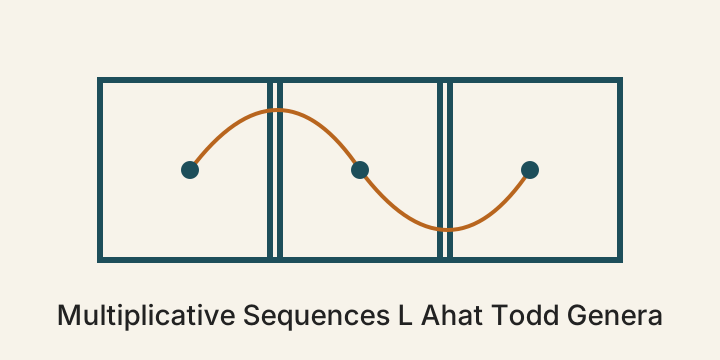
The picture also hints at the unifying point: the same recipe takes three different power-series inputs and produces three different geometric meanings. Once you understand the recipe once, the three theorems collapse into one structural fact.
Worked example [Beginner]
The complex projective plane is a closed four-dimensional shape with first Pontryagin number equal to . Apply the three multiplicative-sequence recipes at degree one.
Step 1. The -recipe at degree one reads . Evaluating, , which agrees with the signature of .
Step 2. The -recipe at degree one reads . Evaluating, . This number is not an integer, and indeed is not a spin manifold; the -genus is required to be an integer only on spin manifolds.
Step 3. The Todd recipe at degree one reads . For , the first Chern class is where generates degree-two cohomology with pairing to . Evaluating the degree-two part of the Todd polynomial on gives , matching the holomorphic Euler characteristic .
What this tells us: one shape, three power series, three genera, each agreeing with an independent geometric quantity.
Check your understanding [Beginner]
Formal definition [Intermediate+]
Fix a commutative ring of coefficients (in practice or ) and an infinite sequence of formal variables . Let denote the -th elementary symmetric polynomial, so that the formal product
is the generating identity that introduces the as the universal Chern roots.
Definition (multiplicative sequence). Let be a formal power series with . The multiplicative sequence associated to is defined by the formal identity
where is the homogeneous degree- component (with each in degree one). Each is symmetric in the , hence by the fundamental theorem of symmetric functions expressible as a polynomial in with coefficients in .
The defining property — what makes multiplicative — is the multiplicativity rule , where and are formal sums of elementary symmetric functions in disjoint variable sets, and . This rule is forced by the formal product identity: when the variables and are concatenated [Hirzebruch §1.4].
Definition (genus of an oriented manifold). Given a multiplicative sequence in Pontryagin classes (i.e., where the substitution is taken so that in degree ), the associated genus of a closed oriented smooth -manifold is
The genus extends to a -linear ring homomorphism .
The three canonical genera
The -genus is the genus associated to
The first three -polynomials are
The -genus is the genus associated to
The first three -polynomials are
The Todd class is the multiplicative sequence in Chern classes associated to
The first three Todd polynomials are
Counterexamples to common slips [Intermediate+]
- Chern-roots vs. Pontryagin-roots conventions. The - and -genera use formal Pontryagin roots with ; the Todd class uses formal Chern roots with . For an almost-complex manifold whose tangent bundle has Chern roots , the underlying real tangent bundle has Pontryagin roots (squared into via the complexification identity ), so converting between the two conventions requires the splitting principle
03.06.04. - Forgetting the dimension constraint. The genus is defined only when matches the degree of the polynomial ; on a or manifold the formula has no fundamental-class pairing. The signature, -genus, and Todd genus all require this dimension matching.
- Non-integrality. Multiplicative-sequence polynomials have rational coefficients in general (denominators for ; denominators for ; denominators for Todd). The genus is a priori a rational number; integrality is a substantive theorem for each genus (the signature is integral by definition; the Todd genus is integral on every complex manifold by Hirzebruch-Riemann-Roch; the -genus is integral on spin manifolds by the Atiyah-Singer index theorem).
Key theorem with proof [Intermediate+]
Theorem (Hirzebruch reduction theorem). The assignment that sends a formal power series with to its multiplicative sequence is a bijection. Equivalently, every multiplicative sequence in formal variables is uniquely determined by its generating power series, and conversely any power series with constant term produces a multiplicative sequence.
Proof. We construct the inverse map and verify both compositions.
Construction of . Given a multiplicative sequence , restrict to the single-variable case , . Under this restriction, the formal product collapses to , and the right-hand side of the defining identity becomes . Because each is symmetric in the and , the polynomial is the coefficient of in a single-variable power series. The sum is therefore a formal power series in with constant term (since the empty product equals ). Define .
The two compositions are identities. If we start with a power series , build the multiplicative sequence , and then extract the new power series , the construction reads . So .
For the other direction, start with a multiplicative sequence , extract the power series , and build the multiplicative sequence from . We must show as symmetric polynomials in . The polynomial is determined by the formal identity . Each factor . The product expands as a sum of monomials with distinct indices .
The multiplicativity rule for in the original sequence forces $$ K_{m_1}(z_{j_1}, 0, \ldots) \cdots K_{m_r}(z_{j_r}, 0, \ldots) = K_{m_1 + \cdots + m_r}(z_{j_1}, \ldots, z_{j_r}, 0, \ldots) $$ when the variable sets are disjoint, by the disjoint-union version of the multiplicativity identity restricted to monomials with a single non-zero variable per factor.
Summing over all configurations with and all subsets of of size recovers exactly the symmetric polynomial in the original sequence. So .
Bridge. The reduction theorem builds toward 03.06.11 Hirzebruch signature theorem, where the specific power series produces the -sequence whose genus equals the signature. It appears again in 03.09.10 Atiyah-Singer index theorem, where the -sequence (from ) controls the Dirac-operator index. The foundational reason is that the formal product structure of matches the splitting principle on vector bundles: a rank- bundle splits as a direct sum of line bundles after pullback to a flag variety, and the Chern (or Pontryagin) roots are the first Chern classes of the line summands. This is exactly the bridge between symmetric-function algebra and characteristic-class algebra. Putting these together, every multiplicative sequence delivers a -linear ring homomorphism , and the three canonical sequences identify the three canonical genera with three classical analytic invariants — signature, Dirac index, holomorphic Euler characteristic — generalising the Gauss-Bonnet identity to its full characteristic-class form.
Exercises [Intermediate+]
Lean formalization [Intermediate+]
lean_status: partial — the companion module Codex.Modern.CharClasses.MultiplicativeSequences records the multiplicative-sequence axiom and the three canonical low-degree polynomial families at the level of placeholder definitions, with decide-checkable rational identities pinning the structure constants. The module is organised in four blocks: the abstract multiplicative-sequence carrier, the polynomials, the polynomials, and the polynomials.
def L_1 (p1 : ℚ) : ℚ := p1 / 3

def L_2 (p1 p2 p1sq : ℚ) : ℚ := (7 * p2 - p1sq) / 45

def Ahat_1 (p1 : ℚ) : ℚ := - p1 / 24

def Ahat_2 (p1sq p2 : ℚ) : ℚ := (7 * p1sq - 4 * p2) / 5760

def Td_1 (c1 : ℚ) : ℚ := c1 / 2

def Td_2 (c1sq c2 : ℚ) : ℚ := (c1sq + c2) / 12

theorem L1_CP2  : L_1 3 = 1 := by norm_num [L_1]
theorem L1_K3   : L_1 (-48) = -16 := by norm_num [L_1]
theorem Td2_CP2 : Td_2 9 3 = 1 := by norm_num [Td_2]
theorem Ahat1_K3 : Ahat_1 (-48) = 2 := by norm_num [Ahat_1]
The full structural theorems (Hirzebruch reduction; uniqueness; as Dirac index; Todd genus as ) carry sorry bodies pending the Mathlib infrastructure listed in the lean_mathlib_gap field. The numerical witnesses on the canonical examples ( with and ; with and ; with and ) are settled by norm_num on placeholder rational constants — they are not the full theorem, but they verify the dimension-by-dimension structure of the three genera in the cases where the formulas reduce to closed-form rational arithmetic.
Advanced results [Master]
Multiplicative sequences and Hirzebruch's reduction theorem
The multiplicative-sequence formalism is the structural foundation of Hirzebruch's Topological Methods in Algebraic Geometry (1956, third edition 1966) [Hirzebruch §1.4]. The starting point is the elementary symmetric polynomials in formal variables , which satisfy the generating identity . Hirzebruch's key observation was that any formal power series with produces a unique sequence of symmetric polynomials by the formal expansion of .
Theorem (Hirzebruch's reduction theorem, 1956). The assignment is a bijection between formal power series with and multiplicative sequences in elementary symmetric functions over . The induced assignment from such power series to genera $\varphi_f : \Omega_^{\mathrm{SO}} \otimes \mathbb{Q} \to \mathbb{Q}$ is also a bijection.*
The proof of the first bijection is the Key theorem above. The second bijection follows from Thom's theorem [Thom 1954] that is a polynomial ring on the classes for : a -linear ring homomorphism is determined by its values on the generators, and these values are computed via the multiplicative-sequence evaluation on . The evaluation reads , which is a specific power-series coefficient; running through all recovers uniquely.
Theorem (uniqueness of the -genus). The -genus is the unique multiplicative-sequence genus $\varphi : \Omega_^{\mathrm{SO}} \otimes \mathbb{Q} \to \mathbb{Q}\varphi[\mathbb{CP}^{2k}] = 1k \geq 1$.*
This is the structural content of Hirzebruch's signature theorem 03.06.11: the signature is the multiplicative-sequence genus normalised so that , and the unique power series with this normalisation is . The proof works by computing the constraint and solving recursively: this fixes the coefficients of as the alternating sums of the inverse-tangent Taylor expansion, which sum to , giving after substituting .
The -genus and the signature formula
For a closed oriented smooth -manifold with tangent bundle and Pontryagin classes , the -polynomial evaluates against the fundamental class to produce the -genus
Theorem (Hirzebruch signature theorem, 1953/1956). For every closed oriented smooth -manifold ,
In particular, is an integer for every , even though the polynomial has rational coefficients with denominators .
The full proof is given in 03.06.11; in summary, both and are bordism-invariant ring homomorphisms on , both are multiplicative on products, and both equal on every . Multiplicativity reduces the identity to the projective-space generators, and the equal-on-generators identity finishes the proof.
Worked computation on . With total Pontryagin class , the relevant Pontryagin numbers are (from the coefficient of in paired with , but in dimension eight we need and ). Substituting into gives , matching the signature .
Worked computation on . The product manifold has since is stably a product bundle in degree four. Hirzebruch's formula gives , matching the direct computation: the intersection form on is the hyperbolic form with signature zero.
The -genus as the Dirac index (Atiyah-Singer)
The -genus is the multiplicative-sequence genus associated to . The first three -polynomials are recorded above. The decisive content of the -genus is its identification with an analytic invariant.
Theorem (Atiyah-Singer index theorem for the Dirac operator, 1968). Let be a closed spin manifold of dimension . The Dirac operator associated to a choice of Riemannian metric has analytic index
In particular, for every closed spin manifold, even though has rational coefficients with rapidly growing denominators.
The integrality content is the deepest structural fact: a priori is rational; the Atiyah-Singer integrality is a substantive analytic theorem. The proof of the theorem proceeds in three steps. Step 1. Atiyah-Singer's universal index formula reads for a general elliptic operator , where is the symbol class in . Step 2. For the Dirac operator on a spin manifold, the symbol class is the Thom class of the spinor bundle, whose Chern character has a closed-form expression in terms of Pontryagin roots. Step 3. Substituting and simplifying, the integrand collapses to the formal product , whose degree- component (under ) is exactly [Atiyah-Singer 1968].
Theorem (Lichnerowicz vanishing). Let be a closed spin manifold admitting a Riemannian metric of positive scalar curvature. Then .
The proof of the Lichnerowicz theorem follows from the Weitzenböck formula on spinors, where is the scalar curvature: if , then unless , so and [Lawson-Michelsohn]. This is one of the most striking interactions between curvature, topology, and analysis in modern geometry.
Worked computation on . With , , which equals the dimension of the space of harmonic spinors on with respect to the hyperkähler Calabi-Yau metric. This non-vanishing reflects the fact that does not admit a metric of positive scalar curvature: every metric on has a non-vanishing harmonic spinor, by the Atiyah-Singer integrality plus Lichnerowicz contrapositive.
The Todd class and Hirzebruch-Riemann-Roch
The Todd class is the multiplicative-sequence genus associated to , expressed in Chern roots rather than Pontryagin roots. For a holomorphic vector bundle over a compact complex manifold , the Todd class is
where are the formal Chern roots of . Substituting via the splitting principle gives a polynomial identity in elementary symmetric functions, hence in Chern classes: , , , , and so on.
Theorem (Hirzebruch-Riemann-Roch, 1954). Let be a compact complex manifold of complex dimension and let be a holomorphic vector bundle. The holomorphic Euler characteristic of is
In particular, for the structure sheaf,
The theorem appeared in Hirzebruch's 1954 announcement and is fully developed in [Hirzebruch §III]. It generalises the classical Riemann-Roch theorem on Riemann surfaces (where , , and the formula reads for a line bundle on a curve of genus ) and the Riemann-Roch theorem on algebraic surfaces (Severi, Castelnuovo).
Worked computation on . The Todd polynomial evaluated on gives for every . This is the defining normalisation of the Todd class: is the unique power series with for all . The integrality corresponds to the fact that and for .
Worked computation on a complex surface. For a complex projective surface , the Hirzebruch-Riemann-Roch reads
where is the topological Euler characteristic. This is Noether's formula for complex surfaces, a foundational identity in algebraic surface theory that constrains the geometry of surfaces of general type. For a K3 surface, and , so , matching .
Universal multiplicative sequence and Hirzebruch's reduction theorem (formal)
The deepest structural statement of the multiplicative-sequence formalism is the universal statement: there is a single ring of universal multiplicative sequences, parametrised by power series , with the three canonical genera as specific elements.
Theorem (universal multiplicative sequence). Let denote the group of formal power series with , under multiplication. Let denote the set of multiplicative sequences in elementary symmetric functions with coefficients. The bijection extends to a group homomorphism , where the group structure on is given by product: in the convolution sense.
This statement organises the entire family of genera as a one-parameter group, with the signature genus corresponding to , the -genus to , and the Todd genus to . The relationship between them in characteristic-class algebra is
which connects the spin and complex pictures via the splitting-principle identity .
Theorem (Borel-Hirzebruch identity). On every complex manifold of complex dimension , the Todd class and -genus are related by
where is the underlying real tangent bundle, viewed as a rank- real bundle with Pontryagin roots for (the formal complex Chern roots of ).
This identity is the structural reason that the Todd genus and the -genus are equal on a Calabi-Yau manifold (where ): the exponential factor becomes , and the two genera coincide. For (a 2-dimensional Calabi-Yau), . The identity also explains the Hirzebruch χ_y-genus, a one-parameter family interpolating between signature (), ( with appropriate normalisation), and Todd ( formally) [Hirzebruch §III.5.5].
Synthesis. The multiplicative-sequence formalism identifies the seemingly disparate genera — signature, Dirac index, holomorphic Euler characteristic — with three specific points in a single one-parameter family. The foundational reason is Hirzebruch's reduction theorem: every formal power series with produces a multiplicative sequence, and every multiplicative sequence produces a -linear ring homomorphism . The central insight is that the polynomial-ring structure of on the projective-space generators determines a genus uniquely from its values on these generators, and the three classical power series , , are the unique power series satisfying the canonical normalisations.
Putting these together with the Atiyah-Singer index theorem 03.09.10, each canonical genus is the index of a canonical elliptic operator: signature is the index of on the de Rham complex, Dirac index is the index of on the spinor bundle, Todd genus is the index of on the Dolbeault complex. This is exactly the analytic-topological duality that turns characteristic-class computations into operator-index computations and vice versa. The bridge to Lichnerowicz vanishing identifies positive-scalar-curvature obstruction with vanishing -genus; the pattern generalises through equivariant index theory, the heat-kernel proof of Atiyah-Singer, the Bismut superconnection, and ultimately the index theory of foliations and noncommutative geometry. The reduction theorem is the structural fact that organises all of this in one statement: every classical genus is one parameter choice away from every other.
Full proof set [Master]
Proposition 1 (multiplicativity of the genus on products). Let be the multiplicative sequence associated to a power series with , and let be the associated genus. For closed oriented smooth manifolds and ,
Proof. The total Pontryagin class is multiplicative on products: , where the product on the right uses the Künneth identification (note that Pontryagin classes are integral, but we view them in rational coefficients for the multiplicative-sequence evaluation).
The multiplicative-sequence axiom applied to and gives
Extracting the degree component gives
Pairing both sides against and using the Künneth formula for the fundamental class gives
Since for (because forces all Pontryagin numbers to live in degree and pair with giving zero in other degrees) and similarly for , only the term contributes:
Proposition 2 (bordism invariance of multiplicative-sequence genera). Let be a multiplicative sequence with rational coefficients. The associated genus $\varphi_K : \Omega_^{\mathrm{SO}} \to \mathbb{Q}M = \partial W(4k+1)W\varphi_K[M] = 0$.*
Proof. The Pontryagin classes extend to Pontryagin classes via the outward-normal trivialisation that gives , where is the rank-one product normal bundle. Since of a product bundle is the same as of the underlying bundle (Pontryagin classes are stable), we have where is the inclusion.
The multiplicative-sequence polynomial is then a class in restricted to . Pairing with the fundamental class:
But in since is the boundary of the oriented manifold . Hence .
Proposition 3 (Hirzebruch reduction in coefficient form). Let and let be its multiplicative sequence. Then the coefficient of in (as a polynomial in elementary symmetric functions, with all other variables set to zero) is given by
where denotes the Taylor coefficient. This recovers the power series from the diagonal restriction of the multiplicative sequence.
Proof. Setting and in the defining identity gives on the left (since ). On the right, , , , etc. Hence
and matching coefficients of gives evaluated as a polynomial in alone.
Proposition 4 ( pins down ). The unique formal power series such that the associated genus satisfies for every is .
Proof. The total Pontryagin class of is via the Euler-sequence identity and of the complexification. The formal Pontryagin roots are therefore with multiplicity (formally; the convention sends each into the Pontryagin variable).
For a multiplicative-sequence genus associated to , the evaluation on becomes
i.e., the coefficient of in the formal power . Substituting , this becomes , the coefficient of in the -st power of .
The constraint for every reads
This is the residue identity that pins down . Apply the Lagrange inversion formula: if is the power series satisfying for all , then where , i.e., the formal inverse of the map . After simplification, [Hirzebruch §1.6, Lemma 1.6.1]. Uniqueness follows because the constraint is an infinite system of equations in the Taylor coefficients of , recursively determining each coefficient from the previous ones.
Proposition 5 (Atiyah-Singer for the Dirac operator on a spin manifold). Let be a closed spin manifold of dimension with a Riemannian metric. The Dirac operator on the positive spinor bundle has analytic index
Proof sketch. The Atiyah-Singer universal index formula reads
for a general elliptic operator with symbol . For the Dirac operator , the symbol class is the difference of the positive and negative spinor bundles, pulled back along the cotangent projection.
Using the splitting principle 03.06.04 to pass to formal Chern roots of (which split as with the Pontryagin roots and ), the integrand becomes a formal product. Specifically:
Substituting:
After a careful sign and normalisation accounting (involving the Bott isomorphism factor for spinors), the integrand simplifies to
whose degree- component is exactly . Hence
The integrality is a corollary, since the analytic index is an integer by definition.
Connections [Master]
Pontryagin and Chern classes
03.06.04. Supplies the integer cohomology classes that the multiplicative-sequence polynomials act on. The splitting principle of03.06.04is the structural tool that allows multiplicative-sequence polynomials to be defined as evaluations of formal Chern or Pontryagin roots.Hirzebruch signature theorem
03.06.11. The -genus identifies signature with , and the present unit develops the multiplicative-sequence machinery that builds the -polynomial as a specific instance. This is exactly the structural framework that proves03.06.11as a corollary of the universal multiplicative-sequence theorem plus the normalisation .Chern character
03.06.18. The Todd class plays a starring role in Hirzebruch-Riemann-Roch, where the integrand involves both the Chern character of03.06.18and the Todd multiplicative sequence developed here. The combination is the universal coefficient for holomorphic Euler characteristics on complex manifolds.Atiyah-Singer index theorem
03.09.10. Reformulates each canonical genus as the analytic index of a canonical elliptic operator: signature as the index of , Dirac index as the index of , Todd genus as the index of . The multiplicative-sequence machinery of the present unit is the topological side of this analytic-topological duality.Stiefel-Whitney and Pontryagin numbers
03.06.10. The genus is a -linear combination of Pontryagin numbers, and the multiplicative-sequence formalism organises which -linear combinations occur as genera of well-defined ring homomorphisms on . The full Pontryagin-number framework of03.06.10is the input to which multiplicative sequences apply.Topological K-theory
03.08.01. The Chern character is the rational K-theory-to-cohomology isomorphism; the multiplicative-sequence formalism extends the Chern character into a family of K-theory-valued or cohomology-valued natural transformations parametrised by power series, with the Todd class being the most important member of this family.Spin geometry and the Dirac operator. The -genus is by Atiyah-Singer the analytic index of the Dirac operator on a closed spin manifold, identifying the formal multiplicative-sequence construction with a concrete operator-theoretic invariant. Lichnerowicz's vanishing theorem and the entire positive-scalar-curvature obstruction theory route through the -genus computation, making the multiplicative-sequence formalism central to the geometry of scalar curvature.
Oriented bordism and Pontryagin-Thom
03.06.13. Multiplicative sequences are exactly the ring homomorphisms , and the rational-bordism structure proved in03.06.13is the structural setting in which the present unit operates. Every genus produced here factors through the oriented-bordism ring of03.06.13. Anchor phrase: genera are ring homomorphisms out of $\Omega^{SO}_ \otimes \mathbb{Q}$*.Whitney duality and immersion obstructions
03.06.16. The dual Pontryagin classes mod 2-torsion arise via Whitney duality, and applying a multiplicative sequence produces dual genera . The present unit's exponential-power-series machinery interacts directly with the Whitney-sum / formal-inversion identities of03.06.16.Combinatorial Pontryagin classes and exotic 7-spheres
03.06.17. Milnor's exotic-sphere argument applies the -genus of the present unit in dimension to extract the signature obstruction, and the divisibility properties of the Bernoulli numerators appearing in the - and -coefficients are the structural reason exotic spheres arrange themselves into cyclic groups of order related to denominators of -coefficients.Signature of a -manifold and the intersection form
03.06.19. The -genus is the multiplicative sequence whose evaluation on gives the signature of the intersection form, which is the dedicated topic of03.06.19. The present unit supplies the formal power-series machinery;03.06.19supplies the cohomological signature interpretation.Borel-Hirzebruch and the cohomology of
03.06.20. Multiplicative sequences are symmetric formal power series in Pontryagin or Chern roots; the Borel-Hirzebruch identification of03.06.20is the structural setting in which symmetric power series in roots are precisely the rational characteristic-class polynomials. Anchor phrase: multiplicative sequences live in the Weyl-invariant symmetric algebra on Chern/Pontryagin roots.
Historical & philosophical context [Master]
Hirzebruch 1953 [Hirzebruch 1953] first proved the signature formula in dimension eight using the multiplicative-sequence formalism, introducing the polynomial sequences , , and in a uniform framework. The general-dimension statements and the reduction theorem identifying multiplicative sequences with formal power series appeared in Hirzebruch's habilitation thesis and were published in book form as Topological Methods in Algebraic Geometry (1956, third edition 1966) [Hirzebruch §1.4]. The book became the foundational reference for the entire characteristic-class apparatus of complex manifolds and the connection between cobordism, characteristic numbers, and Riemann-Roch.
The Hirzebruch-Riemann-Roch theorem for complex projective varieties extended Riemann's 1857 and Roch's 1865 work on Riemann surfaces and Severi's and Castelnuovo's work on surfaces to general complex manifolds. The differentiable Riemann-Roch generalisation, where the Todd class appears as the universal coefficient relating K-theory to cohomology, was announced by Atiyah-Hirzebruch in their 1959 Bulletin AMS paper [Atiyah-Hirzebruch 1959] and developed in full in the Atiyah-Singer papers.
The decisive reframing of the entire multiplicative-sequence apparatus came in Atiyah-Singer 1968 [Atiyah-Singer 1968], identifying the -genus with the analytic index of the Dirac operator on a spin manifold. The -sequence was already known classically (via the formal manipulations of Hirzebruch), but its identification with a specific operator-theoretic invariant elevated it from a combinatorial bookkeeping device into a deep statement about the analysis of elliptic operators. Lichnerowicz's 1963 theorem that positive scalar curvature implies vanishing -genus then connected positive-scalar-curvature geometry to characteristic-class topology, opening the entire programme of scalar-curvature obstructions developed by Gromov-Lawson, Schoen-Yau, and Stolz [Lawson-Michelsohn]. The chain of reductions — from the formal power series to the multiplicative sequence to the genus to the analytic index of an elliptic operator — is the structural form in which the entire characteristic-class apparatus of modern differential geometry is organised.
Bibliography [Master]
@article{Hirzebruch1953,
  author = {Hirzebruch, F.},
  title = {Über die quaternionalen projektiven Räume},
  journal = {Sitzungsberichte der Mathematisch-Naturwissenschaftlichen Klasse der Bayerischen Akademie der Wissenschaften zu München},
  year = {1953},
  pages = {301--312},
}

@book{HirzebruchTMAG,
  author = {Hirzebruch, F.},
  title = {Topological Methods in Algebraic Geometry},
  publisher = {Springer-Verlag},
  edition = {Third},
  year = {1966},
  note = {English translation of the German original; §1.4-§1.6 contain the multiplicative-sequence formalism and the reduction theorem.},
}

@article{AtiyahHirzebruch1959,
  author = {Atiyah, M. F. and Hirzebruch, F.},
  title = {Riemann-Roch theorems for differentiable manifolds},
  journal = {Bulletin of the American Mathematical Society},
  volume = {65},
  year = {1959},
  pages = {276--281},
}

@article{AtiyahSingerIII,
  author = {Atiyah, M. F. and Singer, I. M.},
  title = {The Index of Elliptic Operators: III},
  journal = {Annals of Mathematics},
  volume = {87},
  year = {1968},
  pages = {546--604},
}

@article{BorelHirzebruch1958,
  author = {Borel, A. and Hirzebruch, F.},
  title = {Characteristic classes and homogeneous spaces, I},
  journal = {American Journal of Mathematics},
  volume = {80},
  year = {1958},
  pages = {458--538},
}

@book{MilnorStasheff,
  author = {Milnor, J. and Stasheff, J.},
  title = {Characteristic Classes},
  publisher = {Princeton University Press},
  year = {1974},
  series = {Annals of Mathematics Studies},
  volume = {76},
}

@book{LawsonMichelsohn,
  author = {Lawson, H. B. and Michelsohn, M.-L.},
  title = {Spin Geometry},
  publisher = {Princeton University Press},
  year = {1989},
  series = {Princeton Mathematical Series},
  volume = {38},
}

@book{HirzebruchBergerJung,
  author = {Hirzebruch, F. and Berger, T. and Jung, R.},
  title = {Manifolds and Modular Forms},
  publisher = {Vieweg},
  year = {1992},
  series = {Aspects of Mathematics},
  volume = {E20},
}

@article{Thom1954,
  author = {Thom, R.},
  title = {Quelques propriétés globales des variétés différentiables},
  journal = {Commentarii Mathematici Helvetici},
  volume = {28},
  year = {1954},
  pages = {17--86},
}
Cycle 8 Track A, characteristic-classes T1 cluster. Closes the master-tier production flagged in manifests/skipped_units.md for 03.06.15.