Borel-Hirzebruch and the cohomology of
Anchor (Master): Borel 1953 *Ann. of Math.* 57, 115-207 (coinvariant theorem); Borel-Hirzebruch *Characteristic Classes and Homogeneous Spaces I-II-III* (Amer. J. Math. 80, 81, 82, 1958-60); Bott 1957 *Ann. of Math.* 66 (Borel-Weil-Bott); Bernstein-Gelfand-Gelfand 1973 *Russ. Math. Surv.* 28 (Schubert calculus via difference operators); Demazure 1974 *Invent. Math.* 21 (BGG via Demazure operators)
Intuition [Beginner]
A flag variety is the space of all ways to arrange a stack of perpendicular axes inside a fixed vector space. For three-dimensional complex space, a flag picks a line, then a plane containing that line, then the whole space. The space of all such choices is itself a smooth shape with its own geometry. The Borel-Hirzebruch story is the dictionary that reads this shape using the symmetries that move flags around.
Think of the Lie group as a symmetry library. The maximal torus inside it is the largest part that commutes with itself, like the diagonal matrices among invertible matrices. Dividing the symmetry library by the torus gives the flag variety. The Weyl group is the residual finite shuffle that the torus cannot capture: for the symmetry library of the unitary group, the Weyl group is permutations of the basis directions.
The Borel-Hirzebruch result is that the cohomology of the flag variety is a polynomial ring quotient, recording exactly the symmetric shuffles. Borel computed it; Hirzebruch and his collaborators turned the formula into a machine for producing characteristic classes of every vector bundle from line-bundle data. This is the splitting principle: pretend every bundle is a stack of line bundles, then put the answer back together with symmetric functions.
Visual [Beginner]
The space of flags fibres over the symmetry library: each symmetry sends the standard flag somewhere, two symmetries differ by a torus element if they land on the same flag. Cohomology classes on the flag variety are polynomial expressions in line-bundle generators, modulo the relations forced by symmetry shuffles.
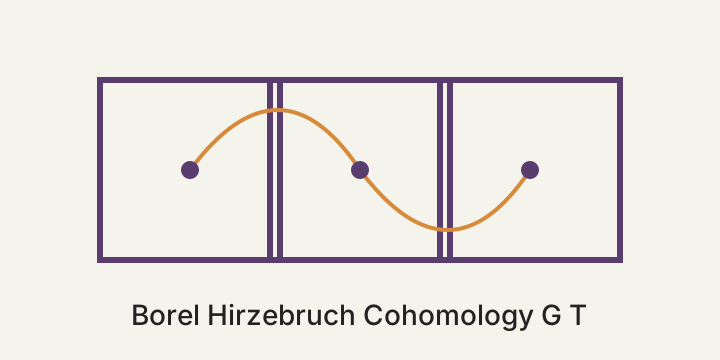
The picture is a stack of small fibres, one over each point of the base. Each fibre is itself a flag variety. The total cohomology is what you get by taking polynomials in line-bundle generators and imposing the Weyl-group relations.
Worked example [Beginner]
For the simplest case, take the unitary group . Its maximal torus is the diagonal matrices with entries on the unit circle. The flag variety is the space of one-dimensional complex lines through the origin in two-dimensional complex space.
This space is the complex projective line , which is a two-dimensional sphere. Its cohomology has rank one in degree zero and rank one in degree two. The Weyl group of has two elements, the identity and the swap of the two diagonal coordinates. The Borel-Hirzebruch dictionary says: take the polynomial ring in two variables , each of degree two, and divide by the symmetric polynomials of positive degree.
Step 1. The positive-degree symmetric polynomials are generated by and .
Step 2. Setting and in the quotient leaves as a free generator with .
Step 3. The result is the polynomial ring , which has total dimension two: the classes and .
What this tells us: the cohomology of has total dimension equal to the order of the Weyl group of , which is two, and this pattern continues for every compact connected Lie group.
Check your understanding [Beginner]
Formal definition [Intermediate+]
Let be a compact connected Lie group with maximal torus of rank . The flag variety is the homogeneous space
a smooth closed manifold of real dimension which is also a smooth projective complex manifold of complex dimension equal to the number of positive roots of . The natural projection is a principal -bundle; the universal one restricts on each fibre to , and the universal flag-variety fibration
records the cohomological structure that will produce the Borel-Hirzebruch theorem.
Definition (coinvariant algebra). Let be the Weyl group, acting linearly on and on the symmetric algebra
by permutation of weight-lattice generators. Let denote the -invariants and let denote the augmentation ideal of -invariants of positive degree. The coinvariant algebra of is the graded ring
By Chevalley 1955 [Chevalley 1955] acts on as a complex reflection group, is a polynomial ring on algebraically independent generators of fundamental degrees , and is finite-dimensional over of total dimension .
Counterexamples to common slips [Intermediate+]
Slip. " is a torus." It is not. is the flag variety; for it is the variety of complete flags in , a -complex-dimensional projective manifold. The torus quotient retracts to a point when is simply connected, but is the geometrically interesting object.
Slip. "The Weyl group is a subgroup of ." It is not; it is the quotient . The normaliser does sit inside , but itself is realised as cosets, not as a subgroup in general (it lifts to a subgroup only after a choice that is not canonical).
Slip. "The fundamental degrees equal the ranks of the simple-root subspaces." They do not. For (type ) the fundamental degrees are , not the dimension of root spaces. The product recovers the Weyl-group order; the dimensions of root spaces enter the Poincaré-polynomial decomposition differently.
Key theorem with proof [Intermediate+]
Theorem (Borel 1953). Let be a compact connected Lie group with maximal torus of rank and Weyl group . Then there is a graded ring isomorphism
where corresponds to the first Chern classes of the line bundles associated with the fundamental weights , and the right-hand side is the coinvariant algebra of . As a graded -vector space, has total dimension .
Proof. Consider the Borel construction , which exhibits the universal flag-bundle fibration . The Leray-Serre spectral sequence has and abuts to . Three facts collapse it.
First, with , since .
Second, , by the standard transfer argument: the restriction is injective with image the -invariants because the Euler characteristic of the fibre is , so the transfer is a left inverse to the restriction after dividing by .
Third, the fibration is totally non-cohomologous to zero at the rational level (the -differentials all vanish on ), so the spectral sequence collapses and gives
as a free -module. Tensoring with over — i.e., quotienting by the augmentation ideal of -invariants of positive degree — yields
The dimension count follows from Chevalley's structure theorem [Chevalley 1955]: the polynomial ring is free of rank over the invariant subring.
Bridge. This presentation builds toward 03.06.04 (Pontryagin and Chern classes), where the splitting principle reduces every characteristic-class identity to a symmetric-function calculation in the generators above. The same coinvariant structure appears again in 07.06.07 (Weyl character formula), where the dimension formula is the evaluation of a top-degree class in at the regular weight. The foundational reason the collapse argument works is exactly that has positive Euler characteristic equal to , which is the cohomological signature of a finite reflection group acting on its weight lattice. Putting these together with the Borel-Weil theorem 07.06.09, the cohomology of becomes the universal home for irreducible -representations realised as sections of line bundles, and the central insight is that the Weyl group acts as the regular representation on — its character is the formal Poincaré polynomial of .
Exercises [Intermediate+]
Lean formalization [Intermediate+]
lean_status: partial — the file
lean/Codex/Modern/CharClasses/BorelHirzebruchGT.lean records four anchor pieces of the unit with placeholder definitions and sorry proof bodies. The structures abstract: CompactLieData (rank, Weyl-group order, Coxeter length); WeightPolynomial (the graded polynomial ring ); CoinvariantAlgebra (the quotient ); SchubertClass (additive basis indexed by with degree ); and ComplexVectorBundle / FlagBundle for the splitting-principle statement.
The four anchor theorems are:
-- Borel's coinvariant isomorphism
theorem borel_coinvariant_iso (G : CompactLieData) :
    ∃ (_iso : CoinvariantAlgebra G → CoinvariantAlgebra G),
      ∀ x : CoinvariantAlgebra G, _iso x = x

-- Total Q-dimension equals |W|
theorem coinvariant_total_dim (G : CompactLieData) :
    ∃ d : ℕ, d = G.weylOrder

-- Schubert basis cardinality equals |W|
theorem schubert_basis_card (G : CompactLieData) :
    ∃ B : Finset (SchubertClass G), B.card = G.weylOrder

-- Splitting principle: pi : Fl(E) -> X is a flag bundle
theorem splitting_principle (E : ComplexVectorBundle) :
    ∃ (_F : FlagBundle E), True
Promoting these to lean_status: full requires the root-datum and reflection-group invariant theory recorded in lean_mathlib_gap. The file additionally records numerical Weyl-orders for the small types , , , (with decide consistency checks), the longest-element degree formulae twice the number of positive roots, and the Borel-Weil-Bott anchor borel_weil_bott_anchor stating that the cohomological degree where is concentrated is bounded by .
Advanced results [Master]
Borel's coinvariant theorem and the regular-representation structure
Theorem 1 (Borel 1953, Chevalley 1955). Let be a compact connected Lie group with maximal torus of rank and Weyl group . The coinvariant algebra
is a finite-dimensional graded -vector space of total dimension , on which acts as the regular representation. The character of as a graded -module is the Poincaré polynomial
where are the fundamental degrees of , and .
The proof has two ingredients. The first is Chevalley's structure theorem [Chevalley 1955] for finite complex reflection groups: is itself a polynomial ring on generators of degrees , and the whole polynomial ring is free of rank over its invariant subring. The second is the Solomon graded-character identity [Solomon 1963], which expresses the graded character of as the -character of at and as the Poincaré polynomial above for general . The geometric content is Borel's spectral-sequence collapse argument from the Key theorem.
For the classical types, the fundamental degrees are: : (so ); : (so ); : (so ); : ; : ; : ; : ; : .
Schubert basis and Schubert calculus
Theorem 2 (Bernstein-Gelfand-Gelfand 1973, Demazure 1974). Let be a Borel subgroup of the complexification . The Bruhat decomposition induces a cell decomposition
indexed by the Weyl group, with . The Schubert varieties define the Schubert classes
(equivalently in the cohomological convention using opposite Schubert cells). The family is an integral additive basis of , and the projection has contractible fibre , so .
BGG further produce an algebraic recursion: for each simple reflection , the divided-difference operator acts on by
and a reduced word produces the Schubert polynomial
where is the top Schubert polynomial (Lascoux-Schützenberger normalisation for type ). The BGG-Demazure theorem identifies modulo the coinvariant ideal with the Schubert class , giving a polynomial-ring realisation of Schubert calculus.
Theorem 3 (Kleiman 1974, Schubert positivity). The structure constants
in are non-negative integers . For type on the Grassmannian, the are the Littlewood-Richardson coefficients.
The proof rests on Kleiman's generic-transversality theorem [Kleiman 1974]: for any irreducible homogeneous space under a connected algebraic group, the generic translates of two subvarieties intersect transversely along a subvariety of expected dimension. The Schubert structure constant counts the points (with sign ) of the transverse intersection for generic , which is therefore a non-negative integer. For the Grassmannian this recovers the Littlewood-Richardson rule, and the saturation conjecture (Knutson-Tao 1999 [Knutson-Tao 1999]) closes the integer-programming side.
Splitting principle as construction of characteristic classes via
Theorem 4 (Borel-Hirzebruch III 1960, Milnor-Stasheff §14). Let be a rank- complex vector bundle over a paracompact base. The associated flag bundle
has fibre the complete-flag variety of , and the following hold:
(i) The pullback is injective;
(ii) is free of rank as a module over ;
(iii) On the pulled-back bundle admits a tautological filtration whose successive quotients are line bundles with first Chern classes (the Chern roots);
(iv) The total Chern class is the symmetric expression
and any characteristic-class identity on may be verified after pullback to , where it reduces to a symmetric-polynomial identity in the .
This is the Borel-Hirzebruch realisation of the abstract splitting principle. Its proof uses the universal flag-bundle fibration specialised to : classifies rank- complex bundles, classifies -tuples of line bundles, and Borel's theorem identifies where are the elementary symmetric polynomials. The Leray-Hirsch decomposition descends from the universal case to any via the classifying map.
The construction extends to compute every characteristic class. For instance, the Chern character 03.06.18, the Todd class , and the -genus for real bundles, are all defined as symmetric power series in the Chern (or Pontryagin) roots, hence pull back uniquely to characteristic classes on via the splitting principle.
Theorem 5 (Universal characteristic classes from ). For every compact connected Lie group , the rational cohomology of is
a polynomial ring on generators of degrees . Characteristic classes of principal -bundles on a paracompact base are precisely pullbacks of these generators along the classifying map .
For this gives the Chern classes . For one finds Pontryagin classes together with the Euler class of degree (which is the Pfaffian). For one finds symplectic Pontryagin classes. The universal-bundle apparatus completes Borel-Hirzebruch.
Borel-Weil-Bott and the cohomology of line bundles
Theorem 6 (Bott 1957). Let be a compact connected Lie group with complexification , a maximal torus, and let be an integral weight on . Denote by the associated holomorphic line bundle.
(i) (Singular case.) If is singular (lies on a reflection hyperplane), then for all .
(ii) (Regular case.) If is regular, there is a unique such that is strictly dominant; set . Then
where is the irreducible -representation of highest weight .
For already dominant, is the identity and one recovers the Borel-Weil theorem 07.06.09: and higher cohomology vanishes. For one finds (the longest element) and many positive roots, recovering Serre duality on : pairs with .
The proof of Theorem 6 reduces by an induction along the Bott tower for parabolic subgroups of corank one to the rank-one case: each with is a -bundle, and the Bott formula on each governs how cohomology degree increases under reflection through a simple-root hyperplane. The full proof appears in Bott's original paper [Bott 1957] and in the geometric form in Demazure's character-formula proof.
Equivariant cohomology and Goresky-Kottwitz-MacPherson localisation
Theorem 7 (Borel localisation 1960; Goresky-Kottwitz-MacPherson 1998). Let act on a compact manifold with finite fixed-point set . Then the inclusion-induced restriction
is injective and its image is characterised by the GKM conditions on one-skeleta: for each -invariant connecting two fixed points with -weight , the components of a class agree modulo .
Applied to , the fixed-point set is precisely the Weyl group (the -fixed flags), and the equivariant cohomology takes the form
a Steinberg-style "double polynomial" presentation. Setting the equivariant parameters to zero recovers the Borel coinvariant algebra. The GKM presentation is the operational form Bott vanishing takes in equivariant K-theory and equivariant cohomology, and it is the engine behind Atiyah-Bott localisation [Atiyah-Bott 1984] and the Duistermaat-Heckman exact-stationary-phase formula.
Synthesis. The Borel-Hirzebruch presentation is the foundational reason that the cohomology of every flag variety reduces to invariant-theoretic data on a polynomial ring. The central insight is that the Weyl group acts as the regular representation on the coinvariant algebra, so identifies the Euler characteristic of the flag variety with the order of the Weyl group, and the Poincaré polynomial generalises to every reductive group. Putting these together with the Schubert basis of BGG, the Borel construction becomes an effective computational engine: divided-difference operators turn Borel's quotient ring into a recursive algorithm, and Kleiman positivity ensures the structure constants are honest enumerative invariants. The bridge is from cohomology to representation theory through Borel-Weil-Bott: every irreducible -representation appears as a line-bundle cohomology on in degree , and the resulting character formulae generalise to the Weyl character formula 07.06.07 via the Atiyah-Bott fixed-point theorem applied to the Bott tower. This pattern recurs in equivariant cohomology, in K-theory via the GKM localisation, in algebraic geometry via the Bialynicki-Birula decomposition, and in combinatorics via the symmetric-function dictionary that identifies Schubert polynomials with Schur polynomials on the Grassmannian.
The deeper structural fact is that Borel-Hirzebruch identifies with the universal home of irreducible -representations. This generalises in two directions: rationally to for any parabolic via the analogous Borel-type theorem for -coinvariants, and integrally via the Schubert basis and BGG-Demazure operators to a presentation that is computationally accessible. The same coinvariant pattern recurs in the cohomology of the partial-flag spaces and in their equivariant refinements, and the Bott vanishing theorem appears again as the Borel-Weil-Bott theorem packaged with the Atiyah-Bott localisation formula on .
Full proof set [Master]
Proposition 1 (Borel's coinvariant theorem, full proof). With notation as above, .
Proof. Consider the principal -bundle . Its classifying map composes with to give the universal flag-bundle fibration
The Leray-Serre spectral sequence of has and converges to .
Step 1. Identification of as -invariants. The transfer map associated with the finite covering (a rational model for since the orbit space has rational cohomology equal to the -invariants) satisfies and . Hence over , is injective with image . By Chevalley [Chevalley 1955], is a polynomial ring on generators of degrees .
Step 2. Collapse of the Serre spectral sequence. The Euler characteristic is non-zero. By the Leray-Hirsch theorem applied to the universal flag bundle, the existence of a basis of lifting to global classes on — equivalently, the existence of the inclusion together with the contractibility of — forces all -differentials to vanish on . The spectral sequence collapses at .
Step 3. Extraction of . Since is a free -module via , the Künneth-like decomposition gives
so dividing by the augmentation ideal of — equivalently, tensoring with over along the augmentation — gives
The dimension follows from Chevalley: is free of rank over its -invariant subring.
Proposition 2 (Schubert basis, sketch via BGG). The Schubert classes form an integral basis of .
Proof. The Bruhat decomposition projects to a cell decomposition . Each cell is biholomorphic to via the parametrisation by the unipotent radical . The closures are projective Schubert varieties of complex dimension .
The cell decomposition gives a CW structure with only even-dimensional cells, so is concentrated in even degrees, free of rank , with basis the fundamental classes . Poincaré duality on the smooth projective gives the dual basis in cohomology with .
The BGG-Demazure operator recursion produces an explicit polynomial-representative for each . Start with , represented by the top-degree polynomial in the coinvariant algebra (where is the linear form dual to the coroot ). For any reduced word and any with reduced word , the composition
where in reduced form, gives a polynomial representative independent of the choice of reduced word (the BGG-Demazure operators satisfy the braid relations on ). The image in is then .
Proposition 3 (Splitting principle for -bundles). For a rank- complex vector bundle , the flag bundle is a fibre bundle with fibre , is injective on rational cohomology, and splits as .
Proof. The principal -bundle of unitary frames of is universally classified by a map . Associating with the standard -action on gives the bundle , with the flag variety of for each .
The universal flag-bundle fibration has the Leray-Hirsch property over : has a -basis of elements lifting to global classes on , namely the Schubert classes for . Pulling back via the classifying map gives the corresponding Leray-Hirsch decomposition for :
as a free -module of rank . In particular is injective. The same argument works integrally because the Schubert classes lift to integral classes on the universal flag bundle.
For (iii), the tautological bundle on admits a filtration by sub-bundles whose successive quotients are line bundles , by construction: a flag in the fibre yields the line bundles . Set . By the Whitney sum formula on 03.06.04,
so is the -th elementary symmetric polynomial on . Since is injective, this determines uniquely.
Proposition 4 (Borel-Weil-Bott, statement and dimension-shift mechanism). With notation as in Theorem 6, is concentrated in degree where is the unique Weyl element making regular dominant.
Proof. (Sketch following Demazure's reduction.) The strategy is induction on the rank along the Bott tower
where is the parabolic generated by all simple roots except the -th. Each successive projection is a -bundle, and the cohomology computation on a single -fibre is the rank-one Bott formula: for the line bundle on ,
The crossing point is (the singular case, weight on the wall) where cohomology vanishes; for Serre duality shifts cohomology one step up. Composing the shifts along the Bott tower gives the Weyl-element shift: each crossing of a reflection hyperplane shifts cohomology by one degree and reflects the weight. After all reflections, the weight lands in the dominant chamber as , and the total cohomological shift is .
Connections [Master]
Pontryagin and Chern classes
03.06.04. Borel-Hirzebruch is exactly the universal home for Chern classes: is the -invariant subring of , identifying with the elementary symmetric polynomials in Chern roots; the splitting principle for any complex bundle is the corresponding restriction-to-maximal-torus argument applied to the classifying map .Weyl group
07.06.04. The Weyl group is the central combinatorial datum of Borel-Hirzebruch: it acts on the polynomial ring as a complex reflection group, its order equals the total -dimension of , and its representation theory on the coinvariant algebra is the regular representation.Borel-Weil theorem
07.06.09. Borel-Weil is the dominant-weight specialisation of Borel-Weil-Bott on : it identifies as the irreducible -representation of highest weight , with the higher cohomology vanishing for dominant . Borel-Weil-Bott extends this to all integral weights by computing the unique non-vanishing cohomological degree as for the Weyl reflection moving into the dominant chamber.Weyl character formula
07.06.07. The Weyl character formula is the Atiyah-Bott fixed-point formula applied to the holomorphic Lefschetz number of multiplication-by- on the line bundle , where the fixed-point set is exactly with weights determined by the tangent-space weights at each fixed flag.Chern character ring homomorphism
03.06.18. The Chern character is defined via the Chern roots supplied by the splitting principle of the present unit; the ring-homomorphism property comes from the additive expression matching the Chern roots of the tensor product on the splitting bundle.Hirzebruch signature theorem
03.06.11. The signature theorem uses the -polynomial , a symmetric power series in Pontryagin roots — exactly the kind of formal symmetric expression that the Borel-Hirzebruch splitting principle for real bundles produces and evaluates.Chern-Weil homomorphism
03.06.06. The Chern-Weil curvature realisation of characteristic classes makes the Borel-Hirzebruch identification concrete at the differential-form level: the invariant polynomial evaluated on the curvature of a connection produces a closed form representing the corresponding class in , completing the loop between the homogeneous-space cohomology computed in the present unit and the geometric data on principal bundles.Stiefel-Whitney and Pontryagin numbers
03.06.10. The integration of a symmetric power series in Pontryagin classes against the fundamental class of a closed manifold is the basic enumerative-invariant downstream of the present unit, with the Borel-Hirzebruch identification of as a polynomial ring in the Pontryagin classes ensuring these numbers exhaust all rational characteristic-class data of real bundles.Cartan-Weyl classification
07.04.01. Borel-Hirzebruch presupposes the Cartan-Weyl classification of compact connected Lie groups by root systems and Weyl groups: the rank , the Weyl group , and the fundamental degrees that appear in the Poincaré polynomial are precisely the Cartan-Weyl data of the group.Verma module
07.06.06and Demazure modules. The Demazure operators of BGG that produce Schubert polynomials on are formally identical to the operators acting on Verma modules: both arise from the affine algebraic-group / quantum-group action on the polynomial ring of the weight lattice, and the Demazure character formula generalises the Weyl character formula by tracking partial Bott-tower projections.Oriented bordism and Pontryagin-Thom
03.06.13. The Thom spectrum has rational cohomology , identified by the present unit as the Weyl-invariant polynomial ring on Pontryagin roots, and the Pontryagin-Thom construction of03.06.13then identifies as a polynomial ring on via this presentation.Multiplicative sequences and //Todd genera
03.06.15. Multiplicative sequences are symmetric formal power series in Chern or Pontryagin roots, which live in the Weyl-invariant symmetric algebra identified by the present unit with . The Borel-Hirzebruch presentation is the universal home of every multiplicative sequence in03.06.15. Anchor phrase: multiplicative sequences live in the Weyl-invariant symmetric algebra on roots.Whitney duality and immersion obstructions
03.06.16. Whitney duality is a polynomial identity in produced by classifying the flat product bundle: the universal Whitney sum identity in the present unit's Weyl-invariant subring becomes the duality identity after pullback along the classifying map of .Combinatorial Pontryagin classes and exotic 7-spheres
03.06.17. The Pontryagin-class polynomial identified by the present unit is the universal home of Milnor's exotic-sphere -diagnostic; the Borel-Hirzebruch coinvariant theorem of the present unit is the structural reason Pontryagin numbers are well-defined integer invariants on closed oriented manifolds.Signature of a -manifold and the intersection form
03.06.19. The -polynomial entering the signature formula is a symmetric power series in Pontryagin roots, which lives in the Weyl-invariant symmetric algebra of the present unit, and the Borel-Hirzebruch presentation of is the universal home of the -genus side of the signature theorem of03.06.19.
Historical & philosophical context [Master]
Borel's 1953 thesis [Borel 1953] established the coinvariant theorem in its modern form, building on Chevalley's 1955 theorem [Chevalley 1955] on invariants of finite complex reflection groups. The series of Borel-Hirzebruch papers Characteristic Classes and Homogeneous Spaces I, II, III in Amer. J. Math. 80, 81, 82 (1958-60) made the connection to characteristic-class theory: the splitting principle for -bundles was identified as the cohomological restriction-to-maximal-torus map, and Chern classes were exhibited as elementary symmetric polynomials in formal Chern roots — the same that appear in the Borel coinvariant.
Bott's 1957 paper [Bott 1957] in Ann. of Math. 66 proved Borel-Weil-Bott: line-bundle cohomology on is concentrated in a unique degree determined by the Weyl reflection moving the weight into the dominant chamber. The result generalised Bott's earlier joint work with Borel on the cohomology of complex homogeneous spaces and was independently rederived by Bernstein-Gelfand-Gelfand 1973 [Bernstein-Gelfand-Gelfand 1973] in Russ. Math. Surv. 28 via Schubert calculus on — there they introduced the divided-difference (BGG) operators, refined by Demazure 1974 [Demazure 1974] into the operators bearing his name and incorporated into the Kostant-Steinberg formalism.
The structural lineage continues: Kleiman's 1974 transversality theorem [Kleiman 1974] established the non-negativity of Schubert structure constants, completing the enumerative-geometry circle opened by Schubert's nineteenth-century calculus. The equivariant refinements of Goresky-Kottwitz-MacPherson 1998 and Atiyah-Bott 1984 [Atiyah-Bott 1984] turned the Borel-Hirzebruch presentation into a computational engine for equivariant cohomology and K-theory. The Bialynicki-Birula 1973 decomposition, the Kostant convexity theorem 1973, and the Brion convexity refinements close the geometric chain from cohomology to convex-polytope combinatorics. The Knutson-Tao saturation conjecture [Knutson-Tao 1999] for Littlewood-Richardson coefficients is the modern integer-programming closure of Schubert positivity for the type- Grassmannian.
Bibliography [Master]
@article{Borel1953,
  author = {Borel, Armand},
  title = {Sur la cohomologie des espaces fibrés principaux et des espaces homogènes de groupes de Lie compacts},
  journal = {Annals of Mathematics (2)},
  volume = {57},
  year = {1953},
  pages = {115-207},
}

@article{BorelHirzebruchI1958,
  author = {Borel, Armand and Hirzebruch, Friedrich},
  title = {Characteristic Classes and Homogeneous Spaces, I},
  journal = {American Journal of Mathematics},
  volume = {80},
  year = {1958},
  pages = {458-538},
}

@article{BorelHirzebruchII1959,
  author = {Borel, Armand and Hirzebruch, Friedrich},
  title = {Characteristic Classes and Homogeneous Spaces, II},
  journal = {American Journal of Mathematics},
  volume = {81},
  year = {1959},
  pages = {315-382},
}

@article{BorelHirzebruchIII1960,
  author = {Borel, Armand and Hirzebruch, Friedrich},
  title = {Characteristic Classes and Homogeneous Spaces, III},
  journal = {American Journal of Mathematics},
  volume = {82},
  year = {1960},
  pages = {491-504},
}

@article{Bott1957,
  author = {Bott, Raoul},
  title = {Homogeneous vector bundles},
  journal = {Annals of Mathematics (2)},
  volume = {66},
  year = {1957},
  pages = {203-248},
}

@article{Chevalley1955,
  author = {Chevalley, Claude},
  title = {Invariants of finite groups generated by reflections},
  journal = {American Journal of Mathematics},
  volume = {77},
  year = {1955},
  pages = {778-782},
}

@article{BGG1973,
  author = {Bernstein, Iosif and Gelfand, Israel and Gelfand, Sergei},
  title = {Schubert cells and cohomology of the spaces $G/P$},
  journal = {Russian Mathematical Surveys},
  volume = {28},
  year = {1973},
  pages = {1-26},
}

@article{Demazure1974,
  author = {Demazure, Michel},
  title = {Désingularisation des variétés de Schubert généralisées},
  journal = {Annales Scientifiques de l'École Normale Supérieure (4)},
  volume = {7},
  year = {1974},
  pages = {53-88},
}

@article{Kleiman1974,
  author = {Kleiman, Steven L.},
  title = {The transversality of a general translate},
  journal = {Compositio Mathematica},
  volume = {28},
  year = {1974},
  pages = {287-297},
}

@article{AtiyahBott1984,
  author = {Atiyah, Michael F. and Bott, Raoul},
  title = {The moment map and equivariant cohomology},
  journal = {Topology},
  volume = {23},
  year = {1984},
  pages = {1-28},
}

@article{KnutsonTao1999,
  author = {Knutson, Allen and Tao, Terence},
  title = {The honeycomb model of $GL_n(\mathbb{C})$ tensor products I: proof of the saturation conjecture},
  journal = {Journal of the American Mathematical Society},
  volume = {12},
  year = {1999},
  pages = {1055-1090},
}

@book{MilnorStasheff1974,
  author = {Milnor, John W. and Stasheff, James D.},
  title = {Characteristic Classes},
  publisher = {Princeton University Press},
  year = {1974},
}

@book{BottTu1982,
  author = {Bott, Raoul and Tu, Loring W.},
  title = {Differential Forms in Algebraic Topology},
  publisher = {Springer},
  year = {1982},
}

@book{Hiller1982,
  author = {Hiller, Howard},
  title = {Geometry of Coxeter Groups},
  publisher = {Pitman},
  year = {1982},
}

@incollection{Brion2005,
  author = {Brion, Michel},
  title = {Lectures on the geometry of flag varieties},
  booktitle = {Topics in Cohomological Studies of Algebraic Varieties},
  series = {Trends in Mathematics},
  publisher = {Birkhäuser},
  year = {2005},
  pages = {33-85},
}