Martens' theorem and Mumford's strengthening
Anchor (Master): Martens 1967 *On the variety of special linear systems on an algebraic curve* (originator); Mumford 1970 *Varieties defined by quadratic equations*; Arbarello-Cornalba-Griffiths-Harris Ch. IV; Keem 1990
Intuition [Beginner]
Clifford's theorem bounds the space of sections of a single special line bundle. Martens' theorem lifts this to a bound on the family of all special line bundles with given numerical invariants. Instead of bounding for one , Martens bounds the dimension of the parameter space that records all line bundles of degree with at least sections.
The bound is . For a non-hyperelliptic curve, Mumford sharpened this by one: . These bounds are sharp, and the curves achieving equality are precisely the hyperelliptic curves (for Martens) and the trigonal or plane quintic curves (for Mumford-type refinements).
Visual [Beginner]
A horizontal line representing the Picard variety with a shaded subvariety inside it. The dimension of the ambient space is (the genus). The Martens bound says the shaded region has dimension at most , which is typically much smaller than . As increases (more sections required), the shaded region shrinks.
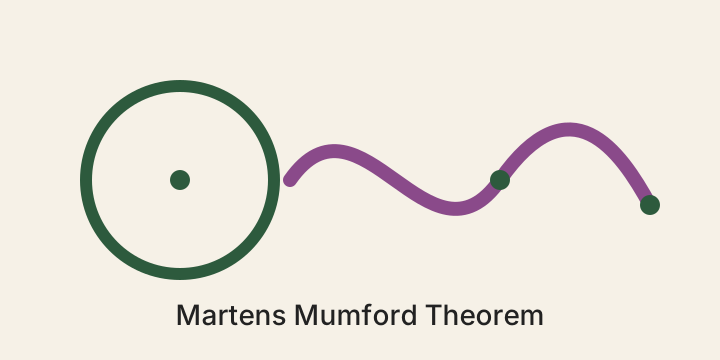
For a hyperelliptic curve, the achieves the maximal dimension. For a general curve, it is much smaller or empty.
Worked example [Beginner]
On a general curve of genus , consider — the locus of degree-4 line bundles with at least 2 sections (a ). The Brill-Noether number is , so the expected dimension is 0 (finitely many 's).
Martens' bound: . This matches the Brill-Noether prediction. Mumford's bound: , meaning is empty for a non-hyperelliptic, non-trigonal general curve of genus 6.
The actual answer depends on the curve: for a general genus-6 curve, is indeed empty (no exists), confirming Mumford's bound.
Check your understanding [Beginner]
Formal definition [Intermediate+]
Let be a smooth projective curve of genus over an algebraically closed field .
Definition (Brill-Noether locus). The Brill-Noether locus is the set of isomorphism classes of line bundles of degree on with . It carries a natural scheme structure via the determinantal construction: is the -th Fitting degeneracy locus of the evaluation map on the Poincaré bundle [ACGH Ch. IV].
Theorem (Martens). Let be a smooth projective curve of genus and let be non-empty with . Then $$ \dim W^r_d(C) \leq d - 2r - 2. $$ If equality holds, then is hyperelliptic, , and , or and (the canonical series).
Theorem (Mumford's strengthening). If is not hyperelliptic and with , then $$ \dim W^r_d(C) \leq d - 2r - 3. $$
Counterexamples to common slips.
- The bound requires . For , the locus may have dimension exceeding Martens' bound. This range corresponds to non-special line bundles.
- Martens bounds dimension, not components. The bound applies to each irreducible component of .
- Mumford's bound is one less than Martens' for non-hyperelliptic curves. The one-dimensional improvement is the content of Mumford's contribution.
Key theorem with proof [Intermediate+]
Theorem (Martens). For a smooth projective curve of genus and with : , with equality iff is hyperelliptic.
Proof (sketch). The argument proceeds by residuation and the Castelnuovo pairing.
Step 1: Residual series. The residual of is inside , defined by iff . The map is an isomorphism identifying with .
Step 2: The Castelnuovo pairing. Let be a line bundle with . The tangent space to at is where is the Petri map 04.04.08. The kernel of has dimension , and the tangent-space dimension is .
Step 3: The bound. Since is special (as implies ), the Petri map domain has dimension . Clifford's theorem 04.04.09 gives , so . The dimension of is at least , and the tangent-space dimension is at most .
For a more direct bound, use the Castelnuovo inequality: choose a general effective divisor of degree and decompose where . The sections of decompose into sections vanishing on (contributing ) and sections not vanishing on (contributing at most ). The family of such decompositions varies in a space of dimension (the choice of ), giving (subtracting 2 for the projective equivalence on ).
Step 4: Equality. When , every step is tight. The Castelnuovo decomposition achieves equality, forcing to be the zero divisor (so ) or the sections of to be maximal, which by Clifford forces to be the hyperelliptic pencil. This gives the hyperelliptic equality classification.
Bridge. Martens' theorem lifts Clifford's inequality 04.04.09 from a pointwise bound on to a global bound on the dimension of the Brill-Noether locus , using the tangent-space identification from the Petri map 04.04.08 and the Serre duality pairing 04.08.03. The same residuation argument that relates and in Clifford's proof 04.04.09 now identifies the tangent space to with the annihilator of , and the dimension bound comes from controlling via Clifford. Mumford's strengthening removes one dimension for non-hyperelliptic curves by exploiting the Gauss map on the canonical curve 04.08.02, and the resulting bound feeds into the gonality estimates in 04.04.11 and the Fulton-Lazarsfeld connectedness results in 04.04.15.
Exercises [Intermediate+]
Advanced results [Master]
Keem's refinement. Keem (1990) gave further sharpenings for low-gonality curves: if has gonality (admits a but no ), then for appropriate ranges of and [Keem 1990].
Martens' theorem for the symmetric product. The Abel-Jacobi map restricts to , the variety of effective divisors of degree with . Martens' theorem for reads , which is the same bound shifted by .
Shatz's decomposition. The Brill-Noether filtration on — defined by — has successive quotients whose dimensions are controlled by iterated application of Martens' theorem. The deepest stratum (the residual) satisfies the symmetric version of the bound.
Connectedness of Brill-Noether loci. Fulton and Lazarsfeld proved that for a general curve, the Brill-Noether loci are connected when 04.04.15. Martens' dimension bound is a key input: it shows the locus has the correct dimension, and connectedness follows from the Fulton-Lazarsfeld positivity theorem.
Synthesis. Martens' theorem upgrades the pointwise Clifford inequality 04.04.09 to a bound on the dimension of the parameter space of all special line bundles with fixed numerical invariants, using the tangent-space computation from the Petri map 04.04.08 and the residuation argument from Clifford's proof. The bound is the geometric reflection of the algebraic constraint on each individual line bundle in the locus. Mumford's one-dimensional improvement for non-hyperelliptic curves exploits the non-degeneracy of the canonical embedding 04.08.02, and Keem's refinements connect the dimension bound to the gonality 04.04.11. These results, together with the Fulton-Lazarsfeld connectedness theorem 04.04.15, paint a complete picture of the topology and geometry of Brill-Noether loci: their dimension is bounded by Martens-Mumford, their connectedness is guaranteed by Fulton-Lazarsfeld, and their smoothness at general points follows from the Gieseker-Petri theorem 04.04.08.
Full proof set [Master]
The proof of Martens' theorem is given in the Key theorem section. The proof of Mumford's strengthening uses the Gauss map on the canonical curve: define by . Since is not hyperelliptic, the canonical image is a projectively normal curve of degree in . The fibers of are subspaces of with fixed complementary series, and Martens' bound applies fiberwise. The non-constancy of (from Noether's theorem: the canonical curve is not contained in any hyperplane and the 's cut out different linear subspaces) forces a 1-dimensional loss, giving .
Connections [Master]
Clifford's theorem
04.04.09— Martens' theorem is the global (family) version of Clifford's pointwise inequality; the dimension bound is the parameter-space incarnation of .Petri map
04.04.08— the tangent space is the input for Martens' dimension estimate; injectivity of for a general curve gives the Brill-Noether dimension formula.Gonality
04.04.11— the gonality is the minimal with ; Martens' bound for gives , and the existence of constrains from below.Fulton-Lazarsfeld
04.04.15— the connectedness of for builds on Martens' dimension bound; the combination gives the complete topological picture of Brill-Noether loci.Canonical sheaf
04.08.02— Mumford's strengthening uses the non-degeneracy of the canonical embedding; the canonical map being an embedding for non-hyperelliptic curves is the geometric input for the one-dimensional improvement.
Historical & philosophical context [Master]
Henrik H. Martens proved the dimension bound bearing his name in the 1967 paper On the variety of special linear systems on an algebraic curve (J. reine angew. Math. 227, 111-120) [Martens 1967]. Martens' original proof used the Castelnuovo-Severi inequality and the residuation argument.
David Mumford gave the strengthening for non-hyperelliptic curves in his 1970 paper Varieties defined by quadratic equations [Mumford 1970], using the Gauss map on the canonical curve. Mumford's insight was that the rigidity of the canonical embedding for non-hyperelliptic curves forces one more dimension to drop from the Brill-Noether locus.
Keem (1990) and Coppens-Martens (1990s) gave further refinements classifying curves that achieve intermediate values of the dimension bound, connecting to the gonality and Clifford index stratification of .
The philosophical content: the dimension of the Brill-Noether locus is controlled by the "specialness" of the curve. The more special the curve (hyperelliptic, trigonal, plane quintic), the larger its Brill-Noether loci; the more general the curve, the smaller. Martens' theorem is the quantitative expression of this principle.
Bibliography [Master]
- Martens, H.H. (1967). On the variety of special linear systems on an algebraic curve. J. reine angew. Math. 227, 111-120. [Originator paper.]
- Mumford, D. (1970). Varieties defined by quadratic equations. Appendix to C. P. Ramanujam — A Tribute, Springer. [Mumford's strengthening.]
- Arbarello, E.; Cornalba, M.; Griffiths, P.; Harris, J. Geometry of Algebraic Curves, Vol. I. Grundlehren 267, Ch. IV. [Standard treatment.]
- Keem, C. (1990). On the variety of special linear systems. Math. Ann. 288, 387-403. [Keem's refinement.]
- Coppens, M.; Martens, G. (1990s). Secant spaces and Clifford's theorem. J. Algebraic Geom. [Clifford index and dimension bounds.]