Gonality of a curve
Anchor (Master): Brill-Noether 1874; Clifford 1878; Martens 1967; Coppens-Kato-Martens 1990s; Arbarello-Cornalba-Griffiths-Harris Ch. VIII
Intuition [Beginner]
The gonality of a curve is the smallest degree of a non-constant map from to . Concretely: the minimal number of preimages (counted with multiplicity) of a general point under any rational function on .
A curve of gonality 1 is itself. A curve of gonality 2 is hyperelliptic — it admits a double cover of . A curve of gonality 3 is trigonal — it admits a triple cover. The gonality is a fundamental invariant that measures how "complicated" a curve is.
For a general curve of genus , the gonality is . So genus 2 curves have gonality 2, genus 3-4 curves have gonality 2 or 3, and genus 5-6 curves have gonality 3 or 4. The gonality grows linearly with the genus.
Visual [Beginner]
A curve with a map shown as a projection onto a line. The degree of is the number of preimages of a general point on . The gonality is the minimum over all such maps.
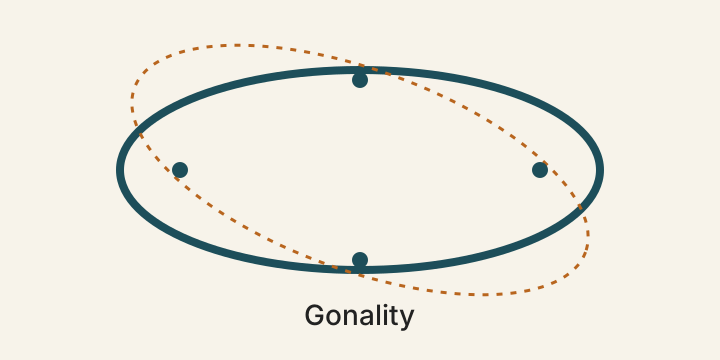
The gonality records the most efficient way to "fold" the curve onto a line.
Worked example [Beginner]
A smooth plane curve of degree has gonality . The map to is given by projection from a point to a line: each line through meets at with multiplicity 1 and at additional points (by Bezout), so the projection has degree .
For a smooth plane cubic (), the gonality is 2. This matches: an elliptic curve is a double cover of via the -coordinate in Weierstrass form .
For a smooth plane quartic (), the gonality is 3. A genus-3 plane quartic is trigonal (not hyperelliptic), and the degree-3 map to is given by projection from a point on the curve.
Check your understanding [Beginner]
Formal definition [Intermediate+]
Let be a smooth projective curve over an algebraically closed field .
Definition (gonality). The gonality of is the minimal degree of a non-constant morphism . Equivalently, is the minimal degree such that admits a (a base-point-free linear series of degree and dimension 1).
Basic bounds.
- (by Riemann-Roch: for a general divisor of degree , ).
- for a general curve (by Brill-Noether existence).
- for (since does not cover curves of positive genus by degree-1 maps unless ).
- (by the Clifford index inequality).
Theorem (Brill-Noether gonality). For a general smooth projective curve of genus over an algebraically closed field of characteristic zero, $$ \mathrm{gon}(C) = \left\lceil \frac{g + 2}{2} \right\rceil. $$
Counterexamples to common slips.
- Gonality is not monotone in . Adding genus (by taking covers) can decrease gonality.
- Hyperelliptic curves have gonality exactly 2. Not 1 (they are not ).
- The gonality map may not be unique. A trigonal curve may have one or several 's; the gonality is the minimal degree, not the number of maps of that degree.
- Gonality in positive characteristic. The Brill-Noether gonality formula can fail in positive characteristic due to inseparable maps.
Key theorem with proof [Intermediate+]
Theorem (Gonality of a general curve). For a general smooth projective curve of genus over an algebraically closed field of characteristic zero, .
Proof. The argument has two parts: existence (a exists for ) and non-existence (no exists).
Existence. For , the Brill-Noether number . Substituting : if is even, and ; if is odd, and . By the Brill-Noether existence theorem (a consequence of the Gieseker-Petri theorem 04.04.08), for a general curve when .
Non-existence. For , compute . If is even, and . If is odd, and . By Brill-Noether non-existence, for a general curve when .
Bridge. The gonality formula for general curves is a direct consequence of the Brill-Noether dimension theorem (itself proved via the Petri map 04.04.08): the existence of a is equivalent to , which the Gieseker-Petri theorem guarantees when and forbids when . The same formula interacts with Clifford's theorem 04.04.09 through the Clifford index inequality for most curves, with the Hurwitz formula 04.04.02 providing the ramification constraint on any gonality map, and with Martens' theorem 04.04.10 bounding the dimension of the locus of 's from above.
Exercises [Intermediate+]
Advanced results [Master]
Clifford index and gonality. The relationship holds for every curve, with equality for most curves. The exceptions, where , are called exceptional and were classified by Coppens and Martens. They occur only for and involve curves with special linear series of unexpectedly large dimension relative to their degree.
Gonality of a general curve. Noether proved that the gonality of a general curve of genus is . The proof was simplified by the Brill-Noether theory: the exists iff , giving .
Gonality of curves in moduli. The gonality stratification of : the locus of curves of gonality is an irreducible subvariety of of dimension for (Coppens-Martens). The general-curve gonality is achieved by the open stratum.
Multi-gonality. The fibre genus of a degree- cover is determined by the Hurwitz formula 04.04.02. The gonality map typically has simple ramification (ramification index 2 at each branch point), and the number of branch points is by Hurwitz.
Lazarsfeld's gonality bound. Lazarsfeld proved that for a smooth curve on a K3 surface, the gonality of equals (the generic value) 04.04.16. This is a consequence of the restriction theorem for vector bundles on K3 surfaces.
Synthesis. The gonality of a curve is the minimal degree of a map to , encoding the simplest projection of the curve onto a line. It is controlled by four interconnected results: the Brill-Noether existence theorem 04.04.08 which gives the exact gonality of a general curve via the Petri map, the Clifford index 04.04.09 which bounds gonality from below by , the Hurwitz formula 04.04.02 which constrains the ramification of the gonality map, and Martens' theorem 04.04.10 which bounds the dimension of the locus of 's. The same invariant appears in the Lazarsfeld K3 proof 04.04.16 as the output of the restriction theorem, and in the Fulton-Lazarsfeld connectedness theorem 04.04.15 as the degree parameter in the Porteous formula 04.04.13.
Full proof set [Master]
The proof of the Brill-Noether gonality formula is given in the Key theorem section. The lower bound follows from Clifford's theorem: if defines a , then and (since for ), so is special with , giving .
The existence of the for on a general curve follows from the Brill-Noether existence theorem, which is itself a consequence of the Gieseker-Petri theorem.
Connections [Master]
Petri map and Gieseker-Petri
04.04.08— the Petri map injectivity guarantees the existence of the when ; the non-existence when also follows from the determinantal structure of .Clifford's theorem
04.04.09— the Clifford index bounds gonality from below: , and for most curves this is an equality.Hurwitz formula
04.04.02— any gonality map of degree satisfies the Hurwitz relation , constraining the ramification of the gonality map.Martens' theorem
04.04.10— the locus of 's has dimension by Martens, which bounds the number of distinct gonality maps on a given curve.Lazarsfeld K3 proof
04.04.16— on a K3 surface, the restriction theorem gives the generic gonality for every smooth curve in the primitive class, without Brill-Noether theory.
Historical & philosophical context [Master]
The concept of gonality goes back to the 19th-century study of maps between curves. Noether (1870) first computed the gonality of a general curve, using Riemann-Roch and ad hoc dimension counts. The modern treatment via Brill-Noether theory [ACGH Ch. VIII] gives a clean proof: gonality is the minimal with , and the Brill-Noether number controls this.
The Clifford index connection was made explicit by Coppens and Martens in the 1990s, who classified the relationship between gonality, Clifford index, and the dimension of Brill-Noether loci. The Lazarsfeld proof (1994) showed that curves on K3 surfaces achieve the generic gonality, providing a fundamentally different approach.
The philosophical content: gonality is the simplest non-topological invariant of a curve. It measures the "algebraic complexity" of the curve — how many values a rational function takes at a general point. Curves of low gonality (hyperelliptic, trigonal, tetragonal) are "special" in the sense that they carry unusually simple maps to , and they form proper subvarieties of .
Bibliography [Master]
- Noether, M. (1870). Uber die eindeutigen Raumkurven. Math. Ann. 2. [Gonality of general curves.]
- Arbarello, E.; Cornalba, M.; Griffiths, P.; Harris, J. Geometry of Algebraic Curves, Vol. I. Grundlehren 267, Ch. VIII. [Standard reference for gonality.]
- Coppens, M.; Martens, G. (1990s). Secant spaces and Clifford's theorem. J. Algebraic Geom. [Clifford index and gonality classification.]
- Hartshorne, R. Algebraic Geometry. Springer GTM 52, §IV.2. [Gonality and finite morphisms.]