Determinantal varieties and the Porteous formula
Anchor (Master): Porteous 1971 *Simple singularities of maps* (originator); Kempf-Laksov 1974; Fulton — Intersection Theory Ch. 14; Harris — Algebraic Geometry Ch. 12 and 14
Intuition [Beginner]
Given a map between two vector bundles and on a variety , the map has a rank at each point. The degeneracy locus is the set of points where the rank drops to or below.
The Porteous formula computes the class of this degeneracy locus in terms of the Chern classes of and . It is the intersection-theoretic tool that turns rank-drop conditions into numerical formulas.
The simplest case: if and both have rank 2 on a surface and is a bundle map, the locus where drops rank (from 2 to 1) has class . The Porteous formula recovers this and extends to arbitrary ranks and arbitrary degeneracy levels.
Visual [Beginner]
A grid of arrows (a matrix) at each point of a base variety . At a general point, all arrows are non-zero (full rank). At special points in the degeneracy locus, some arrows vanish (rank drops). The degeneracy locus is shown as a shaded subvariety of .
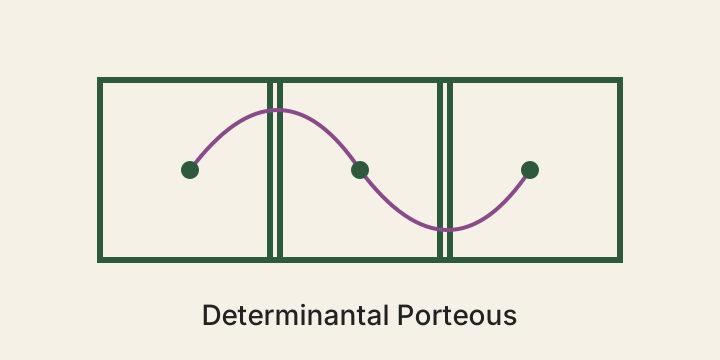
The Porteous formula gives the "size" (homology class) of the degeneracy locus as a polynomial in the Chern classes of the two bundles.
Worked example [Beginner]
On a smooth projective curve of genus , let (the rank-2 product bundle) and (the canonical line bundle). A section of gives a map by , and the degeneracy locus where is the divisor of zeroes .
The rank-drop locus has codimension 1. By the Porteous formula (for , , ): the class is . This recovers the familiar degree of the canonical divisor.
Check your understanding [Beginner]
Formal definition [Intermediate+]
Let be a smooth projective variety, and let and be vector bundles on of ranks and respectively, with a morphism .
Definition (determinantal variety). For a field and integers with , the determinantal variety is the variety of matrices of rank at most . It is defined by the vanishing of all minors. Its codimension is .
Definition (degeneracy locus). The -th degeneracy locus of is $$ D_k(\phi) := {x \in X : \mathrm{rank}(\phi_x) \leq k}. $$ This is the pullback of under the bundle map . When (the expected codimension), is a determinantal scheme with a natural scheme structure via the Fitting ideal.
Theorem (Porteous formula). If the degeneracy locus has the expected codimension in , then its fundamental class in the Chow group $A^(X)$ is* $$ [D_k(\phi)] = \Delta_{m-k}(c(F - E)) \in A^{(m-k)(n-k)}(X), $$ where denotes the determinant of the matrix formed from the Chern classes of the virtual bundle : $$ \Delta_j = \det \begin{pmatrix} c_{n-k+1} & c_{n-k+2} & \cdots \ c_{n-k} & c_{n-k+1} & \cdots \ \vdots & & \ddots \end{pmatrix} $$ with (setting and for ).
Counterexamples to common slips.
- The formula requires expected codimension. If (excess intersection), the Porteous formula gives a lower bound, not equality. Excess-intersection formulas (Fulton's residual scheme) are needed.
- Virtual Chern classes. The Chern class is defined as in the Chow ring, not by subtracting individual Chern classes.
- Determinant of a Toeplitz matrix. The Schur determinant is a determinant of a matrix whose entries are Chern classes, not a single Chern class.
Key theorem with proof [Intermediate+]
Theorem (Porteous formula). Let be a morphism of vector bundles of ranks and on a smooth variety . If has the expected codimension , then in .
Proof (sketch, following Kempf-Laksov 1974).
Step 1: Reduction to the Grassmannian. Pull back to the Grassmannian bundle parametrising -dimensional subspaces of the fibres of . On there is a universal exact sequence where is the universal subbundle of rank and is the universal quotient of rank .
Step 2: Degeneracy condition. The map drops rank to at iff there exists a nonzero section of in the kernel of , which happens iff the image of restricted to vanishes. This defines a section of the bundle on : the zero locus of is the total transform of .
Step 3: Porteous class. The class of the zero locus of in is the top Chern class . Pushing forward to via the projection and applying the Grothendieck formula for Chern classes of tensor products with the universal subbundle gives the Schur determinant .
Step 4: Expected-codimension hypothesis. When has the expected codimension, the pullback to has the expected codimension . The pushforward preserves the class, and the Grothendieck-Riemann-Roch computation gives the Porteous determinant.
Bridge. The Porteous formula is the intersection-theoretic engine behind three results in the Brill-Noether theory of curves. The first is the determinantal structure of the Brill-Noether locus , which is the degeneracy locus of the evaluation map on the Poincaré bundle 04.04.08, whose expected dimension comes directly from the Porteous codimension formula. The second is the Plucker formulas for branched covers, which compute the number of ramification points of a given order using the Porteous formula applied to the jet bundles of the covering map, generalising the Hurwitz formula 04.04.02. The third is the Fulton-Lazarsfeld connectedness theorem 04.04.15, which uses the Porteous formula to prove that degeneracy loci of ample vector bundle maps are connected when the expected codimension equals the dimension of the base, building on the cohomological framework from sheaf cohomology 04.03.01.
Exercises [Intermediate+]
Advanced results [Master]
Kempf-Laksov proof. The Kempf-Laksov proof (1974) uses the Grassmannian bundle construction described in the Key theorem section. The key innovation is the identification of the degeneracy locus with the zero locus of a section of the tensor product on the Grassmannian bundle, reducing the Porteous formula to a computation of the top Chern class of a tensor product.
Giambelli formula. The Porteous determinant is a specialisation of the Giambelli formula for Schur polynomials. The Schur polynomial corresponding to the partition (a rectangular partition) is the Porteous class. This connects degeneracy loci to the representation theory of .
Thom-Porteous formula for singular maps. The original context of Porteous' 1971 paper was the classification of singularities of smooth maps between manifolds. The degeneracy locus where the differential of a map drops rank is computed by the Thom-Porteous formula, and the resulting cohomology class controls the Euler class of the map's singular set.
Plucker formulas as Porteous computations. The Plucker formulas for branched covers — computing the number of ramification points of each order in terms of the degree, genus, and branching data — are special cases of the Porteous formula applied to the jet bundles of the covering map .
Fulton-Lazarsfeld applications. The Porteous formula is the computational tool behind the Fulton-Lazarsfeld connectedness theorem 04.04.15: the non-negativity of the Porteous class for ample vector bundles guarantees that the degeneracy locus is non-empty and connected when the expected codimension equals the dimension.
Synthesis. The Porteous formula is the universal cohomological tool for computing degeneracy loci of bundle maps, sitting at the intersection of four frameworks. The first is the determinantal geometry of rank conditions on matrices, where the expected codimension comes from the ideal generated by minors. The second is the Chern-class computation via the Grassmannian bundle construction, using the universal subbundle and the Grothendieck formula for tensor-product Chern classes. The third is the Brill-Noether application where is a Porteous degeneracy locus, with the Brill-Noether number equal to the expected dimension from the Porteous codimension formula 04.04.08. The fourth is the Fulton-Lazarsfeld positivity where the non-negativity of the Schur determinant for ample bundles implies connectedness and non-emptiness of degeneracy loci 04.04.15, a theme that reappears in Lazarsfeld's K3 proof 04.04.16.
Full proof set [Master]
The proof of the Porteous formula via the Kempf-Laksov construction is given in the Key theorem section. An alternate proof uses the Thom construction: the degeneracy locus is the pullback of the universal determinantal variety under the classifying map . The fundamental class in the Chow ring of the matrix space is computed by the Giambelli formula as the Schur polynomial . Pulling back via and using the naturality of Chern classes gives .
Connections [Master]
Petri map
04.04.08— the Brill-Noether locus is a determinantal variety via the Poincaré bundle evaluation map; the Petri map controls the tangent space, and Porteous controls the expected dimension.Sheaf cohomology
04.03.01— the cohomological framework for the evaluation map on the Poincaré bundle, and the dimension of the degeneracy locus, both rely on the cohomology of line bundles on curves.Fulton-Lazarsfeld
04.04.15— the Porteous formula gives the fundamental class of the degeneracy locus; the Fulton-Lazarsfeld theorem proves this locus is connected for ample bundles.Hurwitz formula
04.04.02— the Plucker formulas (degeneracy-locus computations via Porteous applied to jet bundles) generalise Hurwitz to higher-order ramification data.Lazarsfeld K3 proof
04.04.16— the restriction theorem for vector bundles on K3 surfaces, whose proof uses the Porteous formula to control the degeneracy loci that appear in Lazarsfeld's argument.
Historical & philosophical context [Master]
Ian Porteous stated the formula bearing his name in the 1971 paper Simple singularities of maps (Springer LNM 192) [Porteous 1971]. Porteous was motivated by the singularity theory of smooth maps and the classification of Thom-Boardman singularities. The determinantal formula for the cohomology class of a rank-drop locus was the key computational tool.
George Kempf and Dan Laksov (1974) gave the modern algebraic-geometric proof using Grassmannian bundles [Kempf-Laksov 1974], which is the standard reference. William Fulton systematised the theory in Intersection Theory (1984), Ch. 14, giving the most general statement and proof.
The philosophical content: the Porteous formula is the "quadratic formula of intersection theory." Just as the quadratic formula gives the roots of a polynomial in terms of its coefficients, the Porteous formula gives the class of a degeneracy locus in terms of the Chern classes of the bundles involved. It converts a geometric condition (rank drop) into a numerical computation (Schur determinant of Chern classes).
Bibliography [Master]
- Porteous, I.R. (1971). Simple singularities of maps. Springer LNM 192. [Originator paper.]
- Kempf, G.; Laksov, D. (1974). Determinantal formulas. Ark. Mat. 12, 255-261. [Grassmannian-bundle proof.]
- Fulton, W. Intersection Theory. Springer, Ch. 14. [Standard reference.]
- Harris, J. Algebraic Geometry: A First Course. Springer GTM 133, Ch. 12 and 14. [Accessible treatment.]