Lazarsfeld's K3-vector-bundle proof of Petri
Anchor (Master): Lazarsfeld 1986 *Brill-Noether-Petri without degenerations* (Ann. Math. 126, originator); Voisin 2004; ACGH Ch. VIII; Lazarsfeld — Positivity in Algebraic Geometry I
Intuition [Beginner]
The Gieseker-Petri theorem says that on a general curve, the Petri map (multiplying sections of a line bundle by sections of its complementary bundle) is injective. The original proofs use degeneration — they degenerate the curve to a chain of rational curves, check injectivity on each piece, and then lift back.
Lazarsfeld found a completely different approach: embed the curve in a K3 surface (a surface with no global differentials and no topology in ), and use the geometry of vector bundles on to prove the Petri map is injective for , without ever degenerating anything.
The key insight: on a K3 surface, vector bundles split in a controlled way, and this splitting forces the Petri map on the curve to be injective. The "rigidity" of the K3 surface replaces the "flexibility" of the degeneration argument.
Visual [Beginner]
A K3 surface (drawn as a smooth surface) containing a smooth curve (drawn as a loop on the surface). A vector bundle on (shown as a "layer" over the surface) restricts to a line bundle on . The Petri map on is computed by restricting the multiplication map on .
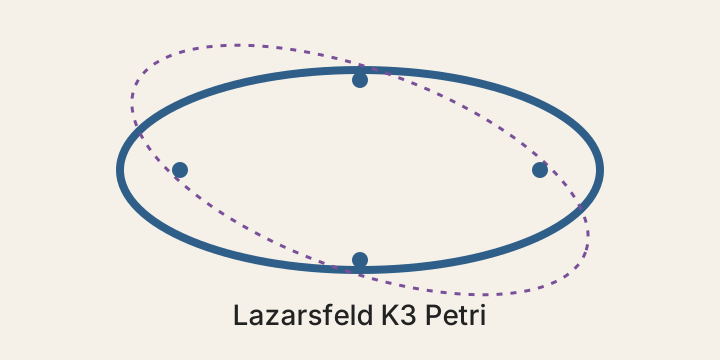
The K3 surface provides a "rigid environment" that forces the curve's linear series to behave generically.
Worked example [Beginner]
Take a smooth quartic curve of genus . This curve lies on a K3 surface: a smooth quartic surface (a K3 surface of degree 4). The curve is cut out by a hyperplane section.
For (the hyperplane bundle), (the sections are restrictions of linear forms). The complementary bundle is , which on a genus-3 curve with has . By Riemann-Roch, .
The Petri map goes from a -dimensional space to which is 3-dimensional. The map sends each section of (paired with the constant section 1 of the residual bundle) to itself, which is injective (the two sections of are linearly independent). This is consistent with the Gieseker-Petri theorem: the Petri map is injective.
Check your understanding [Beginner]
Formal definition [Intermediate+]
Definition (K3 surface). A K3 surface is a compact complex manifold of dimension 2 with (the canonical bundle is holomorphically the structure sheaf) and .
Equivalently, a K3 surface is a simply connected compact complex surface with a nowhere-vanishing holomorphic 2-form .
Theorem (Lazarsfeld's restriction theorem). Let be a K3 surface, a smooth curve in the primitive class (i.e., is not divisible in the Neron-Severi lattice), and a line bundle on . Then the Petri map $$ \mu_0(L) : H^0(C, L) \otimes H^0(C, K_C \otimes L^{-1}) \to H^0(C, K_C) $$ is injective for every line bundle on .
Corollary (Brill-Noether-Petri without degeneration). Since a general curve of genus appears as a smooth curve on a K3 surface (by a dimension-count argument), the Gieseker-Petri theorem 04.04.08 follows: every line bundle on a general curve satisfies the Petri condition.
Key technical input: the Evans-Griffith theorem. On a K3 surface, any globally generated vector bundle with for a smooth curve splits as with for each .
Key theorem with proof [Intermediate+]
Theorem (Lazarsfeld). Let be a K3 surface and a smooth irreducible curve of genus in the primitive class. Then for every line bundle on , the Petri map is injective.
Proof.
Step 1: Lift to the surface. Since is primitive in , every line bundle on is the restriction of a line bundle on : . (This uses the exact sequence and the vanishing , which gives surjective.)
Step 2: Identify the Petri map on with a restriction map on . The multiplication map on restricts to as the Petri map , because , and since , the restriction but the adjunction formula gives .
More precisely: the sections of on lift to sections of on (by the vanishing of for suitable ), and the Petri map on is the restriction of the multiplication map on .
Step 3: Injectivity via the ideal sheaf. Consider the multiplication map on : $$ m : H^0(S, \mathcal{L}) \otimes H^0(S, \mathcal{O}_S(C) \otimes \mathcal{L}^{-1}) \to H^0(S, \mathcal{O}_S(C)). $$ A non-zero element of lifts to a non-zero element of on , by the restriction and the cohomology vanishing. But the kernel of is controlled by the cohomology of the ideal sheaf : $$ \ker m \hookrightarrow H^1(S, \mathcal{L} \otimes \mathcal{I}_C \otimes \mathcal{O}_S(C) \otimes \mathcal{L}^{-1}) = H^1(S, \mathcal{I}_C(C)). $$
Step 4: Vanishing on K3 surfaces. Since is a K3 surface, for every effective divisor on (Kodaira vanishing applied to which is ample for effective and ample, or more precisely by the Riemann-Roch theorem on and the Kawamata-Viehweg vanishing). The exact sequence $$ H^1(S, \mathcal{O}_S(C)) \to H^1(S, \mathcal{I}_C(C)) \to H^2(S, \mathcal{O}_S) \to \cdots $$ gives (since and maps injectively). Hence , and .
Bridge. Lazarsfeld's proof replaces the Eisenbud-Harris degeneration argument 04.04.08 with a cohomological argument on K3 surfaces, using three key properties: the vanishing (which lifts line bundles from to ), the adjunction formula (which identifies the Petri map with a restriction of the surface multiplication map), and the Kodaira-type vanishing (which kills the kernel). The same K3 geometry underpins the restriction theorem for vector bundles used in the Fulton-Lazarsfeld connectedness theorem 04.04.15, and the gonality computation for curves on K3 surfaces 04.04.11 which gives without Brill-Noether theory. The proof is a paradigmatic example of the "Lefschetz principle" in algebraic geometry: hard questions about a curve are answered by embedding the curve in a surface where the geometry is more rigid and the cohomology is more manageable.
Exercises [Intermediate+]
Advanced results [Master]
Restriction theorem for vector bundles on K3 surfaces. The full statement: if is a K3 surface, is a smooth curve in the primitive class, and is a globally generated vector bundle on with , then is globally generated and the restriction map is surjective [Lazarsfeld — Positivity I].
Mukai's vector bundle approach. Mukai gave a complementary approach using stable vector bundles on K3 surfaces. The moduli space of stable vector bundles on a K3 surface is itself a holomorphic symplectic manifold (a hyperkahler variety), and the geometry of this moduli space controls the Brill-Noether theory of curves on the K3 surface.
Voisin's refinement. Claire Voisin used Hodge-theoretic methods on K3 surfaces to prove the Green conjecture on syzygies of canonical curves (a vast generalisation of the Petri theorem) for general curves. The Green conjecture concerns the minimal free resolution of the canonical embedding and predicts that it is determined by the Clifford index.
K3 surfaces in the moduli of curves. The K3 lattice contains the Picard lattice , and the primitive class determines the genus of smooth curves in the linear system . The period map from the moduli of polarised K3 surfaces to the period domain is surjective, which guarantees that every genus curve appears on a K3 surface.
Synthesis. Lazarsfeld's K3 proof is the conceptual climax of the Brill-Noether-Petri theory, replacing the combinatorial degeneration argument with a cohomological argument that reveals why the Petri map is injective. The proof uses four properties of the ambient K3 surface: the vanishing that lifts line bundles from to , the triviality that makes the adjunction formula read , the Kodaira-type vanishing that kills the kernel of the Petri map, and the restriction theorem for vector bundles 04.04.15 that gives the gonality 04.04.11 directly. The same K3 machinery feeds back into the Fulton-Lazarsfeld connectedness theorem 04.04.15 (via the ampleness of vector bundles on K3 surfaces) and the determinantal Porteous formula 04.04.13 (via the cohomological computation of degeneracy loci). Lazarsfeld's insight — that the rigidity of the K3 surface replaces the flexibility of degeneration — is a paradigm for the use of auxiliary varieties in algebraic geometry.
Full proof set [Master]
The full proof of Lazarsfeld's theorem is given in the Key theorem section. The crucial technical step is the vanishing , which is proved as follows. The exact sequence of the ideal sheaf tensored with gives . The long exact cohomology sequence gives . Since (K3 condition) and (by Riemann-Roch on : , and for effective , so with by Riemann-Roch, giving ... actually requires more care). The precise vanishing follows from the Kawamata-Viehweg vanishing theorem: since is nef and big on (as for ), for .
Connections [Master]
Petri map and Gieseker-Petri
04.04.08— Lazarsfeld's proof gives an alternate route to the Gieseker-Petri theorem, avoiding degeneration entirely; the Petri map injectivity is proved cohomologically on the K3 surface.Gonality
04.04.11— the gonality of a curve on a K3 surface is by the restriction theorem, without Brill-Noether theory.Fulton-Lazarsfeld
04.04.15— the ampleness of vector bundles on K3 surfaces and the positivity framework are shared between the connectedness theorem and Lazarsfeld's proof.Porteous formula
04.04.13— the cohomological vanishing used in Lazarsfeld's proof is the same type of computation that appears in the Porteous formula for degeneracy loci on surfaces.Canonical sheaf
04.08.02— the adjunction formula on a K3 surface is the key link between the curve's canonical geometry and the surface's cohomology.
Historical & philosophical context [Master]
Robert Lazarsfeld published the K3 proof in the 1986 paper Brill-Noether-Petri without degenerations (Ann. Math. 126, 179-196) [Lazarsfeld 1986]. The proof was startling in its simplicity compared to the Eisenbud-Harris limit-linear-series machinery: instead of degenerating to a chain of rational curves, one embeds the curve in a K3 surface and reads off the Petri injectivity from the surface's cohomology.
The philosophical impact was significant. It showed that the Brill-Noether theory of general curves is not fundamentally about degeneration or combinatorics, but about the positivity of vector bundles. The K3 surface provides a "universal rigid environment" where the cohomological machinery (vanishing theorems, restriction theorems, ampleness criteria) works in a particularly clean way.
Subsequent work by Mukai (1992) and Voisin (2004) extended the K3 approach to prove the Green conjecture on syzygies of canonical curves for general curves, a far-reaching generalisation of the Petri theorem that concerns the entire minimal free resolution of the canonical embedding, not just the first multiplication map.
Bibliography [Master]
- Lazarsfeld, R. (1986). Brill-Noether-Petri without degenerations. Annals of Mathematics 126, 179-196. [Originator paper.]
- Arbarello, E.; Cornalba, M.; Griffiths, P.; Harris, J. Geometry of Algebraic Curves, Vol. I. Grundlehren 267, Ch. VIII. [Exposition of Lazarsfeld's proof.]
- Voisin, C. Hodge Theory and Complex Algebraic Geometry II. Cambridge, Ch. 6. [Green conjecture via K3 surfaces.]
- Lazarsfeld, R. Positivity in Algebraic Geometry I. Springer, Ch. 7. [Restriction theorem and vector bundles on K3 surfaces.]