Lefschetz (1,1)-theorem
Anchor (Master): Lefschetz 1924 *L'analysis situs et la géométrie algébrique*; Griffiths-Harris §1.2; Voisin I §7.1; Deligne *Théorie de Hodge II* (mixed Hodge structures backdrop)
Intuition [Beginner]
The Lefschetz (1,1)-theorem is a precise bridge between two pictures of a complex algebraic surface — or any smooth projective complex variety. On one side stands the topology: the second cohomology group with integer coefficients, , an abelian group attached to the underlying space. On the other side stands the algebra: the Picard group , the set of holomorphic line bundles up to isomorphism. The theorem identifies exactly which topological classes come from holomorphic line bundles, and the answer is sharp.
Take a class in . Sitting inside the complex cohomology, it lands somewhere in the Hodge decomposition . Lefschetz's 1924 monograph proved: an integer class is the first Chern class of a holomorphic line bundle if and only if it sits inside the -piece. Holomorphy is detected exactly by being purely -type.
This is the codimension-one case of the Hodge conjecture — and unlike the higher-codimension cases, this one is a theorem, not a conjecture. The 1924 proof predates the Hodge decomposition by 17 years; Lefschetz worked with periods and Poincaré residues. The modern proof, via the exponential sequence, is a five-line cohomology calculation that organises the entire subject.
Visual [Beginner]
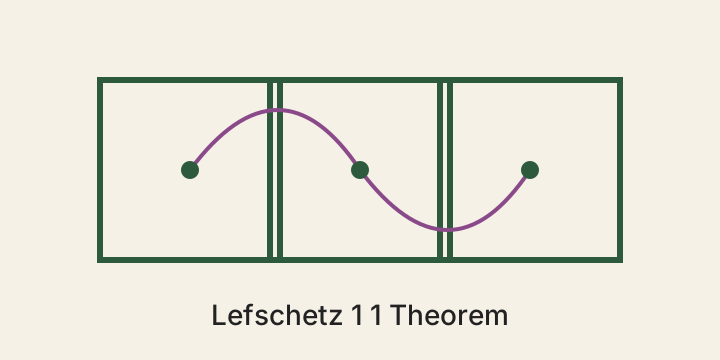
A smooth projective complex surface with its Hodge decomposition of displayed as the middle row of the Hodge diamond — three pieces — and an integer cohomology class projected onto the component, where it must land if and only if it represents a holomorphic line bundle.
Worked example [Beginner]
Take , the complex projective plane.
Step 1. Compute the cohomology. , generated by the class of a line. The Hodge diamond of has , , , so .
Step 2. Identify the Picard group. Every line bundle on is for some integer , so , with the generator having first Chern class .
Step 3. Check the theorem. Every integer class in sits inside — because is already all of . So every integer class is the Chern class of a line bundle (). The theorem is verified, and the conclusion is the strongest possible: on the natural map is an isomorphism.
What this tells us: on projective space every integer cohomology class in degree 2 represents a holomorphic line bundle, because the Hodge diamond of has the entire degree- cohomology already concentrated in bidegree .
Check your understanding [Beginner]
Formal definition [Intermediate+]
Throughout this section let be a smooth projective complex variety, equipped with its underlying compact Kähler structure.
The first Chern class map. A holomorphic line bundle on determines an isomorphism class . The first Chern class is a homomorphism
constructed via the exponential sheaf sequence (below) as the connecting map in cohomology, or equivalently via the curvature of any Hermitian connection on .
The Hodge filtration on . The Hodge decomposition (see 04.09.01) gives
Define the Hodge classes of type as the integer classes that sit in the -piece:
This is the subgroup of integer classes whose image in complex cohomology lies purely in the -piece — equivalently, whose and components vanish.
Theorem (Lefschetz (1,1)-theorem). Let be a smooth projective complex variety. The first Chern class map factors through the subgroup of -Hodge classes,
and the image equals exactly . The kernel of is the connected component of the identity in — namely , a complex torus of dimension .
Néron-Severi group. The image of is the Néron-Severi group . Combined with the (1,1)-statement,
The rank of is the Picard number ; it is a positive integer bounded by . The torsion part of matches the torsion of .
Counterexamples to common slips [Intermediate+]
- Slip: "every integer class is algebraic on a projective variety." False. On a generic abelian surface , but can have rank 1, leaving most of the rank-6 lattice outside the Hodge -locus.
- Slip: "the (1,1)-theorem holds for any compact complex manifold." False. A non-Kähler compact complex manifold lacks the Hodge decomposition; the exponential sequence connecting map is still defined, but the image of need not equal the lattice of -classes, and even the right-hand side is not canonically defined without a Hodge decomposition.
- Slip: "the (1,1)-theorem says ." False — this would forget the kernel . The correct statement is that the quotient equals .
- Slip: "Hodge classes of type live in alone." False — they are the integer-cohomology classes which happen to project entirely into when complexified. They live in ; their image in lies in .
Key theorem with proof [Intermediate+]
Theorem (Lefschetz (1,1)). On a smooth projective complex variety , the first Chern class map has image equal to .
Proof. The proof uses the exponential sheaf sequence on the complex manifold :
where is the constant sheaf, is the sheaf of holomorphic functions, is the sheaf of nowhere-vanishing holomorphic functions under multiplication, and the map sends . The kernel of is the discrete subgroup , identifying the leftmost term.
The associated long exact sequence in sheaf cohomology gives
The middle group is canonically the Picard group: a Čech 1-cocycle with values in is exactly the transition data of a holomorphic line bundle. The connecting map sends a line bundle to a class in — and this connecting map is the first Chern class:
So the image of is exactly the kernel of the next map, , induced by the inclusion . Equivalently,
It remains to identify this kernel with . Consider the composite
where the first map is extension of scalars and the second is the projection onto the -component of the Hodge decomposition. The final identification is the Dolbeault isomorphism (the -piece of the Hodge decomposition is Čech sheaf cohomology of ).
A diagram chase using the compatibility of the exponential sequence with the Hodge filtration shows that the map from the long exact sequence agrees with this composite. Hence
By Hodge symmetry, , so an integer class — being its own complex conjugate — has if and only if . Combined with , the vanishing of both and components is equivalent to , that is, .
Therefore , completing the proof.
Bridge. This identifies with as lattices, and builds toward the broader Hodge conjecture: the foundational reason the codimension-one case is settled is that is the lowest-bidegree Hodge piece where the conjecture has bite, and the exponential sequence supplies a direct geometric witness — the line bundle itself — for every Hodge class. The central insight is that this is exactly the structural mechanism the Hodge conjecture lacks in higher codimension: there is no analogous "exponential sequence" producing subvarieties of codimension from Hodge classes. The pattern appears again in 04.05.09 as the Hodge index theorem on a surface, where the signature of the intersection form on controls the Néron-Severi geometry, and the bridge is to 04.05.02 Picard group, whose connected-component decomposition is now fully indexed by the Hodge filtration.
Exercises [Intermediate+]
Lean formalization [Intermediate+]
lean_status: partial — Mathlib has sheaf cohomology, exponential sheaf sequences, and the Picard group as a category-theoretic invariant; the precise statement that the image of on a smooth projective complex variety equals the integer-Hodge -classes requires the full Hodge decomposition, which is not yet a named Mathlib theorem. The Lean module below states the (1,1)-theorem and the exponential connecting map at the level Mathlib can currently support, with the substantive cohomological identifications stubbed via sorry.
-- Codex.AlgGeom.Hodge.LefschetzOneOne
-- Companion Lean file for 04.09.09 Lefschetz (1,1)-theorem.
-- See lean/Codex/AlgGeom/Hodge/LefschetzOneOne.lean.
Advanced results [Master]
Proof via the exponential sequence and the Hodge decomposition
The mechanism of the (1,1)-theorem repays a second look. The exponential sequence is the load-bearing input: it lives on any complex manifold, with the structure sheaf and the units in multiplication. The induced long exact sequence in sheaf cohomology produces a connecting map , and Čech cocycles in are exactly the transition functions of a line bundle — so on .
The image of is the kernel of the next map . The Hodge decomposition identifies with via the Dolbeault isomorphism, and the inclusion on cohomology corresponds — after complexification — to the projection onto the -component of the Hodge filtration. An integer class has vanishing -component if and only if it has vanishing -component (by complex conjugation, since the class is real), so the kernel is .
This argument is the model for the Hodge conjecture in higher codimension: produce a geometric object (a line bundle, a divisor, a cycle) from a Hodge class via a connecting map of an appropriate short exact sequence. The (1,1)-case works because is intrinsically a sheaf — line bundles are local, gluing data lives in , and the exponential supplies the bridge to integer cohomology. The higher-codimension case has no analogue.
The Néron-Severi group and algebraic equivalence
The image admits an algebraic-geometric description that predates the (1,1)-theorem: the Néron-Severi group is , where is the connected component of the identity in the Picard scheme. Two line bundles are algebraically equivalent if ; the Néron-Severi group is modulo algebraic equivalence.
Theorem (Néron-Severi, 1952): is a finitely generated abelian group. Severi proved the rank finiteness in 1908; Néron gave the full finitely-generated statement in 1952. The torsion subgroup of matches the torsion of (provided is smooth projective).
Two line bundles can be numerically equivalent — having the same intersection numbers against all curves — but not algebraically equivalent. The quotient of by numerical equivalence is the Néron-Severi lattice , often denoted . For surfaces — algebraic equivalence and numerical equivalence agree modulo torsion (Matsusaka 1957).
The Hodge conjecture in degree (1,1) is the Lefschetz theorem — higher degree remains the genuine open problem
Lefschetz's 1924 result is the codimension-one case of what is now called the Hodge conjecture. Hodge's 1950 ICM lecture conjectured the natural generalisation: for smooth projective complex and , every class in
is a -linear combination of fundamental classes of codimension- algebraic subvarieties. The case follows from Lefschetz (1,1) by passing to -coefficients: every line bundle has the form for a divisor , so , the fundamental class of .
The case is the genuine open problem. Atiyah-Hirzebruch (1962) gave counterexamples to the integral version (using torsion classes that cannot be algebraic); Voisin (2007, Comment. Math. Helv. 82) gave counterexamples even modulo torsion to integral coefficients, confirming the necessity of working with -coefficients. Known cases of the rational Hodge conjecture include: abelian varieties of dimension (Tate); abelian varieties of CM type (Pohlmann, Tate); the Hodge-Tate part of (Buskin, with Mukai's contributions); uniruled threefolds (Conte-Murre 1978); various explicit Calabi-Yau and Fano examples. The general conjecture is one of the Clay Millennium Prize Problems and remains a central open question of algebraic geometry.
Worked examples — projective space, K3 surfaces, abelian varieties
Projective space . for all , so in full. Every integer cohomology class is the Chern class of a line bundle, and the surjection is an isomorphism. (no holomorphic 1-forms, so the Jacobian-type torus is a point). Picard number , the Hodge -class being , the hyperplane class.
K3 surfaces. A complex projective K3 surface has and . The lattice is a fixed rank-22 unimodular even lattice of signature (the "K3 lattice"), isomorphic to where is the hyperbolic plane. As the complex structure varies in the moduli of K3 surfaces, the position of inside rotates, and the lattice of integer Hodge -classes jumps in rank — generically rank (non-algebraic K3), rank for an algebraic K3 of Picard number 1, up to rank 20 for singular K3 surfaces (Shioda-Inose 1977 classified those of maximal Picard number). The Lefschetz (1,1)-theorem gives the entire structure of for any K3.
Abelian varieties. For an abelian variety of dimension , and . The Hodge structure is determined by the complex structure on the universal cover : where and is the conjugate. In particular and — the space of Hermitian forms on . The Lefschetz (1,1) integer classes correspond to Riemann forms: integer-valued alternating forms that are compatible with the complex structure (). The line bundle attached to a Riemann form is the theta line bundle; its sections are theta functions. The Picard number measures the dimension of the space of Riemann forms — for a generic abelian variety , for a product of elliptic curves with CM .
Hodge index theorem on a surface. On a smooth projective complex surface , the intersection form on has signature on the primitive part with respect to the Kähler class. This is the Hodge index theorem 04.05.09, a corollary of the Hodge-Riemann bilinear relations and the (1,1)-theorem combined.
Higher-dimensional analogues — the Hodge conjecture is the genuine open problem
The natural higher-degree analogue: define as the lattice of integer Hodge classes of bidegree . Is every element of a -linear (or after Voisin 2007, a -linear) combination of fundamental classes of codimension- subvarieties?
For , the answer is YES — this is Lefschetz (1,1) — and the geometric witness is the line bundle. For , the answer modulo is unknown in general. Some progress is via motives (Grothendieck, Deligne, Voevodsky): if one can prove the Hodge conjecture for the algebraic motive of , the conjecture follows. The standard conjectures of Grothendieck (1968) imply the Hodge conjecture; both are open.
A second line of attack is via the Mumford-Tate group of a Hodge structure: the smallest algebraic subgroup of defined over whose real points contain the Hodge filtration. For abelian varieties, knowing the Mumford-Tate group determines the rational Hodge classes — and known computations of Mumford-Tate groups give all known cases of the Hodge conjecture for abelian varieties (Tate, Pohlmann, André).
The Lefschetz (1,1)-theorem is the witness statement of the conjecture in codimension 1; the codimension case is the central open problem, and the gap is the absence of a higher-codimension exponential sequence — equivalently, the absence of a geometric witness functor from Hodge classes to algebraic cycles.
Synthesis. The Lefschetz (1,1)-theorem is the foundational reason the Hodge conjecture has a complete answer in codimension one: the exponential sequence supplies a connecting map whose image identifies with the integer Hodge -lattice, and the central insight is that this connecting map's image is exactly the Picard group's discrete quotient . Putting these together with the Hodge decomposition, the structure factors: splits the line-bundle data into a continuous complex-torus part (the Jacobian-type quotient ) and a discrete arithmetic part (the lattice of integer Hodge -classes). This is exactly the structure that builds toward 04.05.09 Hodge index theorem on a surface — where the signature of the intersection form on is determined by Hodge-Riemann positivity — and the bridge is to the broader Hodge conjecture [open].
The pattern recurs in two ways. First, it identifies with as lattices — algebraic geometry and Hodge theory agree completely in codimension one. Second, it generalises by analogy in higher codimension: replace line bundles by codimension- cycles modulo rational equivalence, replace the exponential sequence by a hypothetical higher-degree analogue, and ask whether the cycle-class map remains surjective. The pattern recurs again in p-adic Hodge theory, where the analogous question — image of crystalline cycle classes inside crystalline cohomology — drives the standard conjectures and the Fontaine-Mazur programme.
Full proof set [Master]
Proposition 1 (exponential connecting map = first Chern class). On any complex manifold , the connecting map $\delta: H^1(X; \mathcal{O}_X^) \to H^2(X; \mathbb{Z})c_1\mathrm{Pic}(X) = H^1(X; \mathcal{O}_X^)$.
Proof. A line bundle on is determined by its transition functions: choose a cover of that trivialises , with isomorphisms . On the composite is multiplication by a nowhere-vanishing holomorphic function . The collection satisfies the cocycle condition on , so it defines a class in once the cover is refined.
To apply the connecting map, choose a local lift: on each pick a branch with . Such a lift exists if is simply connected (refine the cover). The Čech coboundary satisfies , so for each . The class is the connecting-map image of .
To identify this with , recall the curvature description: choose a Hermitian metric on and let be the Chern connection; the curvature is a -form, and represents in real (in fact -type) de Rham cohomology. A direct computation in local trivialisations shows the de Rham class of equals the image of under . The standard identification of the Čech connecting map with the topological via the comparison theorem between Čech and singular cohomology completes the identification.
Proposition 2 (Lefschetz (1,1)-theorem, full statement). Let be a smooth projective complex variety. The image of equals . The kernel of is the connected component , a complex torus of dimension .
Proof. The image-equals--lattice statement is proved in the Key Theorem section above via the exponential sequence and the Hodge decomposition. The kernel identification follows from the same long exact sequence:
Exactness at gives . The map is the composition , where the second arrow projects onto via the Dolbeault isomorphism.
The image is a discrete lattice of rank inside the complex vector space of complex dimension . The quotient is therefore a complex torus of complex dimension — for a smooth projective curve, this is the Jacobian; in general it is the Picard variety , dual to the Albanese variety via the Hodge-theoretic duality .
Proposition 3 (Néron-Severi finite generation). For any smooth projective complex variety , the group is a finitely generated abelian group.
Proof. By Proposition 2, . The group is finitely generated (singular cohomology of a compact CW complex with finite cell decomposition), so its subgroup is also finitely generated. The structure theorem for finitely generated abelian groups gives for a finite torsion subgroup and the Picard number . The torsion subgroup of matches the torsion of provided has no torsion (always the case since is a complex torus).
Proposition 4 (Picard number bound). For smooth projective complex, .
Proof. From Proposition 2, . The Néron-Severi group is a lattice (the integer points of the real vector space ); its rank is bounded by the real dimension of , which equals the complex dimension (because is intrinsically a real subspace of — it is preserved by complex conjugation, being self-conjugate under with ).
Connections [Master]
Hodge decomposition
04.09.01. The Lefschetz (1,1)-theorem is the statement that one piece of the Hodge decomposition — specifically the -piece — captures all algebraic line-bundle information. The proof uses the Hodge decomposition essentially: identifying with and using the inclusion on cohomology to detect the -component of an integer class.Picard group
04.05.02. The (1,1)-theorem identifies with the integer-Hodge -classes. The Picard group decomposes as , with a complex torus of dimension and a finitely generated abelian group of rank at most .Hodge index theorem on a surface
04.05.09. On a smooth projective surface, the signature of the intersection form on is on the primitive part with respect to the Kähler class. This signature constraint is the combination of Lefschetz (1,1) — identifying with the Hodge -lattice — and the Hodge-Riemann bilinear relations.Line bundle
04.05.03. A line bundle has a first Chern class via the connecting map of the exponential sequence; Lefschetz (1,1) is the bijective characterisation of the image of .Sheaf cohomology
04.03.01. The exponential sequence is a short exact sequence of sheaves on ; the long exact sequence in sheaf cohomology supplies the connecting map .Kodaira vanishing
04.09.02. The cone of ample line bundles inside is a connected open subset; Kodaira vanishing applied to ample classes refines the (1,1)-theorem with a positivity constraint.ddbar-lemma
04.09.05. The ddbar-lemma is the form-level rigidity that makes the Hodge filtration on for a compact Kähler canonical, so the condition "integral class lies in " is well-defined as a cohomological statement. Without ddbar the (1,1)-theorem's hypothesis depends on the metric; with ddbar the algebraic-class criterion is intrinsic.Hard Lefschetz theorem
04.09.07. The (1,1)-theorem is the codimension-1 case of the Hodge conjecture, classifying integral algebraic classes in ; Hard Lefschetz organises the entire cohomology into the Lefschetz primitive decomposition and provides the structural framework for studying integral classes across all bidegrees, with being the lowest-dimensional case where the algebraicity question is fully resolved.Hodge-Riemann bilinear relations
04.09.08. The Hodge-Riemann relations polarise the Hodge structure on , and the Lefschetz (1,1)-theorem then identifies as a sublattice of the polarised weight-2 structure. The signature on the algebraic part follows by restricting the Hodge-Riemann polarisation to the integral -classes.Akizuki-Nakano vanishing theorem
04.09.10. Akizuki-Nakano vanishing supplies the cohomology-vanishing input that, combined with the exponential sequence, characterises which integral classes lift to line bundles; the case ( for ) controls the tangent-separation step that turns a (1,1)-class into an actual embedding.Kodaira embedding theorem
04.09.11. The Lefschetz (1,1)-theorem identifies integral -classes with line bundles; Kodaira embedding adds the positivity condition (the class is a Kähler class) and concludes that the variety embeds in projective space. The two theorems together produce the analytic-to-algebraic dictionary: positive integral -class ample line bundle projective embedding.
Historical & philosophical context [Master]
Solomon Lefschetz proved the (1,1)-theorem in his 1924 Paris monograph L'analysis situs et la géométrie algébrique (Gauthier-Villars, Paris; reprinted in Selected Papers, Chelsea 1971) [Lefschetz1924]. Lefschetz, born 1884 in Moscow and emigrated to the United States in 1905, worked in topology and algebraic geometry at Princeton and the University of Kansas. The 1924 monograph synthesised his earlier work on algebraic surfaces with the new topological methods of Poincaré: it introduced the Lefschetz fixed-point theorem, the Lefschetz pencil, and the proof of the (1,1)-theorem via Poincaré residues and period integrals.
Lefschetz's original argument predates the Hodge decomposition by 17 years. He worked with periods of differential forms — integrals of holomorphic 2-forms over 2-cycles on an algebraic surface — and used the Poincaré residue formula to identify the period matrix of a divisor with a specific bilinear pairing on . His statement, in modern translation: an integer class in is the cohomology class of a divisor if and only if its periods against all holomorphic 2-forms vanish — equivalently, the class lies in .
The modern proof via the exponential sequence is due to Hodge 1941 [Hodge1941] in The Theory and Applications of Harmonic Integrals (Cambridge University Press), where the Hodge decomposition itself was introduced. Hodge formulated the cohomological version: the connecting map has image equal to the integer-Hodge -classes. Griffiths-Harris (1978) [GriffithsHarris1978] §1.2 gives the now-standard textbook treatment combining the two perspectives.
Hodge's 1950 ICM lecture in Cambridge, Massachusetts, formulated the Hodge conjecture as the natural extension of the (1,1)-theorem to higher codimension. The conjecture proposes: for smooth projective complex and , the cycle-class map is surjective. The case is Lefschetz (1,1); the case remains open and has become one of the central problems of modern algebraic geometry — one of the Clay Mathematics Institute's Millennium Prize Problems (announced 2000).
The 20th-century history of the conjecture: Atiyah-Hirzebruch 1962 (Topology 1) showed the integral version (without tensoring with ) fails for torsion classes; Hodge had originally stated his conjecture with -coefficients, and Atiyah-Hirzebruch's torsion counterexamples forced the -coefficient restatement. Voisin 2007 (Comment. Math. Helv. 82, 387–402) [Voisin2007] strengthened this by constructing integer Hodge classes that are not in the image of the integral cycle-class map even modulo torsion, definitively ending the integer version.
Deligne's mixed Hodge theory (Théorie de Hodge II, III, Publ. Math. IHES 40 (1971), 44 (1974)) [Deligne1971] extended the framework to non-compact and singular varieties; the Lefschetz (1,1)-theorem reformulated in mixed Hodge structure language extends to the open / singular setting. Grothendieck's standard conjectures (1968) include the standard conjecture of Hodge type (Conjecture D), which implies the Hodge conjecture and remains open in characteristic 0 (it is true in characteristic via Deligne's proof of the Weil conjectures).
The conjecture has been settled in special cases: Tate 1965 on abelian varieties of CM type; Pohlmann 1968 for abelian varieties whose Hodge groups are tori; Conte-Murre 1978 for uniruled threefolds (Indag. Math.); Buskin 2019 (Crelle 754) for the Hodge classes on . The conjecture for products of two projective varieties has been studied via Mumford-Tate groups; André 1992 proved many cases for abelian varieties. The general Hodge conjecture, however, remains the genuine open problem — without a known mechanism analogous to the exponential sheaf sequence to produce algebraic cycles from Hodge classes in codimension .
Bibliography [Master]
@book{Lefschetz1924,
  author = {Lefschetz, Solomon},
  title = {L'analysis situs et la géométrie algébrique},
  publisher = {Gauthier-Villars},
  address = {Paris},
  year = {1924},
  note = {Reprinted in Selected Papers, Chelsea, 1971}
}

@book{Hodge1941,
  author = {Hodge, W. V. D.},
  title = {The Theory and Applications of Harmonic Integrals},
  publisher = {Cambridge University Press},
  year = {1941},
  edition = {2nd ed. 1952}
}

@book{GriffithsHarris1978,
  author = {Griffiths, Phillip and Harris, Joseph},
  title = {Principles of Algebraic Geometry},
  publisher = {Wiley-Interscience},
  year = {1978},
  note = {Chapter 1.2: exponential sheaf sequence, Picard group, Lefschetz (1,1)-theorem}
}

@book{VoisinHodgeI,
  author = {Voisin, Claire},
  title = {Hodge Theory and Complex Algebraic Geometry, I},
  publisher = {Cambridge University Press},
  year = {2002},
  series = {Cambridge Studies in Advanced Mathematics},
  volume = {76}
}

@article{Voisin2007,
  author = {Voisin, Claire},
  title = {Some aspects of the Hodge conjecture},
  journal = {Japanese Journal of Mathematics},
  volume = {2},
  year = {2007},
  pages = {261--296}
}

@article{Deligne1971,
  author = {Deligne, Pierre},
  title = {Théorie de Hodge II},
  journal = {Publications Mathématiques de l'IHÉS},
  volume = {40},
  year = {1971},
  pages = {5--57}
}

@article{Deligne1974,
  author = {Deligne, Pierre},
  title = {Théorie de Hodge III},
  journal = {Publications Mathématiques de l'IHÉS},
  volume = {44},
  year = {1974},
  pages = {5--77}
}

@article{AtiyahHirzebruch1962,
  author = {Atiyah, M. F. and Hirzebruch, F.},
  title = {Analytic cycles on complex manifolds},
  journal = {Topology},
  volume = {1},
  year = {1962},
  pages = {25--45}
}

@book{Mumford1970,
  author = {Mumford, David},
  title = {Abelian Varieties},
  publisher = {Oxford University Press},
  year = {1970},
  note = {Tata Institute Studies in Mathematics 5}
}

@article{Tate1965,
  author = {Tate, John},
  title = {Algebraic cycles and poles of zeta functions},
  booktitle = {Arithmetical Algebraic Geometry (Proc. Conf. Purdue Univ., 1963)},
  publisher = {Harper and Row},
  year = {1965},
  pages = {93--110}
}

@article{Grothendieck1968,
  author = {Grothendieck, Alexander},
  title = {Standard conjectures on algebraic cycles},
  booktitle = {Algebraic Geometry (Internat. Colloq., Bombay 1968)},
  publisher = {Oxford University Press},
  year = {1969},
  pages = {193--199}
}

@book{Beauville1996,
  author = {Beauville, Arnaud},
  title = {Complex Algebraic Surfaces},
  publisher = {Cambridge University Press},
  year = {1996},
  edition = {2nd},
  series = {London Mathematical Society Student Texts},
  volume = {34}
}