Algebraic torus and character/cocharacter lattices
Anchor (Master): Fulton §1.1; Cox-Little-Schenck §1.1; Borel *Linear Algebraic Groups* §III.8 (algebraic tori in the linear-algebraic-group framework); Demazure 1970 *Sous-groupes algébriques de rang maximum du groupe de Cremona*
Intuition [Beginner]
An algebraic torus is the multiplicative group — -tuples of nonzero complex numbers, multiplied coordinate-by-coordinate — viewed not just as a Lie group but as an algebraic variety, the open subset of on which every coordinate is nonzero. The single most important fact about this variety is that its symmetries — that is, its algebraic homomorphisms into and out of the one-dimensional torus — are classified by two copies of the integer lattice . One lattice records the maps out of (the characters); the other records the maps into (the one-parameter subgroups). The two lattices are dual: pair them and you get an integer.
Why bother? Because every piece of geometry built from an algebraic torus — affine toric varieties, fans, projective toric varieties, mirror polytopes — is encoded combinatorially in these two lattices and the duality between them. A polyhedral cone in one lattice produces an affine variety on which the torus acts; a fan of such cones glues them into a global variety. The lattice formalism turns the geometry of toric varieties into the combinatorics of polytopes, and the dictionary works because the characters and one-parameter subgroups of the torus are already integer-valued.
A second reason: the algebraic torus is the simplest shape-bearing algebraic group beyond affine space and the additive group. Every result about general algebraic groups specialises cleanly on a torus, and most of the structure theory of reductive algebraic groups (Borel, Chevalley, Demazure) is organised by maximal-torus data — the same characters and cocharacters that anchor toric geometry.
Visual [Beginner]
A schematic of the two-dimensional algebraic torus with two integer lattices drawn alongside it: the character lattice , whose points correspond to the Laurent monomial maps sending , and the cocharacter lattice , whose points correspond to the one-parameter subgroup maps sending . A double-arrow between the two lattices labelled with the dot-product pairing — the duality.
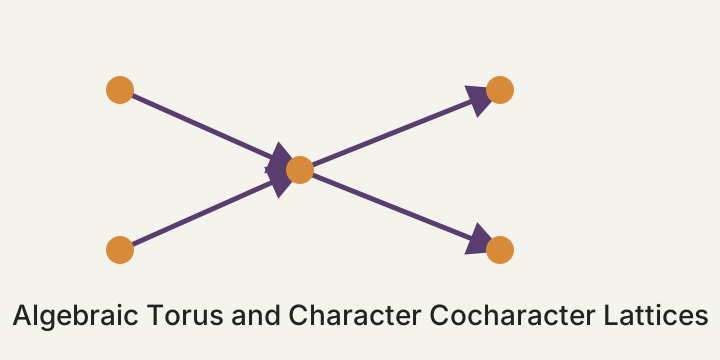
The picture captures the essential idea: the geometry of the torus is recorded by two integer lattices, and every fact about the torus translates into a fact about integer vectors and their dot product.
Worked example [Beginner]
Take the two-dimensional torus with coordinates . Pick a character — a Laurent monomial — and a one-parameter subgroup, and compute how they compose.
Step 1. The character is the map sending . It is determined by the integer pair in the character lattice .
Step 2. The one-parameter subgroup is the map sending . It is determined by the integer pair in the cocharacter lattice .
Step 3. Compose them: starting with , the one-parameter subgroup sends it to , and then the character sends that to . So .
Step 4. Cross-check with the integer pairing. The dot product of and is . The composition is exponentiation to the power of this dot product: . The exponent matches.
What this tells us. Composing a character and a one-parameter subgroup always produces a map , and every such map is exponentiation for some integer . That integer is the dot product of the character's integer label and the one-parameter subgroup's integer label. The pairing between the two integer lattices is the dot product, and it is the bookkeeping that makes the algebraic torus into a combinatorial object — two lattices with an integer pairing.
Check your understanding [Beginner]
Formal definition [Intermediate+]
Let be an algebraically closed field; in toric geometry one usually takes , and this development is written with for definiteness. All schemes are taken over .
Definition (algebraic torus). A split algebraic torus of dimension over is the affine algebraic group $$ T = (\mathbb{G}_m)^n = \mathrm{Spec},\mathbb{C}[x_1^{\pm 1}, \ldots, x_n^{\pm 1}], $$ whose underlying set of -points is with the coordinate-wise multiplication group structure, and whose group structure is encoded by the Hopf-algebra structure on the Laurent polynomial ring with comultiplication , counit , and antipode . The multiplicative group is the one-dimensional case . Throughout this unit, by "torus" we mean a split algebraic torus.
Definition (character). A character of is an algebraic group homomorphism . The set of characters, with operation given by pointwise multiplication of homomorphisms , is a commutative group, denoted and called the character lattice of .
Definition (cocharacter / one-parameter subgroup). A cocharacter, or one-parameter subgroup, of is an algebraic group homomorphism . The set of cocharacters, with operation given by pointwise multiplication in , is denoted and called the cocharacter lattice of .
Definition (pairing). The natural pairing sends a pair to the composition , which is necessarily for a unique integer , called .
Notation for the standard torus. For , write for the character corresponding to , defined as . Write for the cocharacter corresponding to , defined as . The natural pairing is then the integer dot product . After the structure theorem below, these notations exhibit and each as and the pairing as the dot product.
Counterexamples to common slips
The set-theoretic group has continuous and smooth automorphisms vastly more numerous than its algebraic automorphisms. The full group of continuous characters of the compact torus is also , but the route to that identification uses Pontryagin duality of locally compact abelian groups; the algebraic identification uses the Hopf-algebra structure of the coordinate ring. The two identifications agree numerically but are conceptually distinct.
"Character" in representation theory often means the trace of a representation. For the algebraic torus, every irreducible algebraic representation is one-dimensional (by the structure theorem) and the trace of a one-dimensional representation is the representation itself, so the two senses agree for tori — but the equivalence is a property of the torus, not a general fact.
The character group of a non-split form of (for example viewed as a real algebraic group, whose -points form the circle ) is a rank-one abelian group with Galois action, not just . The lattice formalism developed here applies to split tori; the non-split case requires the additional Galois-cohomology data of Borel §III.8.
The duality is a duality of free abelian groups, not of vector spaces. Tensoring with produces dual real vector spaces and , the ambient spaces for the rational polyhedral cones of toric geometry. The lattice-level duality is the load-bearing piece; the vector-space duality is a corollary.
Key theorem with proof [Intermediate+]
Theorem (structure of characters and cocharacters of the algebraic torus). Let be the split algebraic torus of dimension over .
(i) The character lattice is a free abelian group of rank . The map sending to the Laurent monomial is a group isomorphism.
(ii) The cocharacter lattice is a free abelian group of rank . The map sending to is a group isomorphism.
(iii) The natural pairing identifies with and with . Under the isomorphisms in (i) and (ii), the pairing is the integer dot product, , equivalently for all .
Proof. The argument has four steps. First, identify characters with group-like units in the Laurent ring. Second, identify the group-like units with Laurent monomials. Third, identify cocharacters by the same Hopf-algebra technique applied in the other direction. Fourth, verify the pairing is the dot product by direct computation.
Step 1: characters correspond to group-like elements. Affine algebraic group homomorphisms correspond, by the contravariant equivalence between affine group schemes and commutative Hopf algebras, to Hopf-algebra homomorphisms , where is the coordinate ring of and the comultiplication on is . A Hopf-algebra map from is determined by the image , which must be a unit (because is a unit and the map is a ring homomorphism) and must be group-like, meaning in . So characters are in bijection with the group-like units of .
Step 2: group-like units of are Laurent monomials. The comultiplication on sends and extends multiplicatively. The units of are Laurent monomials — any nonzero Laurent polynomial that is a unit must be a single nonzero scalar multiple of a monomial, since is a unique factorisation domain and the only units of a Laurent UFD are scalar times monomials. Among these units, the group-like ones satisfy . Write for and . Then , while . Equality forces , so . Thus the group-like units of are exactly the Laurent monomials , and the multiplication of group-like units is given by addition of exponents: . The map from to is therefore a group isomorphism, proving (i).
Step 3: cocharacters identified by Hopf-algebra duality applied dually. An algebraic group homomorphism corresponds to a Hopf-algebra map . A Hopf-algebra map out of is determined by the images of the generators , which must each be a group-like unit of . By Step 2 applied to the one-variable case (the same argument with ), the group-like units of are exactly . So each generator maps to some for a unique integer , and the cocharacter is . The map from to is a group isomorphism: pointwise multiplication of cocharacters corresponds to addition of integer vectors. This proves (ii).
Step 4: pairing computation. Given and , compute , where is the integer dot product. The composition is therefore the integer power , identifying the abstract pairing with the dot product under the isomorphisms of (i) and (ii). The pairing exhibits as and as because the dot product on is a perfect integer pairing: for each the linear functional ranges over all -linear maps as ranges over , and the assignment is a group isomorphism . This proves (iii).
Bridge. The structure theorem builds toward the entire combinatorial dictionary of toric geometry, and the central insight is that the geometry of a split algebraic torus is faithfully recorded by two dual integer lattices and the perfect pairing between them — there is no further structure to discover at the level of itself. This is exactly the foundational reason why toric varieties, defined as equivariant compactifications of , can be classified combinatorially: every piece of -equivariant geometry lives on the lattice side of the dictionary. The dual lattice is the ambient space for rational polyhedral cones, the basic combinatorial datum of the toric construction; the dictionary identifies a strongly convex rational polyhedral cone with the affine toric variety built from the dual cone and the semigroup .
Putting these together, the structure theorem proved here is the foundational reason that the categorical anti-equivalence between split tori and free abelian groups extends to a full anti-equivalence between toric varieties and fans, which in turn identifies the geometry of toric varieties with the combinatorics of integer-valued polyhedral data. This pattern appears again in 04.11.02 (rational polyhedral cones in ), in 04.11.03 (affine toric varieties from cones), and in 04.11.04 (fans and the global toric variety ); the present unit supplies the lattice and the dual lattice in which all subsequent combinatorial data lives. The bridge is dual to the duality of and : each downstream toric concept has a pair of equivalent descriptions, one on the -side and one on the -side, and the structure theorem is what makes those descriptions interchangeable.
Exercises [Intermediate+]
Lean formalization [Intermediate+]
Mathlib has the group-scheme and multiplicative-group infrastructure but no named development of the split algebraic torus and its character / cocharacter lattices. The intended formalisation reads schematically:
import Mathlib.AlgebraicGeometry.GroupScheme.Basic
import Mathlib.AlgebraicGeometry.GroupScheme.GLn
import Mathlib.RingTheory.Polynomial.Laurent

variable {n : ℕ}

/-- The split algebraic torus of dimension n over the complex numbers. -/
noncomputable def AlgTorus (n : ℕ) : GroupScheme ℂ :=
  GroupScheme.pow GroupScheme.Gm n

/-- The character lattice M(T) of the split torus T = (G_m)^n. -/
noncomputable def CharacterLattice (n : ℕ) : Type :=
  AddSubgroup.Hom (AlgTorus n) GroupScheme.Gm

/-- M(T) is isomorphic to the free abelian group of rank n on Laurent
monomial labels. -/
theorem characterLattice_iso_zn :
    CharacterLattice n ≃+ (Fin n → ℤ) := by
  -- via Hopf-algebra duality: characters ↔ group-like units of the
  -- Laurent ring ↔ Laurent monomials
  sorry

/-- The cocharacter lattice N(T) = Hom(G_m, T). -/
noncomputable def CocharacterLattice (n : ℕ) : Type :=
  AddSubgroup.Hom GroupScheme.Gm (AlgTorus n)

theorem cocharacterLattice_iso_zn :
    CocharacterLattice n ≃+ (Fin n → ℤ) := by
  sorry

/-- The natural pairing M × N → Z agrees with the integer dot product. -/
theorem character_cocharacter_pairing
    (u v : Fin n → ℤ) :
    pairing (characterOf u) (cocharacterOf v) = ∑ i, u i * v i := by
  sorry
The proof gap is foundational but each step is reachable from current Mathlib. The Hopf-algebra description of as a group-like-element comonoid is the missing named object; once supplied, the group-like-element calculation (Step 2 of the proof) is a one-line Mathlib lemma, and the rest follows by transport along the structure isomorphisms. The pairing identity is then a direct integer-arithmetic computation on the lattice side. The expected route is to add a SplitTorus namespace under Mathlib.AlgebraicGeometry.GroupScheme packaging the lattice formalism as a contravariant functor to free abelian groups.
Advanced results [Master]
Theorem (anti-equivalence of categories; Borel III.8 / Demazure-Gabriel 1970). The functor from the category of split algebraic tori over an algebraically closed field to the opposite of the category of finitely generated free abelian groups is an anti-equivalence of categories. Equivalently, is an equivalence between split tori and free abelian groups. The pairing exhibits the two as mutually dual.
The anti-equivalence statement is the categorical refinement of the structure theorem proved above: not only do and classify a single torus, the assignment is a categorical equivalence under which torus homomorphisms correspond to -linear maps in the opposite (respectively, same) direction. This is the foundational reason the lattice formalism works for toric varieties: every -equivariant geometric construction has a faithful combinatorial shadow on the lattice side, and the shadow contains exactly the same information. The anti-equivalence specialises to the case of , where , and recovers the standard fact that algebraic homomorphisms are exactly for .
Theorem (rationality and field of definition). A split algebraic torus over a field has and as free abelian groups of rank with the Galois group acting as the identity. A non-split torus over (a -form of that becomes split after passing to ) has as a -module but carries a non-identity Galois action, and the isomorphism class of the non-split torus over is classified by the continuous Galois module together with the Galois action.
The split / non-split dichotomy is implicit in the very name "split torus" used in the formal definition above. Over every torus is automatically split (because \bar \mathbb{C} = \mathbb{C}), so the dichotomy does not arise. Over the non-split form has -points equal to the circle (rather than ); its character group over is with the complex-conjugation Galois action by negation, . The toric-variety framework of 04.11.02–04.11.04 is developed for split tori; the non-split case requires the additional Galois-cohomology language of Borel §III.8 and is one of the entry points to Voskresenskii's theory of algebraic tori in arithmetic geometry.
Theorem (lattice quotients and torus quotients). Let be a split algebraic torus with character lattice and let be a sublattice of finite index . Then the quotient is a finite abelian group of order , and there is a corresponding short exact sequence of algebraic groups $$ 1 \to F \to T \to T' \to 1, $$ where is the torus with character lattice , and $F = \mathrm{Hom}(M / M', \mathbb{C}^)M / M'Td$.*
The lattice-quotient theorem is the bridge between integer-lattice arithmetic and the geometry of torus quotients. It says that every finite quotient of a torus corresponds to a finite-index inclusion of lattices , and the kernel of the quotient is the finite subgroup of whose character group is the cokernel . The Cartier-dual / Pontryagin-dual flavour of this — replacing the discrete finite group by the dual finite group — is the canonical algebraic-geometry version of Pontryagin duality for finite abelian groups, and is the load-bearing piece in many computations on weighted projective spaces and orbifold toric varieties.
Theorem (one-parameter subgroups generate the rational structure on the algebra of functions). Let be a split algebraic torus with cocharacter lattice and character lattice . The coordinate ring decomposes as an -graded algebra, with the grading determined by the action of on itself by translation. Every one-parameter subgroup induces a -grading on via the integer-valued homomorphism , and these -gradings are the GIT data for taking quotients of toric varieties.
The -grading of the Laurent-polynomial ring is the foundational example of a multi-graded ring, and the -grading via a cocharacter is the input to GIT quotients in the toric setting (Mumford's geometric invariant theory, in the toric special case worked out by Białynicki-Birula and refined by Cox in his homogeneous-coordinate-ring construction). The cocharacter supplies a "GIT linearisation" of the -action, and the resulting GIT quotient is a toric variety whose lattice is the cokernel of a -controlled map of lattices.
Theorem (functorial moduli interpretation; Demazure-Gabriel). The functor sending a scheme to the set of algebraic group homomorphisms over is represented by the affine scheme itself; equivalently, is a multiplicative-monoid-valued functor, naturally a group with values in abelian groups. The character lattice is the Cartier dual of : , and the cocharacter lattice is . Cartier duality is the duality of finite-rank diagonalisable group schemes; for a torus it specialises to the lattice-level duality proved above.
This is the universal-property formulation of the character / cocharacter functors, and is the input to Demazure's anti-equivalence theorem. It also is the categorical content of the lattice-level pairing: is the dualising object, and Cartier duality in the category of affine commutative group schemes sends a torus to its Cartier dual — for a split torus this is the lattice , viewed as a discrete diagonalisable group scheme, and vice versa.
Theorem (Lie algebra of the torus; Borel III.8). The Lie algebra of the split torus is the abelian Lie algebra , canonically identified with via the differential of one-parameter subgroups. Under this identification, the differential of a character is the linear functional , , exhibiting as a -lattice in $\mathfrak{t}^\mathfrak{t}$).*
The differential identification is what makes the toric-symplectic dictionary work: the moment map of a symplectic toric manifold takes values in , and the rational structure of the polytope it produces is exactly the integer lattice . The lattice formalism developed in this unit is therefore not only the foundation for algebraic-toric geometry but also for the symplectic-toric / Delzant-theorem viewpoint (see 05.04.04 for the Delzant theorem in the symplectic category).
Synthesis. The algebraic torus over is the simplest shape-bearing connected algebraic group, and the central insight is that all of its geometry is encoded by a pair of dual integer lattices with the integer-valued perfect pairing . Three apparently distinct descriptions — Hopf-algebra duality on the Laurent ring, the functorial moduli interpretation via Cartier duality, and the differential / Lie-algebra picture — fit into one identification, and the structure theorem proved here is what makes the three descriptions interchangeable.
Putting these together, the lattice formalism organises the toric chapter: every downstream concept (cones in 04.11.02, affine toric varieties in 04.11.03, fans and the global toric variety in 04.11.04, divisors and line bundles via support functions in 04.11.08–04.11.10, the polytope dictionary and the moment map in 04.11.11) has a description on the -side, a description on the -side, and a duality between them; this is exactly the content of the lattice machinery introduced here. The bridge is dual to the duality of and , and the foundational reason the toric dictionary is bidirectional.
This pattern appears again in symplectic toric geometry (see 05.04.04 for the Delzant theorem), where the same lattice becomes the integer lattice in that polarises the moment polytope, and the cocharacter lattice becomes the integer lattice in the Lie algebra along which the Hamiltonian torus acts. The symplectic and algebraic-geometric viewpoints share their combinatorial input — the lattice and its pairing — and produce two equivalent classifications of toric data, one polytope-flavoured (symplectic) and one fan-flavoured (algebraic). This is the foundational reason the symplectic Delzant theorem and the algebraic polytope-toric correspondence agree on the manifold underlying a smooth projective toric variety.
The structure theorem also generalises in two directions. To non-split tori over a non-algebraically-closed field , the lattice carries an additional continuous Galois action, and the isomorphism class of over is classified by the Galois module structure on ; the toric-variety construction extends to non-split tori but the descended polytopes become "rational polytopes with Galois action", a setting developed by Voskresenskii. To the more general setting of reductive algebraic groups, the maximal torus of a connected reductive group is a split torus (after passing to the algebraic closure), and its character / cocharacter lattices, together with the root and coroot data inside them, classify the reductive group by Chevalley's theorem (the root-datum classification). The lattice formalism developed here for tori is therefore the first piece of the root-datum machinery that classifies all reductive groups, and through this is connected to the entire structure theory of Lie algebras and algebraic groups (see the Borel and Demazure-Gabriel anchors). The recursion stabilises after one round: the lattice of a torus is its complete classifying data, and the additional data of a reductive group beyond its maximal torus consists of root systems inside and coroot systems inside , all integer-lattice objects, all reading the same pairing developed in this unit.
Full proof set [Master]
Theorem (structure of characters and cocharacters), proof. Given in the Intermediate-tier section: characters of correspond to group-like units of the coordinate Hopf algebra , which by direct calculation on the comultiplication are exactly the Laurent monomials with coefficient ; cocharacters are identified by the same Hopf-algebra calculation applied to maps out of into ; and the natural pairing is computed by direct substitution as the integer dot product . The three parts together establish with the dot-product pairing.
Proposition (group-like units of a Laurent polynomial ring), proof. Let with comultiplication extended multiplicatively. The group-like units of — that is, units with — are exactly .
Proof. First, every Laurent monomial is a unit (with inverse ) and is group-like: . Second, every unit of is a scalar times a Laurent monomial: write in the monomial basis; is a unit iff there is some with , and matching coefficients in the monomial basis of forces the supports of and to be single integer vectors with (more carefully: is the localisation of the polynomial ring at the variables, and as the ring of fractions it is a UFD whose units are products of units of — which are — and inverses of the variables, so units of are Laurent monomials ). Third, among units with , the group-like ones satisfy , while . Equality of with forces , so ; since is a unit, , hence . The group-like units are therefore exactly the Laurent monomials.
Proposition (functoriality of and ), proof. Given in Exercise 7. The pullback defines a -linear map contravariantly; the pushforward defines a -linear map covariantly. The adjoint identity follows by direct substitution.
Proposition (anti-equivalence of categories), proof. The functor sending and $\phi \mapsto \phi^$ is an anti-equivalence of categories.*
Proof. Faithfulness: a torus map is uniquely determined by its pullback , because determines the Hopf-algebra map on group-like-unit generators of , and the Hopf-algebra map determines by the antiequivalence between affine group schemes and commutative Hopf algebras. Fullness: given a -linear map , construct a Hopf-algebra map by sending the group-like generator to ; this defines a Hopf-algebra map (the comultiplication compatibility is automatic on group-like elements) and hence a torus map with . Essential surjectivity: every finitely generated free abelian group is for some , and , so the functor hits every isomorphism class. The functor is therefore an anti-equivalence.
Proposition (compatibility of algebraic and topological characters), stated in Exercise 6 — full proof. The continuous character group of the compact abelian Lie group is by Pontryagin duality: every continuous homomorphism is of the form for a unique . The algebraic character group of is also by the structure theorem of this unit. Restricting an algebraic character to the compact subgroup produces the continuous character — exactly the Pontryagin-dual character with the same label . The restriction is the identity on , hence a bijection. The algebraic and topological character lattices agree.
Proposition (weight decomposition of an algebraic torus representation), stated in Exercise 8 — full proof. A finite-dimensional algebraic representation of is a finite-dimensional right -comodule, where is the Hopf algebra of . The structure map has image expressible as for uniquely determined (only finitely many nonzero by finite-dimensionality). The comodule axiom forces the to define mutually orthogonal projection operators onto subspaces, and as a vector-space direct sum. Each is the weight- subspace, on which acts by . The classification by multiplicity functions follows. The representation theory of the torus is therefore "diagonal" in the sense of being a direct sum of one-dimensional weight characters; this is the foundational example of a diagonalisable algebraic group, and tori are sometimes called diagonalisable groups in the older literature for exactly this reason.
Proposition (lattice quotients and torus quotients), proof. Let be a sublattice of finite index ; pick a basis exhibiting as with (Smith normal form). The quotient is a finite abelian group of order . Apply the contravariant Hom-functor to the short exact sequence of abelian groups . Since is divisible, the Hom-functor is exact, producing the short exact sequence of algebraic groups . The left term is the Cartier-dual finite group of order ; the middle is ; the right is the torus with character lattice . The displayed sequence identifies as .
Proposition (Lie algebra of the torus), stated in the Advanced-results section — full proof. The Lie algebra of an algebraic group is the tangent space at the identity, . For with local coordinates at the identity, the tangent space is canonically , with the -th basis vector given by the derivation . The differential of the one-parameter subgroup at is the tangent vector , identifying with (and integrally, with the integer lattice inside ). The differential of the character at the identity is the linear functional , , identifying with the integer lattice inside and the pairing with the integer dot product on . The Lie-algebra picture and the lattice picture agree.
Connections [Master]
Group
01.02.01. The algebraic torus is in particular an abelian group, and its character lattice and cocharacter lattice are themselves abelian groups under pointwise multiplication of homomorphisms. The lattice structure on and is the abelian-group structure of the corresponding homomorphism sets, refined by the additional fact that the homomorphism sets carry -module structure (any abelian group is a -module). The foundational group-theoretic input from the prerequisite unit is the very notion of group homomorphism that defines characters and cocharacters; the lattice formalism then specialises that notion to algebraic group homomorphisms between specific affine algebraic groups.Sheaf
04.01.01. The algebraic torus carries the structure sheaf of the affine scheme , and the Hopf-algebra-comultiplication structure that makes a group scheme is recorded as a sheaf morphism . The character / cocharacter description proved in this unit can be reformulated sheaf-theoretically as a description of the group-scheme-homomorphism functor of , and the entire toric-variety construction of04.11.02–04.11.04builds further global sheaves (the structure sheaves of the affine pieces , the sheaf of regular functions on the global ) on top of this lattice formalism.Affine scheme
04.02.02. The algebraic torus is the affine scheme associated to the Laurent-polynomial ring , an instance of the affine-scheme construction of the prerequisite unit. Characters of correspond to Hopf-algebra maps on the coordinate ring, and the structure theorem proved here is exactly a calculation of the Hopf-algebra-map set in the affine-scheme category. The toric-variety chapter that follows is built by gluing affine schemes that include itself (corresponding to ) as the open dense orbit; the present unit supplies the lattice in which the semigroups live.Scheme
04.02.01. The algebraic torus is a particular affine scheme with the additional structure of a group scheme; toric varieties are global schemes built from gluing affine pieces of this form. The structure theorem reduces the geometry of to the integer lattice and gives the lattice in which the combinatorial fan data of04.11.02–04.11.04lives; the result is that the entire chapter04.11.*is a chapter of scheme-theoretic algebraic geometry seen through the lens of integer-lattice combinatorics, with the present unit supplying the dictionary between the two viewpoints.Delzant theorem
05.04.04. The compact subgroup acts symplectically on a symplectic toric manifold with moment map taking values in , and the image polytope is the polarised polytope of the Delzant theorem. The integer lattice from the present unit is exactly the integral structure that makes the moment polytope Delzant (rational, simple, smooth at every vertex), and the symplectic Delzant theorem and the algebraic polytope-toric correspondence of04.11.10–04.11.11agree because they share the lattice developed here. The bridge between the two viewpoints is faithful precisely because the algebraic-character lattice and the topological-character lattice of the compact torus coincide as , by the compatibility proved in Exercise 6.Picard group
04.05.02. The Picard group of a smooth projective toric variety is computed combinatorially from the lattice and the fan in : is the quotient of the group of -piecewise-linear functions on by the group of globally linear functions, the latter being a copy of . The character lattice thus appears as a canonical sublattice of the divisor / line-bundle group of every toric variety, and the duality underwrites the duality of divisor data (Cartier vs Weil, -invariant vs general) on toric varieties. The present unit supplies the lattice and the duality machinery;04.11.08–04.11.10supply the toric Picard computation.Sheaf of differentials
04.08.01. The cotangent sheaf of the algebraic torus is free of rank , with basis the logarithmic differentials for ; equivalently (every character has logarithmic differential ). The character lattice appears directly as the lattice of integer logarithmic-differential classes, and this identification extends to toric varieties: the cotangent sheaf of a smooth toric variety admits a description in terms of and the fan combinatorics, generalising the free-of-rank- statement for the torus itself.Projective space
04.07.01. Projective space is a toric variety, with torus acting on the open chart by coordinate-wise multiplication and on the complementary boundary toric divisors by extension. The character lattice of this torus is , and the fan of in has rays generated by the standard basis vectors and their sum's negative. The present unit's lattice formalism is the combinatorial input that turns into a toric variety;04.11.04develops the fan-construction in generality, and the projective-space example will be the first worked instance.Canonical sheaf
04.08.02. The canonical sheaf of the algebraic torus is , the structure sheaf, because is free of rank and is the line bundle of the volume form , which is nowhere zero. Equivalently, the torus is a Calabi-Yau open piece, and the canonical class of a smooth complete toric variety extending is computed combinatorially from the lattice and the rays of the fan as (the negative of the sum of the toric prime divisors). The lattice formalism developed here is the foundation for that canonical-class computation, which is the toric-variety counterpart of the Calabi-Yau condition for general algebraic varieties.Rational polyhedral cone and dual cone
04.11.02. The first downstream unit promotes the lattice pair into a convex-geometric framework: a rational polyhedral cone and its dual live entirely inside the lattices developed here, with the pairing extended -linearly. Gordan's lemma (finite generation of ) and the cone-duality theorem are the two foundational facts of toric combinatorics, both expressed in this unit's lattice language. The zero cone has dual and semigroup , recovering the present unit's identification as the affine toric variety of the zero cone.Affine toric variety
04.11.03. The second downstream unit constructs the affine variety from each rational polyhedral cone , with acting on by the -grading of the semigroup algebra and embedded as the dense open subset . The torus-character formalism developed here is the foundational reason the -action on is recorded by the -grading: every monomial for is a -eigenvector with weight , and the entire toric coordinate ring is the direct sum of -eigenlines indexed by the lattice points of . The toric variety is, in this sense, the geometric incarnation of the character-lattice together with a chosen semigroup of "allowed" characters.Orbit-cone correspondence
04.11.06. The downstream unit shows that -orbits in a toric variety are in inclusion-reversing bijection with cones of , with each orbit itself an algebraic torus of dimension — a sub-torus of in the categorical sense of the character-lattice formalism developed here. The duality from this unit is the foundational reason the orbit-cone dictionary is exact: faces of live in , orbit-character data lives in , and the perfect pairing supplies the duality controlling the dimension formula . Limit behaviour of one-parameter subgroups for records exactly which orbit a generic torus point degenerates into.Polytope-fan dictionary; the line bundle
04.11.10. The downstream unit takes a lattice polytope and produces a projective toric variety with an ample polarisation whose global sections are indexed by the lattice points of in the character lattice . The character-lattice developed here is exactly the lattice in which the polytope lives; the cocharacter lattice is exactly the lattice in which the normal fan lives; the perfect pairing is the foundational reason inward-normal cones at vertices of produce a fan whose dual-cone structure recovers the global toric variety. The polytope-fan dictionary is the polarised refinement of the lattice formalism of this unit.Tropical semiring and tropical polynomial
04.12.01. The downstream tropical chapter lives on the very same lattice pair developed here: a tropical monomial unwinds to the affine function with slope paired against the real cocharacter vector , so the integer-pairing of this unit becomes the integer-slope structure of tropical polynomials. The valuation map on a non-archimedean field restricts on to the tropicalisation map , intertwining multiplicative torus structure with additive real structure. The tropical semiring is thus the valuation-image arithmetic of the algebraic torus, and the lattice formalism of the present unit is the foundational reason tropical polynomials carry integer slopes and tropical hypersurfaces carry integer multiplicities.Newton polytope and non-archimedean amoeba
04.12.04. The downstream amoeba construction begins with the Log map defined by — the moment map for the maximal compact subtorus developed via the lattice of this unit. The complex amoeba of a Laurent polynomial is the image , and the support in the character lattice indexes the monomials whose tropicalisation produces the limiting non-archimedean amoeba. The Log map and its non-archimedean analogue are both built directly on the character/cocharacter pairing of the present unit, making the lattice formalism the foundational substrate of the amoeba-tropicalisation story.
Historical & philosophical context [Master]
The term "algebraic torus" enters algebraic geometry in the work of the Italian school in the early twentieth century, where the multiplicative group appears as the open subset of on which all coordinates are nonzero. The modern lattice formalism — viewing the algebraic torus through its character group and cocharacter group — was crystallised by Armand Borel in his foundational work on linear algebraic groups in the 1950s, culminating in the textbook Linear Algebraic Groups (Benjamin 1969, with a substantially expanded second edition Springer 1991) [pending], where §III.8 develops the structure of split tori, characters, cocharacters, and their pairing as the foundation for the entire root-datum classification of reductive algebraic groups. Borel's work absorbed and synthesised earlier contributions by Claude Chevalley (in his Séminaire Chevalley 1956–58 reconstructing reductive groups), André Weil (in Adèles and Algebraic Groups, 1961), and the Bourbaki-school formalisation of Lie groups and algebraic groups.
The toric-geometry application — using the lattice to encode equivariant compactifications of via cones and fans — was opened by Michel Demazure in Sous-groupes algébriques de rang maximum du groupe de Cremona (Annales scientifiques de l'École normale supérieure, 4e série, tome 3, 1970, pp. 507–588) [pending], where the rank- algebraic subgroups of the Cremona group are classified through what Demazure calls the "diagram" — essentially a fan in — and the corresponding ambient toric variety. The combinatorial nomenclature "toric variety" became standard after Mumford and his collaborators (George Kempf, Finn Faye Knudsen, David Mumford, Bernard Saint-Donat) developed the broader theory of toroidal embeddings in Toroidal Embeddings I (Lecture Notes in Mathematics 339, Springer 1973) [pending], where the lattice-and-fan formalism is recast as a general technique for resolving singularities and compactifying equivariant varieties. Tadao Oda's Convex Bodies and Algebraic Geometry (Springer 1988) [pending] consolidated the Japanese-school perspective on toric varieties, with extensive emphasis on the lattice category and the dual-cone formalism.
William Fulton's Introduction to Toric Varieties (Annals of Mathematics Studies 131, Princeton 1993) [pending] is the canonical short textbook on the subject, distilled from the William H. Roever Lectures at Washington University, St. Louis (1989). Fulton's §1.1 develops the algebraic torus, the lattices and , and the pairing in approximately the form presented in this unit. The expanded modern textbook treatment, David Cox, John Little, and Henry Schenck's Toric Varieties (Graduate Studies in Mathematics 124, AMS 2011) [pending], extends Fulton's exposition to nearly a thousand pages, with §1.1 providing the canonical reference for the algebraic-torus and lattice formalism in characteristic zero, and substantial later chapters covering Cox's homogeneous-coordinate-ring construction (Cox 1995 The homogeneous coordinate ring of a toric variety, J. Algebraic Geom.), mirror symmetry for toric Calabi-Yau hypersurfaces (Batyrev 1994), and the equivariant cohomology of toric varieties (Brion-Vergne 1997).
Bibliography [Master]
@book{FultonToric,
  author    = {Fulton, William},
  title     = {Introduction to Toric Varieties},
  publisher = {Princeton University Press},
  series    = {Annals of Mathematics Studies},
  volume    = {131},
  year      = {1993}
}

@book{CoxLittleSchenck,
  author    = {Cox, David A. and Little, John B. and Schenck, Henry K.},
  title     = {Toric Varieties},
  publisher = {American Mathematical Society},
  series    = {Graduate Studies in Mathematics},
  volume    = {124},
  year      = {2011}
}

@book{BorelLAG,
  author    = {Borel, Armand},
  title     = {Linear Algebraic Groups},
  publisher = {Springer-Verlag},
  series    = {Graduate Texts in Mathematics},
  volume    = {126},
  edition   = {2},
  year      = {1991}
}

@article{Demazure1970,
  author  = {Demazure, Michel},
  title   = {Sous-groupes alg{\'e}briques de rang maximum du groupe de Cremona},
  journal = {Annales scientifiques de l'{\'E}cole normale sup{\'e}rieure (4)},
  volume  = {3},
  year    = {1970},
  pages   = {507--588}
}

@book{KempfKnudsenMumfordSaintDonat,
  author    = {Kempf, George and Knudsen, Finn Faye and Mumford, David and Saint-Donat, Bernard},
  title     = {Toroidal Embeddings I},
  publisher = {Springer-Verlag},
  series    = {Lecture Notes in Mathematics},
  volume    = {339},
  year      = {1973}
}

@book{OdaConvexBodies,
  author    = {Oda, Tadao},
  title     = {Convex Bodies and Algebraic Geometry: An Introduction to the Theory of Toric Varieties},
  publisher = {Springer-Verlag},
  series    = {Ergebnisse der Mathematik und ihrer Grenzgebiete},
  volume    = {15},
  year      = {1988}
}

@article{Cox1995,
  author  = {Cox, David A.},
  title   = {The homogeneous coordinate ring of a toric variety},
  journal = {Journal of Algebraic Geometry},
  volume  = {4},
  year    = {1995},
  pages   = {17--50}
}

@article{Batyrev1994,
  author  = {Batyrev, Victor V.},
  title   = {Dual polyhedra and mirror symmetry for Calabi--Yau hypersurfaces in toric varieties},
  journal = {Journal of Algebraic Geometry},
  volume  = {3},
  year    = {1994},
  pages   = {493--535}
}

@book{DemazureGabriel,
  author    = {Demazure, Michel and Gabriel, Pierre},
  title     = {Groupes alg{\'e}briques. Tome I: G{\'e}om{\'e}trie alg{\'e}brique, g{\'e}n{\'e}ralit{\'e}s, groupes commutatifs},
  publisher = {Masson et Cie / North-Holland},
  year      = {1970}
}

@book{Voskresenskii,
  author    = {Voskresenski{\u\i}, V. E.},
  title     = {Algebraic Groups and their Birational Invariants},
  publisher = {American Mathematical Society},
  series    = {Translations of Mathematical Monographs},
  volume    = {179},
  year      = {1998}
}

@article{BrionVergne1997,
  author  = {Brion, Michel and Vergne, Mich{\`e}le},
  title   = {An equivariant Riemann--Roch theorem for complete, simplicial toric varieties},
  journal = {Journal f{\"u}r die reine und angewandte Mathematik},
  volume  = {482},
  year    = {1997},
  pages   = {67--92}
}