Affine toric variety
Anchor (Master): Fulton §1.3-1.4; Cox-Little-Schenck §1.3; Oda *Convex Bodies and Algebraic Geometry* Ch. 1 §1.3; Kempf-Knudsen-Mumford-Saint-Donat *Toroidal Embeddings I* Ch. I §1; Demazure 1970 *Sous-groupes algébriques de rang maximum du groupe de Cremona*; Sumihiro 1974 *Equivariant completion*
Intuition [Beginner]
Imagine the rational polyhedral cone from the previous unit as a blueprint. The cone sits inside the lattice space , and its dual cone sits inside . The lattice points inside the dual cone form a tidy bag of integer vectors — closed under addition, containing zero, finitely generated by Gordan's lemma. From this combinatorial bag we are about to build an actual geometric shape: an affine algebraic variety, denoted , whose coordinate ring records the addition law on the bag.
The recipe is short. Each lattice point in produces a formal monomial . When you add two lattice points you multiply their monomials: . The set of all finite -linear combinations of these monomials forms a commutative ring — the semigroup algebra — and the affine algebraic variety is the geometric shape encoded by that ring. Different cones produce different shapes, and the dictionary between cone combinatorics and affine-variety geometry is the heart of toric geometry.
Why bother? Because has two simultaneous descriptions — combinatorial (the cone ) and algebraic-geometric (an affine variety with a torus action) — and every question you ask about the variety becomes a question about the cone. Is the variety smooth? Look at whether the cone generators form part of a lattice basis. How many torus orbits does the variety have? Count the faces of the cone. The whole geometry of is readable from the shape of , which makes toric varieties the playground where algebraic geometry, combinatorics, and convex geometry meet on equal terms.
Visual [Beginner]
A three-panel sketch tracing the construction . Left panel: a rational polyhedral cone in , drawn as the first quadrant with the two ray generators marked. Centre panel: the dual cone in , also the first quadrant, with lattice points marked as a grid of dots filling the quadrant — each dot is a monomial .
Right panel: the affine variety depicted as a smooth surface (the complex plane in two dimensions) with the dense torus shown as the interior away from the two coordinate axes. Arrows between the panels: from to labelled "duality"; from to its lattice points labelled ""; from the lattice points to labelled "".
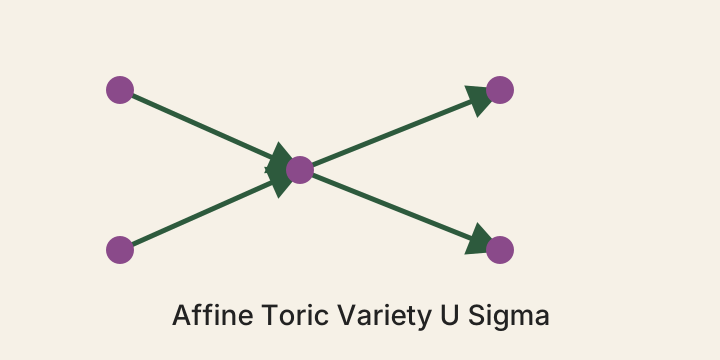
The picture captures the essential pipeline: a cone in produces lattice points in , the lattice points generate a commutative ring, and the spectrum of that ring is the affine toric variety. Three steps, three panels, one combinatorial-to-geometric translation.
Worked example [Beginner]
Take with cone , the closed first quadrant. Compute the affine toric variety step by step and identify it with a familiar algebraic variety.
Step 1. Compute the dual cone. As shown in the previous unit, is the closed first quadrant of , generated by the dual basis vectors and .
Step 2. Enumerate lattice points in the dual cone. The semigroup is the additive monoid of nonnegative integer pairs. It is generated by and as a commutative monoid — every element is uniquely .
Step 3. Form the semigroup algebra. Set and . Each monomial becomes , and the semigroup algebra becomes the polynomial ring . The multiplication rule matches , the ordinary multiplication of monomials.
Step 4. Take the spectrum. , the affine plane. The closed points of are the maximal ideals for , and the dense open torus corresponds to the locus where and .
Step 5. Identify the torus action. The torus acts on by , coordinate-wise multiplication. The dual action on the coordinate ring sends , , recording the -grading: is in degree and in degree .
What this tells us. The cone produces the affine plane with its standard -action by coordinate-wise multiplication. The dense torus corresponds to the zero face — confirming the rule that the affine toric variety of the zero cone is the torus itself. The construction is a recipe for building affine -varieties from cones, and the first-quadrant cone produces the smoothest possible example: the affine plane.
Check your understanding [Beginner]
Formal definition [Intermediate+]
Let be a lattice of rank with dual lattice and integer pairing , as in 04.11.01. Let be a strongly convex rational polyhedral cone, as in 04.11.02. Write for the additive semigroup of lattice points in the dual cone.
Definition (semigroup algebra). The semigroup algebra of over , denoted , is the -vector space $$ \mathbb{C}[S_\sigma] = \bigoplus_{m \in S_\sigma} \mathbb{C} \cdot \chi^m $$ with formal basis , equipped with the commutative-ring multiplication $$ \chi^m \cdot \chi^{m'} = \chi^{m + m'} $$ extended -bilinearly. The identity element is . The grading by records the -degree of each monomial — has degree — and this grading will encode the -action below.
By Gordan's lemma (04.11.02), is finitely generated as a commutative monoid. Choose a finite generating set . Then is generated as a -algebra by the elements . Hence is a finitely generated commutative -algebra, and there is a surjective -algebra map
$$
\mathbb{C}[X_1, \ldots, X_r] \twoheadrightarrow \mathbb{C}[S_\sigma], \qquad X_i \mapsto \chi^{m_i}.
$$
The kernel is the toric ideal associated to and the choice of generators. The toric ideal is generated by binomial relations , one for each integer dependency in with .
Definition (affine toric variety). The affine toric variety associated to is the affine algebraic variety $$ U_\sigma := \mathrm{Spec},\mathbb{C}[S_\sigma] = \mathrm{Spec},\mathbb{C}[\sigma^\vee \cap M]. $$ By the surjection above, is naturally embedded as the vanishing locus of the toric ideal: . When the generating set is taken to be the Hilbert basis , the embedding dimension is , which is the minimal embedding dimension realisable from this construction.
Definition (torus action). The algebraic torus from 04.11.01 acts on via the comorphism
$$
\mathbb{C}[S_\sigma] \to \mathbb{C}[M] \otimes_\mathbb{C} \mathbb{C}[S_\sigma], \qquad \chi^m \mapsto \chi^m \otimes \chi^m,
$$
which encodes the -grading on as an algebraic group action of on . The action restricts to the dense open subscheme coming from the inclusion of monoids (every extends to all of when we adjoin inverses); this dense open is the torus itself, acting on itself by translation.
Convention. For the rest of this unit we assume is strongly convex — that is, — unless explicitly stated otherwise. When is not strongly convex, the same construction works but contains units corresponding to the lineality space of , and the resulting is a torus bundle over the strongly convex case. The strongly convex hypothesis is the standard setup in toric geometry and is what makes have a unique closed -fixed point.
Counterexamples to common slips
"The semigroup should work as well as ." It does not. The lattice points in form an additive semigroup, but the resulting semigroup algebra encodes the wrong functor — the contravariance of requires lattice points in the dual cone. Concretely, for in , both and give (since the cone is self-dual), so the two constructions coincidentally agree; for in they differ — gives , but gives , the correct affine toric variety.
"The Hilbert basis equals the ray generators of ." It does not in general. The ray generators of are part of the Hilbert basis (every ray generator is indecomposable), but additional lattice points in the interior of the parallelepiped of fractional parts may also be indecomposable. For , the dual has rays and but the Hilbert basis is — the interior lattice point is indecomposable because no two nonzero elements of sum to it.
"Replacing by a -equivalent cone gives an isomorphic variety." This is correct when "-equivalent" means equivalent under , the lattice automorphisms of . Two cones differing by a change of basis produce isomorphic affine toric varieties. But cones differing by an arbitrary change of basis (involving irrational coefficients) may produce non-isomorphic varieties — the lattice structure is load-bearing.
Key theorem with proof [Intermediate+]
The signature theorem of this unit identifies the affine toric variety as a genuinely -equivariant affine algebraic variety, classifies it up to -equivariant isomorphism by the cone , and makes the construction functorial in .
Theorem (the affine-toric-variety construction). Let be a strongly convex rational polyhedral cone in a lattice of rank , with dual cone and lattice-point semigroup .
(a) Existence. The semigroup algebra is a finitely generated commutative -algebra; the affine variety is irreducible, normal, and of dimension .
(b) Torus. The torus embeds as an open dense subvariety via the inclusion ; the embedding is the affine toric variety of the zero face , identifying .
(c) Action. The torus acts on via the -grading , restricting to the translation action on , with a -orbit.
(d) Functoriality. If is a face of , the inclusion induces a -equivariant open immersion corresponding to the localisation at the monoid element , where is any lattice point in the relative interior of the face of .
Proof.
(a) Finite generation and normality. By Gordan's lemma (04.11.02), is a finitely generated commutative monoid, with finite generating set . The corresponding monomials generate as a -algebra, so the algebra is finitely generated; its is therefore an affine variety of finite type over .
For irreducibility, note that embeds in the group , so the semigroup is cancellative and torsion-free. Hence the localisation of at the multiplicative set is , which is an integral domain (the Laurent polynomial ring is the localisation of , a UFD). A subring of an integral domain is an integral domain, so is an integral domain, and is irreducible.
For normality, we show is integrally closed in its fraction field . The fraction field of is ; the fraction field of is the same, since generates as a group when is strongly convex (the dual cone is full-dimensional in , hence spans over , hence contains a -basis of ). Now is the intersection of valuation rings: write as an intersection of rational half-spaces with the primitive ray generators of ; then , so $$ \mathbb{C}[S_\sigma] = \bigcap_j \mathbb{C}[M]{\langle u_j, -\rangle \geq 0}, $$ where $\mathbb{C}[M]{\langle u_j, -\rangle \geq 0}\mathbb{C}[M]u_j\mathbb{C}(M)v_{u_j}(\chi^m) = \langle u_j, m\rangle\mathbb{Z}\mathbb{C}(M)\mathbb{C}[S_\sigma]\mathbb{C}(M)$, hence normal.
The dimension of is the transcendence degree of over , namely .
(b) Torus embedding. The inclusion of monoids extends to by adjoining the inverses for . Concretely, is the localisation of at the multiplicative set , and this localisation is an open immersion of affine varieties . The image is open (the complement is the vanishing locus of the product of the generators ) and dense (since is injective into an integral domain, generic points coincide).
The zero cone has dual cone and semigroup , so . The zero cone is a face of (in fact the unique minimal face when is strongly convex, since the lineality space of a strongly convex cone is ), so the embedding is an instance of the face-functoriality from part (d).
(c) Torus action. The comorphism
$$
\mu^* : \mathbb{C}[S_\sigma] \to \mathbb{C}[M] \otimes_\mathbb{C} \mathbb{C}[S_\sigma], \qquad \chi^m \mapsto \chi^m \otimes \chi^m,
$$
is a -algebra map (extends multiplicatively from the generators by the rule ), and the coassociativity and counit axioms for a Hopf-algebra coaction follow from the Hopf-algebra structure on from 04.11.01 (the comultiplication on is exactly , so the coaction on is the restriction of the regular Hopf-coaction to a sub-comodule). Dualising, is a morphism of affine -schemes, and the axioms for a group action follow from the Hopf axioms.
The restriction to is the translation action of on itself: the comorphism , , is the standard Hopf-coaction defining the regular -action. Hence is a single -orbit inside , and this orbit is dense.
(d) Functoriality on face inclusions. Let be a face. By the face-correspondence theorem (04.11.02), for some , equivalently for any in the relative interior of the face of . The dual cone of contains and is obtained from by adjoining the inverses of :
$$
\tau^\vee = \sigma^\vee + \mathbb{R}{\geq 0} \cdot (-m\tau),
$$
since the face direction lies in but does not (it lies in ). At the level of semigroups,
$$
S_\tau = \tau^\vee \cap M = S_\sigma + \mathbb{Z}{\geq 0} \cdot (-m\tau) = S_\sigma[\chi^{m_\tau} \text{ inverted}],
$$
the localisation of at the single element (regarding , the result of inverting one element produces a larger sub-monoid of , namely ).
At the level of algebras, , the localisation of at the element . Dualising, is the basic open subscheme of where is nonzero. Open immersions of affine schemes corresponding to localisation at a single element are -equivariant (since is a -semi-invariant element of weight , the localisation preserves the -grading). Hence the face inclusion induces a -equivariant open immersion .
The composition law produces the composition as a sequence of open immersions, by the localisation rule . The construction is therefore functorial on the category of strongly convex rational polyhedral cones with face inclusions, landing in the category of affine -toric varieties with -equivariant open immersions.
Bridge. The affine-toric-variety theorem builds toward the global toric construction of 04.11.04 and the orbit-cone correspondence of 04.11.05, and the central insight is that the semigroup algebra is the coordinate ring of an affine variety with a built-in torus action, with the action read off mechanically from the -grading on the algebra. This is exactly the foundational reason that toric geometry is combinatorial algebraic geometry: every geometric question about (dimension, smoothness, orbits, divisors, line bundles) becomes a combinatorial question about the cone and its dual, and the dictionary between the two sides is exact and computable.
The functoriality on face inclusions identifies the face poset of with a poset of -equivariant open subvarieties of , generalising the orbit decomposition of an affine -variety into a stratification by torus orbits. Putting these together, the affine toric variety is the universal -equivariant affine extension of along the cone direction , in a sense made precise by Sumihiro's 1974 theorem on equivariant completions. The bridge is dual to the duality from 04.11.01: the cone encodes which characters extend to regular functions on (namely those in ) and which characters extend only to rational functions, and this asymmetry is the entire reason the toric variety is a -equivariant partial compactification of rather than the full torus itself. This pattern appears again in 04.11.04 (gluing the into a global via face inclusions), in 04.11.05 (the orbit-cone correspondence identifying -orbits in with faces of ), and in 04.11.08 (the divisor-support-function dictionary identifying -invariant divisors on with piecewise-linear functions on the support of the fan).
Exercises [Intermediate+]
Lean formalization [Intermediate+]
Mathlib has commutative-monoid-algebra infrastructure in Mathlib.Algebra.MonoidAlgebra.Basic and the framework for affine -schemes in Mathlib.AlgebraicGeometry.AffineScheme. Building the affine-toric-variety functor on top of these requires the rational-polyhedral-cone formalism from 04.11.02 (currently absent from Mathlib) and the algebraic-torus formalism from 04.11.01 (also absent). The intended formalisation reads schematically:
import Mathlib.Algebra.MonoidAlgebra.Basic
import Mathlib.AlgebraicGeometry.AffineScheme
import Mathlib.LinearAlgebra.FreeModule.Basic

-- Assume `RationalPolyhedralCone N` from 04.11.02 and the dual semigroup
-- `dualSemigroup σ : AddSubmonoid (Module.Dual ℤ N)` are in scope.

variable {N : Type*} [AddCommGroup N] [Module ℤ N] [Module.Free ℤ N]

/-- The affine toric variety associated to a strongly convex rational
polyhedral cone σ ⊆ N_ℝ. As a commutative ring, this is the semigroup
algebra ℂ[σ^∨ ∩ M] equipped with its M-grading. -/
noncomputable def AffineToricVariety
    (σ : RationalPolyhedralCone N) (h : σ.StronglyConvex) :
    AlgebraicGeometry.AffineScheme :=
  AlgebraicGeometry.Spec
    (AddMonoidAlgebra ℂ (σ.dualSemigroup))

/-- The torus T = Spec ℂ[M] embeds as an open dense subvariety. -/
theorem AffineToricVariety.torusEmbedding
    (σ : RationalPolyhedralCone N) (h : σ.StronglyConvex) :
    ∃ φ : AlgebraicGeometry.Spec (AddMonoidAlgebra ℂ (Module.Dual ℤ N)) ⟶
          AffineToricVariety σ h,
      AlgebraicGeometry.IsOpenImmersion φ := by
  -- Localisation of ℂ[σ^∨ ∩ M] at the multiplicative set {χ^m : m ∈ σ^∨ ∩ M}
  -- recovers ℂ[M]; the corresponding Spec map is an open immersion.
  sorry

/-- Smoothness criterion (Demazure 1970): U_σ is smooth iff σ is simplicial
unimodular, i.e., σ is generated by part of a ℤ-basis of N. -/
theorem AffineToricVariety.smooth_iff_simplicial_unimodular
    (σ : RationalPolyhedralCone N) (h : σ.StronglyConvex) :
    AlgebraicGeometry.IsSmooth (AffineToricVariety σ h) ↔
      σ.SimplicialUnimodular := by
  -- Cotangent-space dimension at the closed T-fixed point equals
  -- |Hilb(σ^∨)|; smoothness forces this to equal n and the Hilbert basis
  -- to be a ℤ-basis of M, which dualises to the simplicial unimodular
  -- condition on σ.
  sorry

/-- Functoriality on face inclusions: τ ⊆ σ a face induces a T-equivariant
open immersion U_τ ↪ U_σ. -/
theorem AffineToricVariety.face_open_immersion
    (σ : RationalPolyhedralCone N) (τ : σ.Face) :
    ∃ φ : AffineToricVariety τ.val sorry ⟶ AffineToricVariety σ sorry,
      AlgebraicGeometry.IsOpenImmersion φ := by
  -- Localisation of ℂ[S_σ] at χ^{m_τ} for m_τ in the relative interior
  -- of σ^∨ ∩ τ^⊥ gives ℂ[S_τ]; the corresponding Spec map is an open
  -- immersion of affine schemes.
  sorry
Each step is reachable from current Mathlib but requires substantive new development. The rational-polyhedral-cone formalism is the primary missing prerequisite; once that is in place, the affine-toric-variety construction follows from existing AddMonoidAlgebra and AffineScheme infrastructure. The smoothness criterion requires the cotangent-space identification, which uses Mathlib's CotangentSpace and RingHom.Smooth machinery in Mathlib.RingTheory.Smooth.Basic. The face-functoriality requires the cone-face formalism from 04.11.02 and reduces to localisation of commutative monoid algebras — already available in Mathlib.Algebra.MonoidAlgebra.Basic via AddMonoidAlgebra.equivMapDomain and the universal property of Spec.
Advanced results [Master]
Theorem (functoriality of the affine-toric construction). The assignment is a contravariant functor from the category of strongly convex rational polyhedral cones in (with face inclusions as morphisms) to the category of affine -toric varieties (with -equivariant morphisms). The functor is fully faithful on face inclusions and produces -equivariant open immersions on morphisms.
The functoriality theorem is the formal content of part (d) of the main theorem above. Its categorical packaging is the proper home for the cone-to-variety dictionary: every face inclusion gives a -equivariant open immersion , and composition of face inclusions corresponds to composition of open immersions. The dual functor is what allows the global toric variety of 04.11.04 to be constructed by gluing along these open immersions — the gluing lemma for is exactly the statement that the functor extends from cones to fans by colimit.
Theorem (Sumihiro's equivariant covering; Sumihiro 1974). Let be a normal algebraic variety with an action of an algebraic torus . Then admits an open cover by -stable affine subvarieties.
Sumihiro's theorem (originally proved in Equivariant completion, Journal of Mathematics of Kyoto University 14, 1974, pp. 1-28) is the foundational result that every normal -variety is "locally toric": the affine pieces developed here are sufficient to reconstruct any normal -variety. In the toric setting (where acts with a dense open orbit), Sumihiro's theorem combined with the affine-toric construction implies that every normal toric variety is of the form for some fan . This is the foundational reason that the cone-and-fan formalism is exhaustive — it captures all normal toric varieties, not just a special class.
Theorem (universal property of ). Let be a torus and let for a strongly convex rational polyhedral cone . The affine toric variety represents the functor $$ \mathbf{Aff}\mathbb{C}^{\mathrm{op}} \to \mathbf{Set}, \qquad R \mapsto \mathrm{Hom}{\mathbf{Mon}}(S_\sigma, (R, \cdot)) $$ from commutative -algebras (opposite of affine schemes) to sets, sending to the set of monoid homomorphisms from the additive semigroup to the multiplicative semigroup . Equivalently, for every -algebra .
The universal property identifies as the moduli space of monoid homomorphisms from . This is exactly what does in general for any monoid: . The toric specialisation makes this universal property concrete and geometrically meaningful: a -point of is a choice of complex number for each such that and — that is, a multiplicative "evaluation" of in .
Theorem (normality and Cohen-Macaulayness; Hochster 1972). Let be a strongly convex rational polyhedral cone. Then is a normal Cohen-Macaulay domain. In particular, is normal and Cohen-Macaulay.
Hochster's theorem (Rings of invariants of tori, Cohen-Macaulay rings generated by monomials, and polytopes, Annals of Mathematics 96, 1972, pp. 318-337) is the foundational structure theorem for affine semigroup rings of the form . Normality is essentially the content of the main theorem above; Cohen-Macaulayness is a stronger property requiring the depth of the maximal ideal (the augmentation ideal at the -fixed point) to equal the Krull dimension . Hochster's proof uses the -action and the structure of the semigroup to construct a regular sequence of length in , exhibiting Cohen-Macaulayness directly. Cohen-Macaulayness has substantial consequences for toric singularities: every singular toric variety is rational and Cohen-Macaulay, hence has well-behaved local cohomology and good intersection-theoretic properties.
Theorem (resolution of toric singularities via simplicial subdivision). Let be a strongly convex rational polyhedral cone of dimension in . There exists a fan refining the fan such that every cone in is simplicial unimodular. The corresponding gluing is a smooth toric variety, and the natural map is a -equivariant projective birational morphism — a toric resolution of .
The toric resolution theorem (in this form due to Demazure 1970 and KKMS 1973, with algorithmic refinement by Bouvier-Gonzalez-Sprinberg 1995) makes resolution of singularities combinatorially explicit for toric varieties. The simplicial subdivision is performed by iteratively adding rays to , splitting non-simplicial-unimodular subcones into smaller pieces. The result is a smooth toric variety mapping properly and birationally to the original . For surfaces (dimension ), the simplicial-unimodular subdivision is exactly the continued-fraction expansion of the cone's index, recovering the classical Hirzebruch-Jung resolution of cyclic-quotient singularities . Hirzebruch's 1953 paper Über vierdimensionale Riemannsche Flächen mehrdeutiger analytischer Funktionen von zwei komplexen Veränderlichen (Mathematische Annalen 126, 1-22) computed these resolutions for surface singularities, and the connection to toric geometry was made explicit by Demazure.
Theorem (orbit-cone correspondence; foreshadowing 04.11.05). Let be a strongly convex rational polyhedral cone in of dimension . The -orbits in are in inclusion-reversing bijection with the faces of : a face of dimension corresponds to a -orbit of dimension . The closures of orbits stratify , and the closure contains if and only if (as faces of ).
This is the orbit-cone correspondence, the central structural result connecting the combinatorics of to the equivariant geometry of . Its proof (deferred to 04.11.05) uses the face-functoriality from this unit together with the universal property of to identify each orbit with the spectrum of a localisation of the semigroup algebra. The orbit corresponding to the zero face is the open dense orbit ; the orbit corresponding to the full cone (when has dimension ) is the unique closed -fixed point.
Synthesis. The affine toric variety is the combinatorial bridge from rational polyhedral cones to algebraic geometry, and the central insight is that the semigroup algebra — manifestly a finitely generated commutative -algebra by Gordan's lemma — has a coordinate-ring interpretation as the regular functions on a -equivariant affine algebraic variety, with the -action read off mechanically from the -grading. Three structural results — finite generation (Gordan), normality (Hochster), and the smoothness criterion (Demazure) — combine into a single dictionary: the geometric properties of are determined by the lattice combinatorics of the cone and its dual. The bridge is exactly the duality of 04.11.01: the cone encodes which characters of extend to regular functions on (namely those in ) and which extend only to rational functions, and this asymmetry is the entire reason that the toric variety is a -equivariant partial compactification of rather than the full torus itself.
Putting these together, the construction identifies the category of strongly convex rational polyhedral cones (with face inclusions) with a category of affine -toric varieties (with -equivariant open immersions), and this functor extends to the global toric construction of 04.11.04 via colimits over fans. The foundational reason that toric geometry is effectively combinatorial is that this functor is fully faithful and structure-preserving — every geometric question about a normal -variety reduces, via Sumihiro's theorem on equivariant covers and the affine model developed here, to a combinatorial question about cones and their lattice-point semigroups. This is exactly what makes toric geometry a working laboratory for testing conjectures in algebraic geometry: the geometric side is rich enough to model substantive phenomena (resolution of singularities, intersection theory, Hodge theory, mirror symmetry), while the combinatorial side is concrete enough to compute by hand or by software (Macaulay2, Polymake, Normaliz, GAP).
The affine model also generalises in three directions worth recording. To non-strongly-convex cones (where contains a positive-dimensional linear subspace), the construction still produces an affine variety, but the lineality space of corresponds to a sub-torus acting by the identity action, so becomes a torus bundle over the strongly-convex quotient . The pattern recurs in the toroidal-embeddings setting of KKMS 1973, where non-strongly-convex cones encode degenerate toroidal compactifications. To non-rational cones (where the cone generators are irrational), the semigroup may fail to be finitely generated (Gordan's lemma requires rationality), so the affine model can degenerate to an infinite-type scheme; this is the regime of Berkovich analytic toric geometry developed by Berkovich (1990) and used in tropical geometry. To arbitrary base rings (replacing by a commutative ring ), the construction produces an affine -scheme with a -action; the resulting toric schemes over specialise to toric varieties over fields and degenerate to combinatorial Stanley-Reisner schemes over , providing the foundation for the integral models of toric varieties used in arithmetic geometry. Each generalisation preserves the cone-to-variety dictionary developed here, with technical modifications recording the deviation from the strongly-convex rational case over .
Full proof set [Master]
Proposition (irreducibility of ), proof. Given in Exercise 4: the semigroup is cancellative and torsion-free; the semigroup algebra embeds into the group algebra , a Laurent polynomial ring which is a localisation of and hence an integral domain; therefore is an integral domain and is irreducible.
Proposition (smoothness criterion), proof. Given in Exercise 7: () When with part of a -basis of , computation gives , smooth. () When is smooth at the closed -fixed point, the Zariski cotangent space identifies with the Hilbert basis of , smoothness forces and the Hilbert basis to be a -basis of ; dualising gives the simplicial-unimodular condition on .
Proposition (toric ideal presentation), proof. Given in Exercise 8: the surjection , , has kernel generated by binomials with in , by the monomial-grouping argument; hence for the toric ideal .
Proposition (normality of ), proof. Given in part (a) of the main theorem: where are the primitive ray generators of ; each is a valuation subring of with valuation ; an intersection of valuation rings is integrally closed; hence is normal.
Proposition (face-functoriality), proof. Given in part (d) of the main theorem: for a face of with for in the relative interior of , the semigroup relation realises as the localisation ; the corresponding open immersion is -equivariant since is a -semi-invariant of weight , and localisation at a semi-invariant preserves the -grading.
Proposition (universal property of ), proof. Let and let be the semigroup associated to a strongly convex rational polyhedral cone . For every commutative -algebra , there is a natural bijection given by .
Proof. The forward map sends a -algebra homomorphism to the function defined by . This function is a monoid homomorphism to the multiplicative monoid : , and .
The inverse map sends a monoid homomorphism to the -algebra homomorphism extending by -linearity: (a finite sum, since elements of have finite support).
The two maps are mutually inverse and natural in , by direct computation: starting with , the round trip is , the original . Naturality in records that pre-composition with a -algebra map commutes with the bijection.
Hence represents the functor , the moduli space of monoid homomorphisms from .
Proposition (functoriality of ), proof. The assignment extends to a contravariant functor , with the morphism induced by a face inclusion being the -equivariant open immersion .
Proof. The face-functoriality (proven in part (d) of the main theorem) gives the action on morphisms. We verify the functor laws:
Identity. The identity face inclusion corresponds to the identity , since has in its relative interior, giving the identity localisation .
Composition. Let be a chain of face inclusions. By the face-correspondence theorem of 04.11.02, is a face of and is a face of . Choose and , with appropriate adjustment so that is also in the closure of (achievable by perturbation if necessary). Then , which factors through since is already invertible in the larger localisation: explicitly, the inclusion on faces gives (the larger face has the smaller annihilator), so inverting in is a further localisation. Composition of open immersions of affine schemes corresponds to iterated localisation, which is a single localisation at the product of the two generators, matching the composite face inclusion .
Contravariance. The functor reverses arrows: a face inclusion in produces an open immersion in — both arrows going the same direction, since both face inclusion and open immersion are "into the larger object". The contravariance shows up at the level of coordinate rings: is an inclusion going in the opposite direction to the face inclusion, since the semigroup gets bigger when the cone gets smaller (more lattice points become available in the dual).
Hence is a (contravariant on coordinate rings, covariant on schemes) functor from to .
Connections [Master]
Algebraic torus and character/cocharacter lattices
04.11.01. The torus and its character/cocharacter lattices developed in the prerequisite unit supply the ambient algebraic-group setting for the affine toric variety. The torus is itself the affine toric variety of the zero cone: . The -grading on the semigroup algebra is exactly the Hopf-comodule structure under the -Hopf-algebra , and the -action on is the dualised comodule structure. Every step of the affine-toric-variety construction reads directly from the lattice data developed in04.11.01and04.11.02.Rational polyhedral cone and dual cone
04.11.02. The cone and its dual from the prerequisite unit are the combinatorial input data of the affine-toric-variety construction. Gordan's lemma (finite generation of ) is the foundational reason that is a finitely generated -algebra and hence that is an affine variety of finite type. The face-correspondence theorem (inclusion-reversing bijection ) becomes the face-functoriality of developed here: a face produces a -equivariant open immersion via localisation of the semigroup algebra.Affine scheme
04.02.02. The affine toric variety is by definition an affine scheme: , with closed points the maximal ideals of the semigroup algebra. The general affine-scheme formalism — , the equivalence between commutative rings and affine schemes, the structure sheaf — supplies the geometric apparatus that makes the toric construction algebraic-geometric rather than purely combinatorial. The functoriality inherits the contravariance of from this unit's formalism.Fan and toric variety
04.11.04. The next unit in the toric chapter constructs the global toric variety from a fan — a finite collection of rational polyhedral cones in closed under taking faces and intersections — by gluing the affine pieces for along the open immersions produced by the face-functoriality developed here. The affine-toric-variety construction is therefore the local building block of toric geometry, and the global construction reads as the colimit of the affine pieces in the category of -toric varieties.Orbit-cone correspondence
04.11.06. The orbit-cone correspondence (developed three units ahead) identifies the -orbits in with the faces of via , with the orbit corresponding to a face of dimension having dimension . The closure ordering on orbits matches the reverse face-inclusion on . This identification specialises the face-correspondence theorem of04.11.02to the equivariant geometry of , and the proof uses the face-functoriality and universal property developed in this unit.Smoothness and completeness via fans
04.11.05. The downstream sibling unit globalises the Demazure smoothness criterion proved here ( smooth iff is simplicial unimodular) into the smoothness criterion for the global toric variety : smoothness is local, so smooth iff every chart smooth iff every simplicial unimodular. The Hilbert-basis-equals-Krull-dimension count established at the affine level is the technical core of the global criterion. The completeness criterion in[04.11.05]is a separate global statement about that has no purely affine counterpart, but it builds on the affine charts supplied by this unit.Toric resolution of singularities
04.11.07. The downstream resolution unit takes the affine smoothness criterion of this unit as its target condition: every cone in the refined fan must be simplicial unimodular, equivalently every affine chart of the resolved variety must be smooth. The star-subdivision algorithm operates on cones in , with each subdivision step replacing one affine chart by a finite collection of smaller charts corresponding to the subcones. The face-functoriality developed here ensures the new charts glue compatibly into the refined toric variety, and the smoothness criterion measures progress of the algorithm.Smoothness, étaleness, and unramified morphisms
04.02.05. The smoothness criterion of Demazure 1970 — is smooth iff is simplicial unimodular — is a special case of the general smoothness theory of affine schemes from this unit. The cotangent-space computation at the closed -fixed point identifies the cotangent dimension with the size of the Hilbert basis of , and smoothness forces this to equal . The toric resolution theorem (refining a fan to make every cone simplicial unimodular) is the toric implementation of Hironaka's resolution of singularities, and reduces resolution to combinatorial fan refinement.Spec of a commutative ring
04.02.01. The functor from commutative rings to affine schemes is the foundation of the affine-toric-variety construction: is literally . The functoriality of (contravariant from commutative rings to affine schemes) supplies the contravariance of on coordinate rings, with the face-inclusion-to-open-immersion correspondence being a specialisation of the localisation-to-open-immersion correspondence in .Polytope-toric correspondence
04.11.11. The polytope-toric correspondence (developed several units ahead) builds projective toric varieties from rational lattice polytopes via the cone and the projective spectrum . The affine pieces of at each vertex are exactly affine toric varieties for the corresponding "vertex cone" of , so the polytope-toric construction reduces to gluing affine toric varieties developed in this unit.Resolution of singularities
04.06.02. The toric resolution theorem (every singular toric variety admits a -equivariant resolution by refining the fan) is the toric implementation of Hironaka's theorem on resolution of singularities. The simplicial-unimodular subdivision is performed combinatorially on the fan, and the resulting smooth toric variety maps properly and birationally to the original. For toric surfaces, this recovers the Hirzebruch-Jung resolution of cyclic-quotient singularities via continued-fraction expansion, a classical result that predates toric geometry by two decades.
Historical & philosophical context [Master]
The affine toric variety was first written down in modern form by Michel Demazure in Sous-groupes algébriques de rang maximum du groupe de Cremona (Annales scientifiques de l'École normale supérieure, 4e série, tome 3, 1970, pp. 507-588) [Demazure 1970]. Demazure's program was to classify the algebraic subgroups of the Cremona group of maximal rank, and the cone-and-fan formalism arose as the combinatorial language needed to enumerate the affine -equivariant compactifications of the torus. The smoothness criterion (simplicial unimodular cones produce smooth ) and the functoriality on face inclusions are due to Demazure, who also introduced the term "espace torique" — the French original of "toric variety".
The scheme-theoretic foundation of the affine-toric-variety construction was systematised by George Kempf, Finn Faye Knudsen, David Mumford, and Bernard Saint-Donat in Toroidal Embeddings I (Lecture Notes in Mathematics 339, Springer 1973) [pending], where the cone-and-fan formalism is recast as a tool for resolving singularities and compactifying equivariant varieties over arbitrary base schemes. KKMS's "toroidal embedding" is the local-affine model for varieties that look étale-locally like affine toric varieties; the global toric setting (where the variety is genuinely a torus embedding) is the rigid combinatorial special case. Hideyasu Sumihiro's Equivariant completion (Journal of Mathematics of Kyoto University 14, 1974, pp. 1-28) [Sumihiro 1974] established the foundational theorem that every normal -variety admits a -equivariant affine open cover — a result that, applied to normal toric varieties, identifies the affine toric pieces developed here as the building blocks of toric geometry. Without Sumihiro's theorem, one would have only the affine-local picture; with it, every normal toric variety is captured by a fan.
The semigroup-ring perspective on has roots earlier, in the invariant theory of finite group actions on polynomial rings. Hilbert's 1890 paper Über die Theorie der algebraischen Formen (Mathematische Annalen 36) [pending] proved the finite generation of invariant rings of finite groups, the First Fundamental Theorem of invariant theory; Gordan's 1873 paper [Gordan 1873] proved the finite generation of nonnegative integer solutions to linear inequalities, the semigroup version that became Gordan's lemma. Melvin Hochster's Rings of invariants of tori, Cohen-Macaulay rings generated by monomials, and polytopes (Annals of Mathematics 96, 1972, pp. 318-337) [pending] unified these threads, proving that the semigroup ring is normal Cohen-Macaulay for every strongly convex rational polyhedral cone — the foundational structure theorem for toric singularities.
Tadao Oda's Convex Bodies and Algebraic Geometry (Springer 1988) [pending] consolidated the Japanese-school perspective, with emphasis on the dual-cone formalism, the affine-toric construction, and the orbit-cone correspondence; William Fulton's Introduction to Toric Varieties (Princeton 1993) [Fulton 1993] is the canonical short textbook, and David Cox, John Little, and Henry Schenck's Toric Varieties (AMS 2011) [pending] is the modern thousand-page treatment. David Cox's 1995 paper The homogeneous coordinate ring of a toric variety (Journal of Algebraic Geometry 4, 17-50) [Cox 1995] introduced the total coordinate ring of a toric variety, reframing the affine pieces as localisations of a single graded ring at irrelevant ideals — a perspective that unifies projective and toric geometry under a common functorial roof.
Bibliography [Master]
@article{Demazure1970,
  author  = {Demazure, Michel},
  title   = {Sous-groupes alg{\'e}briques de rang maximum du groupe de Cremona},
  journal = {Annales scientifiques de l'{\'E}cole normale sup{\'e}rieure (4)},
  volume  = {3},
  year    = {1970},
  pages   = {507--588}
}

@book{KempfKnudsenMumfordSaintDonat,
  author    = {Kempf, George and Knudsen, Finn Faye and Mumford, David and Saint-Donat, Bernard},
  title     = {Toroidal Embeddings I},
  publisher = {Springer-Verlag},
  series    = {Lecture Notes in Mathematics},
  volume    = {339},
  year      = {1973}
}

@article{Sumihiro1974,
  author  = {Sumihiro, Hideyasu},
  title   = {Equivariant completion},
  journal = {Journal of Mathematics of Kyoto University},
  volume  = {14},
  year    = {1974},
  pages   = {1--28}
}

@article{Hochster1972,
  author  = {Hochster, Melvin},
  title   = {Rings of invariants of tori, {C}ohen-{M}acaulay rings generated by monomials, and polytopes},
  journal = {Annals of Mathematics},
  volume  = {96},
  year    = {1972},
  pages   = {318--337}
}

@article{Mumford1972,
  author  = {Mumford, David},
  title   = {An analytic construction of degenerating {A}belian varieties over complete rings},
  journal = {Compositio Mathematica},
  volume  = {24},
  year    = {1972},
  pages   = {239--272}
}

@book{OdaConvexBodies,
  author    = {Oda, Tadao},
  title     = {Convex Bodies and Algebraic Geometry: An Introduction to the Theory of Toric Varieties},
  publisher = {Springer-Verlag},
  series    = {Ergebnisse der Mathematik und ihrer Grenzgebiete},
  volume    = {15},
  year      = {1988}
}

@book{FultonToric,
  author    = {Fulton, William},
  title     = {Introduction to Toric Varieties},
  publisher = {Princeton University Press},
  series    = {Annals of Mathematics Studies},
  volume    = {131},
  year      = {1993}
}

@book{CoxLittleSchenck,
  author    = {Cox, David A. and Little, John B. and Schenck, Henry K.},
  title     = {Toric Varieties},
  publisher = {American Mathematical Society},
  series    = {Graduate Studies in Mathematics},
  volume    = {124},
  year      = {2011}
}

@article{Cox1995,
  author  = {Cox, David A.},
  title   = {The homogeneous coordinate ring of a toric variety},
  journal = {Journal of Algebraic Geometry},
  volume  = {4},
  year    = {1995},
  pages   = {17--50}
}

@article{Gordan1873,
  author  = {Gordan, Paul},
  title   = {{Ueber die Aufl\"osung linearer Gleichungen mit reell ganzzahligen Coefficienten}},
  journal = {Mathematische Annalen},
  volume  = {6},
  year    = {1873},
  pages   = {23--28}
}

@article{Hilbert1890,
  author  = {Hilbert, David},
  title   = {{\"U}ber die {T}heorie der algebraischen {F}ormen},
  journal = {Mathematische Annalen},
  volume  = {36},
  year    = {1890},
  pages   = {473--534}
}

@article{Hirzebruch1953,
  author  = {Hirzebruch, Friedrich},
  title   = {{\"U}ber vierdimensionale {R}iemannsche {F}l{\"a}chen mehrdeutiger analytischer {F}unktionen von zwei komplexen {V}er{\"a}nderlichen},
  journal = {Mathematische Annalen},
  volume  = {126},
  year    = {1953},
  pages   = {1--22}
}

@book{EwaldCombConvAlg,
  author    = {Ewald, G{\"u}nter},
  title     = {Combinatorial Convexity and Algebraic Geometry},
  publisher = {Springer-Verlag},
  series    = {Graduate Texts in Mathematics},
  volume    = {168},
  year      = {1996}
}

@book{BerkovichSpectralTheory,
  author    = {Berkovich, Vladimir G.},
  title     = {Spectral Theory and Analytic Geometry over Non-{A}rchimedean Fields},
  publisher = {American Mathematical Society},
  series    = {Mathematical Surveys and Monographs},
  volume    = {33},
  year      = {1990}
}