Bernstein-Kushnirenko theorem
Anchor (Master): Bernstein 1975 *The number of roots of a system of equations*; Kushnirenko 1976 *Newton polytopes and the Bezout theorem*; Fulton §5.5; Cox-Little-Schenck §13.5; Gelfand-Kapranov-Zelevinsky *Discriminants, Resultants, and Multidimensional Determinants* Ch. 6
Intuition [Beginner]
Classical Bezout says that two plane curves of degrees and meet in points, if they are placed generally and counted correctly. Bernstein-Kushnirenko is the sparse version. Instead of measuring a polynomial only by its total degree, it looks at which monomials actually appear. Those exponent vectors form a Newton polytope. The number of solutions in the algebraic torus is controlled by the mixed volume of those Newton polytopes.
Why does this matter? A polynomial with only a few monomials can have a large total degree but far fewer solutions than a dense polynomial of that degree. The Newton polytope remembers sparsity. It counts the exponents that are present, not the monomials that could have appeared.
For one variable, this is familiar. A Laurent polynomial with largest exponent and smallest exponent has at most nonzero roots, not roots. The Newton polytope is the interval , and its length is the count. Bernstein-Kushnirenko is the same idea in many variables.
Visual [Beginner]
Draw two Laurent polynomials in two variables. For each polynomial, plot the exponent pairs of the monomials that appear, then take their convex hulls. The first hull is a triangle. The second is a square. Their mixed area predicts how many isolated solutions the two equations have inside the torus.
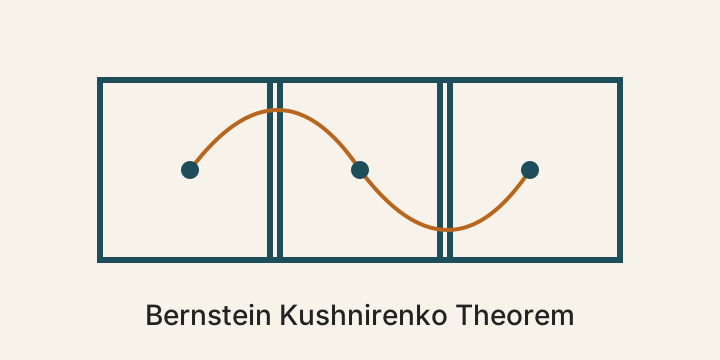
The picture replaces algebraic degree by geometry of exponent sets. Dense degree- polynomials have simplex-shaped Newton polytopes. Sparse polynomials have smaller or differently shaped polytopes, and the solution count follows the shape.
Worked example [Beginner]
Consider one Laurent equation $$ f(x)=3x^4-5x+2x^{-1} $$ on the torus .
Step 1. List the exponents. The monomials have exponents , , and .
Step 2. Take the Newton polytope. In one dimension the convex hull is the interval .
Step 3. Measure its length. The interval has length .
What this tells us. Multiply the equation by to get . For generic coefficients, this has roots in . The exponent interval length is the sparse root count. Bernstein-Kushnirenko says the same Newton-polytope principle works for equations in variables.
Check your understanding [Beginner]
Formal definition [Intermediate+]
Let be the character lattice of the algebraic torus . A Laurent polynomial is a finite sum $$ f(x)=\sum_{m\in A} c_m x^m,\qquad c_m\in\mathbb{C}^*,\quad A\subset M\text{ finite}, $$ where . Its support is , and its Newton polytope is $$ \operatorname{Newt}(f)=\operatorname{conv}(A)\subset M_\mathbb{R}. $$
For lattice polytopes , let denote mixed volume with the convention of 04.11.13:
$$
\operatorname{MV}(P,\ldots,P)=\operatorname{Vol}(P),
$$
where a fundamental lattice simplex has volume .
A system $$ f_1(x)=\cdots=f_n(x)=0,\qquad x\in T $$ with is generic with fixed Newton polytopes if the coefficients of all monomials with exponents in prescribed finite supports are chosen outside a proper Zariski closed subset of the coefficient space. This genericity ensures that all torus solutions are isolated and reduced, and that no unwanted solutions appear on the toric boundary of a compactification adapted to the polytopes.
Bernstein-Kushnirenko theorem. For generic Laurent polynomials on with Newton polytopes ,
$$
#{x\in T
When all , this becomes Kushnirenko's theorem: $$ #V(f_1,\ldots,f_n)=n!\operatorname{Vol}(P) $$ for generic equations with the same Newton polytope .
Classical Bezout is recovered by taking , where is the standard simplex. Since $$ n!\operatorname{MV}(d_1\Delta_n,\ldots,d_n\Delta_n)=d_1\cdots d_n, $$ the theorem gives the usual product of degrees for dense homogeneous equations after restricting to the torus and accounting for boundary intersections in projective space.
Counterexamples to common slips
The theorem is not a count for every coefficient choice. Special coefficients can make roots collide, create positive-dimensional solution sets, or move solutions to the toric boundary. Genericity is part of the statement.
Total degree can overcount sparse systems. A polynomial with exponents has total degree , but its Newton triangle can give a much sharper sparse count when paired with other sparse equations.
The theorem counts torus roots. If a solution has a zero coordinate, it lies outside . Compactified counts need boundary analysis in the relevant toric variety.
Key theorem with proof [Intermediate+]
Theorem (Bernstein-Kushnirenko). Let be lattice polytopes. For generic Laurent polynomials with , the number of isolated common zeros in $(\mathbb{C}^)^n$, counted with multiplicity, is* $$ n!\operatorname{MV}(P_1,\ldots,P_n). $$
Proof. Choose a smooth projective toric variety whose fan refines the normal fans of all . Each polytope determines a nef toric divisor on and a line bundle whose torus-weight sections are indexed by lattice points of 04.11.10. The Laurent polynomial is the restriction to the dense torus of a section .
For generic coefficients, the divisors meet properly and avoid contributing intersection components on the toric boundary. This is the toric Bertini step: on each orbit stratum, the restrictions of the form a generic system with the expected codimension, so only the dense-torus stratum contributes zero-dimensional intersections.
Therefore the number of torus solutions equals the intersection product
$$
D_{P_1}\cdots D_{P_n}
$$
on . By the toric mixed-volume formula 04.11.13, this intersection product is
$$
n!\operatorname{MV}(P_1,\ldots,P_n).
$$
Combining the compactification step with the mixed-volume intersection formula gives the stated count.
Bridge. Bernstein-Kushnirenko builds toward tropical correspondence theorems 04.12.05, where algebraic roots degenerate to balanced tropical intersections, and appears again in Newton-polytope amoeba theory 04.12.02. The foundational reason is that a Laurent polynomial identifies an equation with a toric divisor, while 04.11.13 identifies the intersection of those divisors with mixed volume. Putting these together, the bridge is the toric compactification that generalises classical Bezout from total degree to Newton polytopes.
Exercises [Intermediate+]
Advanced results [Master]
Bernstein's theorem has a sharper nondegeneracy form. For every nonzero covector , take the initial face on which is minimal and the corresponding initial Laurent polynomial . If for every the system $$ \operatorname{in}_u(f_1)=\cdots=\operatorname{in}_u(f_n)=0 $$ has no solution in , then the system is nondegenerate at infinity and the Bernstein count holds. This criterion is the explicit boundary-avoidance condition: initial systems are the equations induced on toric boundary strata.
Kushnirenko's theorem is the equal-polytope case and can be read as the degree of a projective toric embedding. If is full-dimensional and the all have Newton polytope , then is the degree of under the embedding by . The root count is an intersection of generic hyperplane sections pulled back to the dense torus.
Sparse resultants refine the theorem from counting roots to detecting when roots exist. Given supports , the sparse resultant is the irreducible equation in coefficient space cutting out systems with a common torus root, when the supports are essential. Its Newton polytope is governed by mixed subdivisions of the Minkowski sum, linking Bernstein-Kushnirenko to secondary polytopes and GKZ discriminants.
Tropical geometry gives a degeneration-level version. Under a valuation, the solutions of a generic system tropicalise to intersections of tropical hypersurfaces dual to regular subdivisions of the Newton polytopes. Local multiplicities are lattice mixed volumes of dual cells, and the global balancing sum recovers the Bernstein number. Mikhalkin's plane-curve correspondence 04.12.05 is a curve-counting descendant of this mechanism.
Synthesis. Bernstein-Kushnirenko builds toward tropical enumerative geometry 04.12.05 and sparse resultants, and appears again in amoeba-spine convergence 04.12.02. The central insight is that supports identify equations with Newton polytopes, toric compactification identifies equations with divisors, and 04.11.13 identifies divisor intersections with mixed volume. Putting these together identifies sparse algebraic root counts with convex geometry and generalises Bezout from degree to support.
Full proof set [Master]
Proposition (one-variable Laurent case). A generic Laurent polynomial with Newton interval has exactly roots in $\mathbb{C}^$.*
Proof. Write with and multiply by to obtain an ordinary polynomial of degree with nonzero constant coefficient. For generic coefficients, has distinct roots in , and the nonzero constant coefficient excludes . Since multiplication by is invertible on , and have the same torus roots.
Proposition (Bezout from Bernstein-Kushnirenko). If for the standard simplex , then .
Proof. Mixed volume is symmetric and multilinear under scaling. Therefore $$ \operatorname{MV}(d_1\Delta_n,\ldots,d_n\Delta_n)=d_1\cdots d_n\operatorname{MV}(\Delta_n,\ldots,\Delta_n). $$ The repeated mixed volume is ordinary volume, and in the lattice normalisation. Multiplying by gives .
Proposition (toric proof under nondegeneracy at infinity). If every nonzero initial system has no torus solution, then the compactified divisor intersection equals the dense-torus solution count.
Proof. Choose a smooth projective toric compactification refining all normal fans. Boundary orbits correspond to nonzero cones, equivalently to covector directions after passing to faces. Restricting the section defined by to the orbit associated with gives the initial polynomial , up to multiplication by a torus character. A common zero on that boundary orbit is therefore equivalent to a torus solution of the corresponding initial system. The nondegeneracy hypothesis excludes such zeros on every boundary orbit. Hence all isolated intersections of the compactified divisors lie in the dense torus, so their intersection product equals the torus solution count. Applying 04.11.13 computes that product as .
Connections [Master]
04.11.13supplies the mixed-volume intersection formula that computes the compactified divisor product.04.11.10supplies the passage from a Newton polytope to a toric line bundle and its section space.04.12.02treats Newton polytopes and amoebas; Bernstein-Kushnirenko is the enumerative theorem attached to the same support geometry.04.12.05uses tropical intersections with local lattice multiplicities, a degeneration of the Bernstein mixed-volume count.04.03.04is the dense projective-space ancestor: ordinary degree counts become sparse Newton-polytope counts after moving to the torus.
Historical & philosophical context [Master]
Bernstein's 1975 paper [Bernstein 1975] stated the mixed-volume theorem for systems of Laurent polynomial equations and introduced the nondegeneracy-at-infinity condition through face systems. Kushnirenko's 1976 paper [Kushnirenko 1976] gave the equal-polytope Newton-polytope version and positioned it as a refinement of Bezout for sparse equations.
The later GKZ synthesis [Gelfand-Kapranov-Zelevinsky] connected Bernstein-Kushnirenko to sparse resultants, secondary polytopes, and -discriminants. In modern toric geometry, Fulton's treatment expresses the theorem as the enumerative face of toric intersection theory: Newton polytopes determine compactifying line bundles, and mixed volume is the resulting top intersection number.
Bibliography [Master]
@article{Bernstein1975Roots,
  author = {Bernstein, D. N.},
  title = {The Number of Roots of a System of Equations},
  journal = {Functional Analysis and Its Applications},
  volume = {9},
  pages = {183--185},
  year = {1975}
}

@article{Kushnirenko1976Newton,
  author = {Kushnirenko, A. G.},
  title = {Newton Polytopes and the Bezout Theorem},
  journal = {Functional Analysis and Its Applications},
  volume = {10},
  pages = {233--235},
  year = {1976}
}

@book{GelfandKapranovZelevinsky1994,
  author = {Gelfand, I. M. and Kapranov, M. M. and Zelevinsky, A. V.},
  title = {Discriminants, Resultants, and Multidimensional Determinants},
  publisher = {Birkhauser},
  year = {1994}
}

@book{Fulton1993Toric,
  author = {Fulton, William},
  title = {Introduction to Toric Varieties},
  publisher = {Princeton University Press},
  year = {1993}
}

@book{CoxLittleSchenck2011Toric,
  author = {Cox, David A. and Little, John B. and Schenck, Henry K.},
  title = {Toric Varieties},
  publisher = {American Mathematical Society},
  year = {2011}
}