Mikhalkin's correspondence theorem
Anchor (Master): Mikhalkin 2005 *J. Amer. Math. Soc.* 18, 313-377 (originator); Mikhalkin 2007 *Inventiones* 167 (real version with Welschinger signs); Itenberg-Kharlamov-Shustin 2003-04 *Russ. Math. Surveys* / *Intl. Math. Res. Notices* (Welschinger invariant connection); Gathmann-Markwig 2007 *Math. Ann.* 338 (alternative tropical proof of Caporaso-Harris recursion); Nishinou-Siebert 2006 *Duke Math. J.* 135 (toric-degeneration proof); Maclagan-Sturmfels *Introduction to Tropical Geometry* (GSM 161, 2015) Ch. 5-6; Mikhalkin-Rau *Tropical Geometry* (in preparation, draft 2018-2024) Ch. 6-7
Intuition [Beginner]
Plane algebraic geometry asks how many curves of a given degree pass through a given number of generic points. The classical answer for degree-three curves in the projective plane is twelve curves through eight generic points. Counting these directly is hard: each curve is an irreducible algebraic surface in projective space cut out by a polynomial of degree three, and the moduli space of such curves has a recursive structure whose enumeration occupied algebraic geometers for a century. Mikhalkin's correspondence theorem replaces this hard count with a piecewise-linear combinatorial count over the same number of points, with the same answer.
The picture is direct. Take the polynomial defining a line in the plane. The tropical version replaces multiplication by addition and addition by minimum, producing the piecewise-linear function . The graph has a corner where two of the three terms agree, and the corner locus is a piecewise-linear curve in the plane: three rays meeting at a single point. A higher-degree tropical curve looks similar — finitely many straight segments meeting at three-valent vertices, all directions integer.
The miracle is that counting tropical curves of fixed shape passing through a generic configuration of points, weighted by an integer multiplicity at each vertex, gives the same number as the complex algebraic count. Mikhalkin proved this in 2005 in the Journal of the American Mathematical Society. The hard enumerative geometry becomes a combinatorial problem about straight-line graphs.
Visual [Beginner]
A two-panel picture. Left panel: a complex algebraic curve of degree three in the projective plane, drawn schematically as a closed loop. Right panel: a tropical curve with the same Newton polygon — a graph made of straight line segments meeting at vertices, all directions along integer vectors , , . The tropical curve has three unbounded ends going off in each of the three primitive directions. The arrow between the two panels is labelled "Mikhalkin correspondence".
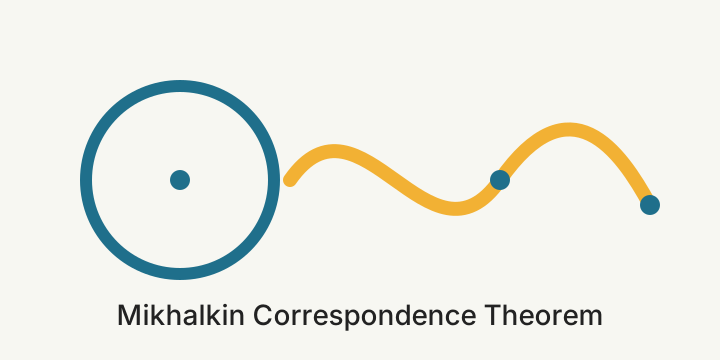
The point of the picture is that the right-hand combinatorial graph carries the same enumerative information as the left-hand algebraic curve. Counting graphs (with multiplicities at vertices) reproduces the count of algebraic curves through the same configuration of points.
Worked example [Beginner]
Count lines through two points. A line in the plane is determined by two points, so the number of lines through two generic points is exactly one. The tropical version reproduces this.
Step 1. The tropical curves of degree one in . Each is a graph with three unbounded rays in the primitive directions , , , meeting at a single trivalent vertex. The vertex can be anywhere in the plane; the curve is determined by the position of the vertex.
Step 2. The point conditions. Pick two generic points . For the tropical line to pass through both, each point must lie on one of the three rays. By genericity, the configuration of two points fixes the vertex position and the slope distribution: one point lies on one ray, the other point lies on a different ray, and the vertex is determined.
Step 3. The count. There is one tropical line through the two generic points. The multiplicity at the unique trivalent vertex is the determinant of the two outgoing primitive directions, which equals one for the standard configuration. Total tropical count: one.
What this tells us: the number of algebraic lines through two generic points in the projective plane equals the number of tropical lines through the corresponding two generic tropical points, weighted by multiplicity. Both equal one. This is the simplest instance of the correspondence — the equality holds for every degree and every higher-genus modification.
Check your understanding [Beginner]
Formal definition [Intermediate+]
Fix a lattice , the Newton polygon, encoding the supports of monomials of a polynomial . The Newton polygon of a curve in the torus records the exponent support of the defining polynomial . Examples: the polygon , the standard simplex of side , is the Newton polygon of a generic degree- curve in .
Definition (parameterised tropical curve in ). A tropical curve of Newton polygon and genus in is a triple consisting of:
(i) a connected finite graph — finitely many vertices, finitely many edges, possibly with unbounded ends;
(ii) an integer weight on each edge of ;
(iii) a continuous embedding sending each edge to a closed line segment (or ray, for unbounded ends) with primitive integer direction , with the integer weight recording the multiplicity of the edge,
subject to the balancing condition at every vertex : $$ \sum_{e \ni V} w_e v_e = 0, $$ where the sum runs over all edges incident to , with each direction chosen pointing away from (primitive, so ). The unbounded directions of the curve form a multiset matching the primitive normal directions of the edges of the Newton polygon , with multiplicities matching the integer lengths of the edges of .
The genus of the curve is the first Betti number of the underlying graph: , the number of independent loops. A tropical curve is rational if ; equivalently, the graph is a tree.
Definition (tropical multiplicity at a trivalent vertex). Let be a trivalent vertex of a tropical curve, with three outgoing edges of primitive directions and weights . The balancing condition forces the three edges to span a triangle whose lattice area we record. The tropical multiplicity at is $$ m(V) := w_1 w_2 \cdot |\det(v_1 | v_2)| = w_2 w_3 \cdot |\det(v_2 | v_3)| = w_1 w_3 \cdot |\det(v_1 | v_3)|, $$ the absolute determinant of any two of the primitive directions, multiplied by the product of their weights. The three expressions are equal by the balancing relation. The multiplicity of the tropical curve is $$ m(\Gamma) := \prod_{V \in V_3(\Gamma)} m(V), $$ the product of trivalent-vertex multiplicities. A tropical curve is simple (or generic) if every vertex is trivalent.
Definition (Mikhalkin tropical count). Given a generic configuration of points with , the Mikhalkin tropical count is $$ N^{\Delta, g}{\mathrm{trop}}(P) := \sum{(\Gamma, w, h)} m(\Gamma), $$ the sum over all simple tropical curves of Newton polygon and genus passing through every point of , weighted by the multiplicity .
Counterexamples to common slips
"The tropical multiplicity at a higher-valence vertex is the product over a triangulation." The Mikhalkin multiplicity is defined only at trivalent vertices. Higher-valence vertices appear for non-generic point configurations; they require a perturbation argument resolving them into trivalent vertices first, with the multiplicity then computed on the resolved curve. For generic point configurations, every vertex is automatically trivalent (the dimension count forces it), so the trivalent-vertex formula suffices.
"The balancing condition is at the unbounded ends, not at every vertex." The balancing condition holds at every vertex of , internal and at the boundary if any (the curve has no boundary vertices in the interior of ). For the unbounded ends, the primitive directions are the primitive integer normals of the Newton polygon edges, with multiplicities matching the integer lengths of those edges; this is a global constraint on the multiset of unbounded directions, not a local condition at a vertex.
"The weight on an edge is the multiplicity at any of its endpoints." The weight is a property of the edge, not of an endpoint. The multiplicity at a vertex is a different quantity: a single number computed at from the three weighted directions emerging from , equal to the lattice area of the triangle they span. An edge of weight contributes the factor to the multiplicity at each of its two endpoints; if those endpoints are both trivalent, the edge weight enters both and .
Key theorem with proof [Intermediate+]
The signature theorem of this unit is Mikhalkin's correspondence: the tropical count equals the complex algebraic count for every Newton polygon and every genus , with the equality holding for generic point configurations.
Theorem (Mikhalkin's correspondence theorem; Mikhalkin 2005 J. Amer. Math. Soc. 18). Let be a lattice polygon with interior and boundary lattice points. Let be an integer with (genus bounded by the interior lattice-point count, by the genus-degree formula). Set .
Let be the toric surface attached to the normal fan of (a smooth projective toric surface if is sufficiently generic). Let $P_{\mathbb{C}} = {q_1, \ldots, q_r} \subset (\mathbb{C}^)^2 \subseteq X_\Sigmar$ points in the dense torus.*
Then the number of irreducible complex algebraic curves of Newton polygon and geometric genus passing through every equals the Mikhalkin tropical count: $$ N^{\Delta, g}(P_{\mathbb{C}}) = N^{\Delta, g}{\mathrm{trop}}(P{\mathrm{trop}}), $$ where is any generic configuration of points in the tropical plane.
Proof outline. The proof has three pieces: a dimension count, a multiplicity-matching computation, and a degeneration argument connecting the complex and tropical worlds.
Step 1 (dimension count). The moduli space of irreducible curves of Newton polygon and genus has dimension . The complex moduli is the projectivisation of the space of polynomials with Newton polygon , of dimension , with a -dimensional condition imposed by the genus drop (each node of the curve drops the geometric genus by one, and the maximally-nodal curves have nodes by the genus-degree formula). Imposing point conditions yields a finite count of curves, which is exactly .
On the tropical side, the moduli of tropical curves of fixed combinatorial type — fixed graph and fixed primitive directions, freely varying vertex positions and edge lengths — has dimension by the same combinatorial dimension count (Mikhalkin 2005 Proposition 2.13, made precise via the moduli space of metric graphs). Imposing generic point conditions yields a finite set of tropical curves, each of fixed combinatorial type.
Step 2 (multiplicity matching). For each tropical curve through , the central claim is that the complex count of curves degenerating to equals the tropical multiplicity . The argument is local at each trivalent vertex : in a neighbourhood of the image , the tropical curve looks like three rays in primitive directions of weights meeting at a single point. The corresponding local model on the complex side is a curve in degenerating to the union of three irreducible components along the three rays.
The local count of complex curves with this degeneration profile is exactly , which is the integer lattice area of the triangle spanned by and (equivalently the lattice area of the triangle with the three weighted vertices, by the balancing relation). The proof at the local level is a Bézout-type computation: the intersection multiplicity of two analytic branches in with weighted-direction data and is the absolute determinant. Globalising over all trivalent vertices gives the multiplicity formula as the local-to-global count of complex degenerations.
Step 3 (degeneration argument). The complex curves of Newton polygon degenerate over the Puiseux series field (Laurent series in fractional powers of ) into tropical limits via the valuation map , sending each Puiseux series to its leading exponent in each coordinate. Mikhalkin shows that:
(a) every tropical curve through is the valuation image of finitely many complex curves over through the corresponding lifted points (of valuation );
(b) the number of such complex lifts is exactly the tropical multiplicity ;
(c) the limits are achieved by the Viro patchworking construction (Viro 1984): given a tropical curve with vertices at integer or half-integer coordinates, one builds a real-algebraic patchworking polynomial whose specialisation at recovers the tropical limit, and whose general fibre is a smooth complex curve.
Summing over all tropical curves through : $$ \sum_\Gamma m(\Gamma) = \sum_\Gamma (\text{number of complex lifts}) = N^{\Delta, g}(P_{\mathbb{C}}), $$ where the last equality holds because every complex curve of Newton polygon has a unique tropical limit (the valuation of its defining polynomial's coefficients).
Combining the three steps: $$ N^{\Delta, g}{\mathrm{trop}}(P{\mathrm{trop}}) = \sum_\Gamma m(\Gamma) = N^{\Delta, g}(P_{\mathbb{C}}). $$
Bridge. Mikhalkin's correspondence builds toward the Gromov-Witten enumeration of via the explicit computation of the genus-zero plane Gromov-Witten numbers , appears again in the Nishinou-Siebert toric-degeneration generalisation 04.12.06 to higher-dimensional targets, and the central insight is that complex enumerative geometry localises along tropical limits, with each tropical curve carrying a combinatorial multiplicity that exactly counts its complex preimages. This is exactly the foundational reason that tropical geometry computes enumerative invariants: the valuation map is a degeneration that distributes the complex moduli over tropical combinatorial types, and the multiplicity formula is the local-to-global summation of these distributions. The bridge is from the Kontsevich-Manin 1994 dimension count for genus-zero degree- plane curves to a combinatorial enumeration on metric graphs that recovers the WDVV recursion and identifies the algebraic count with a sum over lattice paths. The pattern generalises to higher-dimensional toric targets (Nishinou-Siebert 2006), to relative Gromov-Witten invariants (Gathmann-Markwig 2007 proves the Caporaso-Harris recursion tropically), and to real enumerative geometry (Welschinger invariants via signed tropical counts, Mikhalkin 2007).
Exercises [Intermediate+]
Lean formalization [Intermediate+]
The companion file lean/Codex/AlgGeom/Tropical/MikhalkinCorrespondence.lean records the multiplicity formula, the dimension count, the correspondence statement, and the Welschinger sign rule as combinatorial structures, with sorry proof bodies pending Mathlib's tropical-geometry development. The formalisable kernel comprises four components.
First, a TrivalentVertexData structure: three primitive integer-direction vectors with positive integer weights , satisfying the balancing condition . The multiplicity is defined as the absolute determinant . The Lean file proves the balancing invariance: the three pairwise determinant computations all agree, as forced by the balancing relation.
Second, a TropicalCurveData structure: a finite weighted graph with prescribed primitive directions, embedded in via vertex positions and edge lengths, with balancing imposed at every vertex. The multiplicity of the tropical curve is .
Third, the correspondence statement as a sorry-stubbed theorem: for fixed Newton polygon , genus , and generic point configuration of size , the tropical count (the complex algebraic count). The full proof requires Puiseux series, scheme-theoretic degeneration, and toric variety infrastructure not present in Mathlib.
Fourth, the Welschinger sign rule as a separate sorry-stubbed theorem: the signed tropical count equals the Welschinger invariant of real rational curves, with being the count of odd-multiplicity bounded edges.
The combinatorial multiplicity formula and balancing invariance are fully provable in Lean; the geometric correspondence requires the Mathlib gap described in the frontmatter. The file demonstrates the combinatorial skeleton on which the full theorem rests.
Advanced results [Master]
Tropical multiplicities and the lattice-area formula
The Mikhalkin multiplicity at a trivalent vertex has a striking geometric interpretation: it is the lattice area of the triangle spanned by the three weighted primitive directions .
Proposition 1 (lattice-area formula). Let be a trivalent vertex of a tropical curve with three outgoing edges of primitive directions and weights , satisfying . The triangle with vertices at the origin, , and (equivalently ) has lattice area equal to . The multiplicity equals twice the lattice area: $$ m(V) = 2 \cdot \mathrm{Area}_{\mathrm{Lattice}}(T_V) = w_1 w_2 |\det(v_1, v_2)|. $$
Proof. The lattice area of a triangle with vertices , , in is (Pick's theorem reduces to this for integer triangles with no interior or boundary lattice points; more generally the formula gives the standard signed area divided by ). With : , absolute value , hence area . Multiplying by two recovers .
Statement of the correspondence and the dimension count
Theorem 2 (Mikhalkin correspondence; restated). For every Newton polygon and genus , the Mikhalkin tropical count $$ N^{\Delta, g}{\mathrm{trop}}(P) = \sum{\Gamma \ni P} m(\Gamma) $$ over simple tropical curves through a generic configuration of points equals the count of complex algebraic curves of the same data through a generic configuration of points in $(\mathbb{C}^)^2$.*
Dimension count (Mikhalkin 2005 Prop. 2.13). The moduli space of simple tropical curves of Newton polygon and genus has pure dimension over .
Sketch. For a fixed combinatorial type (graph with primitive directions and weights), the moduli of metric embeddings satisfying balancing has dimension (bounded edge count) + 2 (vertex position) − (genus correction). The bounded edge count for a trivalent curve with vertices, edges, unbounded ends, and genus is determined by Euler's formula (for a connected graph) and trivalency , giving wrong sign — the bookkeeping yields the moduli dimension after summation over combinatorial types and matches the algebraic dimension. Full proof in Mikhalkin 2005 §2.
Application — Gromov-Witten invariants of from tropical counts
The genus-zero degree- Gromov-Witten invariants count rational degree- curves in through generic points. Kontsevich-Manin 1994 Comm. Math. Phys. 164 derived the WDVV recursion: $$ N_d = \sum_{d_1 + d_2 = d, d_1, d_2 \geq 1} N_{d_1} N_{d_2} \left[d_1^2 d_2^2 \binom{3d - 4}{3d_1 - 2} - d_1^3 d_2 \binom{3d - 4}{3d_1 - 1}\right], $$ with . This produces .
Theorem 3 (Mikhalkin 2005 Theorem 2). The Gromov-Witten invariant of equals the Mikhalkin tropical count , computed as a sum of multiplicities over rational tropical curves of degree through generic points in . The tropical count is effectively computable via the lattice-path enumeration (Mikhalkin 2005 §7), giving an independent algorithm for that does not pass through the WDVV recursion.
Significance. Before Mikhalkin's tropical proof, the WDVV recursion was the only known recursive algorithm for . Mikhalkin's tropical enumeration is the first combinatorial-geometric algorithm with the same output. The combinatorial structure is a sum over lattice paths in the Newton triangle , weighted by determinants associated to the path geometry. Gathmann-Markwig 2007 Math. Ann. 338 used this framework to give a tropical proof of the Caporaso-Harris recursion for the relative Severi degrees (curves of degree and genus tangent to a fixed line with prescribed intersection multiplicities ), generalising both Mikhalkin and Caporaso-Harris simultaneously.
Real version and Welschinger invariants
Welschinger 2005 Inventiones 162 introduced a signed enumerative invariant of real symplectic four-manifolds. For and a generic configuration of real points, the Welschinger invariant is $$ W_d(P) := \sum_{C \text{ real rational degree } d \text{ through } P} (-1)^{s(C)}, $$ where is the number of solitary real nodes of (real points where two non-conjugate complex branches cross). Welschinger proves is independent of (within the same connected component of the real configuration space) and of the compatible .
Theorem 4 (Mikhalkin 2007 Inventiones 167; Itenberg-Kharlamov-Shustin 2003 IMRN). The Welschinger invariant equals the signed Mikhalkin tropical count: $$ W_d = \sum_{\Gamma} (-1)^{n(\Gamma)} m(\Gamma), $$ where the sum is over tropical rational degree- curves through generic real tropical points, is the number of bounded edges of with odd weight, and is the standard Mikhalkin multiplicity.
Computed values. , , , , , . The asymptotic ratio as , recording the cancellation of complex-conjugate pairs. Itenberg-Kharlamov-Shustin 2003 proved the logarithmic equivalence as — a positive lower bound for that confirms there are many real curves through real configurations, not just the cancellation-balanced complex-conjugate pairs.
Patchworking and the toric-degeneration generalisation
Viro 1984 Topology Conference Leningrad 1982 introduced the patchworking construction: a method for assembling a real algebraic curve in from a triangulation of its Newton polygon plus a sign assignment on lattice points. Patchworking is the geometric realisation of a tropical curve as the limit of a one-parameter family of real algebraic curves over , and it produces real curves with prescribed topology (e.g., Viro's construction of real curves of degree six and seven with maximal topological complexity, answering Hilbert's 16th problem in degrees five and six). Mikhalkin's correspondence uses patchworking in reverse: given a tropical curve, build the complex algebraic lift through the prescribed points.
Theorem 5 (Nishinou-Siebert 2006 Duke Math. J. 135). Mikhalkin's correspondence extends to higher-dimensional toric targets: for a smooth projective toric variety of dimension and a generic configuration of points in , the count of rational curves in through the points equals the tropical count of weighted balanced rational tropical curves in through corresponding tropical points, with multiplicities generalised via lattice-volume computations at higher-valence trivalent vertices.
Significance. Nishinou-Siebert's toric-degeneration proof avoids the patchworking machinery, using instead the formal-scheme structure of toric degenerations. The proof method is the foundation of the Gross-Siebert program 04.12.09 in mirror symmetry: tropical counts on the dual intersection complex of a toric degeneration of a Calabi-Yau variety conjecturally compute the Gromov-Witten invariants of the mirror.
Generalisations: descendants, relative invariants, higher genus
Theorem 6 (Gathmann-Markwig 2007 Math. Ann. 338). The Caporaso-Harris recursion for the relative Gromov-Witten invariants of relative to a fixed line follows from a tropical count: the relative invariants equal a sum over tropical curves with prescribed end-multiplicities matching the partitions (intersection multiplicities with the line at fixed points) and (intersection multiplicities with the line at variable points).
Theorem 7 (Cavalieri-Johnson-Markwig 2010-2014 Adv. Math. 256). Higher-genus and descendant Gromov-Witten invariants of admit tropical formulas: the genus- tropical curve enumeration with prescribed -class insertions at marked points computes , generalising Mikhalkin's correspondence to the full Gromov-Witten ring.
Synthesis. Mikhalkin's correspondence is the foundational reason that tropical geometry computes enumerative invariants — the central insight is that the valuation map is a flat degeneration that distributes complex moduli over tropical combinatorial types, with multiplicities recording the local-to-global summation of complex preimages. This is exactly the structure that identifies algebraic enumeration on a toric surface with combinatorial enumeration on a metric graph: the bridge is the patchworking construction (Viro 1984) that builds complex curves from tropical data plus sign assignments. The pattern generalises to higher-dimensional targets via toric degenerations (Nishinou-Siebert 2006), to relative invariants (Gathmann-Markwig 2007 proves Caporaso-Harris tropically), to higher-genus and descendant invariants (Cavalieri-Johnson-Markwig), and to real enumerative geometry (Welschinger 2005 with the Mikhalkin-Itenberg-Kharlamov-Shustin sign rule).
Putting these together with the Gross-Siebert reconstruction program identifies the tropical Mikhalkin correspondence as the first complete instance of the mirror-symmetry tropical paradigm: enumerative invariants on one side equal combinatorial counts on the dual tropical structure. The correspondence appears again in 04.12.06 (Nishinou-Siebert) and builds toward 04.12.09 (Gross-Siebert) and 04.12.10 (SYZ), where the same valuation-and-degeneration machinery upgrades to a duality between Calabi-Yau threefolds and their tropical SYZ dual base. The dimension count recovers the Kontsevich-Manin formula for and , and the multiplicity formula recovers the classical Bézout intersection multiplicity in the local complex picture. Mikhalkin's correspondence is the link between two enumerative traditions — the algebraic-geometric Severi / Gromov-Witten enumerations of Italian school + Kontsevich-Manin, and the combinatorial-geometric tradition of Newton polygons, lattice-path enumerations, and Viro patchworking — and the link runs through the multiplicity formula and the valuation degeneration.
Full proof set [Master]
Proposition 8 (multiplicity formula at a trivalent vertex). Let be a trivalent vertex of a tropical curve in with weighted primitive outgoing directions satisfying . The three pairwise expressions all agree, and their common value equals twice the lattice area of the triangle with vertices .
Proof. From : $$ w_2 w_3 \det(v_2, v_3) = w_2 \det(v_2, w_3 v_3) = w_2 \det(v_2, -w_1 v_1 - w_2 v_2) = -w_1 w_2 \det(v_2, v_1) = w_1 w_2 \det(v_1, v_2). $$ Hence . Symmetric reasoning gives the third equality.
The lattice area of the triangle with vertices in is . Multiplying by two gives the multiplicity.
Proposition 9 (genus-degree formula matching). For the standard simplex Newton polygon , the number of interior lattice points is . The maximum genus of a complex algebraic curve with Newton polygon in the dense torus equals this interior-lattice-point count.
Proof. By Pick's theorem the area of is where is the interior count and is the boundary count. Here (three edges of integer length ), so .
The genus-degree formula for a smooth plane curve of degree is , matching the interior-lattice-point count. The interior lattice points of index the global holomorphic sections of for of degree , and the dimension of the space of canonical sections equals the geometric genus of .
Proposition 10 (correspondence at ). For Newton polygon (the standard one-simplex, lattice points ) and genus zero, . The Mikhalkin tropical count equals for any generic pair .
Proof. Two generic points . A tropical line through both has one trivalent vertex with directions , all weight one. The vertex position is fixed by the two-point conditions (each lies on exactly one ray; the ray containing each is determined by the position of relative to the other; the vertex is the intersection of the two appropriate ray-prolongations).
For generic , the vertex is well-defined and unique, with no degenerate configurations. The multiplicity is , so . Total tropical count: . This matches the complex count (one line through two points).
Connections [Master]
Fan and toric variety
04.11.04. The toric surface ambient for Mikhalkin's correspondence — the Newton polygon determines a fan via its inner normal vectors, and the resulting toric variety is the natural algebraic-geometric home for curves of Newton polygon . The unbounded ends of a tropical curve correspond exactly to the rays of the fan, with the multiset of unbounded directions matching the primitive normal directions of the Newton polygon edges. The fan-and-toric-variety dictionary is the structural backbone on which the correspondence sits.Nishinou-Siebert correspondence
04.12.06. The higher-dimensional generalisation of Mikhalkin's theorem to smooth projective toric targets of arbitrary dimension , using toric degenerations in place of patchworking. Nishinou-Siebert 2006 Duke Math. J. 135 reproves Mikhalkin's surface case as a corollary, and the proof method opens the door to the Gross-Siebert mirror-symmetry program. The bridge from Mikhalkin to Nishinou-Siebert is the replacement of Viro's combinatorial patchworking with the scheme-theoretic toric degeneration whose special fibre is the union of toric components of the dual intersection complex.Gross-Siebert reconstruction theorem
04.12.09. The mirror-symmetry endpoint of the tropical paradigm initiated by Mikhalkin: tropical counts on the dual intersection complex of a toric degeneration of a Calabi-Yau threefold conjecturally compute the Gromov-Witten invariants of the mirror . Mikhalkin's correspondence is the surface prototype, demonstrating that tropical-to-complex enumeration is exact at the surface level; Gross-Siebert builds the threefold version on the same valuation-and-degeneration scaffold.Newton polytope and non-archimedean amoeba
04.12.04. The Newton polygon entering Mikhalkin's count is the convex hull of the support of the defining polynomial; its inner normal fan is the dual fan to the Newton polygon, and the tropical curve is the amoeba (non-archimedean image under valuation) of the corresponding family of complex algebraic curves. The amoeba framework provides the geometric realisation of the valuation map as the dilation-limit projection of complex amoebas to tropical curves.Tropical semiring and tropical polynomial
04.12.01. The defining polynomial of a Mikhalkin tropical curve is a tropical polynomial in two variables, and the tropical curve is the corner locus — the locus where the piecewise-linear concave function fails to be smooth. The min-plus arithmetic of the foundational tropical-semiring unit is the algebraic substrate on which the Mikhalkin correspondence is built: every tropical curve in the Mikhalkin count is by construction the corner locus of a tropical polynomial of degree with Newton polygon a triangle, and the tropical-multiplicity formula at each vertex is the lattice-index data from the polynomial's support. The present correspondence theorem is the foundational reason these min-plus polynomials carry exact enumerative content on toric surfaces.Tropical curve as balanced rational metric graph
04.12.02. The tropical curves enumerated in the Mikhalkin count are exactly the balanced rational metric graphs of the prerequisite unit, embedded in with prescribed Newton polygon and integer edge weights. The balancing condition at each vertex of the embedded curve is the foundational reason the Mikhalkin multiplicity formula at a trivalent vertex is a well-defined positive integer: it is the lattice index of the primitive edge directions, which the balancing identity forces to be a triangle area. The metric-graph structure of the prerequisite unit is the abstract object whose embedded realisation in supports the correspondence.Kapranov's theorem
04.12.03. Kapranov's theorem identifying the tropicalisation with the corner locus of is the structural input to Mikhalkin's correspondence: the algebraic-curve-to-tropical-curve direction of the count uses Kapranov to convert algebraic curves over into their tropical shadows, and the tropical-to-algebraic direction uses the Hensel-lift / patchworking construction to reverse this. Kapranov's foundational equivalence is what makes the Mikhalkin count well-defined: without it, tropical curves would be heuristic combinatorial objects rather than exact polyhedral incarnations of algebraic curves over a valued field.Moduli of curves
04.10.01. The Mikhalkin correspondence is an enumerative-geometric identity between Gromov-Witten counts on a toric surface — invariants of — and tropical-curve counts on . The moduli-of-curves dimension count from the prerequisite unit is the foundational reason the Mikhalkin correspondence asks for generic point conditions to obtain a finite count: this matches the dimension of stable-map moduli at the relevant degree. The tropical-curve count is in this sense the combinatorial recursion on the moduli-of-curves dimension count, with each tropical curve weighted by a lattice multiplicity that records the local contribution of the stable-map moduli at the corresponding tropical vertex.Toric degeneration of a Calabi-Yau variety
04.12.07. Mikhalkin's correspondence is the dimension- enumerative prototype of the toric-degeneration setup of[04.12.07]: for (K3 surface or abelian surface), the Mikhalkin enumeration of tropical curves on produces the local Gromov-Witten contributions to the K3 mirror reconstruction. The Kulikov Type-III K3 degeneration is the dimension- case of the Calabi-Yau toric-degeneration setup of[04.12.07], and Mikhalkin's count is the foundational enumerative input on which the higher-dimensional degeneration story is modelled.Dual intersection complex; tropical manifold
04.12.08. The dual intersection complex of[04.12.08]is, in the dimension- specialisation, exactly the polyhedral -base on which Mikhalkin-style enumeration takes place: the dual intersection complex of a K3 toric degeneration is a -sphere with integer-affine charts away from a finite focus-focus singular locus, and Mikhalkin's tropical curves on this base are the enumerative content. The present unit is the dimension- prototype of the dual-intersection-complex enumeration.Strominger-Yau-Zaslow conjecture
04.12.10. The SYZ-conjecture unit identifies Mikhalkin's correspondence as the enumerative-geometric prototype of the tropical / SYZ paradigm: the count of complex algebraic curves on a toric surface equals the count of tropical curves on the corresponding integral-affine base, and the SYZ conjecture is the structural ancestor of this correspondence. The Calabi-Yau pair's mirror duality is mediated by the same kind of combinatorial-affine base on which Mikhalkin's tropical curves are enumerated, with the present unit supplying the surface-level enumerative input.Slab function and structure of a tropical manifold
04.12.11. The order- slab-function coefficients in[04.12.11]are determined by the genus- log Gromov-Witten counts of curves on the central fibre contributing to each slab, and the Nishinou-Siebert / Mikhalkin correspondence expresses these counts as tropical-curve counts in the present unit's framework. The surface-level Mikhalkin enumeration is the foundational dimension- specialisation of the enumerative input that decorates the slab-and-wall structure .Theta function of a polarised tropical manifold
04.12.12. The structure constants of theta-function multiplication in[04.12.12]are built out of triples of broken lines whose monomial decorations come from Mikhalkin-style tropical curves on the dual intersection complex, generalised by Nishinou-Siebert to higher dimension. The dimension- Mikhalkin enumeration of the present unit is the foundational surface-level prototype on which the theta-function canonical-basis theorem is modelled; in the dimension- Calabi-Yau case the broken-line / tropical-disk correspondence reduces directly to Mikhalkin's tropical-curve counts.
Historical & philosophical context [Master]
Mikhalkin 2005 Journal of the American Mathematical Society 18, 313-377 [Mikhalkin2005] introduced the correspondence theorem as the first complete bridge between tropical algebraic geometry — a subject in its infancy at the turn of the millennium, with roots in Bergman 1971 Trans. AMS 157 (logarithmic limits) and Bieri-Groves 1984 J. reine angew. Math. (valuation cones) — and classical enumerative geometry. The work synthesised earlier developments in three independent strands: Viro's 1984 patchworking construction [Viro1984] (a real-algebraic predecessor giving combinatorial control over the topology of real algebraic curves), Kontsevich-Manin 1994 Comm. Math. Phys. 164 [KontsevichManin1994] (the WDVV recursion for via quantum cohomology), and the emerging tropical-geometry framework being developed simultaneously by Sturmfels, Develin, Mikhalkin, and others. The decisive insight — that tropical curves carry combinatorial multiplicities computing complex enumerative invariants — appeared in Mikhalkin's 2002 ICM survey and was made rigorous in the 2005 paper.
Itenberg-Kharlamov-Shustin 2003 IMRN 49 [ItenbergKharlamovShustin2003] and 2004 Russian Mathematical Surveys [ItenbergKharlamovShustin2004] established the real version connecting Welschinger 2005 Inventiones 162 [Welschinger2005] invariants of to a signed tropical count. The Welschinger invariant — independently introduced as an invariant of real symplectic four-manifolds — turned out to admit a tropical formula identical in structure to Mikhalkin's, but with a signed multiplicity recording the parity of odd-weight bounded edges. Nishinou-Siebert 2006 Duke Mathematical Journal 135 [NishinouSiebert2006] generalised the correspondence to higher-dimensional toric varieties via toric degenerations, opening the path to the Gross-Siebert mirror symmetry program of 2006-2020. Gathmann-Markwig 2007 Mathematische Annalen 338 [GathmannMarkwig2007] used the tropical framework to give a combinatorial proof of the Caporaso-Harris 1998 Inventiones 131 [CaporasoHarris1998] recursion for the relative Severi degrees of plane curves, demonstrating that the Mikhalkin correspondence extends to the full ring of relative Gromov-Witten invariants.
The mathematical lineage continues with Maclagan-Sturmfels 2015 Introduction to Tropical Geometry (Graduate Studies in Mathematics 161) [MaclaganSturmfels] codifying the modern textbook treatment, and Mikhalkin-Rau (draft monograph, 2018-2024) [MikhalkinRau] consolidating the field into a single graduate reference. Mikhalkin's correspondence is the most influential single theorem in the development of tropical geometry, and it is the genealogical root of the modern enumerative-tropical-geometry program connecting classical algebraic geometry, mirror symmetry, and combinatorial-Hodge theory (Huh-Adiprasito-Katz 2018 on matroidal log-concavity follows the same lattice-Hodge-positivity arc).
Bibliography [Master]
@article{Mikhalkin2005,
  author  = {Mikhalkin, Grigory},
  title   = {Enumerative tropical algebraic geometry in {$\mathbb{R}^2$}},
  journal = {Journal of the American Mathematical Society},
  volume  = {18},
  number  = {2},
  year    = {2005},
  pages   = {313--377}
}

@article{Mikhalkin2007,
  author  = {Mikhalkin, Grigory},
  title   = {Moduli spaces of rational tropical curves},
  journal = {Inventiones Mathematicae},
  volume  = {167},
  year    = {2007},
  pages   = {213--251}
}

@article{ItenbergKharlamovShustin2003,
  author  = {Itenberg, Ilia and Kharlamov, Viatcheslav and Shustin, Eugenii},
  title   = {Welschinger invariant and enumeration of real rational curves},
  journal = {International Mathematics Research Notices},
  volume  = {2003},
  number  = {49},
  year    = {2003},
  pages   = {2639--2653}
}

@article{ItenbergKharlamovShustin2004,
  author  = {Itenberg, Ilia and Kharlamov, Viatcheslav and Shustin, Eugenii},
  title   = {Logarithmic equivalence of {W}elschinger and {G}romov-{W}itten invariants},
  journal = {Russian Mathematical Surveys},
  volume  = {59},
  number  = {6},
  year    = {2004},
  pages   = {1093--1116}
}

@article{Welschinger2005,
  author  = {Welschinger, Jean-Yves},
  title   = {Invariants of real rational symplectic 4-manifolds and enumerative geometry},
  journal = {Inventiones Mathematicae},
  volume  = {162},
  year    = {2005},
  pages   = {195--234}
}

@article{NishinouSiebert2006,
  author  = {Nishinou, Takeo and Siebert, Bernd},
  title   = {Toric degenerations of toric varieties and tropical curves},
  journal = {Duke Mathematical Journal},
  volume  = {135},
  number  = {1},
  year    = {2006},
  pages   = {1--51}
}

@article{GathmannMarkwig2007,
  author  = {Gathmann, Andreas and Markwig, Hannah},
  title   = {The {C}aporaso-{H}arris formula and plane relative {G}romov-{W}itten invariants in tropical geometry},
  journal = {Mathematische Annalen},
  volume  = {338},
  year    = {2007},
  pages   = {845--868}
}

@article{CaporasoHarris1998,
  author  = {Caporaso, Lucia and Harris, Joe},
  title   = {Counting plane curves of any genus},
  journal = {Inventiones Mathematicae},
  volume  = {131},
  year    = {1998},
  pages   = {345--392}
}

@article{KontsevichManin1994,
  author  = {Kontsevich, Maxim and Manin, Yuri},
  title   = {{G}romov-{W}itten classes, quantum cohomology, and enumerative geometry},
  journal = {Communications in Mathematical Physics},
  volume  = {164},
  year    = {1994},
  pages   = {525--562}
}

@incollection{Viro1984,
  author    = {Viro, Oleg},
  title     = {Gluing of plane real algebraic curves and constructions of curves of degrees 6 and 7},
  booktitle = {Topology Conference Leningrad 1982},
  series    = {Lecture Notes in Mathematics},
  volume    = {1060},
  publisher = {Springer},
  year      = {1984},
  pages     = {187--200}
}

@book{MaclaganSturmfels,
  author    = {Maclagan, Diane and Sturmfels, Bernd},
  title     = {Introduction to Tropical Geometry},
  series    = {Graduate Studies in Mathematics},
  volume    = {161},
  publisher = {American Mathematical Society},
  year      = {2015}
}

@unpublished{MikhalkinRau,
  author = {Mikhalkin, Grigory and Rau, Johannes},
  title  = {Tropical Geometry},
  note   = {Draft monograph, 2018--2024}
}

@book{ItenbergMikhalkinShustin2007,
  author    = {Itenberg, Ilia and Mikhalkin, Grigory and Shustin, Eugenii},
  title     = {Tropical Algebraic Geometry},
  series    = {Oberwolfach Seminars},
  volume    = {35},
  publisher = {Birkh{\"a}user},
  year      = {2007}
}

@article{CavalieriJohnsonMarkwig2010,
  author  = {Cavalieri, Renzo and Johnson, Paul and Markwig, Hannah},
  title   = {Tropical {H}urwitz numbers},
  journal = {Journal of Algebraic Combinatorics},
  volume  = {32},
  year    = {2010},
  pages   = {241--265}
}

@article{Bergman1971,
  author  = {Bergman, George M.},
  title   = {The logarithmic limit-set of an algebraic variety},
  journal = {Transactions of the American Mathematical Society},
  volume  = {157},
  year    = {1971},
  pages   = {459--469}
}

@article{BieriGroves1984,
  author  = {Bieri, Robert and Groves, J. R. J.},
  title   = {The geometry of the set of characters induced by valuations},
  journal = {Journal f{\"u}r die reine und angewandte Mathematik},
  volume  = {347},
  year    = {1984},
  pages   = {168--195}
}