Toric degeneration of a Calabi-Yau variety
Anchor (Master): Gross-Siebert 2006 *J. Differential Geom.* 72, §1-§3 (originator paper: log-geometric mirror programme; the toric-degeneration setup; maximally unipotent monodromy); Gross 2011 *Tropical Geometry and Mirror Symmetry* (CBMS 114) Lecture 4 (textbook exposition); Mumford 1972 *Compositio Math.* 24 (originator: degeneration of Abelian varieties via tilted polytopes); Kempf-Knudsen-Mumford-Saint-Donat 1973 *Toroidal Embeddings I* (foundational polyhedral degeneration); Nishinou-Siebert 2006 *Duke Math. J.* 135 §2-§3 (toric degeneration of toric varieties as the prototype); Morrison 1993 *J. AMS* 6 (maximally unipotent monodromy in mirror symmetry); Deligne 1971 *Inst. Hautes Études Sci. Publ. Math.* 40 (originator: limit mixed Hodge structure); Friedman 1983 *Annals of Math.* 118 (originator: smoothings of normal-crossings degenerations); Kulikov 1977 *Math. USSR Izv.* 11 + Persson-Pinkham 1981 *Annals of Math.* 113 (K3 degenerations and the type classification)
Intuition [Beginner]
A Calabi-Yau variety is a complex algebraic variety with a distinguishing feature: it carries a nowhere-vanishing holomorphic volume form. The simplest Calabi-Yau is an elliptic curve (one-dimensional); the next case is the K3 surface (two-dimensional); the case of greatest interest to physics is the quintic threefold (three-dimensional). Calabi-Yau varieties are smooth, geometrically rigid, and analytically hard. The structure that makes them tractable comes from looking at them in a one-parameter family in which they degenerate to something simpler.
A toric degeneration of a Calabi-Yau variety is a one-parameter family of complex varieties in which all the fibres for nonzero parameter are smooth Calabi-Yau, but the special fibre at is broken into pieces. The pieces are individually combinatorial in nature: each one is a toric variety, which is built straight from a lattice polytope. The pieces are glued along their boundaries according to the combinatorics of a polyhedral subdivision. The whole degenerate special fibre at is therefore a piecewise-linear assembly, and the smooth Calabi-Yau fibres for can be reconstructed from this assembly by an algebraic deformation.
The deeper reason this picture matters is that the smooth Calabi-Yau encodes its mirror partner not in its own complex structure but in the combinatorics of its degeneration. The mirror Calabi-Yau is built from the same polyhedral data, looked at from the dual side. The large-complex-structure limit, also called the maximally unipotent monodromy point, is the parameter value at which this combinatorial picture is exposed; it is the point in the moduli space at which the mirror map and the Strominger-Yau-Zaslow heuristic become precise. Gross and Siebert in 2006 turned this picture into a rigorous algebraic-geometric programme; their toric-degeneration setup is the foundation on which the rest of the programme is built.
Visual [Beginner]
A three-panel schematic. Left panel: a smooth Calabi-Yau quintic threefold drawn as a generic-fibre object, indicated by an opaque shaded region in representing the vanishing locus of a degree-five polynomial. Middle panel: the same family parametrised by , with the quintic tilting and breaking as into a union of five projective hyperplanes meeting along a triangulation of their common intersection. Right panel: the dual intersection complex of the broken central fibre — a triangulated 3-sphere whose vertices are the five hyperplane components, whose edges record pairwise intersections, and whose triangles record triple intersections. The dual intersection complex is the integral affine base on which mirror symmetry will operate.
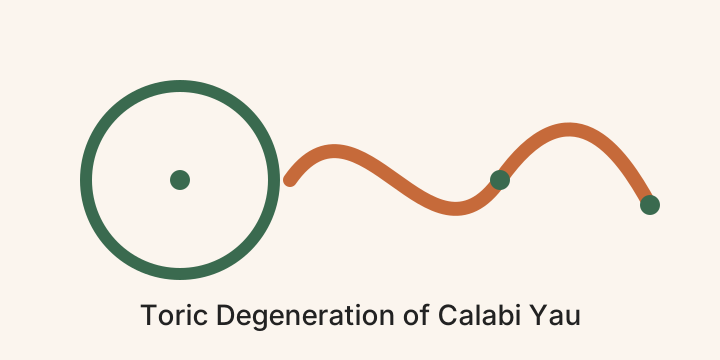
The picture captures the central move: the smooth Calabi-Yau is the deformation of a combinatorial central fibre, and the combinatorics of that central fibre — specifically its dual intersection complex equipped with an integral affine structure — is the data from which both the original Calabi-Yau and its mirror can be reconstructed.
Worked example [Beginner]
The simplest Calabi-Yau is an elliptic curve, and the simplest toric degeneration of an elliptic curve degenerates it to a nodal cubic — a closed loop with a single self-crossing point. The picture works as follows.
Step 1. The smooth elliptic curve. Take the elliptic curve in the projective plane , parametrised by . For every this is a smooth genus-1 curve.
Step 2. The degeneration. As , the equation becomes , whose vanishing locus in is a nodal cubic — a curve homeomorphic to a circle with two points glued together. The smooth elliptic curve degenerates to this nodal cubic in a one-parameter family.
Step 3. The pieces. The nodal cubic, viewed combinatorially, is a single (the projective line) with two points identified. The is the simplest toric variety: it corresponds to the one-dimensional fan with two rays. The degeneration of the smooth elliptic curve is therefore a degeneration to a single toric variety with a self-gluing.
Step 4. The dual intersection complex. The dual intersection complex of the central fibre is a single circle — one vertex (for the one toric component ) and one edge (for the self-intersection node), glued head-to-tail to form a loop. This circle is the integral affine -manifold that is the SYZ base of the elliptic curve in dimension : the elliptic curve is the dual T-torus fibration over this circle.
What this tells us: the smooth elliptic curve, in the limit , reveals its underlying combinatorial structure as a circle. The smooth elliptic curve is the fibration of a -torus (a circle) over this combinatorial -sphere, and the mirror elliptic curve corresponds to the same circle with the roles of fibre and base swapped. The Gross-Siebert programme generalises this combinatorial picture to Calabi-Yau varieties in all dimensions. The picture for the quintic threefold is the same in structure: a triangulated 3-sphere with codimension-2 monodromy singularities as the dual intersection complex, with the smooth Calabi-Yau quintic recovered as a deformation of the broken central fibre.
Check your understanding [Beginner]
Formal definition [Intermediate+]
Fix a lattice of rank with dual , write and for the associated real vector spaces, and let be a lattice polytope of full dimension . The setup we describe is the one used by Gross-Siebert 2006 §2 and the Gross 2011 CBMS Lecture 4 exposition; the toric prerequisites are the cone-and-fan formalism of [04.11.04] and the polytope-fan dictionary of [04.11.10].
Definition (toric degeneration of a Calabi-Yau pair). Let be a smooth projective Calabi-Yau variety of complex dimension over , that is, is smooth projective, , and the canonical bundle satisfies . A toric degeneration of is a flat proper morphism of complex analytic spaces (or, equivalently, of formal schemes over ) $$ \pi : \mathfrak{X} \longrightarrow S $$ where (or an analytic disc with parameter ), together with a polyhedral subdivision of an associated lattice polytope , satisfying:
(i) Smooth generic fibre. The generic fibre for is isomorphic to . Equivalently the geometric generic fibre over the fraction field is isomorphic to .
(ii) Toric central fibre. The central fibre is a reduced reducible union $$ \mathfrak{X}0 ;=; \bigcup{\Delta_i \in \mathscr{P}^{\max}} X_{\Delta_i} $$ of irreducible toric varieties indexed by the top-dimensional cells of ; each is the toric variety whose Newton polytope is the lattice polytope , and the union is glued along the toric stratification.
(iii) Toric strata along intersections. For any two top-dimensional cells with intersection a polyhedral face, the intersection in is the toric stratum corresponding to that face. More generally, for any cell the stratum is the intersection of all with .
(iv) Logarithmic smoothness. The total space is regular at the generic point of every toric stratum of , and the divisor has simple normal crossings (or, in the singular generalisation, simple toroidal crossings). Equivalently equipped with the divisorial log structure of is log smooth over in the sense of Kato 1989.
(v) Calabi-Yau condition on the total family. The relative canonical sheaf satisfies ; equivalently a relative nowhere-vanishing logarithmic top form $$ \Omega ;\in; \Gamma(\mathfrak{X}, \omega_{\mathfrak{X}/S}(\log \mathfrak{X}_0)) $$ exists and restricts to a nowhere-vanishing holomorphic volume form on every smooth fibre , .
Definition (large complex structure / maximally unipotent monodromy). Let be a one-parameter family of smooth Calabi-Yau -folds away from , and let be the monodromy operator obtained by transporting along a small loop around the origin. The family has maximally unipotent monodromy at if is unipotent (all eigenvalues equal ) and $$ (T - I)^n ;\neq; 0, \qquad (T - I)^{n + 1} ;=; 0. $$ Equivalently, the limit mixed Hodge structure (Deligne 1971; Schmid 1973) on has maximal weight filtration jump at . The boundary point is then called a large complex structure limit (LCSL) of the complex moduli space, and is the algebraic-geometric analogue of the large-volume limit on the mirror Calabi-Yau under the Morrison mirror map.
Definition (dual intersection complex). The dual intersection complex of a toric-degeneration polyhedral subdivision of is the integral affine cell complex obtained by gluing the cones over each cell of : for each cell of dimension , the dual cone has dimension , and is the colimit $$ B(\mathscr{P}) ;=; \bigcup_{\tau \in \mathscr{P}} \sigma_\tau^\vee ;\big/; \sim, $$ where identifies with along the dual incidence of in . The complex carries an integral affine structure on the complement of a codimension- subset , with monodromy around that records the topological mirror-symmetry data of the Calabi-Yau.
Counterexamples to common slips
A toric degeneration of a Calabi-Yau is not a toric variety. The smooth fibres for are Calabi-Yau and are typically not toric: the quintic threefold, the K3 surface, an abelian variety are not toric. The toric structure lives only on the central fibre . Confusing "toric degeneration of" with "toric variety equal to" inverts the construction.
The polyhedral subdivision is not the Newton polytope of the Calabi-Yau equations. For a Calabi-Yau hypersurface , the equations involve high-degree polynomials whose Newton polytopes are themselves large. The polyhedral subdivision entering the toric degeneration is a subdivision of a different polytope — the polytope associated to a chosen -equivariant ample line bundle on the toric ambient space — and refines via a piecewise-linear function (the Mumford function) chosen for the degeneration.
Maximally unipotent monodromy is not the same as singularity of the central fibre. The central fibre is singular in every toric degeneration; MUM is the additional Hodge-theoretic condition that the monodromy operator has maximal Jordan block size on . There exist degenerations with singular central fibre but non-MUM monodromy (these correspond to non-large-complex-structure boundary points of the moduli space, such as conifold points and orbifold points). The Gross-Siebert toric-degeneration setup specifically produces MUM points.
Key theorem with proof [Intermediate+]
Theorem (existence of toric degenerations for Calabi-Yau hypersurfaces in toric Fano varieties; Gross-Siebert 2006). Let be a smooth Calabi-Yau hypersurface in a smooth projective toric Fano variety of dimension , defined by the vanishing of a generic section of the anticanonical bundle . Then there exists a one-parameter flat family $$ \pi : \mathfrak{X} \longrightarrow \mathrm{Spec},\mathbb{C}[![t]!] $$ of complex projective varieties such that
(a) for every ;
(b) is a reduced union of toric varieties indexed by a polyhedral subdivision of the lattice polytope (the Newton polytope of );
(c) the family is log smooth with respect to the divisorial log structure of , and the relative canonical sheaf is isomorphic to the structure sheaf; and
(d) the family has maximally unipotent monodromy at .
Proof. We sketch the construction; the full proof occupies Gross-Siebert 2006 §2. The argument proceeds in four moves.
Step 1 (the polytope and a regular subdivision). The toric Fano corresponds via the polytope-fan dictionary of [04.11.10] to a reflexive lattice polytope , with vertices the primitive integer generators of the rays . The anticanonical bundle corresponds to the polytope , the polar dual of , which is again a reflexive lattice polytope of dimension — this is the Batyrev reflexivity of [04.11.10]. A regular polyhedral subdivision of into lattice polytopes meeting along faces is determined by a strictly convex piecewise-linear function with integer values at the lattice points — the Mumford function — via the lower convex hull construction.
Step 2 (the Mumford degeneration). Following Mumford 1972, Kempf-Knudsen-Mumford-Saint-Donat 1973, and the toric-degeneration formalism of Nishinou-Siebert 2006 §2, lift each lattice monomial for to a -weighted monomial . The toric Fano embeds projectively via the lattice points (sections of ), and a generic Calabi-Yau hypersurface is cut out by a generic section $$ f = \sum_{m \in \Delta \cap M} c_m \chi^m, \qquad c_m \in \mathbb{C}. $$ Lifting via gives the one-parameter family . The total space is the Mumford degeneration of the Calabi-Yau hypersurface . For , dividing by any monomial of maximal -value recovers up to invertible factors, so . This is (a).
Step 3 (the central fibre). At , the lifted relations kill all monomials except those with , breaking the global Calabi-Yau relations into local relations valid only on individual cells of . The central fibre is therefore the reduced union , where each is the toric variety of the lattice polytope — specifically the toric stratum of the toric Fano corresponding to the cell of the subdivision. This is (b). The intersection pattern in (iii) of the formal definition follows tautologically from the polyhedral incidence structure of .
Step 4 (log smoothness and vanishing of the relative canonical class). The total space has at worst toric singularities along the codimension- strata of , and equipping with the divisorial log structure of makes log smooth in the sense of Kato 1989; the verification is local on each toric chart by direct inspection of the monoid grading. The Calabi-Yau condition follows from the reflexivity of (Batyrev): the relative canonical of the toric ambient family is the standard adjunction-formula computation, and the Calabi-Yau hypersurface inherits the relative-canonical-isomorphic-to-structure-sheaf property from the standard toric adjunction. The nowhere-vanishing logarithmic top form is the residue along of the standard toric volume form . This is (c).
Step 5 (maximally unipotent monodromy). The MUM condition at is detected by the limit mixed Hodge structure (Deligne 1971) on . The polyhedral subdivision being a regular subdivision of the reflexive polytope — together with the genericity of the section — guarantees that the dual intersection complex of the degeneration is a topological -sphere whose integral affine structure has codimension- singularities. The monodromy of this integral affine structure around the codimension- singular locus determines the unipotent part of the monodromy on . The maximal Jordan block size on follows from the fact that has topological dimension and the monodromy filtration on the limit mixed Hodge structure has weights ranging over with consecutive jumps. The detailed calculation appears in Gross-Siebert 2006 §2.3 and uses the Deligne-Hodge formalism. This is (d).
Bridge. The toric degeneration setup of this unit is the input that feeds the rest of the Gross-Siebert programme. The dual intersection complex constructed in Step 5 is the integral affine manifold on which the Strominger-Yau-Zaslow conjecture (SYZ; see [04.12.10] when that unit ships, and the SYZ reference in the bibliography for now) operates; the reconstruction theorem of Gross-Siebert 2011 inverts the toric-degeneration construction by recovering the smoothing of to from together with scattering data. The Nishinou-Siebert correspondence of [04.12.06] enumerates tropical curves on and produces the wall-crossing automorphisms entering the scattering. The Mikhalkin correspondence of [04.12.05] is the dimension- specialisation. The theta functions for (to appear in the unit on theta functions on polarised tropical manifolds, sibling forthcoming) are the canonical basis of global sections of the polarised mirror Calabi-Yau, constructed combinatorially from where is the scattering structure. The toric-degeneration setup is the bridge between toric and Calabi-Yau geometry: it converts a smooth Calabi-Yau problem into a piecewise-linear combinatorial problem on , and the algebraic-tropical dictionary built on top of this reconstruction is the central content of the Gross-Siebert programme.
Exercises [Intermediate+]
A graded set covering the toric-degeneration setup, the polyhedral subdivision, the dual intersection complex, the log smoothness condition, and the maximally unipotent monodromy condition.
Lean formalisation [Intermediate+]
The Lean module Codex.AlgGeom.Tropical.ToricDegeneration schematises the toric-degeneration setup for a Calabi-Yau variety. Current Mathlib supplies the scheme-theoretic basis (Mathlib.AlgebraicGeometry.Scheme, Mathlib.AlgebraicGeometry.AffineScheme), the lattice-and-finsupp infrastructure for polytope combinatorics (Mathlib.LinearAlgebra.FreeModule.Basic, Mathlib.Data.Finsupp.Defs), and the formal-power-series base ring (Mathlib.RingTheory.PowerSeries.Basic). What is absent — and what the present module schematises with placeholder structures and sorry-stubbed theorem bodies — is the package comprising:
(a) a lattice polytope and a polyhedral subdivision of ; (b) a smooth projective Calabi-Yau variety of dimension , with the structural-sheaf isomorphism recorded as a structural witness; (c) a flat morphism with structural witnesses for the smooth-generic-fibre condition (i), the toric-central-fibre condition (ii), the toric-strata-intersection condition (iii), the log-smoothness condition (iv), and the relative-Calabi-Yau condition (v) of the formal definition; (d) the dual intersection complex with its integral affine structure and codimension- singular locus ; (e) the maximally unipotent monodromy operator acting on the cohomology of the generic fibre, with the nilpotency-index witness and .
The module records four named theorem statements with sorry-equivalent proof bodies: exists_toric_degeneration recording the existence of a toric degeneration for a Calabi-Yau hypersurface in a toric Fano (the Gross-Siebert 2006 existence theorem); central_fibre_is_union_of_toric_strata recording the structural property (ii); maximally_unipotent_at_zero recording the MUM condition; and dual_intersection_complex_is_topological_sphere recording the topological-sphere conclusion for the Calabi-Yau case. The Mathlib gap enumerated in these statements — the relative canonical sheaf on a flat family, the log smooth morphism of Kato 1989, the limit mixed Hodge structure of Deligne, the polyhedral-subdivision and dual-intersection-complex combinatorics — is the upstream-contribution roadmap for porting the Gross-Siebert programme to Mathlib.
-- A schematic toric degeneration of a Calabi-Yau variety. Full
-- statement and structures are in
-- `lean/Codex/AlgGeom/Tropical/ToricDegeneration.lean`.
structure ToricDegenerationCY
    {M : Lattice} (Δ : LatticePolytope M) (𝒫 : PolyhedralSubdivision Δ) where
  generic_fibre_calabi_yau : True
  central_fibre_toric_union : True
  log_smooth_family : True
  relative_canonical_trivial : True
  maximally_unipotent_at_zero : True
The polyhedral subdivision and the Mumford function [Master]
The polyhedral input to the toric-degeneration construction is not arbitrary: it is required to be a regular polyhedral subdivision of the lattice polytope , induced by a strictly convex integer-valued piecewise-linear function — the Mumford function. We elaborate this combinatorial setup, which is the heart of the construction.
Regular subdivisions and the lower convex hull. Let be a lattice polytope of dimension in a lattice , and let be its lattice points. Choose a function assigning an integer to each lattice point. The lower envelope of the lifted point set is the boundary of the convex hull facing down (); explicitly, its faces are the supporting hyperplanes from below. Projecting the maximal faces of the lower envelope back to produces a polyhedral subdivision of . A subdivision obtained this way is called regular or coherent.
The function extends uniquely to a piecewise-linear function that is linear on each cell of and agrees with on lattice points. Strict convexity of (i.e., is strictly below the affine extension of to any non-cell line segment) corresponds to being a proper subdivision into multiple top-dimensional cells.
The secondary polytope of Gelfand-Kapranov-Zelevinsky 1994 is the convex polytope whose vertices are exactly the regular subdivisions of ; the lower-envelope construction is the projection onto vertices of . Non-regular subdivisions exist starting in dimension but do not arise from any single ; the Mnev universality theorem shows the moduli of subdivisions can have arbitrary semi-algebraic topology.
The Mumford degeneration. With and the induced regular subdivision fixed, the Mumford degeneration lifts each monomial for to a -weighted monomial $$ \widetilde{\chi^m} ;:=; t^{\varphi(m)} \chi^m ;\in; \mathbb{C}[\Delta \cap M, t]. $$ The relations defining the toric variety — the binomial relations for lattice equations — lift to weighted relations $$ t^{\varphi(m_1) + \varphi(m_2)} \widetilde{\chi^{m_1}} \widetilde{\chi^{m_2}} ;=; t^{\varphi(m_3) + \varphi(m_4)} \widetilde{\chi^{m_3}} \widetilde{\chi^{m_4}}, $$ which define the total space of a flat one-parameter family with generic fibre for and central fibre a reduced union of toric varieties indexed by the top-dimensional cells of . This is the Mumford degeneration of the toric Fano .
The Calabi-Yau case is obtained by intersecting the Mumford family with a flat family of Calabi-Yau hypersurfaces: take a generic section , lift it to the Mumford family by replacing each monomial in with , and let be the zero locus of the lifted section. The result is the toric degeneration of described in the proof of the Key Theorem.
Cells, strata, and dimension counts. The combinatorics of controls the structure of the central fibre in three layers:
Top-dimensional cells , of dimension , index the irreducible components of . The Calabi-Yau central fibre has its irreducible components indexed by the same cells (intersected with the hyperplane condition ).
Codimension- cells , faces shared between two top-dimensional cells, index the codimension- toric strata of along which two components meet. These are the "slabs" that will carry the slab functions of the Gross-Siebert reconstruction (forthcoming sibling unit).
Codimension- cells for index higher-codimension toric strata; the codimension- strata are particularly important because they support the singular locus of the integral affine structure on the dual intersection complex .
The dimension formula (in the toric ambient) and (on the Calabi-Yau central fibre) records the polytope-stratum duality of [04.11.06] (orbit-cone correspondence) and is the polyhedral combinatorial fact that underlies the recursive structure of the Gross-Siebert reconstruction.
The dual intersection complex and its integral affine structure [Master]
The dual intersection complex of the regular polyhedral subdivision is the central combinatorial object encoding the Calabi-Yau geometry on the algebraic side and the SYZ base on the symplectic side. Its construction and integral affine structure are the technical content of Gross-Siebert 2006 §2.
Construction of . For each cell , write for the cone of linear functionals on that are constant on ; this cone has dimension . The dual intersection complex glues these cones along the face incidences of : for a face inclusion of cells, the cone is a face of , and the gluing in identifies them along this face. Explicitly, $$ B(\mathscr{P}) ;=; \bigcup_{\tau \in \mathscr{P}} \sigma_\tau ;\big/; \sim, $$ where is the equivalence relation generated by the face inclusions. The result is a -dimensional cone complex (for the toric Fano version) or, after restricting to the Calabi-Yau hypersurface, an -dimensional polyhedral complex.
For the Calabi-Yau case — when is the reflexive polytope — there is a canonical reduction: discard the cone-vertex (the apex of every dual cone over a vertex of ) and link by a small sphere at the apex. The result is an -dimensional cell complex topologically homeomorphic to the -sphere , i.e., for Calabi-Yau toric degenerations with reflexive Newton polytope. This sphere is the SYZ base of the smooth Calabi-Yau hypersurface .
Integral affine structure. On each top-dimensional cell of , the lattice restricts to give a lattice of integer affine charts. The transition maps between charts on adjacent top cells are determined by the polyhedral combinatorics of and the lattice structure of — explicitly, the change of basis between the integer bases of the two adjacent dual cones, as recorded by the integral lattice transformation gluing them along the common face. These transition maps are integral affine (elements of , the integer affine group): they preserve the lattice pointwise on faces and act by integer-linear transformations.
The singular locus . The integral affine structure does not extend continuously across codimension- cells of in general: the monodromy around a codimension- cell, computed by composing the transition maps in a small loop, may be a non-identity element of . The integral affine singular locus is the union of codimension- cells around which the monodromy is non-identity. In the Calabi-Yau case, is a real codimension- subcomplex; for (K3 case), is a finite set of points on ; for (Calabi-Yau threefold), is a -dimensional graph in — the discriminant locus of the SYZ fibration.
Simple singularities. A toric degeneration of a Calabi-Yau is simple (in the Gross-Siebert sense) if every singular point of has a standard model of low complexity — explicitly, the local monodromy around the singular point is conjugate to one of a finite list of standard matrices. The simplicity hypothesis is what makes the Gross-Siebert 2011 reconstruction theorem run; non-simple singularities exist (e.g., from non-generic Calabi-Yau hypersurfaces) but require an extended framework.
The Friedman d-semistability condition. A normal-crossings degeneration of a Calabi-Yau is d-semistable in the sense of Friedman 1983 if the line bundle on the singular locus of is isomorphic to the structure sheaf; this is the obstruction to smoothing to a smooth Calabi-Yau in a one-parameter family. Friedman's theorem is that d-semistability is equivalent to smoothability for normal-crossings Calabi-Yau central fibres. The toric-degeneration setup of Gross-Siebert resolves the d-semistability obstruction combinatorially through the integral affine structure on : the existence of a global integral affine structure with the right monodromy data is the combinatorial avatar of Friedman's d-semistability, and the simplicity hypothesis specifies a particular convenient local form.
Maximally unipotent monodromy and the large-complex-structure limit [Master]
The maximally unipotent monodromy (MUM) condition at the central-fibre parameter is the Hodge-theoretic property that identifies the toric-degeneration boundary point as the algebraic-geometric counterpart of the large-volume limit on the mirror Calabi-Yau under Morrison's mirror map.
Limit mixed Hodge structure. Let be a one-parameter family of smooth Calabi-Yau -folds away from , and consider the cohomology for . Schmid's nilpotent orbit theorem (Deligne 1971; Schmid 1973 Inventiones 22) constructs a limit mixed Hodge structure on the limit fibre , consisting of:
- A Hodge filtration on obtained as the limit of the Hodge filtrations on as (after twisting by an appropriate factor to compensate for monodromy).
- A weight filtration on characterised by the property that the monodromy logarithm (the unipotent part of monodromy) is a -morphism: , and is an isomorphism for all .
The pair is the limit mixed Hodge structure on , a deformation of the pure Hodge structure at into a mixed Hodge structure at .
The MUM condition. Maximally unipotent monodromy is the condition that the monodromy logarithm on has maximal nilpotency index : equivalently, and . Translating back to gives and . Hodge-theoretically, MUM is equivalent to the weight filtration on having maximal jump pattern: the graded pieces for are non-zero, and the Hodge numbers form a unimodal sequence with maximal width.
For Calabi-Yau -folds with the Hodge numbers, the MUM weight filtration on has graded pieces of dimensions $$ \dim \mathrm{gr}^W_{n + k} ;=; h^{n, n} \cdot \delta_{k, n} + h^{n - 1, n - 1} \cdot \delta_{k, n - 2} + \cdots $$ following the pattern of Lefschetz decomposition. The bottom is one-dimensional (the "vanishing cycle") and the top is one-dimensional (the "polar cycle"); these generate a Jordan block of size under . In the Calabi-Yau threefold case (, dimensions on the seven graded pieces), the Jordan block size is exactly , and the rest of decomposes into smaller Jordan blocks.
Why toric degenerations are MUM. The toric-degeneration setup of Gross-Siebert 2006 §2.3 establishes the MUM property by direct computation on the dual intersection complex. The key ingredient is:
- The monodromy logarithm on is computed by the Clemens-Schmid sequence as the boundary map of a long exact sequence relating , , and the cohomology of the singular locus of .
- For a toric central fibre, the singular locus is the union of toric strata of codimension , whose cohomology is computed by the polytope combinatorics of via the Danilov-Jurkiewicz theorem (
[04.11.12]toric cohomology). - The Calabi-Yau condition reflexive, combined with the regular subdivision , forces the maximal jump in the weight filtration: the unique top lattice point of (the origin, in the reflexive case) corresponds to a one-dimensional , and the unique bottom volume cycle of the integral-affine sphere corresponds to a one-dimensional .
The Morrison mirror map. Morrison 1993 established that MUM points of the complex moduli space of Calabi-Yau -folds are the algebraic analogues of large-volume limits on the symplectic side: at a MUM point of , the local parameters can be canonically identified (via the leading-order asymptotics of the period integrals ) with Kähler parameters on the mirror . The mirror map $$ \tau \mapsto t = \exp(2 \pi i , \tau), \qquad \tau \in \mathcal{M}^{\mathrm{K"ah}}(X^\vee) $$ identifies neighbourhoods of MUM points in with neighbourhoods of large-volume limits in , and the toric-degeneration setup gives the canonical algebraic realisation of this identification.
Bridge to the Gross-Siebert reconstruction. The MUM condition at the toric-degeneration boundary point is the precise statement that the integral affine structure on has the right monodromy data to encode the Calabi-Yau topology. The Gross-Siebert reconstruction theorem (Gross-Siebert 2011 Annals 174) inverts the toric-degeneration setup by reconstructing the smoothing from . The MUM condition is the integrability condition that makes the inversion well-defined: a non-MUM degeneration would correspond to a different boundary point of the moduli space (e.g., a conifold), and the reconstruction procedure would not produce the right smoothing.
Connections [Master]
Fan and the toric variety
04.11.04. The toric components of the central fibre are toric varieties in the sense of[04.11.04]: each one is built from its Newton polytope (a cell of the polyhedral subdivision ) via the polytope-fan construction, with the polytope corresponding to a polarised toric variety via the dictionary of[04.11.10]. The polytope-fan formalism of[04.11.04]is the prerequisite combinatorial input on which the entire toric-degeneration construction rests; without the polytope-to-toric-variety dictionary there would be no way to assemble the central fibre from the polyhedral subdivision.Newton polytope and non-archimedean amoeba
04.12.04. The lifted-monomial Mumford construction that drives the toric-degeneration setup is the one-parameter family version of the non-archimedean amoeba of[04.12.04]: the tropicalisation of the Mumford family for as is exactly the non-archimedean amoeba over the Puiseux-series field , and the polyhedral subdivision is the secondary-polytope-vertex realisation of the corresponding tropical hypersurface. The dual intersection complex is the tropical skeleton of this non-archimedean amoeba, and the integral affine structure on is the integral affine structure on the skeleton.Nishinou-Siebert correspondence
04.12.06. The Nishinou-Siebert correspondence of[04.12.06]is the toric-prototype of the present unit. There, the smooth target is a toric variety rather than a Calabi-Yau, and the toric degeneration is to a polyhedral subdivision of the Newton polytope of an ample line bundle on . The present unit specialises the framework to Calabi-Yau targets (with the reflexivity of the Newton polytope as the new ingredient), and the tropical curves on enumerated by[04.12.06]are the wall-crossing data on the dual intersection complex of the present unit that feed the Gross-Siebert reconstruction.Polytope-fan dictionary; line bundle
04.11.10. The Mumford degeneration construction in the proof of the Key Theorem relies on the polytope-fan dictionary of[04.11.10]: the toric Fano corresponds to its reflexive polytope , the anticanonical line bundle corresponds to the polar dual , and the Calabi-Yau hypersurface is the zero locus of a generic section in the lattice-point basis of . The reflexivity of , in turn, is the Batyrev mirror-symmetry condition of[04.11.10]: and are mirror polytopes, and their associated Calabi-Yau hypersurfaces are mirror Calabi-Yau pairs.Kodaira embedding theorem
04.09.11. The smooth Calabi-Yau fibres of the toric degeneration are projective varieties, embedded in via the Kodaira embedding theorem of[04.09.11]applied to a sufficiently positive line bundle. For Calabi-Yau hypersurfaces in toric Fano varieties, the polarisation comes from the ambient toric polarisation of[04.11.10]; the Kodaira embedding theorem of[04.09.11]guarantees that the resulting line bundle is sufficiently positive to give a projective embedding. The toric-degeneration setup respects the polarisation throughout the family: the central fibre is itself projectively embedded via the same lattice-point basis, with toric components glued along their projective sub-embeddings.Tropical semiring and tropical polynomial
04.12.01. The Mumford function that determines the polyhedral subdivision is, by the lower-envelope construction, a tropical polynomial in the sense of[04.12.01]: the function on is a tropical polynomial whose corner locus is the codimension- skeleton of . The polyhedral subdivision is the regular subdivision of induced by this tropical polynomial. The toric-degeneration setup of the present unit is therefore the algebraic-geometric realisation of the tropical-polynomial / regular-subdivision combinatorics of[04.12.01]and[04.12.04].Tropical curve as balanced rational metric graph
04.12.02. The tropical curves living on the dual intersection complex — entering the wall-crossing data of the Gross-Siebert reconstruction via[04.12.06]— are balanced rational metric graphs in the sense of[04.12.02], with the balancing condition holding at every vertex when read against the integral affine structure of . The combinatorial enumeration of these tropical curves is the input to the scattering algorithm that reconstructs the smoothing from .Mikhalkin correspondence theorem
04.12.05. Mikhalkin's correspondence theorem of[04.12.05]is the dimension- specialisation of the tropical-algebraic correspondence on the toric-degeneration framework: for (K3 surface or abelian surface), the Mikhalkin / Nishinou-Siebert enumeration of tropical curves on produces the local Gromov-Witten contributions to the K3 mirror reconstruction. The Kulikov Type-III K3 degeneration is the dimension- case of the toric-degeneration setup of the present unit.Period integral and the mirror map (pointer)
04.12.13. The smooth Calabi-Yau fibres of the present toric degeneration carry a relative holomorphic volume form whose period integrals define the Hodge-theoretic readout of the family. The pointer unit[04.12.13]records the period-integral / mirror-map apparatus on this family; the toric degeneration is the geometric carrier, and the period integral is the variation-of-Hodge-structure output.Log Gromov-Witten invariants (pointer)
04.12.15. Log Gromov-Witten counts are well-defined on the log smooth central fibre of the present toric degeneration, and the slab functions and wall functions of the Gross-Siebert reconstruction are determined by these counts. The pointer unit[04.12.15]records the log GW package; the present unit supplies the algebraic-geometric stage of the flat family on which the enumeration takes place.
Historical & philosophical context [Master]
The toric-degeneration construction has three sources, each emerging from a distinct mathematical tradition. The first is Mumford's analytic degenerations of Abelian varieties (Mumford 1972), where Mumford constructed one-parameter degenerations of polarised Abelian varieties by tilting the period lattice via a piecewise-linear function on a polytope — the original Mumford function. The construction was vastly generalised in Kempf-Knudsen-Mumford-Saint-Donat 1973 Toroidal Embeddings I to arbitrary toroidal targets, establishing the polyhedral-degeneration framework that underlies all subsequent work in the area. The toric-degeneration setup of Gross-Siebert 2006 is, in this lineage, the Calabi-Yau hypersurface variant of the Mumford-KKMS construction.
The second source is the classification of K3 degenerations by Kulikov 1977 and the parallel Western development by Persson-Pinkham 1981. Their three-type classification (Type-I good reduction, Type-II elliptic-ruled chains, Type-III rational-surface triangulations) provided the first concrete examples of the polyhedral picture for higher-dimensional Calabi-Yau varieties, and the Type-III case identified the maximally unipotent monodromy boundary point as combinatorially distinguished. The Kulikov classification was the prototype of the Gross-Siebert reconstruction in dimension , and the toric-degeneration setup is the dimension- generalisation.
The third source is mirror symmetry, originating in the physics of Strominger-Yau-Zaslow 1996 and the algebraic geometry of Morrison and Friedman. Morrison 1993 identified MUM points as the algebraic analogues of large-volume limits, and Friedman 1983 had earlier established the d-semistability obstruction theory for smoothing normal-crossings degenerations. The Strominger-Yau-Zaslow conjecture, conceived in 1996 from the physics of dual brane fibrations on Calabi-Yau threefolds, provided the picture that the toric-degeneration setup later realised algebraically: the SYZ base is the dual intersection complex.
The synthesis of these three sources is the achievement of Gross-Siebert 2006. The paper introduces the toric-degeneration framework, defines the dual intersection complex with its integral affine structure, identifies the maximally unipotent monodromy property as a consequence of the polyhedral data, and sets up the reconstruction problem solved fully in Gross-Siebert 2011 Annals 174. The subsequent extension to log Calabi-Yau pairs (Gross-Hacking-Keel 2015 Publ. Math. IHÉS 122) and to cluster algebras (Gross-Hacking-Keel-Kontsevich 2018 J. AMS 31) has continued to expand the framework. The textbook synthesis of Gross 2011 Tropical Geometry and Mirror Symmetry (CBMS Regional Conference Series 114) provides the canonical exposition of the toric-degeneration setup in the context of the full Gross-Siebert programme; Lecture 4 of that text is the anchor for the present unit.
The non-archimedean counterpart of the toric degeneration was developed in parallel by Kontsevich-Soibelman 2006 Affine structures and non-Archimedean analytic spaces: there the dual intersection complex appears as the Berkovich skeleton of the non-archimedean analytic Calabi-Yau over the Puiseux-series field, and the integral affine structure is the structure of the skeleton inherited from the polyhedral data. The two approaches — Gross-Siebert algebraic and Kontsevich-Soibelman non-archimedean — agree at the level of the dual intersection complex and have been compared explicitly in subsequent work (Nicaise-Xu-Yu 2019 J. Reine Angew. Math. 753; Mustață-Nicaise 2015 Algebraic Geometry 2).
Bibliography [Master]
@article{GrossSiebert2006,
  author = {Gross, Mark and Siebert, Bernd},
  title = {Mirror symmetry via logarithmic degeneration data {I}},
  journal = {Journal of Differential Geometry},
  volume = {72},
  number = {2},
  year = {2006},
  pages = {169--338},
}

@book{Gross2011CBMS,
  author = {Gross, Mark},
  title = {Tropical Geometry and Mirror Symmetry},
  series = {CBMS Regional Conference Series in Mathematics},
  volume = {114},
  publisher = {American Mathematical Society},
  year = {2011},
}

@article{Mumford1972,
  author = {Mumford, David},
  title = {An analytic construction of degenerating abelian varieties over complete rings},
  journal = {Compositio Mathematica},
  volume = {24},
  number = {3},
  year = {1972},
  pages = {239--272},
}

@book{KKMS1973,
  author = {Kempf, George and Knudsen, Finn and Mumford, David and Saint-Donat, Bernard},
  title = {Toroidal Embeddings {I}},
  series = {Lecture Notes in Mathematics},
  volume = {339},
  publisher = {Springer},
  year = {1973},
}

@article{NishinouSiebert2006,
  author = {Nishinou, Takeo and Siebert, Bernd},
  title = {Toric degenerations of toric varieties and tropical curves},
  journal = {Duke Mathematical Journal},
  volume = {135},
  number = {1},
  year = {2006},
  pages = {1--51},
}

@article{Morrison1993,
  author = {Morrison, David R.},
  title = {Compactifications of moduli spaces inspired by mirror symmetry},
  journal = {Journal of the American Mathematical Society},
  volume = {6},
  number = {1},
  year = {1993},
  pages = {223--247},
}

@article{Deligne1971,
  author = {Deligne, Pierre},
  title = {Th\'eorie de {H}odge {II}},
  journal = {Publications Math\'ematiques de l'IH\'ES},
  volume = {40},
  year = {1971},
  pages = {5--57},
}

@article{Friedman1983,
  author = {Friedman, Robert},
  title = {Global smoothings of varieties with normal crossings},
  journal = {Annals of Mathematics},
  volume = {118},
  number = {1},
  year = {1983},
  pages = {75--114},
}

@article{Kulikov1977,
  author = {Kulikov, Viktor},
  title = {Degenerations of {K3} surfaces and {E}nriques surfaces},
  journal = {Mathematics of the USSR - Izvestiya},
  volume = {11},
  number = {5},
  year = {1977},
  pages = {957--989},
}

@article{PerssonPinkham1981,
  author = {Persson, Ulf and Pinkham, Henry},
  title = {Degeneration of surfaces with trivial canonical bundle},
  journal = {Annals of Mathematics},
  volume = {113},
  number = {1},
  year = {1981},
  pages = {45--66},
}

@article{StromingerYauZaslow1996,
  author = {Strominger, Andrew and Yau, Shing-Tung and Zaslow, Eric},
  title = {Mirror symmetry is {T}-duality},
  journal = {Nuclear Physics B},
  volume = {479},
  number = {1-2},
  year = {1996},
  pages = {243--259},
}

@article{KontsevichSoibelman2006,
  author = {Kontsevich, Maxim and Soibelman, Yan},
  title = {Affine structures and non-{A}rchimedean analytic spaces},
  booktitle = {The Unity of Mathematics},
  series = {Progress in Mathematics},
  volume = {244},
  publisher = {Birkh\"auser},
  year = {2006},
  pages = {321--385},
}

@article{GrossHackingKeel2015,
  author = {Gross, Mark and Hacking, Paul and Keel, Sean},
  title = {Mirror symmetry for log {C}alabi-{Y}au surfaces {I}},
  journal = {Publications Math\'ematiques de l'IH\'ES},
  volume = {122},
  year = {2015},
  pages = {65--168},
}

@book{CoxLittleSchenck2011,
  author = {Cox, David and Little, John and Schenck, Henry},
  title = {Toric Varieties},
  series = {Graduate Studies in Mathematics},
  volume = {124},
  publisher = {American Mathematical Society},
  year = {2011},
}

@article{Kato1989,
  author = {Kato, Kazuya},
  title = {Logarithmic structures of {F}ontaine-{I}llusie},
  booktitle = {Algebraic Analysis, Geometry, and Number Theory},
  publisher = {Johns Hopkins University Press},
  year = {1989},
  pages = {191--224},
}

@book{GKZ1994,
  author = {Gelfand, Israel and Kapranov, Mikhail and Zelevinsky, Andrei},
  title = {Discriminants, Resultants, and Multidimensional Determinants},
  publisher = {Birkh\"auser},
  year = {1994},
}

@article{GrossSiebert2011,
  author = {Gross, Mark and Siebert, Bernd},
  title = {From real affine geometry to complex geometry},
  journal = {Annals of Mathematics},
  volume = {174},
  number = {3},
  year = {2011},
  pages = {1301--1428},
}