Slab function and structure of a tropical manifold
Anchor (Master): Gross-Siebert 2010 *J. Algebraic Geom.* 19 *Mirror symmetry via logarithmic degeneration data II* §1-§4 (slab functions and the consistency-of-structure theorem); Gross-Siebert 2011 *Annals of Mathematics* 174 *From real affine geometry to complex geometry* §2 (the data $(B, \mathscr{P}, \varphi, \mathscr{S})$ and the reconstruction theorem from a consistent structure $\mathscr{S}$); Gross 2011 *TGMS* CBMS 114 Lecture 5 (textbook synthesis); Carl-Pumperla-Siebert 2010 arXiv:1011.6228 (scattering diagrams from Gross-Siebert log-Gromov-Witten counts; the algorithm assembling the consistent structure from broken lines); Kontsevich-Soibelman 2006 *Birkhäuser* (affine structures with singularities and the non-archimedean SYZ); Gross-Hacking-Keel 2015 *Publ. Math. IHÉS* 122 (the cluster-algebra realisation of the same scattering / slab apparatus); Cox-Little-Schenck 2011 *Toric Varieties* (AMS GSM 124) Ch. 1-3 + Ch. 6 (the toric-coordinate language used at every step)
Intuition [Beginner]
A tropical manifold is a piecewise-linear space cut into polyhedral chambers, with integer affine coordinates on each chamber but the gluing between adjacent chambers possibly twisted. When you try to lift this piecewise-linear picture back to a smooth complex Calabi-Yau variety, the gluing data on each chamber is a toric chart, and the data on each wall between two chambers must record how the two toric charts paste together. The polynomial that encodes this pasting is called a slab function.
A slab function lives on a codimension-one face — a "slab" between two adjacent maximal chambers — and it is a Laurent polynomial in the toric coordinates that are common to both chambers. The total collection of slab functions and other wall-crossing data is the structure of the tropical manifold, written . The structure is the bookkeeping object: it tells you, at every wall in the manifold, exactly how the two sides of the wall are glued so that the resulting complex manifold is well-defined.
Without slab functions, the chambers would just be isolated toric charts that happen to share a polyhedral boundary. With slab functions, the toric charts are glued into a single coherent smooth complex variety. Slab functions are what turn the combinatorial-tropical skeleton into honest algebraic geometry.
Visual [Beginner]
A two-panel cartoon. Left panel: a piecewise-linear surface partitioned into polyhedral chambers (think hexagonal patches on a flat region of a tropical manifold), with the codimension-one boundaries between chambers highlighted in colour. Right panel: a zoom on one such boundary slab between two chambers, with a Laurent polynomial labelled along the slab, recording the transition data between the toric charts on the two adjacent chambers.
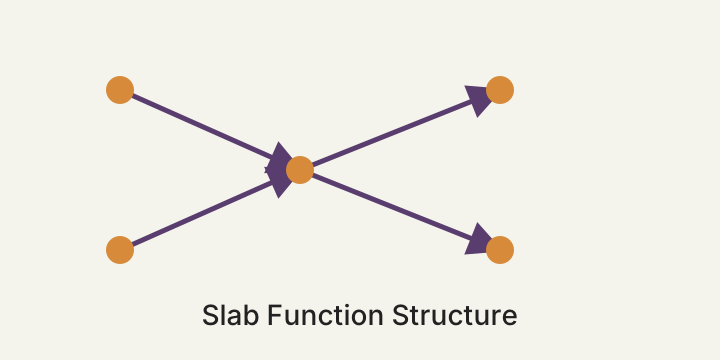
The picture captures the slab function as a piece of polynomial data attached to a codimension-one face of the polyhedral decomposition. Each maximal chamber carries its own toric coordinates; each slab between two chambers carries a polynomial in the coordinates common to both, and this polynomial is exactly the gluing rule.
Worked example [Beginner]
Consider the simplest substantive tropical manifold: a one-dimensional piecewise-linear interval split into two segments at a single interior point. The two segments are two chambers; the single interior point is one slab.
Step 1. On the left chamber, toric coordinates are a single variable . On the right chamber, toric coordinates are a single variable .
Step 2. At the slab between them, the two coordinates must be identified by a transition rule. The simplest substantive slab function is $$ f_\rho ;=; 1 + t \cdot z, $$ where is a deformation parameter measuring how far from the central fibre we are. The transition rule says: on the slab, glue .
Step 3. The resulting one-dimensional complex manifold is a one-parameter family. When , the slab function reduces to and the two chambers paste along the identity transition , giving a degenerate central fibre. When , the slab function deforms the transition, smoothing out the meeting point into a single smooth complex curve.
What this tells us: the slab function is the polynomial that interpolates between the identity central-fibre gluing and the smoothed generic-fibre transition. A whole tropical manifold has many chambers and many slabs; the collection of all slab functions is the structure , and consistency of is what allows the chambers to paste into a single coherent complex Calabi-Yau.
Check your understanding [Beginner]
Formal definition [Intermediate+]
Fix a tropical manifold of dimension in the sense of [04.12.08]: a topological manifold together with a polyhedral decomposition and an integral affine structure on with singularities along a codimension-2 closed subset , satisfying the local-models conditions of Gross-Siebert (every point of admits an open affine chart in , and the singularities along are of the focus-focus or join-up type). Fix in addition a strictly convex piecewise-linear function on — the polarisation of the tropical manifold — making a polarised tropical manifold.
Write for the set of -dimensional cells of . Maximal cells are elements of ; slabs are codimension-one cells in that lie in and separate two maximal cells. For a maximal cell, the tangent space at any interior point of is the integral lattice of the affine chart on , and the toric ring of is $$ R_\sigma ;:=; \mathbb{C}[t, t^{-1}][\Lambda_\sigma] ;=; \mathbb{C}[t, t^{-1}][z^{m} \mid m \in \Lambda_\sigma], $$ the Laurent-polynomial ring on over the deformation parameter ring .
Definition (slab function). Let be a slab with adjacent maximal cells . Let be the tangent integral lattice of , sitting inside both and as the common codimension-one sublattice. A slab function on is a Laurent polynomial $$ f_\rho ;\in; \mathbb{C}[t][\Lambda_\rho] ;=; \mathbb{C}[t][z^{m} \mid m \in \Lambda_\rho] $$ in the toric coordinates of , normalised so that $$ f_\rho \big|{t = 0} ;=; 1 \in \mathbb{C}[\Lambda\rho], $$ and required to be compatible at every codimension-two cell with — meaning the local slab-function pull-back at is an analytic restriction from a Laurent polynomial in that is itself the slab-function output at for any neighbouring slab.
Definition (wall). A wall is a codimension-one rational polyhedral subset in the interior of a maximal cell (so does not coincide with a face of ) together with a wall-crossing automorphism $$ \theta_\mathfrak{d} ;\in; \mathrm{Aut}\big(R_\sigma \big/ (t^N)\big) $$ of the truncated toric ring of , for some order . The wall-crossing automorphism is required to be of the form $$ \theta_\mathfrak{d}(z^m) ;=; z^m \cdot f_\mathfrak{d}^{\langle n_\mathfrak{d}, m\rangle}, $$ where is a wall function and is a primitive normal covector to in . The exponent is the signed transverse-crossing number of the monomial direction across .
Definition (structure). A structure on is a pair consisting of:
A collection of slab functions, one on each slab away from the discriminant locus, normalised as above.
A locally finite collection of walls in the interiors of maximal cells, satisfying a consistency condition at every codimension-two cell : the product of wall-crossing automorphisms around a small loop encircling in , taken in the order prescribed by the cyclic ordering of walls and slabs at , is the identity automorphism modulo for every .
The locally-finite condition means that for every compact and every , only finitely many with have non-identity wall-crossing automorphism modulo .
Counterexamples to common slips
A slab function is not an arbitrary Laurent polynomial in . The normalisation is the defining condition: is a -deformation of the constant function . Without this normalisation, the central-fibre gluing would not be the identity pasting that the toric-degeneration setup requires.
A slab is not the same as a wall. A slab is a codimension-one face of the polyhedral decomposition in the away-from-discriminant region ; it is a constituent of . A wall is a separate codimension-one polyhedral subset added in the interior of a maximal cell to enforce consistency; it is not a face of . Both are codimension one in , but their roles in are different: slab functions are imposed input; walls are computed output of the scattering algorithm.
The consistency condition is not automatic from a choice of slab functions. The slab functions alone produce a system of toric-chart transition rules that, in general, fails to glue consistently around a codimension-2 cell — the round-trip product around deviates from the identity at order or higher. The walls are added precisely to absorb this deviation: their wall-crossing automorphisms must compose to cancel the slab-function monodromy at every . Consistency is a substantive condition that, in the Gross-Siebert programme, is solved order-by-order in by the scattering algorithm of Kontsevich-Soibelman / Carl-Pumperla-Siebert.
Key theorem with proof [Intermediate+]
Theorem (consistency-of-structure, Gross-Siebert 2010). Let be a polarised tropical manifold of dimension , and let be a consistent structure on it. Then for every order there is a flat -family of schemes with central fibre the toric central fibre of the polarised tropical manifold, and the families for assemble into a formal flat family whose generic fibre is a smoothing of .
Proof. The proof has three movements. We give the intermediate version; the Master tier elaborates the Čech-cohomological framing.
Step 1 (chartwise scheme structure from the toric data). Each maximal cell carries a toric ring . The chartwise scheme is the affine toric scheme over associated to the cocharacter lattice . The central-fibre scheme is the affine toric variety .
Step 2 (codimension-one gluing via slab functions). For adjacent maximal cells sharing a slab , the slab function defines a transition rule between the toric coordinates on and . Specifically, if and are the toric monomials adjacent to (i.e., the primitive normals to pointing into and respectively), the transition is $$ z_- ;=; z_+^{-1} \cdot f_\rho \cdot \pi_\rho, $$ where is a power of determined by the polarisation across . The relation defines the gluing of the two affine schemes and along the codimension-one stratum . This is the local model on every slab.
Step 3 (consistency at codimension two via walls). At every codimension-two cell , the slab functions on the slabs adjacent to produce a transition cocycle on the small loop around in . By the consistency condition built into , the product of slab transitions around , composed with the wall-crossing automorphisms of the walls crossing the small loop, is the identity automorphism modulo . Therefore the chartwise schemes glue consistently around every .
Combining the three movements: for every the chartwise affine schemes glue into a single flat -scheme . The compatibility is automatic from the chartwise constructions. The formal limit is the desired flat formal family with central fibre . Effective algebraisation of to an honest one-parameter family is the reconstruction theorem of [04.12.09]; the present theorem provides the order-by-order construction.
Bridge. The consistency-of-structure theorem builds toward [04.12.09] Gross-Siebert reconstruction theorem, where the formal family is promoted to a one-parameter algebraic smoothing of ; appears again in [04.12.12] theta functions, where the slab-and-wall data are exactly what determines the global theta function coefficients on the smoothing; and identifies slab functions with the codimension-one component of the Calabi-Yau Čech cocycle. The foundational reason this works is that toric charts on adjacent maximal cells already paste consistently at the central-fibre level; the slab functions are the order- deformations of these identity pastings, and consistency at every codimension-two cell forces the order- deformations to glue into a smooth complex structure. Putting these together generalises the polytope-fan dictionary of [04.11.10] from the smooth toric case to the degenerate Calabi-Yau case: in the toric case, the identity slab functions paste affine toric charts into the projective toric variety ; in the Calabi-Yau case, substantive slab functions paste a more elaborate central fibre into a smooth Calabi-Yau via the formal one-parameter family.
Exercises [Intermediate+]
Lean formalisation [Intermediate+]
The Lean module Codex.AlgGeom.Tropical.SlabFunction schematises the data of a slab function, a wall, and a structure on a polarised tropical manifold. Current Mathlib supplies the basics of Laurent polynomial rings via Mathlib.RingTheory.LaurentPolynomial, the truncated polynomial rings via Mathlib.Algebra.Polynomial.AlgebraMap, and the lattice / free module infrastructure via Mathlib.LinearAlgebra.FreeModule.Basic. The polyhedral-decomposition and integral-affine-with-singularities packages, the toric-degeneration constructions, and the wall-crossing automorphism groups are absent and are the principal Mathlib gaps for the present unit.
The module declares: a Lattice placeholder (the integral lattice at a chamber), a PolarisedTropicalManifold structure recording with witnesses for the polyhedral decomposition, the polarisation, and the integral affine structure (deferred to 04.12.08); a Slab type recording a codimension-1 face of ; a SlabFunction structure consisting of a Laurent polynomial together with a witness that ; a Wall structure recording a codimension-1 subset in the interior of a maximal cell together with a wall-crossing automorphism of the truncated toric ring; and a Structure type packaging the two collections together with a consistency witness.
Two named theorems are recorded with sorry-equivalent proof bodies: structure_glues_orderwise records the consistency-of-structure theorem (Gross-Siebert 2010), asserting that a consistent structure produces a flat -family for every ; and polarisation_compatibility records the compatibility of the slab-function transitions with the polarisation , asserting that the factor in the transition rule encodes the height jump of across .
The Mathlib gap is: (i) polyhedral decompositions of a topological manifold with integral affine charts and discriminant-locus singularities; (ii) Laurent polynomial rings parametrised by a lattice with a deformation parameter ; (iii) the wall-crossing automorphism groups of truncated toric rings, requiring pro-nilpotent Lie-algebra completions; (iv) the order-by-order scattering algorithm of Kontsevich-Soibelman / Carl-Pumperla-Siebert; (v) the formal-smoothing-from-consistent-structure theorem of Gross-Siebert 2010 JAG 19. The aggregated gap is the natural target for upstream Mathlib contributions extending the present partial Lean development.
Definitions: slab functions and walls [Master]
We elaborate the technical content of the slab-function and wall definitions, with attention to the integer-affine-with-singularities setting in which they live.
The polarised tropical manifold revisited. A polarised tropical manifold in the sense of Gross-Siebert 2011 Annals 174 §2 is a quadruple where is a topological -manifold, is a polyhedral cell decomposition of , is a strictly convex piecewise-linear polarisation, and is a structure as defined below. The pair admits an integral affine atlas away from a closed singular locus of codimension , with focus-focus / join-up local models near controlling the local monodromy of the affine charts (Gross-Siebert 2006 JDG 72 §3). Each maximal cell inherits a global integral affine chart (since is codimension , every maximal cell is contained in ).
Tangent lattices at faces. For each cell in the away-from-discriminant region, the tangent integral lattice is the rank- subgroup of the integral affine lattice parallel to . For a face inclusion, is a primitive sublattice. The maximal-cell tangent lattices are rank ; the codimension-one slab tangent lattices are rank ; the codimension-two cell tangent lattices are rank . The dual lattices encode normal directions: for a slab with adjacent maximal cells , the quotients each carry a canonical primitive generator pointing into the respective chamber, recording the local toric-coordinate change across .
Slab functions in detail. Let be a slab adjacent to maximal cells . Denote by the common rank- tangent lattice of . A slab function on is an element $$ f_\rho ;\in; \mathbb{C}[t]\big[\Lambda_\rho\big] ;=; \mathbb{C}[t][z^m \mid m \in \Lambda_\rho] $$ satisfying:
(a) Normalisation. ; equivalently for some .
(b) Positive-Newton condition. Every monomial appearing in with has the property that points "outward" with respect to a chosen orientation of the slab (specifically: in the convention of Gross-Siebert 2010 JAG 19 §1, where is the primitive outward normal of at ). This condition records the analytic positivity of the slab-function transition.
(c) Compatibility at codimension-2. For every , the restriction — obtained by projecting the monomials of to via and integrating out the transverse direction — agrees with the codimension-2 slab-function data at .
Walls in detail. Let be a maximal cell. A wall in is a pair where is a closed rational polyhedral subset of of dimension , not contained in any face of , and is an automorphism of the truncated toric ring of the form $$ \theta_\mathfrak{d}(z^m) ;=; z^m \cdot f_\mathfrak{d}^{\langle n_\mathfrak{d}, m\rangle} $$ where is a primitive covector normal to in , and is the wall function. The wall-crossing automorphism is uniquely determined by the pair ; conversely, the wall function is determined by once a primitive normal is chosen.
The wall function satisfies a structural condition: its monomials have — that is, every monomial of is tangent to . This ensures the wall-crossing automorphism preserves the codimension and acts non-identically only in the wall-crossing direction.
The toric central fibre . Before assembling a smoothing via slab functions, the polarised tropical manifold determines a toric central-fibre scheme . The construction: for each maximal cell , take the affine toric variety of the cocharacter lattice; the central fibre is the union glued along the toric strata indexed by faces of . The strict convexity of provides an ample line bundle extending the toric polarisation on each piece. This is the singular degenerate Calabi-Yau pair that the structure then smooths.
The structure on [Master]
A structure on a polarised tropical manifold is the bookkeeping object recording the codimension-one polynomial gluing data needed to smooth the toric central fibre .
Definition (structure). A structure on consists of:
(I) A collection of slab functions, one on each slab in the away-from-discriminant region, each satisfying the normalisation, positive-Newton, and codimension-2 compatibility conditions above.
(II) A locally finite collection of walls in the interiors of maximal cells, with wall-crossing automorphisms as defined above.
(III) Consistency at codimension two. For every and every , the product of slab-function transitions and wall-crossing automorphisms taken in cyclic order around a small loop encircling is the identity modulo in the appropriate truncated toric ring.
The locally finite condition in (II) is that for every compact and every , only finitely many with act non-identically modulo . This local finiteness is what permits the order-by-order assembly of the formal smoothing.
The wall-crossing automorphism group. The automorphisms live in a pro-nilpotent group associated to each slab (Kontsevich-Soibelman 2006). Concretely, is the group of automorphisms of of the form for a normal direction and a normalised polynomial. The group law is composition, taken in the order determined by the angle of in the normal -circle to . Pro-nilpotence ensures convergence of order-by-order products.
The slab attachment of a wall. A wall is attached to a slab if ends on the slab in the closure of the maximal cell where lives. The collection of walls attached to a slab is locally finite (by the local-finiteness condition on ). The Kontsevich-Soibelman / Gross-Siebert scattering algorithm produces walls attached to slabs in a controlled order-by-order fashion, with each newly-added wall correcting the order- inconsistency at a specific codimension-2 cell.
The order-by-order construction. Given the polarised tropical manifold and an initial choice of slab functions where records the linear-in- coefficient, the scattering algorithm of Carl-Pumperla-Siebert / Kontsevich-Soibelman iterates:
Order input: slab functions and walls truncated at .
Consistency check at codimension-2: for each , compute the product of order- transitions and automorphisms around .
Wall addition: for every codimension-2 cell where the order- check fails, add new walls of order whose order- wall-crossing automorphisms cancel the failure.
Increment: the augmented and are consistent modulo at all codimension-2 cells.
Iterate: the procedure terminates at every order in finitely many wall-additions per codimension-2 cell (Carl-Pumperla-Siebert 2010 + Kontsevich-Soibelman 2006), producing a consistent structure as .
The Gross-Siebert input. The slab functions at order are not arbitrary: they are determined by the log Gromov-Witten counts of the central fibre via the Gross-Siebert log-Gromov-Witten theory of Gross-Siebert 2013 JAMS 26. Specifically, the order- coefficient is a sum over genus- log-curves on contributing to the slab . This is the bridge from the algebraic-enumerative content of [04.12.06] (Nishinou-Siebert correspondence) to the slab-function content of the structure: the curve counts on the algebraic side become the polynomial coefficients on the tropical side.
Scattering diagrams and consistency [Master]
The technical heart of the structure is the consistency condition at codimension-2 cells of — equivalently, the closing-up of the scattering diagram built from slabs and walls.
The scattering diagram. Around each codimension-2 cell , the slabs and walls incident at form a local scattering diagram. Choose a small open neighbourhood of a point of in , and a small loop in encircling . Choose a starting chamber incident at , and a starting monomial in the toric coordinates of .
As crosses each slab (or wall ) in cyclic order, the carried monomial picks up a transition factor: $$ z^m ;\longmapsto; z^m \cdot f_{\rho_i}^{\langle n_{\rho_i}, m\rangle} ;\text{ or }; z^m \cdot f_{\mathfrak{d}j}^{\langle n{\mathfrak{d}j}, m\rangle}. $$ After traversing the full loop, the carried monomial has been transformed by a total automorphism $\Theta\tau\mathbb{C}[t][\Lambda_{\sigma_\star}]/(t^{N+1})$.
Definition (consistency). The structure is consistent at to order if . The structure is consistent if it is consistent at every codimension-2 cell to every order .
The Kontsevich-Soibelman scattering theorem (2006). Let and be two walls meeting at a point in , with primitive normals not proportional. Then there exists a unique locally finite collection of additional walls in , each contained in the closed half-plane bounded by , such that the union is consistent at the meeting point to every order .
This is the local model for codimension-2 scattering. Applied globally to at every codimension-2 cell , the theorem produces the walls needed to complement the initial slabs into a consistent structure .
The order-1 obstruction. The simplest substantive illustration of consistency arises at a focus-focus singularity of the integral affine structure (Gross-Siebert 2010 JAG 19 §4). At a focus-focus singularity, the local model has two slabs meeting at a singular codimension-2 cell which is removed from the away-from-discriminant region. In a punctured neighbourhood, the two slabs carry order-1 functions with monomials related by the focus-focus monodromy for primitive with . The order-1 transition cocycle around fails to vanish; the order-1 wall added by the scattering algorithm has wall function and corrects the cocycle.
The Gross-Siebert reconstruction algorithm. Given the order-1 slabs determined by the central-fibre log-curve counts, the Carl-Pumperla-Siebert / Gross-Siebert algorithm iterates the Kontsevich-Soibelman scattering theorem at every codimension-2 cell of :
Initial data. Slab functions and the empty wall collection .
Step . At every codimension-2 cell , the order- inconsistency is a Lie-algebra-valued vector. Add new walls at order near whose order- wall functions cancel the inconsistency.
Termination at every . At each order the number of added walls is finite per codimension-2 cell, by the Kontsevich-Soibelman scattering theorem.
Output. The infinite-order structure is consistent at every and provides the input for the Gross-Siebert reconstruction theorem
[04.12.09].
Synthesis. The slab-function-and-wall apparatus on a polarised tropical manifold is the codimension-one polynomial bookkeeping that the Gross-Siebert reconstruction theorem consumes; the consistency condition at codimension-2 cells is the cocycle condition the codimension-one data must satisfy to produce a global smoothing. The foundational reason this works is that the toric charts on maximal cells of already paste consistently at the central-fibre level, and the slab functions are the order- deformations of these pastings; consistency at codimension-2 forces the deformations to glue order-by-order into a flat formal family. Putting these together generalises the polytope-fan dictionary of [04.11.10] from the toric case to the degenerate Calabi-Yau case: identity slab functions in the toric case give the projective toric variety , substantive slab functions in the Calabi-Yau case give the smooth mirror. The pattern recurs in [04.12.12] theta functions, where the slab functions determine the broken-line coefficients of the canonical -basis of sections; this is exactly the structure constants of multiplication on the mirror Calabi-Yau. The bridge is the Carl-Pumperla-Siebert algorithm, identifying the central-fibre log-curve counts of [04.12.06] with the order-1 slab-function coefficients, and identifying the higher-order scattering corrections with the higher-order log-curve counts.
Connections [Master]
Dual intersection complex; tropical manifold
04.12.08. The slab-function-and-structure apparatus of the present unit is the codimension-one polynomial enhancement of the dual intersection complex from the prerequisite unit. The polyhedral decomposition and the integral affine structure with singularities on are the ambient data; the slab functions on codimension-one cells are the additional polynomial data layered on top, making into a polarised tropical manifold equipped with a structure . Conversely, every consistent structure presupposes the dual intersection complex as its underlying combinatorial substrate.Toric degeneration of a Calabi-Yau variety
04.12.07. The Gross-Siebert reconstruction starts from a toric degeneration of a Calabi-Yau variety, whose dual intersection complex is and whose codimension-one transition data is recorded by the slab functions of the structure . The slab function on slab is precisely the transition function in the central-fibre Čech cocycle of the toric degeneration, restricted to the codimension-one stratum dual to . Conversely, given a consistent structure on , the reconstruction theorem produces a toric degeneration whose codimension-one transitions are exactly the slabs of .Gross-Siebert reconstruction theorem
04.12.09. The consistency-of-structure theorem in this unit is the order-by-order input to the Gross-Siebert reconstruction theorem of[04.12.09]: every consistent structure produces a formal flat family , and the reconstruction theorem then algebraises this formal family to an honest one-parameter family with generic fibre the mirror Calabi-Yau. The two units pair:[04.12.09]consumes the consistent ; the present unit defines and proves the order-by-order assembly.Theta function of a polarised tropical manifold
04.12.12. The broken-line construction of theta functions on a polarised tropical manifold reads directly from the slab functions and walls of the structure : each broken line bends at slabs and walls, picking up the corresponding monomials as scattering coefficients. The well-definedness of theta functions — independence of the broken-line construction from the choice of base point — is exactly the consistency condition of . The pair of units[04.12.11]and[04.12.12]are inverse: the present unit defines ;[04.12.12]consumes to define .Nishinou-Siebert correspondence theorem
04.12.06. The order- slab-function coefficients in are determined by the genus- log Gromov-Witten counts of curves on the central fibre contributing to the slab . The Nishinou-Siebert correspondence theorem expresses these log GW counts as Mikhalkin-style tropical-curve counts in the dual intersection complex . The structure thus reads its order- data directly from the enumerative content of the correspondence theorem; higher-order corrections (the walls of ) are determined by higher-order log GW counts via the Carl-Pumperla-Siebert algorithm.Polytope-fan dictionary; the line bundle
04.11.10. The toric case of the slab-function-and-structure formalism is exactly the polytope-fan dictionary: when is the polarised tropical manifold associated to a polytope (interior of , cell decomposition into vertex stars, = strictly convex piecewise-linear support function), all slab functions reduce to and the structure is consistent. The reconstruction theorem applied to this identity structure recovers the projective toric variety with its ample line bundle , generalising in the present setup to substantive when the central fibre is no longer smooth toric but rather a degenerate Calabi-Yau.Fan and toric variety
04.11.04. The local model on every maximal cell of is the affine toric variety , the toric variety of the apex fan in . The slab functions paste these affine toric pieces into the central fibre , exactly as the fan-gluing prescription of[04.11.04]pastes affine toric pieces into . The structure then deforms this pasting order-by-order in , producing the smooth mirror Calabi-Yau as a one-parameter generic-fibre family.Tropical curve as balanced rational metric graph
04.12.02. The walls of the structure are sub-pieces of tropical hypersurfaces in — their wall functions define codimension-one tropical varieties in the maximal-cell coordinates whose top-cells carry the lattice multiplicities of[04.12.02]. Broken lines through the structure are tropical-curve fragments with prescribed boundary conditions on slabs and walls; the genus-0 broken-line ensemble assembling theta functions is a tropical-curve enumeration weighted by slab-and-wall data. The present apparatus is therefore a polynomial-coefficient enrichment of the foundational balanced-metric-graph framework of the prerequisite unit.
Historical & philosophical context [Master]
The slab function and the structure as defined here were introduced by Gross and Siebert in 2006 and 2010 as the codimension-one polynomial bookkeeping object of their mirror-symmetry programme. The Gross-Siebert 2006 Journal of Differential Geometry 72 paper [Gross-Siebert 2006] set up the log-Calabi-Yau central fibre and its dual intersection complex with integer affine structure; the Gross-Siebert 2010 Journal of Algebraic Geometry 19 paper [Gross-Siebert 2010] introduced slab functions on codimension-one cells, defined the structure , and proved the consistency-of-structure theorem assembling a formal smoothing of the central fibre. The 2011 Annals paper [Gross-Siebert 2011] then promoted the formal smoothing to an algebraic one-parameter family.
The conceptual ancestor of the slab function is the toric gluing cocycle: in the construction of a toric variety from a fan , the affine toric charts are pasted via Laurent-monomial transitions on the overlap. In the degenerate Calabi-Yau setting, the central fibre is built from affine toric pieces glued by plain transitions , but smoothing to the generic fibre requires deformation of these transitions to — and is the slab function. The conceptual lineage runs through Kempf-Knudsen-Mumford-Saint-Donat 1973 Toroidal Embeddings I (gluing toric pieces via combinatorial data), Mumford 1972 Compositio Mathematica (the first explicit Tate-curve construction of an Abelian variety by a slab-function-like cocycle), and the toric mirror-symmetry foundations of Batyrev 1994 J. Algebraic Geometry 3 and Hori-Vafa 2000 arXiv
The wall apparatus of the structure is due to Kontsevich and Soibelman in their 2006 Birkhäuser paper Affine structures and non-archimedean analytic spaces [Kontsevich-Soibelman 2006], which introduced scattering diagrams in the non-archimedean SYZ programme. The Carl-Pumperla-Siebert 2010 arXiv preprint [Carl-Pumperla-Siebert 2010] provided the algorithmic recipe assembling a consistent structure from the Gross-Siebert log Gromov-Witten counts (Gross-Siebert 2013 JAMS 26 [Gross-Siebert 2013]). The full consistency-of-structure theorem appeared in Gross-Siebert 2010 JAG 19, with simplified expositions in Gross's 2011 CBMS lecture notes [Gross 2011 CBMS]. The two-dimensional log-Calabi-Yau case was worked out in detail by Gross-Hacking-Keel 2015 Publications IHÉS 122 [Gross-Hacking-Keel 2015], connecting slabs and walls to cluster-algebra structure and X-cluster transformations.
The philosophical thread running through the apparatus is the algebraic realisation of the SYZ heuristic: Strominger-Yau-Zaslow 1996 [Strominger-Yau-Zaslow 1996] proposed that mirror Calabi-Yau pairs arise as dual special-Lagrangian torus fibrations over a common integral affine base , with mirror symmetry implemented as fibrewise T-duality. Gross-Siebert replace the analytic SYZ heuristic with an algebraic-combinatorial machine: realises algebraically what SYZ realises symplectically, and the slab function is the algebraic shadow of the symplectic mirror-map transition along a codimension-1 wall in the base.
Bibliography [Master]
@article{GrossSiebert2010,
  author = {Gross, Mark and Siebert, Bernd},
  title = {Mirror symmetry via logarithmic degeneration data {II}},
  journal = {Journal of Algebraic Geometry},
  volume = {19},
  number = {4},
  year = {2010},
  pages = {679--780},
}

@article{GrossSiebert2006,
  author = {Gross, Mark and Siebert, Bernd},
  title = {Mirror symmetry via logarithmic degeneration data {I}},
  journal = {Journal of Differential Geometry},
  volume = {72},
  number = {2},
  year = {2006},
  pages = {169--338},
}

@article{GrossSiebert2011,
  author = {Gross, Mark and Siebert, Bernd},
  title = {From real affine geometry to complex geometry},
  journal = {Annals of Mathematics},
  volume = {174},
  number = {3},
  year = {2011},
  pages = {1301--1428},
}

@article{GrossSiebert2013,
  author = {Gross, Mark and Siebert, Bernd},
  title = {Logarithmic {Gromov-Witten} invariants},
  journal = {Journal of the American Mathematical Society},
  volume = {26},
  number = {2},
  year = {2013},
  pages = {451--510},
}

@book{Gross2011CBMS,
  author = {Gross, Mark},
  title = {Tropical Geometry and Mirror Symmetry},
  series = {CBMS Regional Conference Series in Mathematics},
  volume = {114},
  publisher = {American Mathematical Society},
  year = {2011},
}

@article{CarlPumperlaSiebert2010,
  author = {Carl, Michael and Pumperla, Max and Siebert, Bernd},
  title = {A tropical view on {Landau-Ginzburg} models},
  journal = {preprint arXiv:1011.6228},
  year = {2010},
}

@article{KontsevichSoibelman2006,
  author = {Kontsevich, Maxim and Soibelman, Yan},
  title = {Affine structures and non-{A}rchimedean analytic spaces},
  booktitle = {The Unity of Mathematics},
  series = {Progress in Mathematics},
  volume = {244},
  publisher = {Birkh{\"a}user},
  year = {2006},
  pages = {321--385},
}

@article{GrossHackingKeel2015,
  author = {Gross, Mark and Hacking, Paul and Keel, Sean},
  title = {Mirror symmetry for log {Calabi-Yau} surfaces {I}},
  journal = {Publications math{\'e}matiques de l'IH{\'E}S},
  volume = {122},
  year = {2015},
  pages = {65--168},
}

@book{CoxLittleSchenck2011,
  author = {Cox, David A. and Little, John B. and Schenck, Henry K.},
  title = {Toric Varieties},
  series = {Graduate Studies in Mathematics},
  volume = {124},
  publisher = {American Mathematical Society},
  year = {2011},
}

@article{StromingerYauZaslow1996,
  author = {Strominger, Andrew and Yau, Shing-Tung and Zaslow, Eric},
  title = {Mirror symmetry is {T}-duality},
  journal = {Nuclear Physics B},
  volume = {479},
  number = {1-2},
  year = {1996},
  pages = {243--259},
}

@book{MaclaganSturmfels2015,
  author = {Maclagan, Diane and Sturmfels, Bernd},
  title = {Introduction to Tropical Geometry},
  series = {Graduate Studies in Mathematics},
  volume = {161},
  publisher = {American Mathematical Society},
  year = {2015},
}

@article{KontsevichSoibelman2008,
  author = {Kontsevich, Maxim and Soibelman, Yan},
  title = {Stability structures, motivic {D}onaldson-{T}homas invariants and cluster transformations},
  journal = {preprint arXiv:0811.2435},
  year = {2008},
}

@incollection{KempfKnudsenMumfordSaintDonat1973,
  author = {Kempf, George and Knudsen, Finn and Mumford, David and Saint-Donat, Bernard},
  title = {Toroidal Embeddings {I}},
  series = {Lecture Notes in Mathematics},
  volume = {339},
  publisher = {Springer},
  year = {1973},
}

@article{Batyrev1994,
  author = {Batyrev, Victor V.},
  title = {Dual polyhedra and mirror symmetry for {C}alabi-{Y}au hypersurfaces in toric varieties},
  journal = {Journal of Algebraic Geometry},
  volume = {3},
  year = {1994},
  pages = {493--535},
}