Motion in a non-inertial frame / Coriolis force
Anchor (Master): Coriolis 1835 (originator); Foucault 1851 (originator of pendulum demonstration); Arnold Ch. 1; Landau-Lifshitz Ch. 6; Goldstein Ch. 4
Intuition [Beginner]
When you stand on a merry-go-round that is spinning, you feel pushed outward. That outward push is not a real force — no one is shoving you — it is a consequence of describing your motion in a rotating frame rather than a stationary one. The rotating frame requires extra "fictitious" forces to make Newton's second law work.
Three fictitious forces appear. The centrifugal force pushes outward from the axis of rotation — this is what pins you to the wall of a spinning carnival ride. The Coriolis force pushes sideways on anything that moves within the rotating frame — on the merry-go-round, a ball thrown straight appears to curve. The Euler force appears only when the spin rate is changing — during spin-up or spin-down.
On Earth, the centrifugal force is what makes the planet bulge at the equator. The Coriolis force deflects moving air: in the Northern Hemisphere, air flowing toward low pressure curves to the right, creating the counter-clockwise circulation around storms. The Foucault pendulum demonstrates Earth's rotation by swinging in a plane that slowly precesses over the course of a day.
Visual [Beginner]
A top-down view of a rotating platform with a ball rolling outward from the centre. In the inertial frame (left panel), the ball moves in a straight line. In the rotating frame (right panel), the same ball appears to curve to the right — the Coriolis deflection. An inset shows the three fictitious-force vectors on a particle in the rotating frame.
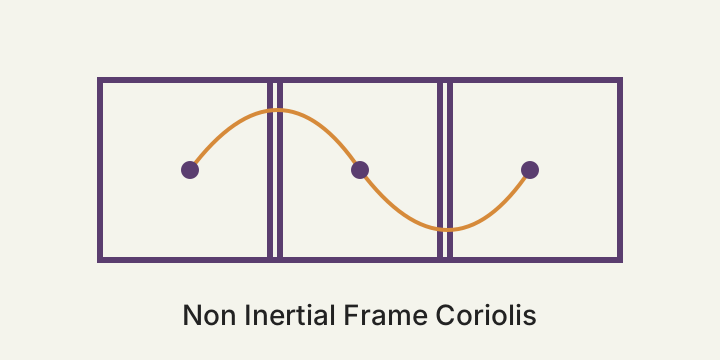
The picture to keep in mind: a rotating observer attributes curved trajectories to invisible forces. The centrifugal force points outward, the Coriolis force points perpendicular to the velocity, and both vanish when the frame stops rotating.
Worked example [Beginner]
A horizontal platform rotates at constant angular speed rad/s (about one rotation every 3 seconds). A ball of mass kg is released from rest at a distance m from the rotation axis, in the rotating frame.
The centrifugal acceleration is m/s, directed outward. The centrifugal force on the ball is N, outward.
If the ball is also given a radial velocity m/s outward in the rotating frame, the Coriolis acceleration is m/s, directed perpendicular to the velocity (to the right if the rotation is counter-clockwise). The Coriolis force is N, sideways.
What this tells us: the fictitious forces are proportional to the mass, the spin rate, and (for Coriolis) the speed. At low spin rates they are small, which is why we do not notice them in daily life on Earth, where rad/s.
Check your understanding [Beginner]
Formal definition [Intermediate+]
Let be coordinates in an inertial frame and let the rotating frame have coordinates related by
where is a time-dependent rotation. Let be the angular velocity vector defined by the skew-symmetric matrix (the hat map from to , satisfying ).
Differentiating twice gives the relation between accelerations:
In the inertial frame, Newton's second law is (real forces only). Multiplying by and rearranging:
where is the real force expressed in rotating-frame coordinates. The three additional terms are the fictitious forces:
- Coriolis force:
- Euler force:
- Centrifugal force:
The Lagrangian in the rotating frame is obtained by substituting the inverse transformation into :
The Euler-Lagrange equations of reproduce the three fictitious-force terms.
Counterexamples to common slips
- The Coriolis force does no work. Since (a cross product is perpendicular to each factor), the Coriolis force is always perpendicular to the velocity. It deflects trajectories without adding or removing kinetic energy.
- The centrifugal force can do work. Unlike the Coriolis force, the centrifugal force has a component along the velocity for a radially moving particle. The work done by the centrifugal force changes the kinetic energy in the rotating frame.
- The Euler force vanishes for uniform rotation. When (constant angular velocity), the Euler force is zero. Most applications (Earth's rotation, centrifuges) have approximately constant and only the centrifugal and Coriolis forces matter.
Key theorem with proof [Intermediate+]
Theorem (equations of motion in a rotating frame). Let a particle of mass move under a real force in an inertial frame. In a frame rotating with time-dependent angular velocity , the equation of motion is
The Lagrangian reproduces this equation via the Euler-Lagrange equations.
Proof. The coordinate transformation is with . Differentiate once:
The matrix is skew-symmetric (differentiate to get ). Define the angular velocity by the hat-map relation , i.e. for all . Then .
Differentiate again:
Using : . So
Newton's law becomes . Multiply by : . Rearranging gives the stated equation.
For the Lagrangian: substitute into . Expanding the squared norm:
So . Computing the Euler-Lagrange equations of in the coordinates reproduces the three-force equation above.
Bridge. The rotating-frame Lagrangian here builds toward the general theory of non-inertial frames in classical mechanics and general relativity, where the metric absorbs the fictitious-force structure into the geometry. The bridge between the Lagrangian and the symplectic formulation is that defines a modified Poincare-Cartan one-form on whose exterior derivative encodes the Coriolis term as a magnetic-type coupling , which appears again in 05.00.09 (charged particle in an EM field) as the minimal-coupling term . The foundational reason the rotating-frame Lagrangian has the velocity-dependent term is exactly the same reason the charged-particle Lagrangian does: both are linear in the velocity and both produce a velocity-dependent force perpendicular to the motion. Putting these together identifies the Coriolis force as the mechanical analogue of the Lorentz force, with the angular velocity playing the role of the magnetic field . This is exactly the structure that underlies the correspondence between rotating-frame dynamics and charged-particle dynamics, and the central insight is that the term is the Coriolis analogue of the vector-potential coupling .
Exercises [Intermediate+]
Advanced results [Master]
The Jacobi integral in a rotating frame. In a uniformly rotating frame () with gravitational potential , the Lagrangian does not depend explicitly on time (for time-independent ). The associated conserved quantity (the Jacobi integral) is
This is the inertial-frame energy minus the kinetic energy of the frame rotation. The Jacobi integral constrains the motion in the rotating frame and defines the Hill zero-velocity surfaces that bound the region accessible to a particle of given .
Tidal forces and the Roche lobe. In the co-rotating frame of a binary system (two bodies orbiting their common centre of mass), the effective potential includes the gravitational potential of both bodies and the centrifugal potential. The Roche lobe is the equipotential surface passing through the inner Lagrange point . Matter inside a star's Roche lobe is gravitationally bound to that star; matter flowing through is transferred to the companion. This is the mechanism behind mass transfer in close binary stars and accretion disc formation.
The Lense-Thirring effect. In general relativity, a rotating massive body drags spacetime around with it (frame dragging). The post-Newtonian correction to the equations of motion in a frame co-rotating with the central body includes a gravitomagnetic Coriolis-like force where is the Lense-Thirring precession frequency, is the body's angular momentum, and is the distance. This was measured by the Gravity Probe B experiment (2011) and by LAGEOS satellite laser ranging.
Geostrophic balance. In atmospheric dynamics at large scales, the Coriolis force approximately balances the pressure gradient force. The resulting geostrophic wind flows along isobars (lines of constant pressure) rather than across them. In the Northern Hemisphere, the geostrophic wind blows with low pressure to its left (counter-clockwise around cyclones). The balance is where is the Coriolis parameter and is the geostrophic wind speed. Deviations from geostrophic balance drive the ageostrophic convergence that produces vertical motion, clouds, and precipitation in weather systems.
Synthesis. The rotating-frame formalism is the bridge between the abstract Lagrangian mechanics of 05.00.01 and the practical description of motion in non-inertial reference frames. The foundational reason the three fictitious forces appear is that the coordinate transformation is time-dependent, and the Euler-Lagrange equations in the new coordinates inherit additional terms from the chain rule — exactly the same mechanism that produces gauge-field couplings when the trivialisation of a fibre bundle is changed.
The central insight is that the Coriolis term in the Lagrangian is mathematically identical in structure to the magnetic coupling , and this identifies the angular velocity with the magnetic field (up to a factor of 2 and a mass-to-charge ratio). The bridge is the vector potential whose curl gives the uniform effective field . Putting these together with the Foucault pendulum precession rate identifies the precession as the analogue of cyclotron motion: the pendulum plane rotates at the "cyclotron frequency" of the effective Coriolis magnetic field, filtered by the projection onto the local vertical. The pattern recurs throughout geophysical fluid dynamics, where every large-scale motion on Earth is shaped by the Coriolis deflection, and the foundational reason weather systems have the structure they do is that the effective magnetic field of Earth's rotation imposes a preferred handedness on the flow.
Full proof set [Master]
Proposition (acceleration transformation between frames). If with and angular velocity defined by for all , then .
Proof. Differentiate : . Substitute : . Differentiate again: . The first term: . Collect: .
Proposition (rotating-frame Lagrangian produces the fictitious forces). The Euler-Lagrange equations of give .
Proof. Compute the two partial derivatives of .
Velocity derivative. . The time derivative is .
Position derivative. Using the scalar triple product identity , the Coriolis-coupling term gives . The centrifugal term gives . The potential contributes . So .
Euler-Lagrange equation. Substituting: . The two terms combine to . Rearranging: . The two terms... wait: and . So the equation is . The cancels from the first term... actually: and . Their difference is . Rearranging: .
Connections [Master]
Galilean group and Newtonian mechanics
05.00.06. The rotating frame is a non-inertial frame: the transformation is not an element of the Galilean group (which only permits constant-velocity boosts, not time-dependent rotations). The fictitious forces are the dynamical signature of this departure from Galilean covariance.Worked Lagrangian examples
05.00.09. The charged particle in a magnetic field, developed in05.00.09, is the direct mathematical analogue of the Coriolis force. Both arise from a velocity-dependent term in the Lagrangian that is linear in , and both produce a force perpendicular to the velocity.Noether's theorem
05.00.04. The rotating-frame Lagrangian breaks the rotational symmetry of the inertial-frame Lagrangian when is externally imposed. The lost rotational Noether charge is partially recovered as the Jacobi integral (conserved in a uniformly rotating frame with time-independent ).Lagrangian on
05.00.01. The rotating-frame Lagrangian is the original Lagrangian expressed in new coordinates on , where the coordinate change is the time-dependent rotation . The additional terms in are the pullback of under this non-autonomous diffeomorphism of .Small oscillations and normal modes
05.00.11. The Foucault pendulum is a small-oscillation problem in a rotating frame. The normal modes of the stationary pendulum (two degenerate modes at frequency ) are split by the Coriolis coupling into two modes that precess at around the vertical.
Historical & philosophical context [Master]
Gaspard-Gustave de Coriolis published his Memoire sur les equations du mouvement relatif des systemes de corps in 1835 [Coriolis 1835] in the Journal de l'Ecole Polytechnique. Coriolis was working on the efficiency of water wheels and rotating machinery; his mathematical derivation of the fictitious forces in a rotating frame was a byproduct of analysing energy transfer in rotating systems. The Coriolis force had been derived earlier by Laplace in the context of tidal theory (1799), but Coriolis gave the general three-dimensional treatment.
Leon Foucault's pendulum demonstration took place at the Pantheon in Paris in 1851 [Foucault 1851]. A 67-metre pendulum with a 28-kg brass bob swung for several hours, its plane of oscillation visibly precessing at the predicted rate. The demonstration was the first direct laboratory-scale proof of Earth's rotation, independent of astronomical observation. Foucault's paper in the Comptes rendus of the Academie des Sciences ignited immediate international interest; copies of the experiment were set up in cities worldwide within months.
The application of Coriolis forces to meteorology and oceanography was developed by William Ferrel (1856) and Adolf Erik Nordenskiold, who showed that the large-scale circulation of the atmosphere is governed by the balance between the pressure gradient and the Coriolis force. The geostrophic approximation and the concept of cyclonic and anticyclonic circulation are direct consequences of the Coriolis deflection on a rotating sphere.
Bibliography [Master]
@article{Coriolis1835Memoire,
  author    = {Coriolis, Gaspard-Gustave},
  title     = {M{\'e}moire sur les {\'e}quations du mouvement relatif des syst{\`e}mes de corps},
  journal   = {Journal de l'{\'E}cole Polytechnique},
  volume    = {15},
  pages     = {142--154},
  year      = {1835}
}

@article{Foucault1851Demonstration,
  author    = {Foucault, L{\'e}on},
  title     = {D{\'e}monstration physique du mouvement de rotation de la Terre},
  journal   = {Comptes rendus hebdomadaires des s{\'e}ances de l'Acad{\'e}mie des Sciences},
  volume    = {32},
  pages     = {135--138},
  year      = {1851}
}

@book{Arnold1989Mathematical,
  author    = {Arnold, V. I.},
  title     = {Mathematical Methods of Classical Mechanics},
  series    = {Graduate Texts in Mathematics},
  volume    = {60},
  publisher = {Springer},
  edition   = {2nd},
  year      = {1989}
}

@book{Goldstein1980Classical,
  author    = {Goldstein, Herbert},
  title     = {Classical Mechanics},
  publisher = {Addison-Wesley},
  edition   = {2nd},
  year      = {1980}
}

@book{LandauLifshitz1976Mechanics,
  author    = {Landau, L. D. and Lifshitz, E. M.},
  title     = {Mechanics},
  series    = {Course of Theoretical Physics},
  volume    = {1},
  publisher = {Pergamon Press},
  edition   = {3rd},
  year      = {1976}
}